A two story house with a steep composition roof, three valleys and a chimney looked fine from the street. The listing photographs agreed with the street.
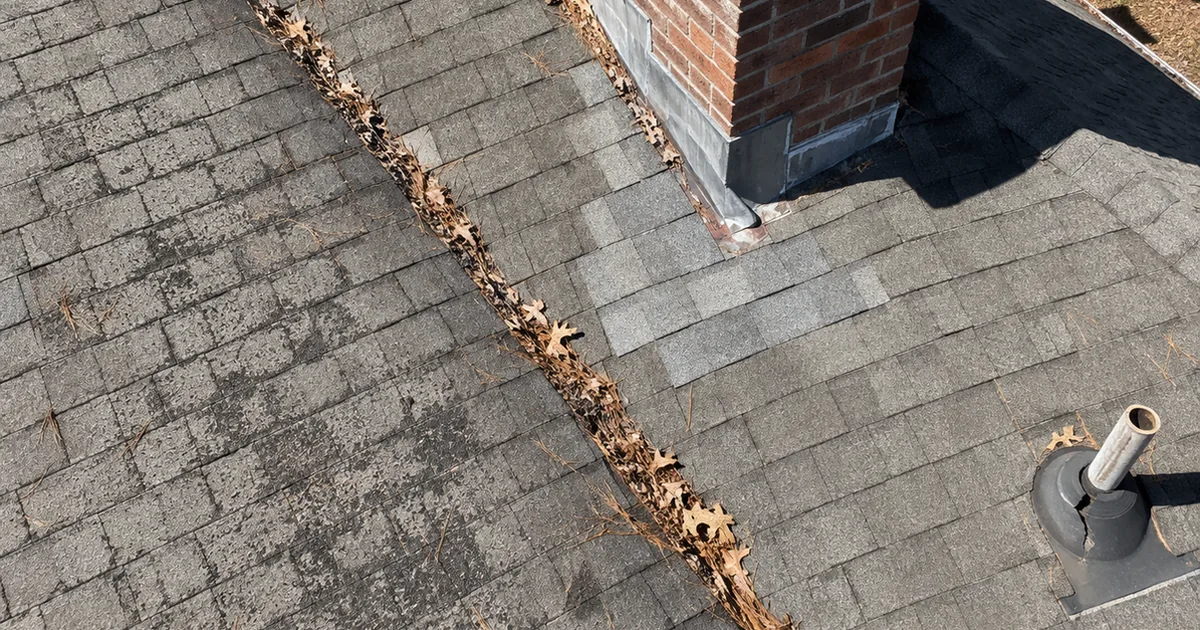
The drone frames did not. Granule loss was concentrated on one plane and barely present on the others. One valley had been roofed over rather than replaced, so the metal was buried under the field. And near the chimney there was a patch of about six shingles sitting slightly proud of their neighbors in a color that was close but not right. That is a repair, and a repair is a question.
The attic answered the question, in a way nothing from above could have. Directly under that chimney a dark stain ran down one rafter and across the sheathing, old and dry on the day we were there, with the original nail points around it rusted and the rust no longer spreading. This is a composite of a situation we meet often rather than any one identifiable job, and it is the reason this article exists. Nothing in the drone imagery could tell you whether that stain was active. Nothing in the attic could tell you the valley had been covered rather than replaced.
The written standard asks us to inspect the roof, not to stand on it
This surprises people, so it is worth putting first.
Our inspectors work to the InterNACHI Standards of Practice. It requires the inspector to inspect “the roof-covering materials; the gutters; the downspouts; the vents, flashing, skylights, chimney, and other roof penetrations; and the general structure of the roof from the readily accessible panels, doors or stairs.” It requires the inspector to describe “the type of roof-covering materials,” and to report as in need of correction “observed indications of active roof leaks.”
Then it says what the inspector is not required to do, and the list is short and specific. The inspector is not required to “walk on any roof surface.” The inspector is not required to walk on roof areas that appear, in the inspector’s opinion, to be unsafe, or where doing so might, in the inspector’s opinion, cause damage. The same standard states plainly that “an inspection will not identify concealed or latent defects.”
That is the gap, and it is a real one. The obligation is to inspect the roof. The standard does not require a person on every plane and explicitly excuses walking where walking would break something. For decades the practical consequence was that a lot of roofs got inspected from a ladder at the eave and a pair of binoculars from the driveway, which is a legitimate way to satisfy the standard and a poor way to learn anything. A drone is not a workaround to that standard. It is the most faithful way anyone has found to satisfy it.
What the camera genuinely sees better than a person on a ladder
Square-on imagery of every plane, including the planes that no ground position on a hemmed-in lot will ever show you.
That vantage matters because roof wear is rarely even. Granule loss concentrated on the southwest plane and nearly absent on the north tells you something about exposure that an overall condition rating never will. Cupped, curled, lifted or missing tabs read clearly from directly above, and so does the direction of the lift, which points at the wind that caused it.
Repairs read even more clearly. A color mismatch. A patch lying proud of the field. A row of fasteners two inches high of where it belongs. None of those are dramatic, and all of them are the visible edge of a story somebody decided not to put in the disclosures.
The camera frames flashing at chimneys, walls, skylights and penetrations, including the detail that matters most, which is whether counterflashing has been let into a mortar joint or simply caulked on top of the brick. It shows whether a valley is open metal, woven or closed cut, and whether one has been covered rather than replaced. It shows debris packed into valleys and behind chimneys, and gutters holding enough standing water to have gone green.
It shows vent boots, which deserve their own sentence. A split collar on a plumbing vent boot is one of the most common genuine leak sources on a composition roof in California, it costs very little to fix, and it is close to invisible from the ground. At a rake edge or a cut you can sometimes count the number of covering layers, which changes both the weight on the structure and the cost of the eventual tear-off. And on low-slope and flat sections, which cannot be meaningfully evaluated from any ground position, it shows ponding and seam condition.
Four roof questions a drone cannot answer
First, whether the deck under the covering is sound. Soft or delaminated sheathing sometimes reads as a shallow dip in the plane, and frequently reads as nothing at all. A camera sees the surface, not the assembly under it.
Second, whether a stain is active or historic. That is an attic question, answered with a moisture meter against the wood, a look at whether the nail points are rusting or have stopped, and a judgment about the age of the staining.
Third, what the underlayment is and how much of it is left. On a tile roof that is not one question among several, it is the entire question, because tile routinely outlives the underlayment beneath it by decades. Our guides to tile-roof underlayment in Murrieta and Riverside go into what that failure actually looks like, and the short version is that it looks like nothing from above right up until it does not.
Fourth, whether the flashing detail under a covering was ever built correctly, as opposed to sealed over afterward. Sealant photographs beautifully from twelve feet up and fails in about year three.
The attic holds the half of the roof that decides the negotiation
Yes, a proper roof inspection includes the attic when the attic is readily accessible, and the attic is usually where the useful finding turns out to be.
The InterNACHI standard requires the inspector to inspect “insulation in unfinished spaces, including attics, crawl spaces and foundation areas” and “ventilation of unfinished spaces,” and to describe “the type of insulation observed” and “the approximate average depth of insulation observed at the unfinished attic floor area or roof structure.” It also says the inspector is not required to “enter the attic or any unfinished spaces that are not readily accessible, or where entry could cause damage or, in the inspector’s opinion, pose a safety hazard.”
From inside, we read the underside of the sheathing for staining, delamination and daylight at the penetrations. We look at rafters, collar ties and their connections. We look at nail points, because rust that is fresh and rust that stopped ten years ago look different and mean different things. We put a meter on any wood that looks suspect. And we check whether the ventilation path from soffit to ridge is actually open or has been packed solid with insulation at the eave, which is a finding in its own right and the subject of our guide to attic insulation and ventilation.
Here is why this is the section that matters commercially. A stained rafter with a dry meter reading and rust that has stopped spreading is a repaired leak, and it belongs in the disclosure conversation. A stained rafter that reads wet on a day it has not rained for a week is an active leak, and it belongs in the price. Those two houses look identical from a drone.
Three roofs where the drone earns its place, and one where it does not
Steep or multi-level composition roofs, where walking is genuinely unsafe and where the standard already excuses us from trying.
Tile, concrete and clay, which is the strongest case of all. Foot traffic breaks tile. Every broken tile is a leak path that somebody has to find later, and the person who broke it is rarely the person who finds it. Flying a tile roof is not a convenience, it is the only way to look at the whole thing without leaving damage behind.
Low-slope and flat sections behind parapets, which cannot be seen from the ground at all, and where ponding and seam failure are the two things you actually need to know about.
Then the honest counterpoint. On a single-story, walkable composition roof in decent condition, an inspector on the roof with hands on the covering learns things a camera cannot, starting with how the deck feels underfoot. Soft sheathing announces itself to a boot long before it announces itself to a lens. The right tool depends on the roof, and anyone who tells you one method replaces the other entirely is selling a method rather than an inspection.
How often a roof actually needs looking at
There is no single correct interval, and anyone who quotes you one without asking what the roof is made of is guessing. What there is instead is a list of triggers, and it is more useful than a number.
At every sale, on both sides of the transaction. That is the obvious one and it is still the one most often skipped by sellers, which is a subject we take up in our article on whether a pre-listing inspection is worth it.
After any storm that brought real wind or hail to your area. Storm damage is frequently localized to one exposure, which is exactly the pattern that is invisible from the ground and obvious from above.
Before and after any work that puts a trade on the roof. Solar, HVAC, satellite dishes, chimney work, even painters working off the roof edge. A second trade on a roof is one of the most common sources of new roof damage we document, and the solar retrofit case is common enough to have its own guide. California has also started to formalize remote photo and video inspection for some permit items, including reroofs and solar, which we covered when AB 1738 passed.
When the roof approaches the expected service life for its material. That life varies enormously between composition, tile, wood shake and metal, and we are not going to publish a single number that pretends otherwise.
And when an insurer asks, which in California is increasingly often. Roof age and roof condition have become a live underwriting question here, and our piece on wildfire insurance and home hardening covers where that pressure is coming from.
Which roof findings are small and which change the deal
A split vent boot is a small repair that prevents an expensive one. Fix it and move on.
Missing kick-out flashing where a roof plane dies into a wall is a small piece of sheet metal and can be a very large amount of concealed damage in the wall below it, which is why it has a guide of its own. The roof-side defect is the cheap part.
A valley that has been covered over rather than replaced is a deferred replacement rather than a repair, and it should be priced as one. So should a second or third layer of composition over an original, because somebody is paying for that tear-off eventually.
Ponding on a low-slope section is a slope or design problem, and it does not resolve with a patch. Debris-choked valleys and gutters holding standing water are maintenance, but sustained maintenance failure at the roof edge turns into fascia and drainage problems that are not maintenance any more.
And roof age can matter more to a transaction than the repair list does, because an insurability question can stall a deal that a vent boot never would. We report condition and we photograph it. Pricing the work is a roofing contractor’s job, and we will say so rather than guess at a number. From 2028, SB 1301 limits nonrenewals based on roof age alone, though the five-years-of-life confirmation it calls for is a different document from a condition report.
What a useful roof report contains
Dated imagery of every plane, not one attractive frame of the front elevation. If the report has three roof photographs and the house has seven planes, you are looking at a marketing document.
Close frames of every penetration, valley and flashing detail. An overview shows the shape of a roof while hiding every detail that decides whether it is watertight.
Attic photographs taken from directly under whatever the roof imagery raised. If the drone found something at a chimney, the report should show you the sheathing below that chimney, with a moisture reading if the wood looked suspect and the area was accessible.
And plain language about what was not accessible and why. That sentence is the most important one in any inspection report, because it defines the edge of what you actually bought. “Not visible from the ground” and “attic entry blocked by stored items and low framing” are two very different limitations, and the report should not blur them. Our guide to reading a California inspection report goes through how to find those limitation statements quickly.
How we run it, and what it costs you in time
Drone roof imagery is part of every inspection we do rather than an upgrade, because a roof we cannot see properly is a section of the report we cannot stand behind.
The reports come back the same day, within six to eight hours, which matters on a contingency clock. We pair the aerial frames with infrared scanning where a temperature difference might reveal moisture behind a finished surface, and we are honest in the report about what infrared can and cannot establish, as we set out in our piece on what infrared scanning actually shows. We also produce a 3D tour and floor plan, which agents tend to use for entirely different reasons than we produce them.
Our inspectors hold InterNACHI Certified Professional Inspector credentials and work to the InterNACHI Standards of Practice, which is the same written standard quoted throughout this article. Where a roof needs a scope we do not provide, we say so and name what is needed, the same boundary we describe in our guide to what a general inspection covers and what needs a specialist.
The honest summary
A drone answers one question very well. What does this roof look like right now, on every plane, including the places nobody can safely stand.
The attic answers the other one. Has this roof been leaking, and is it leaking today.
Buy the one that answers the question you actually have. On a house you are purchasing, buy both, and understand that they are not two appointments. They are two halves of the same one, and an inspection that gives you only the aerial half has told you what the roof looks like while leaving out what it has done.
So when you book, ask for dated imagery of every plane, close frames of every valley and penetration, attic photographs directly under anything the roof raised, and an explicit statement of what was not accessible. If that statement includes the attic, our guide on turning a “not inspected” line into a dated task covers how to get it opened in time. Then do not treat a clean aerial image as proof that the roof is dry or that the deck underneath it is sound. It is not evidence of either.
We fly every roof we inspect, across California and throughout our home region in the Bay Area, including Discovery Bay, Bay Point, Albany and San Francisco, as well as the tile-roof markets in Murrieta and Riverside.
See what is included in every inspection, look at a sample inspection report, or read our frequently asked questions before you book.
Roof and gutter debris is also a wildfire question on a property in a mapped hazard zone, because the adopted Zone 0 rule places the roof and rain gutters inside the ember-resistant zone.
- When the Flood Map Under Your House Changes. Roof drainage determines how much water reaches grade at all, which is the part of the water question an inspection can actually answer.
- What a “Hardened” Home Will Mean in California. Needle-packed gutters and valley debris are the maintenance gaps drone imagery reads best, and they are ember-exposure conditions of the kind a future state hardening standard has to address.