When we find gray plastic tubing or old galvanized steel on a water supply line, the buyer’s next question is usually whether the whole house has to be repiped and whether the seller has to pay for it.
A report can tell you what pipe we saw. It cannot tell you how long that pipe will last or what an insurance carrier will say.
The decision is sort, paper, price. Sort the finding. Get the plumber’s written evaluation and the insurer’s written answer while your inspection days are running. Compare the bids with the price. This is not legal or plumbing advice.
A report tells you what pipe was seen, and the standard does not require more
Under the InterNACHI Standards of Practice, an inspector reports water supply conditions that can be seen and run. The standard does not require the inspector to report on polybutylene.
The InterNACHI Standards of Practice page says, “Last revised October 2022.” Section 3.6, Plumbing, says the inspector shall report as in need of correction “deficiencies in the water supply by viewing the functional flow in two fixtures operated simultaneously” and “active plumbing water leaks that were observed during the inspection.”
The inspector shall inspect “interior water supply, including all fixtures and faucets, by running the water.”
The same section says the inspector is not required to “determine the exact flow rate, volume, pressure, temperature or adequacy of the water supply.” The inspector is not required to “determine the water quality, potability or reliability of the water supply or source.” The inspector is not required to “determine the existence or condition of polybutylene, polyethylene, or similar plastic piping.”
Section 1.2 addresses material defects. It says, “The fact that a system or component is near, at, or beyond the end of its normal, useful life is not, in itself, a material defect.”
Section 2.1, item 8, says, “An inspection does not determine the life expectancy of the property or any components or systems therein.”
So a report can be silent on polybutylene even when the house has it. A good looking two fixture flow test is not a promise about pipe inside the walls.
The report may name the pipe only where it is visible. That may be at the water heater, the main shutoff, under sinks, in a garage, or in an open crawl space. At Inspection.re, when we see gray polybutylene tubing, we photograph it and write it up as a finding. That is our practice, not something the standard requires.
Read how to read each section of the report before deciding what a pipe comment means.
Our reports arrive the same day, within 6 to 8 hours, and can include a Matterport 3D tour with findings tagged in place. See a same-day report with findings tagged in place.
Gray polybutylene is a known problem with a closed claims window
Polybutylene is gray plastic water pipe that went into about six million properties starting in 1978. The large class action settlement that paid for replacements stopped taking claims on May 1, 2009.
The Public Justice page, formerly Trial Lawyers for Public Justice, is titled “Alert: Polybutylene Plumbing Claims Process Now Underway.” It carries a 2007 copyright. The page says polybutylene plumbing was installed in about six million properties “since 1978.”
It says the settlement “obtained a minimum of $1.103 billion in relief for owners of property with defective polybutylene plumbing.” It also states, “The deadline for filing a claim is May 1, 2009.”
That page was written before the deadline. As written, the deadline is long past. A buyer today should not expect a settlement fund to pay for a repipe. The page does not say what happened to the fund afterward. We did not open the court order itself. We are not lawyers. Anyone who thinks they have a claim should ask a real estate attorney.
The page also says that in installations since 1990, metal insert fittings often replaced plastic ones. The tubing “generally remains the same.”
The build year is a hint, not a finding. A house from the late 1970s to the mid 1990s may have polybutylene. It may have been repiped. It may have it in only one place. The pipe has to be seen.
The problem most often described involves the fittings and chlorine in treated water. We did not open a primary engineering study for this article, so treat that mechanism as reported, not proven here.
The showing side is covered in the Vista agent guide and the Chula Vista agent guide. This decision comes later, after the report is in your hands.
Galvanized steel corrodes from the inside, so the pipe can look fine and flow badly
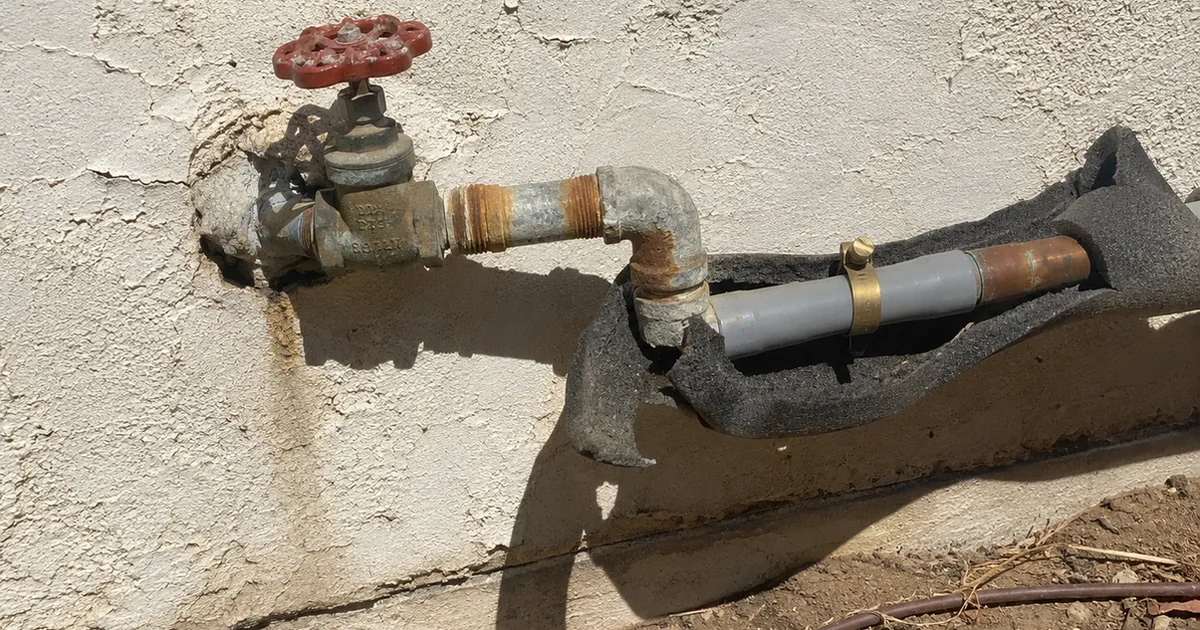
Galvanized supply pipe is steel with a zinc coating. Once the zinc is gone, the iron corrodes inside the pipe. That is why old galvanized lines show up as low pressure and discolored water.
The East Bay Municipal Utility District page on “Galvanized iron pipes” says, “Zinc corrodes more readily than iron, and the zinc serves as a ‘sacrificial’ coating.” It continues, “Once the zinc is gone, the iron begins to corrode.”
The page says, “Old, corroded galvanized pipes can cause low water pressure and discolored water.” It also says that “discrete mounds can form inside the pipes called tubercles which can block water flow.”
Iron pipes do not corrode uniformly. One section may be more restricted than another. A visible pipe can look intact while the inside has narrowed.
The EBMUD page says, “Galvanized pipes are not generally used for drinking water today; they were commonly used before the 1960s.” It also says, “Most homes in the East Bay built after 1960 don’t have galvanized pipes.” That information speaks to the utility’s service area. It does not identify the pipe in your house.
To identify the pipe, EBMUD says “a magnet will only stick to iron pipes.”
The two fixture flow check in the standard is the closest field check for this. A house can pass it on a quiet morning and fail with two showers running. Ask whether the seller has noticed pressure drops, rusty first draw water, or patched leaks.
The older home history is in our Pasadena galvanized and cast iron guide. The related electrical and pipe history is in the Long Beach guide to old wiring and pipes.
Lead is a separate question, and the answer is a water test
Galvanized pipe is not automatically a lead problem. A galvanized line that was once connected to lead plumbing can hold lead containing scale, and the way to find out is to test the water.
EBMUD says, “scales containing lead can form on the interior walls of the galvanized pipes” where a lead pipe was once connected. It says, “These lead-containing scales can become dislodged or dissolve over time, imparting lead into the water.”
The same page states, “The best way to find out if lead is present is to test the water.”
For the East Bay system, EBMUD says lead release from galvanized pipe “has not been observed in EBMUD’s system.” That statement concerns its own system.
The page also says boiling does not remove lead. It mentions a filter certified to NSF/ANSI Standard 53 for lead removal. EBMUD offers its own customers a free lead test on request. Other utilities differ, so ask your water utility.
Ask the buyer’s agent or the water utility how to get a lead test done. A home inspection does not test water. The inspection standard says the inspector is not required to determine “water quality, potability or reliability.”
The federal lead service line rule at change of ownership concerns the line from the main to the house. That is a different piece from the pipe inside the walls.
Sort the finding first, then pick the move
Most pipe lines in a report fall into six situations. Each one leads to a different next call.
| What the report or listing says | What it tells you | Usual move |
|---|---|---|
| Gray polybutylene tubing seen with plastic fittings, the plastic fittings at connections | Known problem material, fitting type recorded | Written evaluation from a licensed plumber, insurer question, two repipe bids, then a price conversation |
| Gray polybutylene tubing seen with metal insert fittings | Same tubing family with a different fitting | Same steps. The evaluation should say what was seen and where |
| Polybutylene seen at one place only, for example a water heater connection, with other pipe copper | Partial, possibly a past repair | Ask the seller what was repaired and when. Ask the plumber to check the rest where it can be reached |
| Galvanized supply, two fixture flow acceptable, no leaks noted | Old pipe that passed today | Plan and budget. Ask the seller about pressure history. Consider a written bid |
| Galvanized supply with weak flow, rusty water, leaks or patches | Pipe already showing its age | Plumber’s written evaluation before the deadline, then credit or price discussion from the bids |
| Report silent, walls closed or a “not inspected” line, and the house is from an era that used these pipes | Unknown | Ask the seller in writing what the pipe is. Ask the plumber what can be seen without opening walls |
A “not inspected” line has a specific meaning. Read what a “not inspected” line really means.
FLIR infrared can sometimes show a temperature pattern on a wall or ceiling that suggests moisture. It does not see inside a pipe. It cannot tell polybutylene from copper behind drywall. It is not a leak test. See what a thermal image can and cannot tell you.
Ask the insurance agent a specific question before the days run out
Whether, and on what terms, a carrier will cover a house with polybutylene or old galvanized pipe differs by carrier. Your insurance agent should answer in writing before the inspection deadline.
We did not find a California rule, in any source we opened, that sets one policy for polybutylene or galvanized pipe. We are not stating what any insurer does. We did not open any insurer’s underwriting guideline. We did not find a California Department of Insurance filing on it either.
Ask the insurance agent these questions:
- Will you write the policy with this plumbing?
- At what terms?
- Is there a replacement deadline?
- Is water damage from the supply lines excluded?
- Does the answer change if a licensed plumber’s written evaluation shows that part of the house is already copper?
Put the answer in writing before removing the inspection deadline. An answer after that point leaves the buyer with no room to ask for anything.
This article gives no premium or price. None of the sources cited here gives a California price for insurance or repiping.
Read how to ask the seller for repairs or a credit before sending a request.
Weigh the repipe bids against the price, then choose repair, credit or price change
A repipe is a cost you can only weigh once two written bids exist. Order the evaluation and the bids while the inspection days are running.
The California purchase agreement, C.A.R. Residential Purchase Agreement, revision 12/22, sets a default investigation period of 17 days unless the contract says otherwise. A request does not stop the clock. Only a written removal, cancellation or extension signed by both sides moves the date.
Do not treat the 17 days as a promise that a plumber will finish. The work begins with getting the right paper from the plumber, then getting comparable bids, then asking the agent and lender how a proposed credit or price change works.
The Contractors State License Board says, “anyone who contracts to perform work on a project that requires a building permit, or uses employee labor or worker(s), or contracts for work valued at $1,000 or more for combined labor and materials costs must hold a current, valid license from CSLB.” CSLB offers an online license check.
Ask each bidder to put the scope in writing. The scope should identify which fixtures and lines are included and where the pipe will be run. It should say whether wall and ceiling access repair and paint are included or left to someone else. It should say whether a permit is included and state the schedule.
Bids that leave these points out are not comparable.
This article gives no repipe price. None of the sources cited here gives a California repipe price. Do not use a guessed number. Get two written bids.
C.A.R. Form RR, public copy revision 12/18, lets the buyer check repair, credit, price reduction and pest work. The buyer can check more than one box. The seller has no obligation to respond. A credit must be disclosed to the buyer’s lender. The form warns that a credit may not be enough to remedy all defects.
If the seller agrees to all requests, Form RR makes that agreement conditional on the buyer removing the inspection protection in the contract and releasing the seller and brokers regarding the disclosed condition. Check the revision on your own paperwork. Ask the agent or a real estate attorney about the contract language. Do not interpret it yourself. We inspect houses.
A credit can pay for the work after closing. A price reduction changes the loan amount. A repair done by the seller before closing is harder to verify. Ask your agent and lender how each choice works for this loan.
A request built on a written plumber’s scope and a bid is stronger than “pipes are old.”
See which license fits each referral, how the 17 days and removal work, which findings are worth asking about and whether a finding is a deal breaker or a reason to reprice.
The seller’s side is covered in what a seller can do when the buyer’s list arrives.
Plan the first year, then close the loop
For an older house with old pipe, the buyer’s plan is paper from the plumber and the insurer, a repipe decision with bids in hand, and a plan for what to do if a line fails before the work is done.
Where is the main water shutoff?
Know where the main water shutoff is on move in day. Our reports record its location. Section 3.6 of the standard says the inspector shall describe the location of the main water supply shut off valve.
That location matters before you decide whether to repipe. It also matters if a supply line fails before the work is done.
Can the inspection company check seller repairs?
Inspection.re offers re-inspection after seller repairs. The buyer or buyer’s agent orders it, and whoever orders it pays. The flat rate is based on scope and quoted by phone at 1-888-88-INSP-9.
The RPA Final Verification of Condition is, by default, 5 days before close of escrow. It is not a second inspection. See verifying repairs before close of escrow.
Is polybutylene a reason to cancel?
On its own, it is a finding that needs a plumber’s evaluation, a bid and an insurer’s answer. Whether it ends the deal depends on those documents and on the price. That is the buyer’s call with the agent.
Can the seller refuse to pay for a repipe?
Yes. The seller has no obligation to respond to a request under the form we read. The buyer’s choice is then to accept, renegotiate or use the contract’s rights. Ask the agent or an attorney. Do not interpret the contract yourself.
Can an inspector tell me how many years the pipes have left?
No. The standard says an inspection does not determine life expectancy. No one can promise a number from one visit.
Does the old class action pay for a repipe now?
As the page we read states, the claim deadline was May 1, 2009. Ask a real estate attorney about anything beyond that.
Sort the finding. Get the plumber and the insurer in writing. Compare the bids with the price. Then ask.
Call 1-888-88-INSP-9 or schedule an inspection. See what is included and the questions buyers ask us most.
We inspect across California, including Los Angeles, San Diego, Temecula, Riverside and San Francisco.