We recently inspected a single-story home in Bear Creek, Murrieta. Built in 2004. Beautiful curb appeal. Concrete tile roof that looked, from the street, like it had another twenty years left in it. The listing agent and the buyer’s agent were both relaxed because the seller’s disclosure said “roof inspected and serviced 2022.” Everyone was ready for a clean report.
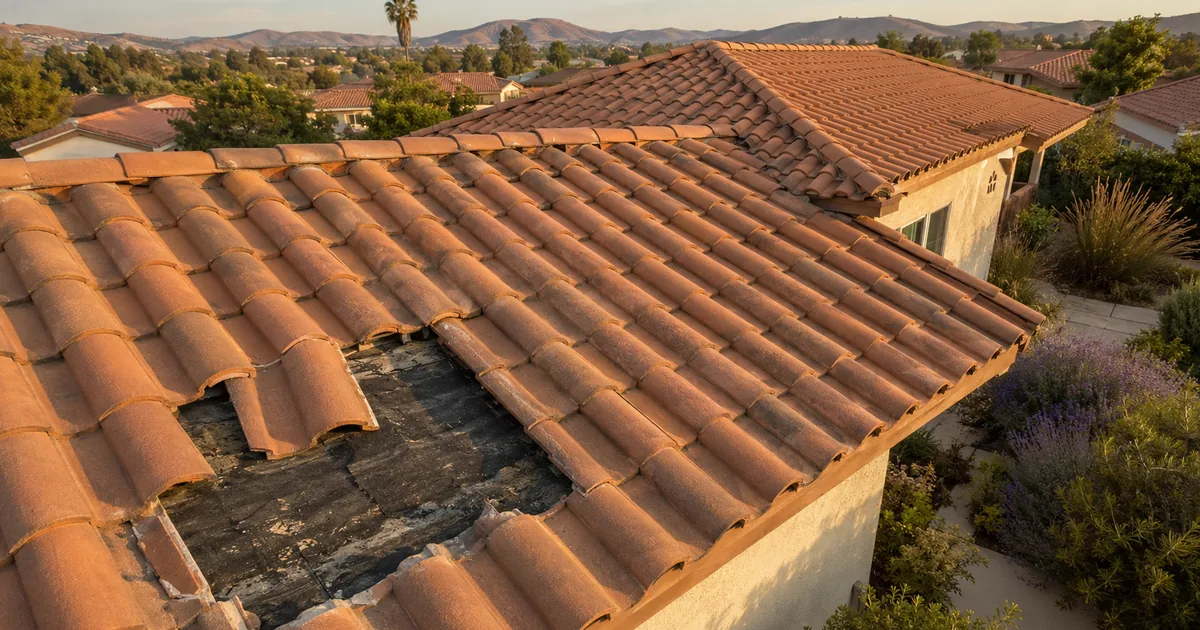
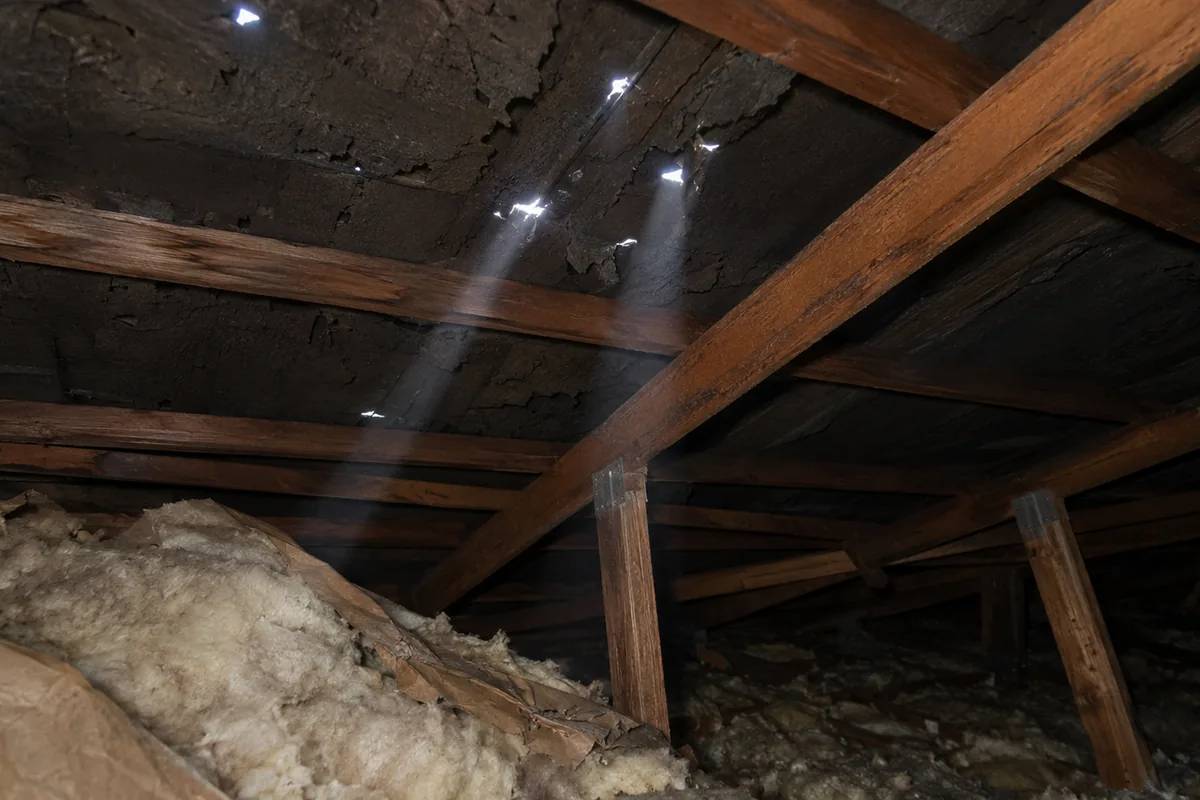
The drone told a different story. Three close-ups of the south-facing valley showed the underlayment was exposed where two cracked tiles had shifted, and the felt underneath was sun-bleached, brittle, and torn. We climbed into the attic. From inside, with a flashlight off, we could see daylight pinholes at the ridge in four places. The synthetic felt was cracking at every truss it crossed. The roof had maybe one rainy season left before it would leak into the living room.
The repair quote came back at about $34,000 for a full tear-off and reroof with new underlayment. The deal didn’t die, but it required a about a $26,000 seller credit at closing, two extra weeks of negotiation, and a buyer who almost walked. The agents handled it well. They could have handled it faster if they had known what to look for before the inspection.
This post is for them, and for every Murrieta agent who is going to see this same problem in the next 12 months. About half the housing stock in Murrieta was built between 1998 and 2005. Those homes are now at the exact age where this defect surfaces. You will see it. Here’s what to do.
Why this happens (the short version)
A tile roof is two systems pretending to be one. The tile is the wear surface. It deflects rain, blocks UV, and looks pretty for 50 years or more. But the tile is not the waterproofing. The actual waterproof layer is the underlayment, which is either an asphalt-saturated felt (on older installs) or a synthetic membrane (on newer ones). The underlayment sits between the tile and the roof deck and does all the real work of keeping water out of the house.
The problem is that the underlayment ages much faster than the tile. Builders in the early 2000s used 30-pound felt with a manufacturer-stated 20 to 25-year service life. In Murrieta’s climate (105-degree summers, intense UV, dry-wet cycling) it ages even faster. By year 18, the felt is brittle. By year 22, it’s cracking. By year 25, it’s failing.
The homeowner sees nothing wrong because the tile is still perfect. The seller disclosure says “roof inspected and serviced” because somebody walked the roof and replaced a few broken tiles. Nobody lifted a tile to look at the felt underneath.
Then a winter atmospheric river dumps four inches of rain in two days and the ceiling stains appear.
The signs you can see during a showing
You are not expected to climb a roof. But there are five things you can spot at a normal showing, in five minutes, that tell you the roof needs to be on your inspection priority list.
Tile color uniformity. A roof that has been partially replaced (some tiles new, some original) usually shows it. Look from across the street. If sections of the roof are noticeably different shades, somebody has been swapping broken tiles, which means the roof is moving. Movement breaks tiles, and broken tiles mean exposed underlayment.
Visible felt at the eaves. Stand at the corner of the house and look up at the underside of the eave. If you can see black or gray felt sticking out past the last row of tiles, look at the condition. Felt that’s curling, cracking, or showing sky behind it is felt that has failed.
Patches at the ridge or valleys. A roof with mortar repairs or visible mastic around the ridge tiles, the valleys, or any roof penetration (vents, skylights, chimneys) has been patched. Patching is not maintenance. Patching is a delaying tactic between now and a reroof.
Stains on the underside of any soffit. Soffits are the underside of the roof overhang. Water stains there mean water has gotten past the tile and the underlayment and is following the rafter tails out. This is a serious finding.
Granular debris in the gutters. Tile roofs don’t shed granules. But the underlayment, when it deteriorates, does shed asphalt granules that wash into the gutters. Granules in a gutter on a tile-roofed house is a tell.
If you see any of these, mention it to your buyer before the inspection and prepare them for the possibility that the report comes back with a serious roof finding. Buyers handle bad news better when they were braced for it.
How to read the inspection report when it lands
A good inspection report on a tile roof should include four things, and you should look for all of them. If any are missing, ask.
First, drone or roof-walk photos of every elevation. Not just an overhead shot. You want the south-facing slopes (most UV exposure), the valleys (where water concentrates), the ridge (where wind lifts tiles), and every penetration. The report should show condition at each.
Second, an attic-side observation of the underlayment. The inspector should have gone into the attic and looked up. They’re checking for daylight visible through pinholes (a sign of failure), water staining on the roof deck (a sign the underlayment already leaked), and the felt’s general condition where it’s visible.
Third, the age of the roof and the expected remaining service life of the underlayment. This is a judgment call but a competent inspector will give you a range. “Roof shows underlayment failure consistent with 22 years of UV exposure; recommend reroof within 12 to 24 months” is a useful sentence. “Roof appears serviceable” is not.
Fourth, photographs of any specific defects with location annotated. “Cracked underlayment, southwest valley, accessible from attic via second-bedroom hatch” lets your buyer get a contractor to give a precise estimate. “Roof has issues” doesn’t.
If the inspection report says the tile looks good and stops there, ask the inspector specifically what they found about the underlayment. If they didn’t look, you don’t have a roof inspection, you have a tile inspection.
The Murrieta HOA complication
This is where Murrieta is different from most cities and where most agents lose time. A large share of Murrieta is master-planned, and the HOA owns the roof on a meaningful subset of those homes. Many of Murrieta’s master-planned communities have CC&Rs that allocate exterior maintenance (including the roof) to the HOA. The split between homeowner-owned and HOA-owned roofs is community-specific, so the title company’s CC&R packet is the source of truth on any given listing.
If the roof is HOA-owned, your buyer cannot demand a seller credit for the repair. The repair is the HOA’s responsibility. What your buyer needs is a written commitment from the HOA, before closing, that the roof issue is acknowledged and on the maintenance schedule.
Three things to do when the HOA owns the roof:
Pull the CC&Rs section on maintenance responsibility. Your title company has them in the resale disclosure package. Read it specifically for the words “roof,” “exterior,” “common element,” and “limited common element.” Limited common element usually means the HOA maintains it but it’s exclusively for that unit’s use, which still means the HOA pays for repair.
Get the HOA’s reserve study. Reserve studies are public to homeowners and your buyer becomes one at closing. A reserve study that shows the roof reserve is fully funded means the HOA can actually pay for the reroof. A reserve study that shows the roof reserve at 30% funded means a special assessment is coming, and your buyer’s share of that assessment can run $3,000 to $8,000 depending on the community size.
Write the contingency carefully. If the HOA owns the roof and the reserve is underfunded, your buyer should know they’re potentially walking into a special assessment. The agent’s job is to surface this risk before closing, not after.
If the roof is homeowner-owned (which it is in most of Murrieta’s older non-HOA tracts and in many of the single-family-detached HOA communities), then the negotiation is simpler: seller credit at closing for the cost of the reroof, or the seller does the reroof before closing.
The insurance angle
In 2024 and 2025 California insurance carriers got aggressive about roof age. State Farm, Allstate, Farmers, and the FAIR plan are all underwriting around roof condition more strictly than they were five years ago. A failing underlayment on a 20-year-old tile roof can trigger one of three responses from the insurance carrier:
Refusal to write a new policy until the roof is replaced. This is the most common.
A policy with a higher premium and a roof-replacement-cost rider that excludes the existing roof. This is what FAIR plan offers when other carriers refuse.
A policy that writes the home but excludes water damage from leaks attributed to roof failure. This is the gotcha clause buyers don’t notice until they file a claim.
The practical implication for the agent: if the inspection finds underlayment failure, the buyer should call their insurance broker the same day, with the inspection report in hand. The broker will tell them which carriers will or won’t write the policy. If no carrier will write it without a new roof, the financing won’t fund and the deal has to either restructure (seller does the roof before closing) or fall apart.
This is also why the seller’s existing insurance policy matters. If the seller has had the same carrier for 15 years and is grandfathered into a policy that wouldn’t be written today, the buyer cannot inherit that policy. The buyer is a new applicant.
The negotiation playbook
Three positions, depending on what the inspection found and who owns the roof.
Position A: roof is failing, homeowner-owned, buyer wants the house. Ask for a seller credit equal to a competitive reroof bid plus 15 percent for permits, dump fees, and surprises. Get three bids quickly. Tile reroofs in Murrieta in 2025 run $9 to $14 per square foot installed, including new underlayment, ridge venting, and reflashing. A typical 2,400-square-foot home is $25,000 to $40,000.
Position B: roof is failing, HOA-owned, buyer wants the house. Get the HOA’s written acknowledgment that the issue is on the maintenance schedule. Ask for a seller credit equal to the buyer’s likely share of a special assessment if one is plausible. This is a smaller number but it’s the right ask.
Position C: roof is failing, buyer is on the fence. Walk. A roof problem at closing on top of a buyer who isn’t sure is a recipe for a deal that closes and then sours within six months. The buyer’s other concerns will surface. Better to release everyone now.
Whatever position you’re in, do not let the seller offer to “patch and warranty” the roof. Patching a failing tile roof is exactly the maintenance pattern that got the roof to this condition. A “5-year warranty” from a roofing company on a patched 22-year-old underlayment is worth roughly what the paper is printed on. The right answer is reroof or credit, nothing in between.
Questions to ask the listing agent before you order the inspection
Five questions, in this order. Email them before the inspection appointment, not after.
- What year was the home built and when, if ever, has the roof been replaced or had underlayment work?
- Does the HOA (if any) own the roof or does the homeowner?
- Has the seller made any insurance claims on the roof in the last seven years? CLUE report covers this.
- Who is the current insurance carrier and has the seller had any recent renewal pushback on the roof?
- Will the seller permit a roofing contractor walk-through during the inspection contingency period for a repair-bid estimate?
The answers to these tell you what kind of inspection day you’re going to have and how much of the contingency period you’ll need.
What to tell your buyer before the inspection
A short script. Adapt to fit your voice.
“This home was built in 2004. That puts the roof underlayment, which is the actual waterproofing layer underneath the tile, at the age where it’s likely showing wear. The inspector will check it from the drone and from inside the attic. If they find underlayment failure, that’s not a deal-killer, but it’s a real number and we’ll need to negotiate it. I want you to know that going in so you’re not surprised.”
Buyers who are told this in advance handle the finding fine. Buyers who hear it for the first time when the report lands often panic and walk for the wrong reasons.
The bottom line
A tile roof in Murrieta is not a “set it and forget it” asset for a 25-year-old home. The tile lies. The underlayment is what matters. A drone inspection plus an attic walk gives you the real answer in 45 minutes, and the answer reshapes the deal whether anyone wants it to or not.
For your buyer, this is the difference between closing on a home that’s actually $25,000 to $40,000 short of being a finished asset, and closing on one that’s priced correctly. For you, the agent, this is the difference between a smooth close and a deal that derails in week three of the contingency.
If your buyer is also looking in nearby Menifee, the hidden problem there is different: expansive clay soil causing foundation movement across the master-planned communities. Read Menifee Foundation Cracks and Expansive Clay Soil for the full agent breakdown. For a buyer’s overview of inspecting in the city next door, see our Temecula home inspection guide.
If you are also looking at older, raised-foundation Murrieta homes, read our Elsinore Fault seismic readiness guide for the cripple wall and foundation bolting issues that surface on pre-code stock. In Chula Vista, the same tile roof problem compounds with retrofit solar arrays bolted through the tile. Our Chula Vista solar retrofit roof guide covers how solar mounts crack tiles and create unflashed penetrations that accelerate underlayment failure. For a market where the roof is also the front line of wildfire exposure, read our guide to fire-hardening a historic foothill home in Sierra Madre.
We’re based in Temecula and Murrieta is a primary market for us. Every Murrieta inspection includes drone photos of all four roof elevations, an attic-side underlayment check, and an honest assessment of remaining service life. If you want us on your next Murrieta buyer-side inspection, schedule online at inspectionre.com/schedule or send us the listing link and we’ll tell you what we’d watch for on that specific home before the contingency period starts.