The Missing Diverter: A Whittier Kick-Out Flashing and Roof-to-Wall Water Guide for Agents
The house was in the Friendly Hills area, a 1960s ranch-style home that had been re-roofed within the last ten years. Good-looking composition shingles, clean ridge, new step flashing running up the sidewall where a lower roof slope met the two-story section. The roofer had done solid work on every part of the roof you could see. But where the step flashing terminated at the bottom of the run, right at the gutter line, there was no kick-out diverter. The step flashing just ended, and the gutter butted against the stucco wall.
We looked at the stucco below that junction and found a faint vertical stain running about three feet down from the roof line. The paint was bubbling slightly at the bottom of the stain. We checked the interior wall on the other side and found a soft spot in the drywall near the baseboard that had been painted over. That water had been running behind the stucco and into the wall cavity for years, following a path that started at a two-inch gap where a ten-dollar piece of flashing should have been.
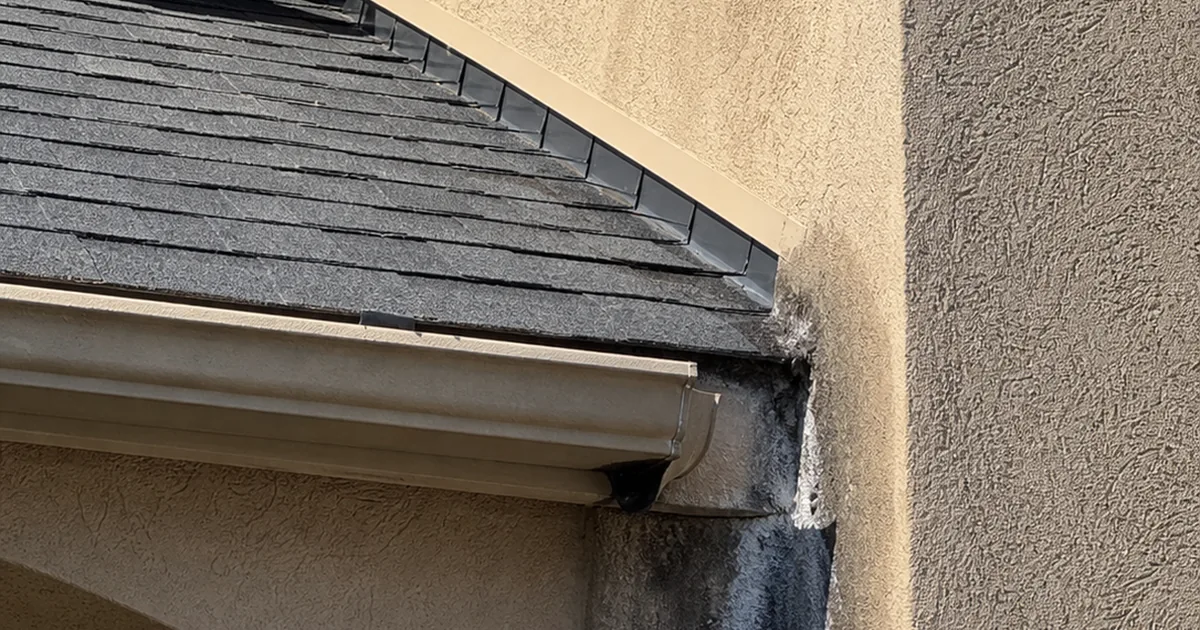
That is the shape of this finding. A kick-out diverter is a small, bent piece of metal at the bottom of a step-flashing run that pushes water into the gutter instead of letting it follow the flashing behind the wall cladding. When it is missing, water enters the wall invisibly, and by the time the damage shows on the surface, the sheathing and framing behind the stucco have been wet for a long time.
This guide is for the agent working Whittier and the surrounding southeast Los Angeles County markets, including nearby Downey, Norwalk, La Mirada, and Cerritos, where stucco cladding, re-roofed tract homes, and older character houses with complex roof-to-wall intersections produce the same conditions. Here is what the kick-out diverter does, why it goes missing, and how to catch the damage before a buyer inherits it.
Why this matters for the agent
Here is what is at stake. Water entry behind a wall cladding is one of the most damaging conditions a house can carry, because it is invisible until it is severe. Stucco does not show water penetration the way wood siding does. By the time a stain appears on the exterior or a soft spot shows on the interior, the plywood sheathing behind the stucco may be delaminated, the framing may be rotting, and the damage may extend several feet from the entry point. A missing kick-out diverter is one of the most common causes of this, and it is one of the easiest to prevent.
Whittier makes this an agent’s issue because of its housing mix. The city has three distinct building patterns that each produce the problem differently. Uptown Whittier has pre-war character homes, many with stucco over original wood siding, complex roof lines, and roof-to-wall intersections that were flashed with whatever was standard in the 1930s and 1940s. Friendly Hills has hillside homes from the 1950s and 1960s where driven rain hits the uphill roof-to-wall junctions hard, and where re-roofs are common. The post-war flats have tract homes that have had additions, second-story conversions, and patio covers added over the decades, each creating new roof-to-wall junctions where kick-out flashing was never part of the scope.
The 1987 Whittier Narrows earthquake prompted a wave of repairs and re-roofing across the city. Many of those re-roofs installed new shingles and new step flashing but skipped the kick-out diverter at the gutter termination, because it was not a well-understood requirement at the time and many roofers simply did not install them. Those homes are now nearly forty years into a slow water entry that started the day the new roof went on.
What a kick-out diverter does
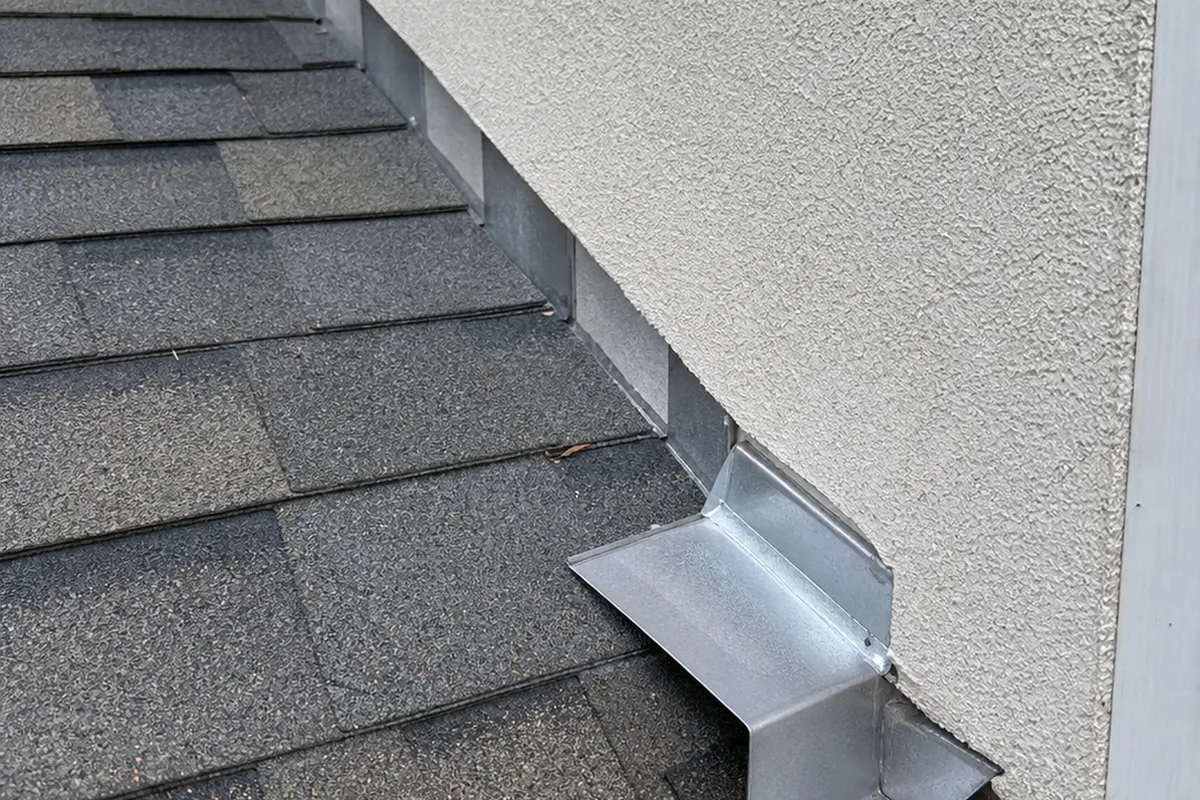
The concept is mechanical and simple. Where a sloped roof meets a sidewall, step flashing runs up the joint, one piece at each course of shingles, overlapping like shingles themselves. Water that runs down the roof hits this step flashing and is directed downward along the wall line. At the bottom of the run, where the step flashing ends and the gutter begins, that water needs to go into the gutter.
Without a kick-out diverter, it does not. The water follows the last piece of step flashing right behind the wall cladding, because surface tension and the angle of the metal guide it there. On a stucco wall, it enters the gap between the stucco and the building paper, or between the building paper and the sheathing, and from there it soaks the sheathing, runs down the framing, and pools wherever gravity takes it.
A kick-out diverter is a piece of bent metal, sometimes called a diverter flashing, that sits at the bottom of the step-flashing run and extends outward over the gutter. It catches the water that would otherwise follow the flashing behind the wall and redirects it into the gutter channel. The IRC at R903.2.1 addresses flashing requirements at roof-to-wall intersections, and roofing manufacturers now require kick-out flashing in their installation specifications. It is a small, inexpensive component, and its absence produces damage that costs thousands to repair.
The distinction matters: a kick-out diverter is not the same thing as step flashing. Step flashing is the series of L-shaped metal pieces woven into the shingle courses along the wall. The kick-out is one specific piece at the bottom of that run. A roof can have excellent step flashing and still lack the diverter at the termination. We see that regularly.
What the damage looks like
The damage from a missing kick-out diverter follows a predictable pattern, and once you know what to look for, you start seeing it on block after block.
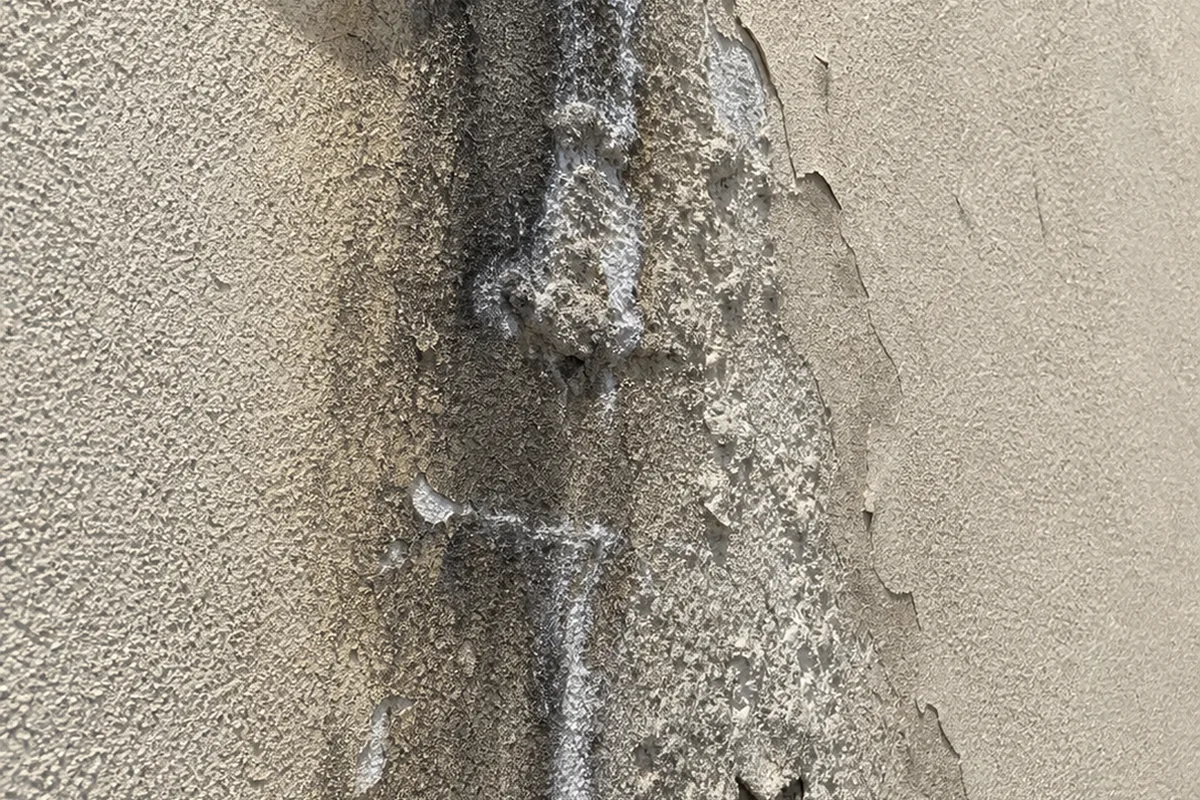
On the exterior, look for a vertical stain on the stucco or siding below the roof-to-wall junction. The stain typically starts right at the point where the step flashing meets the gutter and runs straight down. On stucco, it may appear as discoloration, darkening, or a line of efflorescence, which is the white chalky mineral deposit that forms when water passes through cementitious material and evaporates on the surface. On painted stucco, the paint may be bubbling, peeling, or soft to the touch.
On the interior, the damage can appear far from the entry point. Water that enters behind stucco at the roof line may travel down the wall cavity, along a top plate, or sideways along a header before it shows up as a stain, a soft spot, or mold on an interior wall or ceiling. This is the “phantom leak” problem. The homeowner calls a plumber because the stain is near a bathroom, and the plumber finds nothing, because the water source is at the roof line, not the plumbing.
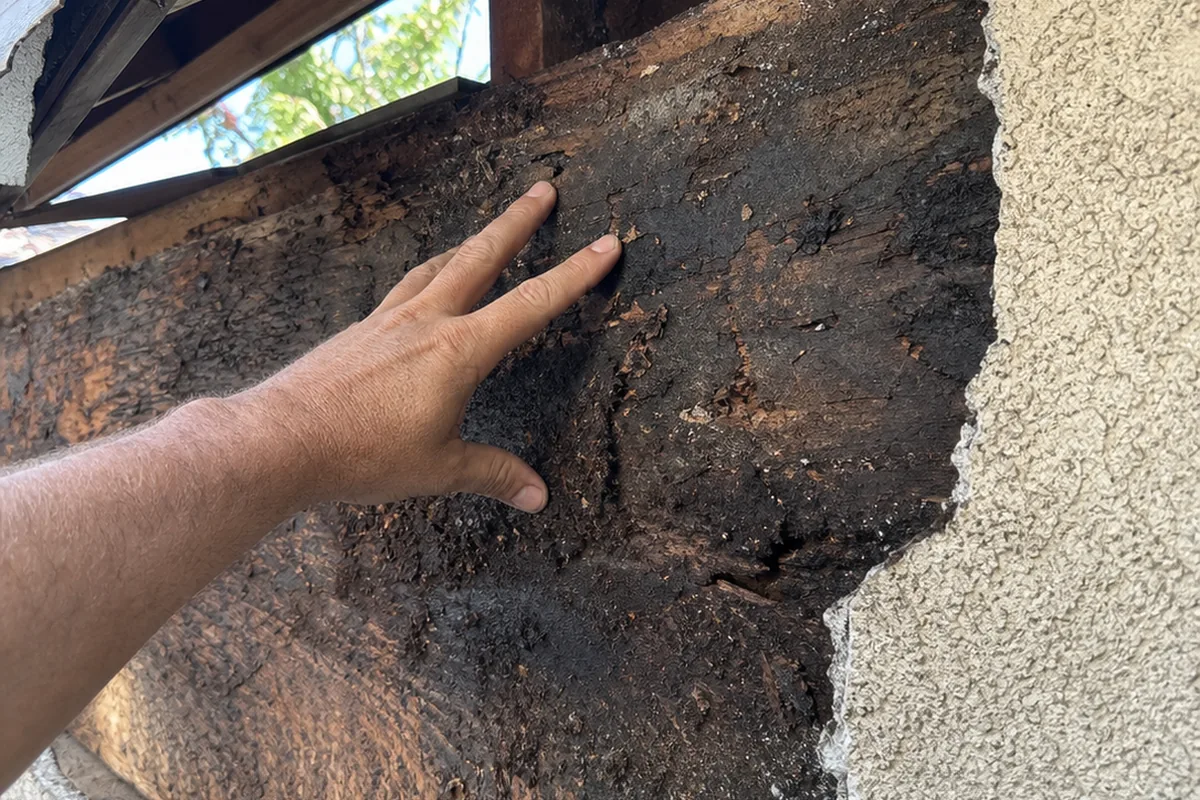
The hidden damage is the real cost. Between the exterior cladding and the interior drywall sits the sheathing, typically plywood or OSB, and the framing. Both absorb water. OSB in particular delaminates when it stays wet, losing its structural capacity in a way that is not reversible. Framing members that stay wet develop fungal decay. We have seen cases in Whittier where the stucco exterior looked like a minor stain, and behind it the sheathing was black and soft over a four-foot section. The repair was not a paint job.
What agents should tell every buyer
When a buyer is under contract in Whittier, give them these points before the inspection.
- Look at every spot on the house where a roof slope meets a sidewall, particularly where the bottom of that intersection reaches the gutter line. If there is no visible piece of metal directing water from the step flashing into the gutter, a kick-out diverter is missing.
- Look at the stucco or siding below each of those intersections for staining, discoloration, efflorescence, or paint failure. Any of these suggests water has been entering behind the cladding.
- A house that was re-roofed in the late 1980s or 1990s is particularly likely to be missing kick-out flashings, because the component was not consistently installed in that era.
- The absence of visible exterior damage does not mean the wall is dry. Stucco hides moisture well, and the damage behind it can be extensive before it shows on the surface.
- If the inspection report flags a missing kick-out diverter, ask the inspector whether there is evidence of moisture intrusion at that location. The diverter itself is a cheap install. The wall repair behind it may not be.
- Interior stains or soft spots on walls near a roof-to-wall intersection, even if they are nowhere near plumbing, should be investigated as potential water entry from the exterior. The water can travel inside the wall.
A buyer who walks the exterior looking at roof-to-wall junctions is catching one of the most common and most damaging moisture entry points in California housing. Our Los Angeles buyers checklist covers this as a priority item.
Schedule a Whittier inspection →
Red flags during showings
These are visible from the ground in most cases. You do not need to get on the roof.
- A roof-to-wall junction where the step flashing visibly terminates at the gutter line with no metal piece extending outward over the gutter.
- A vertical stain or discoloration on the stucco below a roof-to-wall junction, particularly one that runs straight down from the gutter level.
- White chalky deposits (efflorescence) on the stucco surface below a roof-to-wall intersection.
- Paint bubbling, peeling, or lifting on the wall below a roof-to-wall junction.
- A gutter that is butted tight against the stucco wall at the point where a roof slope terminates, with no visible transition.
- On the interior, stains or soft spots on walls that correspond to a roof-to-wall junction on the other side.
- Evidence of a recent exterior paint job on one specific section of wall below a roof-to-wall junction, which sometimes indicates a stain was covered rather than investigated.
If we see these, we document them, note the location, and tell the buyer what they are looking at. We do not guess at the extent of hidden damage behind the stucco, but we tell the buyer plainly when the pattern suggests concealed moisture.
The negotiation playbook
When a missing kick-out diverter and associated water damage surfaces in Whittier, the deal usually moves one of a few ways.
The first path is install the diverter and investigate the wall. The diverter itself is inexpensive to install, and a roofer can retrofit one without removing more than a few courses of shingles at the bottom of the step-flashing run. But installing the diverter only stops future water entry. The question is what damage has already occurred behind the cladding. A moisture evaluation of the wall, which may involve probing or an infrared scan, determines the repair scope.
The second path is a credit for the full scope. When the exterior staining and the interior soft spots both point at significant concealed damage, the buyer should get a bid that covers the diverter installation, the stucco removal at the affected section, the sheathing and framing inspection and repair, and the stucco and paint restoration. That bid anchors the negotiation. This can be a mid-four-figure to low-five-figure repair depending on how far the water has traveled.
The third path is the seller handles it before closing. This works when the seller is cooperative and the scope is defined. The diverter installation and a limited stucco repair are straightforward enough for a pre-closing fix. The risk is that the seller’s contractor patches the stucco without investigating what is behind it. Make sure the scope includes opening the wall enough to inspect the sheathing and framing.
The fourth path is the buyer accepts the condition with a price adjustment and plans the repair after closing. This is reasonable when the staining is minor and the infrared scan does not show broad moisture in the wall. It is not reasonable when the interior shows active damage, because the repair scope tends to grow once the wall is opened. We say so when we see it.
How the inspection actually catches it
This is a finding that rewards a methodical exterior walk, because the location is specific and the signs are consistent. We inspect every roof-to-wall intersection on the house and check whether a kick-out diverter is present at the bottom of each step-flashing run. Where one is missing, we look at the wall below for the staining, efflorescence, and paint failure that indicate water has been entering the wall.
Where infrared scanning is part of the inspection, it adds a layer that visual inspection alone cannot provide. Moisture in a wall cavity shows as a temperature differential on a thermal camera, and we can often identify the extent of concealed moisture without opening the wall. That is not a substitute for a destructive investigation, but it tells the buyer whether the problem is a surface stain or a soaked wall.
We look at the step flashing itself, its condition, its integration with the shingles, and whether it appears to have been installed as part of a re-roof or is original. We note the roofing material, its age, and the general quality of the roof-to-wall transition. A re-roof that installed good step flashing but skipped the diverter is better than one that did neither, but the water still gets in.
What we do not do is remove stucco, open walls, or determine the structural condition of concealed framing. When the pattern at a roof-to-wall junction suggests concealed moisture damage, we flag it, document it, and refer the buyer to a qualified contractor for a destructive investigation. Our guide on how to read a home inspection report explains how these referrals work and how to prioritize them alongside other findings. For the broader picture of stucco and moisture at the wall system level, including weep screeds and flashing at the base of the wall, that guide covers what this one does not.
Quick FAQ
What exactly is a kick-out diverter? It is a bent piece of metal flashing installed at the bottom of a step-flashing run where a sloped roof meets a sidewall above a gutter. Its job is to redirect water from the step flashing outward into the gutter instead of letting it follow the flashing behind the wall cladding. It is also called diverter flashing or kick-out flashing. It is one specific piece, not the entire run of step flashing.
Why was it not installed when the roof was done? In many re-roofs, particularly those done before the mid-2000s, roofers replaced the shingles and the step flashing but did not install a kick-out diverter because it was not a widely understood requirement and was not explicitly enforced by all jurisdictions. Some roofers still skip it today if they are not specifically asked. The IRC and roofing manufacturers now require it.
How much does it cost to install one? The diverter itself is an inexpensive metal component, and the labor to retrofit one at the bottom of an existing step-flashing run is modest. The real cost is whatever wall damage has accumulated behind the cladding while the diverter was missing. The diverter stops the problem. The wall repair addresses the consequence.
Can the damage be behind the stucco even if the exterior looks fine? Yes. Stucco is a hard, rigid cladding that does not show moisture penetration the way wood siding does. Water can be soaking the sheathing and framing behind the stucco for years before a stain, bubble, or soft spot appears on the surface. That is why we check the interior walls opposite each roof-to-wall junction as well.
Is this related to the roof covering condition? Only at the intersection. The roof covering itself, its age, its layers, and its remaining life is a separate evaluation. A roof can be in excellent overall condition and still lack a kick-out diverter at one specific junction. They are different findings that happen to be in the same area.
The honest summary
Whittier has character homes, hillside homes, and tract homes with additions, and every version produces roof-to-wall intersections where a small piece of bent metal is the only thing standing between the gutter and the inside of the wall. When that piece is missing, and it is missing more often than most agents expect, water enters behind the stucco on every rain event and works on the sheathing and framing silently for years. The repair is proportional to how long it went unnoticed.
We will check every roof-to-wall junction on the house, note whether the kick-out diverter is present, look at the wall below for signs of moisture entry, and tell your buyer plainly what we see. The diverter itself costs almost nothing. The wall behind it, once the water has had years to work, can cost quite a lot. Catching it before closing is the whole point. That is the job.
Schedule a Whittier inspection → · See what every inspection includes → · Read our FAQ → · View a sample report → · Explore Whittier home inspections →
Related reading
- Stucco and Weep Screed Moisture in Eastvale. The wall-system side of stucco moisture, including the base-of-wall flashing and weep screed.
- Composition Roof Layers in Northridge. The roof covering itself, its age, layers, and condition, a different roofing subject.
- Where the Water Goes in Tarzana. Surface water and grading, the ground-level version of the water management problem.
- Why Infrared Scanning Matters in California Homes. How thermal imaging detects concealed moisture in walls and ceilings.
- How to Read a Home Inspection Report in California. How moisture and flashing findings are prioritized in the report.
- Double-Tapped Breakers: A Downey Agent’s Guide. A different Gateway Cities finding, an electrical panel wiring defect rather than a water-intrusion path.
- Wood Siding on San Francisco Homes. Water entering lower down the same envelope, at the base of a wood-clad wall instead of the roof-to-wall joint.