Buyers ask us about the fireplace on almost every inspection, and the question is nearly always the same: is the chimney safe to use, and did the inspection already answer that?
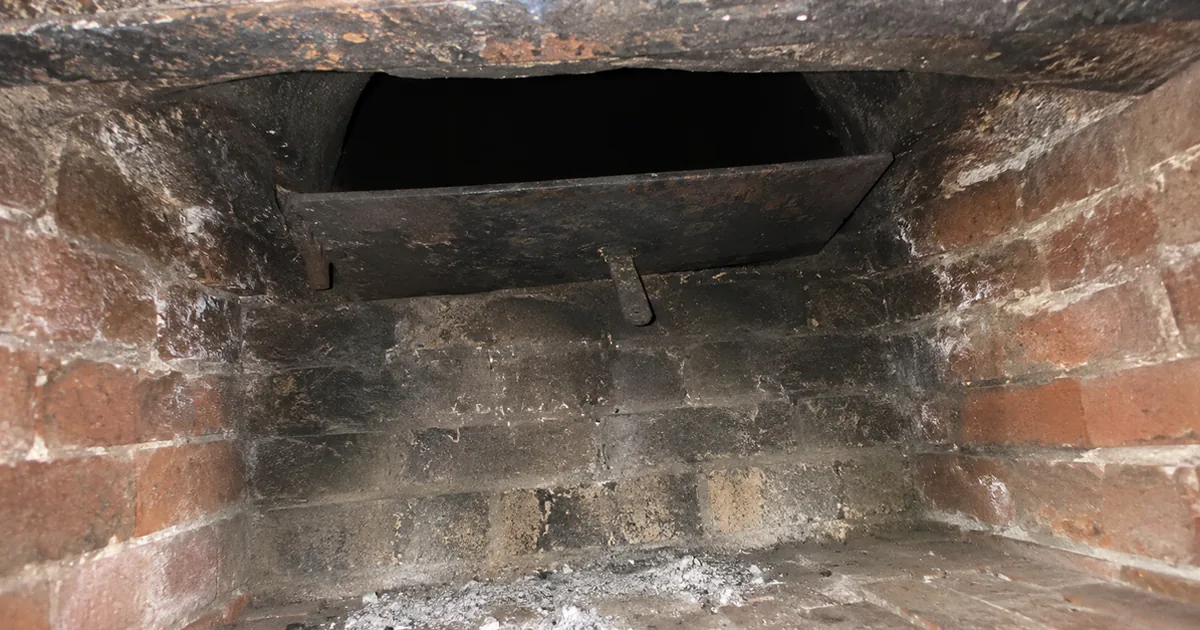
Mostly, it did not. We look at the firebox, the damper, the hearth and the parts of the chimney we can see. We do not look inside the flue.
So the real decision is whether to pay a chimney specialist for a Level 2 inspection, and by which day. That decision belongs in the first days of the inspection period, not after the deadline. This is not legal, contractor or fire-safety advice.
A home inspection covers the visible fireplace, and the standard leaves out the inside of the flue
Under the InterNACHI Standards of Practice, the inspector does not inspect the flue or the interior of the chimney. The inspector looks at what is readily accessible and visible.
The InterNACHI Standards of Practice page says “Last revised October 2022.” Section 3.8, Fireplace, says the inspector shall inspect “readily accessible and visible portions of the fireplaces and chimneys,” “lintels above the fireplace openings,” damper doors “by opening and closing them, if readily accessible and manually operable,” and “cleanout doors and frames.”
The same section lists what the inspector shall report as in need of correction. That includes “evidence of joint separation, damage or deterioration of the hearth, hearth extension or chambers,” “manually operated dampers that did not open and close,” and “the lack of a smoke detector in the same room as the fireplace” and a carbon monoxide detector in the same room.
Then it lists what the inspector is not required to do. Among the items: “inspect the flue or vent system,” “inspect the interior of chimneys or flues,” “determine the need for a chimney sweep,” “determine the adequacy of drafts or draft characteristics,” “perform a smoke test,” “dismantle or remove any component,” and “perform a National Fire Protection Association (NFPA)-style inspection.”
Section 2.1 adds that “An inspection will not identify concealed or latent defects.”
We don’t pretend a home inspector is a chimney sweep. If we see more than the standard asks for, such as a stained ceiling beside the chimney or a loose cap, it goes in the report. What we cannot see from the firebox or the roof edge, we cannot describe. How to read each section of the report shows how a line like that reads.
A Level 2 inspection looks inside, and the chimney sweep standard calls it recommended on a sale
The Chimney Safety Institute of America procedure for a Level 2 inspection says it is recommended when the property is being sold. Some pages describe it as required on a sale. The CSIA document itself says recommended.
We read the CSIA Standard Operating Procedure, Level 2 Inspection, Masonry Chimney Attached to a Building Heating Appliance, revision dated 4/5/19. It says NFPA 211 “has defined three levels of inspection.” It says a Level 2 is recommended “when the conditions of use are changing, such as adding a new appliance, or replacing an existing appliance with a dissimilar one” or “if a Level 1 inspection is not sufficient to determine serviceability of the venting system.”
It continues: “A Level 2 inspection is also recommended when the property is being sold; if you are planning on lining or relining the chimney or if there has been a building or chimney fire, weather or seismic event or any operating malfunction likely to have caused damage to the chimney.”
The document is written as guidance for chimney sweep professionals. It also says CSIA does not warrant that following the procedure “will reveal every possible defect.” We did not open a California statute, a lender guide or an insurer’s rule on chimney inspections for this article, so we are not saying any of them requires one. Ask your agent whether your contract, lender or insurer asks for a chimney report.
California buyers should notice the word “seismic” in that list. A masonry chimney in a house that has been through earthquakes is a reasonable thing to ask about. We are not saying it is damaged. We are saying the sweep standard names that event as a reason to look.
What a Level 2 covers that a home inspection does not
A Level 2 includes a camera scan of the flue, a trip to the roof and a look in the attic. That is the part a home inspection leaves out.
From the same CSIA document: “Video scanning (or similar inspection) of the chimney interior is required during a Level Two inspection.” The sweep is told to look for unused openings into the flue and “recommend that they be properly sealed,” and to “report any cracks or gaps noted in the chimney liner.”
The procedure also covers the chimney’s clean-out door, the crown and flashing at the top, the attic where the chimney passes through, and the condition of the appliance and its damper. It says a Level 2 “will require that you go on the roof” and inspect “within accessible attics, basements and crawl spaces.”
One line is easy to miss: “If it is not possible to video scan the chimney interior due to size or multiple offsets, be sure to note that in your report.” If your Level 2 report says the scan could not be done, you have bought a partial answer. Ask what they could and could not see, and why.
We did not find, in the document we read, any price or time for a Level 2, so this article gives none. Ask the company you call.
For the part of the chimney above the roof, what a drone roof inspection sees explains the flashing and top-of-chimney views we can add from above. And for what we can read at the attic end, see what we read from the attic hatch.
Match what the report says to the next call
Most fireplace lines in a report fall into six situations, and each points to a different first move. This table is our opinion from the field, not a code requirement.
| What the report or listing says | What it tells you | Usual first move |
|---|---|---|
| Fireplace or chimney interior not inspected, or flue not evaluated | The standard excludes the flue, so nothing was learned about it | If you plan to burn anything, order a Level 2 on day one |
| Damper does not open or close | A listed correction item, and the damper is part of what a Level 2 checks | Ask the seller what they know; add it to the Level 2 request |
| Hearth, hearth extension or firebox shows joint separation or damage | A visible defect in the part we can reach | Ask a licensed mason or fireplace specialist for a written look; add the flue to the Level 2 |
| No smoke or carbon monoxide detector in the room with the fireplace | A listed correction item | Ask the seller to install working detectors, or plan to do it yourself before the first fire |
| Ceiling or attic staining near the chimney, or loose or cracked flashing | Possible water entry around the chimney | Ask for a roofer and the Level 2 to look at the same spot; the attic photos help |
| You plan to put in a gas insert, stove or different appliance | Change of use, which the sweep standard names as a reason for a Level 2 | Order the Level 2 before the inspection days end, and tell the specialist the plan |
A “not inspected” line has a particular meaning, laid out in what a “not inspected” line really means.
Decide whether you will use the fireplace, and tell whoever you hire
If you will burn wood or run a gas appliance through that chimney, the flue matters. If the fireplace is decorative and you will never light it, the hearth, the damper and the detectors still matter, but a flue scan matters less.
That is a buyer’s choice, and it is cheap to make out loud. Say it to your agent on day one, and say it to the specialist when you book, because the answer changes what they should look for.
On an older masonry chimney you intend to light, we would not skip it. That is opinion, not a code.
A few cases deserve a harder look:
- A fireplace the listing calls “functioning” or “wood burning.”
- An older masonry chimney with no sign of a liner you can see from the firebox.
- A house where the seller says the fireplace has “never been used.”
- A fireplace that has been closed up, covered or converted to a different appliance.
If the fireplace was altered, the unpermitted work guide covers the permit questions. The furnace has its own limits, covered in what a furnace inspection leaves out.
Ask the seller for the chimney’s history in writing
Ask for the last sweep or inspection record, any liner or insert installation, any fire, any earthquake damage and the names of whoever did the work. Ask in writing so the answer is on record.
A short written list from the buyer’s agent to the seller’s agent can request:
- The date and company of the last chimney sweep or inspection, and any report or photos.
- Whether a liner, insert or stove was ever installed, who installed it and whether a permit was closed.
- Whether the chimney has had a fire, a repair or an earthquake inspection.
- Whether the seller has used the fireplace, and with what fuel.
- Whether the seller knows of any smoke or draft problem.
Read the seller’s disclosure package for what it says about the fireplace and about alterations and repairs, and ask your agent to point out those lines. We did not open the statutory disclosure form for this article, so we are not quoting it. Ask the agent or a real estate attorney what it requires.
“It was like that when we bought it” tells you the seller never checked. It does not tell you the chimney is sound. How to ask the seller for repairs or a credit covers how to word a request once you have a finding.
Order on day one, because the inspection days are fixed
The California purchase agreement sets a default investigation period of 17 days, and a request for repairs does not stop the clock.
The C.A.R. Residential Purchase Agreement, revision 12/22, sets 17 days unless the contract says otherwise. A request does not stop that clock. Only a written removal, cancellation or extension signed by both sides moves the date. Check your own paperwork.
So the practical order is: schedule the home inspection early, read the fireplace lines the same day, and call a chimney specialist the same afternoon if the table above points to one. Our reports arrive the same day, within 6 to 8 hours, and can include a Matterport 3D tour with findings tagged in place. See a same-day report with findings tagged in place.
When you book, ask three things: will you video scan the whole flue, will you go on the roof and into the attic, and will I get a written report with images. Those match what the CSIA procedure describes.
Read how the 17 days and removal work before you agree to extend or remove anything. We inspect houses; contract questions go to your agent, broker or a real estate attorney.
If your agent is new to a file mid-escrow, what an agent does the day the report arrives lists the order of calls.
If the Level 2 finds a problem, the usual choices apply
A liner crack, a gap or an unsealed opening is a finding like any other, and the buyer can ask for a repair, a credit or a price change, or decide the house is not worth it.
C.A.R. Form RR, public copy revision 12/18, lets the buyer check repair, credit, price reduction and pest work, and more than one box. The seller has no obligation to respond. A credit must be disclosed to the buyer’s lender, and the form warns that a credit may not be enough to remedy all defects. Check the revision on your own paperwork.
A request attached to a written specialist report with images is stronger than “the chimney looks old.” This article gives no repair price, because none of the sources we read gives one. Ask for a written description of the repair from someone holding the right license class; which license fits each referral explains how to match the trade.
Not every finding is a reason to renegotiate. Which findings are worth asking about and whether a finding is a deal breaker or normal help sort a chimney finding from the rest of the report. If you are the seller reading the buyer’s list, what a seller can do when the buyer’s list arrives is the other side.
If the seller agrees to repairs, ask for the proof. Verifying repairs before close of escrow lays out how, and Inspection.re offers re-inspection after seller repairs. The buyer or buyer’s agent orders it, and whoever orders it pays. The flat rate is based on scope and quoted by phone at 1-888-88-INSP-9.
Plan the days you have left, then close the loop
For a house with a masonry fireplace, the buyer’s plan is simple: read the fireplace lines, say whether you will use it, send the seller a written question, and book a Level 2 on day one if the table points to one.
Winter makes this timely. A buyer who closes in December may light the first fire within weeks, and how a wet winter shows up in a California home inspection covers the water side of the same season.
Does a home inspector check the inside of the chimney?
Not under the standard we read. Section 3.8 says the inspector is not required to inspect the flue or the interior of the chimney. A Level 2 is the inspection that does.
Is a Level 2 required when I buy a house?
The CSIA procedure we read says it is recommended when the property is being sold. We did not find a California law that requires one. Your contract, lender or insurer may ask, so check.
Do I need one if I will never light the fireplace?
That is your call with your agent. The hearth, damper and detector lines in the report still matter. A flue scan matters less if nothing will burn.
What if the camera cannot scan the flue?
The CSIA procedure tells the sweep to say so in the report. Ask what they could not see and why, then decide whether the answer is good enough before the inspection days end.
Read the fireplace lines, say whether you will use it, ask the seller in writing, and order the Level 2 early. Then decide with the facts in hand.
Call 1-888-88-INSP-9 or schedule an inspection. See what is included and the questions buyers ask us most. We inspect across California, including Los Angeles, San Diego, Temecula, Riverside and San Francisco.