Where the Water Goes First: A Lake Balboa Roof Drainage and Gutter Guide for Agents
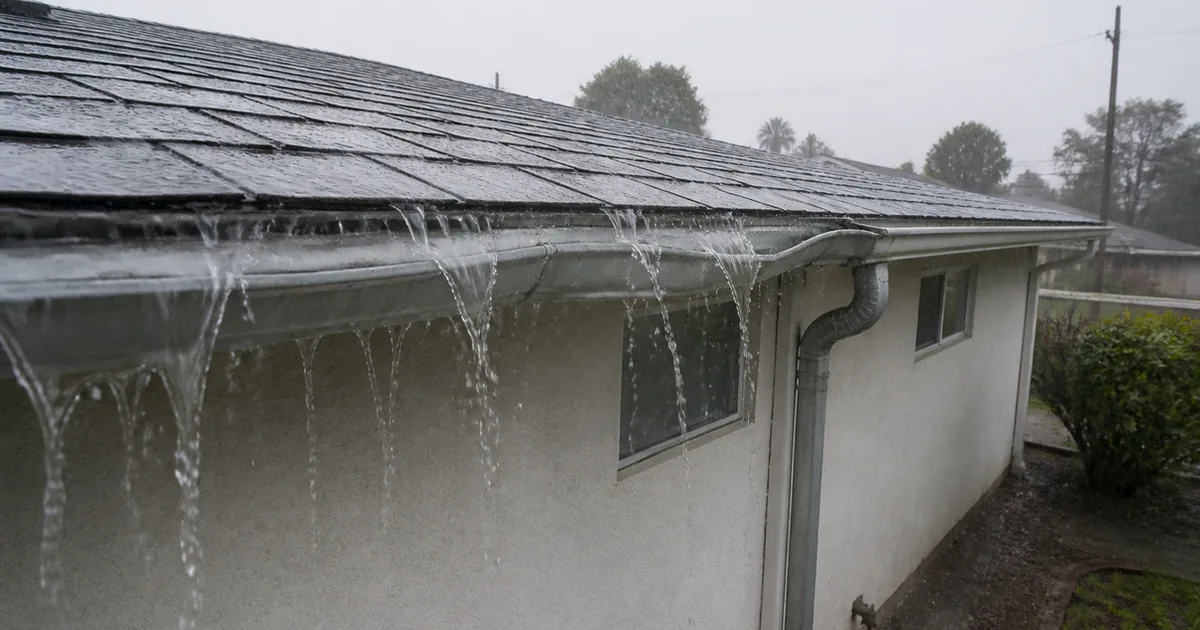
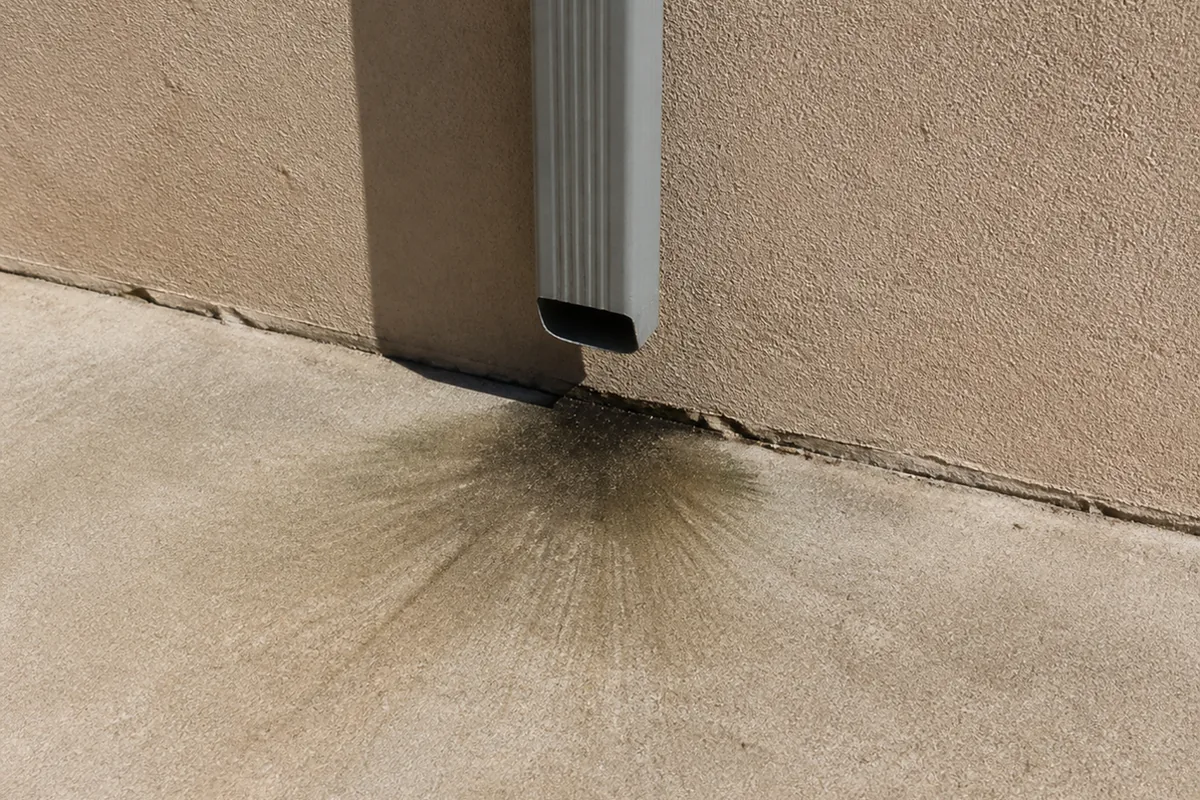
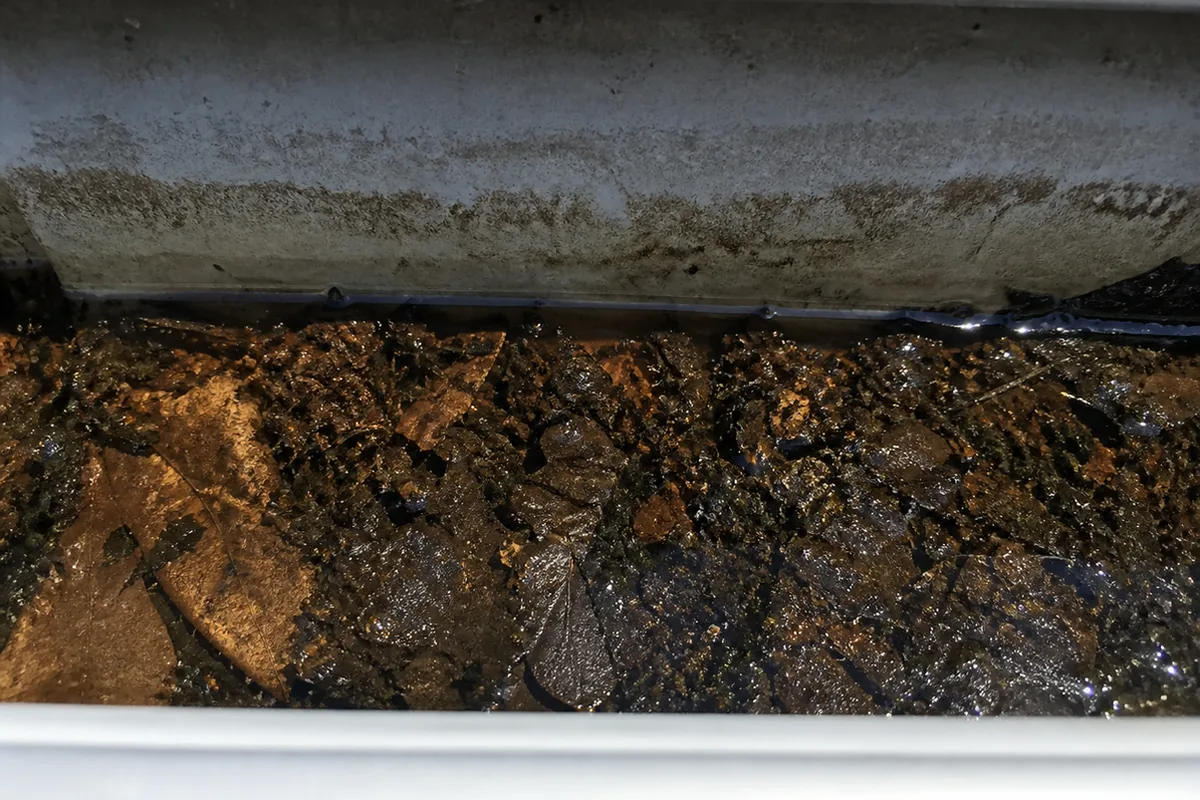
The gutter looked intact from the driveway, a continuous run along the front of a flat-roofed 1950s tract home near the lake, no obvious dents or gaps. On the roof, the story was different. The gutter sagged noticeably between two hangers, holding a visible pool of standing water and a mat of decomposed leaves instead of draining clean. At the corner, the downspout dropped straight down the wall and stopped six inches above a concrete walkway, no elbow, no extension, no splash block, dumping every gallon that made it through the clog directly against the foundation. Neither defect was dramatic on its own. Together, on a lot that already sits close to the water table near the Sepulveda Basin, they meant a meaningful share of every storm’s roof runoff was landing exactly where it should not.
We are describing this as a composite of a pattern we see repeatedly across Lake Balboa’s flat, post-war tract stock, not one identified property or job. It comes up often enough on this specific lot type that every agent working here should understand roof drainage as its own system, separate from grading, because the two get confused constantly and they fail in different ways.
This guide is for the agent working Lake Balboa and the surrounding communities we also serve, including nearby Van Nuys, Pacoima, and Panorama City, where the same flat lots and basin-adjacent water table show up on block after block. Here is why this is a real, checkable pattern in Lake Balboa, what a gutter and downspout system is actually supposed to do, and how it differs from the surface grading question a buyer may already be tracking.
Why this matters for the agent
Lake Balboa is a flat, post-war grid of 1950s tract homes built around the recreation lake and the Sepulveda Basin flood-control area. This registry’s own notes on the city document what buyers and agents here already sense: lots closest to the basin carry a documented higher water table than the surrounding valley floor. That fact changes the stakes of an otherwise ordinary roofing detail. On a lot with plenty of natural drainage capacity in the soil, a sluggish gutter is a maintenance item. On a lot where the ground beneath the foundation already holds more water than most of the valley, every gallon of roof runoff that reaches grade instead of being carried away adds directly to a site-drainage situation that has less margin to begin with.
That is the local angle behind this article: not that gutters matter everywhere, which they do, but that Lake Balboa’s basin-adjacent water table makes getting roof water off the property before it ever touches the ground a more consequential, more worth-checking system than it would be on a higher, better-draining lot elsewhere in the valley.
What a gutter and downspout system is actually supposed to do
A functioning roof-drainage system does two jobs, not one. The gutter’s job is to intercept the water shedding off every roof slope and carry it, without overflowing, to a downspout. The downspout’s job is to carry that water down the wall and release it a meaningful distance away from the foundation, not just off the roof edge and onto the ground six inches from the wall.
Skipping either half defeats the system. A gutter that catches water perfectly but feeds a downspout that dumps at the foundation has just relocated the water from the roof edge to the wall base, arguably making the concentration worse than no gutter at all. A downspout with a proper extension attached to a gutter that overflows behind the fascia never gets the water it is supposed to carry away in the first place.
Common real defects
On a typical Lake Balboa inspection, roof-drainage problems fall into a handful of repeatable categories.
- Undersized or missing gutters relative to roof area. A gutter sized for a smaller roof, or a section of roof with no gutter at all, cannot keep up with a real storm and overflows at exactly the point where the roof meets the wall.
- Gutters pitched wrong or sagging, holding standing water. A gutter needs a slight continuous fall toward its downspout. Sagging hangers or a level-installed run instead of a pitched one lets water and debris sit rather than drain, adding weight that makes the sag worse over time.
- Downspouts that dump water directly at the foundation. No extension, no splash block, no connection to a drain line, just a bare downspout stub ending a few inches above grade right next to the wall, the single most common defect we find on this housing stock.
- Disconnected or crushed downspout sections. A downspout knocked loose by a ladder, a parked vehicle, or age, or a buried section crushed by settled soil, sends water somewhere other than its intended path, often straight down along the foundation wall.
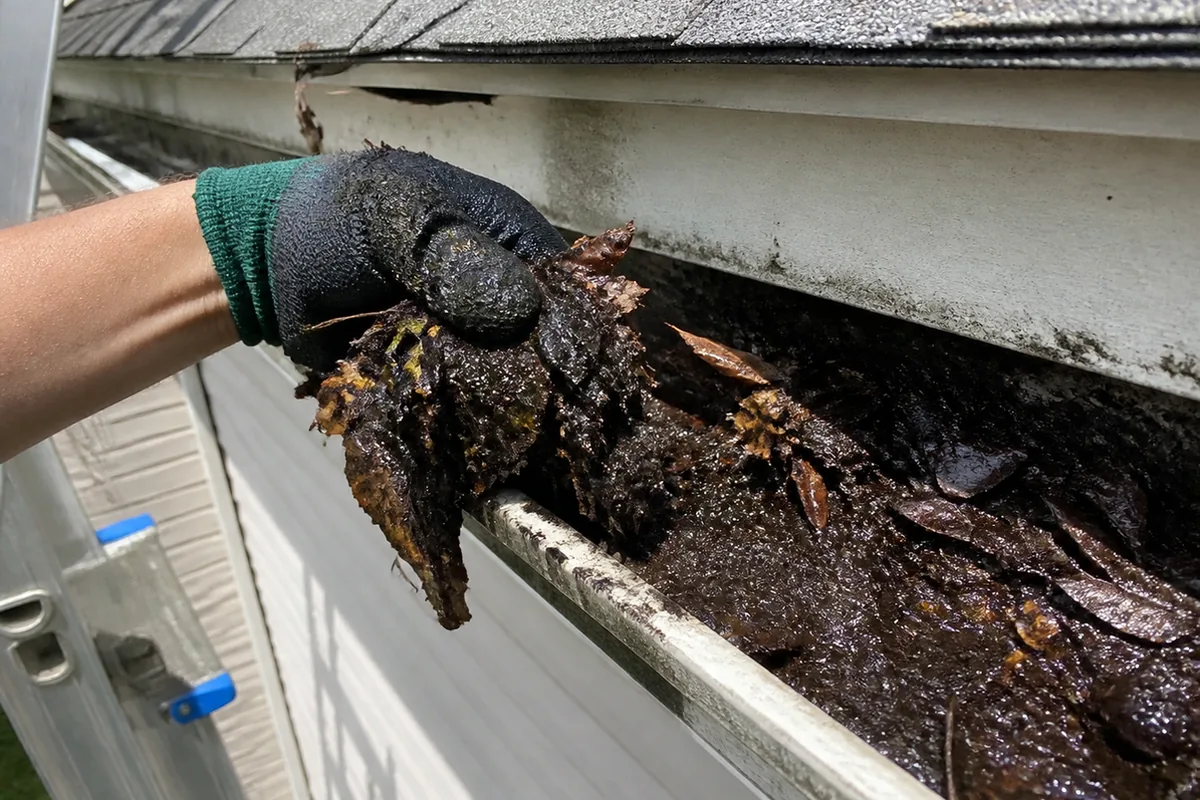
- Gutters clogged with debris causing overflow behind the fascia. Leaves, seed pods, and roofing granules build up over years of deferred cleaning, and once a gutter is full enough, water overflows the back lip instead of the front, running down behind the fascia board and into the wall assembly rather than visibly over the gutter edge where it would be obvious from the ground.
The fascia and rot consequence, briefly
Chronic gutter overflow, especially the back-overflow behind the fascia that a homeowner rarely notices from the ground, keeps that fascia board and the rafter tails behind it wet for long stretches at a time. That is exactly the sustained-moisture condition wood decay fungi need to establish themselves. We keep the deep mechanism discussion out of this article and route it to our Toluca Lake wood decay and fungal rot guide, which covers what decay fungi need to grow and how an inspector documents it. Here, the short version is enough: a gutter that overflows behind the fascia year after year is a wood-decay risk factor at that specific location, on top of everything it does to the foundation below.
Before we get to the grading distinction, one CTA worth keeping handy: see what every inspection includes →
A specific system, distinct from grading
It is easy to lump gutters in with grading and drainage generally, and easy to be wrong doing it. Our Tarzana grading and drainage guide covers water that is already on the ground: negative slope toward the house, buried weep screeds, hardscape pitched the wrong direction, irrigation heads aimed at the wall. That article’s whole scope starts at the moment water reaches grade.
This article covers the system that determines how much water reaches grade at the foundation in the first place, and where. A perfectly graded lot can still funnel a downspout’s entire output directly against the one section of foundation wall the grading was designed to protect, if the downspout has no extension. Conversely, a lot with mediocre grading can perform acceptably if every downspout carries its water well clear of the wall before ever letting it touch the ground. The two systems interact, but they are not the same system, and a buyer who only asks about grading can walk right past a downspout dumping at the wall.
What agents should tell every buyer
- A gutter and downspout system has two separate jobs, catching roof water and carrying it away from the foundation, and both have to work for the system to actually protect the house.
- A downspout ending a few inches above grade with no extension or splash block is one of the most common and most fixable defects we find, and it is worth checking on every showing, not just during inspection.
- Standing water or sagging in a gutter section is a sign the system is not draining properly, whether from wrong pitch, damage, or debris.
- This is not the same system as surface grading, and a well-graded lot can still have a downspout undoing that grading at one specific wall.
- On a lot near the Sepulveda Basin, where the water table already runs higher, getting roof water away from the foundation matters more than it would on a better-draining lot elsewhere.
- Chronic gutter overflow behind the fascia is a quiet contributor to wood decay at the eave, worth mentioning even though it shows up in a different part of the report.
Red flags during showings
- A downspout that ends a few inches above grade with no extension, splash block, or connection to a drain line.
- Visible sagging or standing water in a gutter section, especially after a recent rain.
- Staining, streaking, or a greenish growth pattern on the fascia board directly below a gutter section.
- A downspout that has clearly been knocked loose, crushed, or disconnected from the gutter above it.
- Soil erosion or a worn channel in the ground directly below a downspout outlet.
- Debris visibly built up and overflowing a gutter’s front edge during or shortly after rain.
The negotiation playbook
When a roof-drainage finding surfaces in a Lake Balboa escrow, the deal usually moves down one of a few paths.
The first path is a straightforward correction, appropriate for the most common finding, a missing downspout extension or splash block, since adding one is inexpensive and does not require a specialist.
The second path is a gutter cleaning and adjustment, warranted when the defect is debris buildup or minor sag rather than damage, and a maintenance pass restores the system without replacement.
The third path is a gutter contractor’s replacement scope, appropriate when sections are undersized for the roof area, badly damaged, or pitched wrong from the original installation, and a proper resizing or re-hang is the actual fix.
The fourth path is a credit or informed acceptance, appropriate when the finding is limited and the buyer is comfortable correcting it themselves shortly after closing, particularly on a lot with otherwise good grading and no signs of foundation moisture yet.
How the inspection actually catches it
We walk the roofline and every gutter run on every Lake Balboa inspection, checking pitch, attachment, and debris load, and we trace every downspout from the gutter outlet down to where it actually discharges.
Where we find a gutter holding standing water, a downspout dumping at the foundation, or staining that points to chronic back-overflow at the fascia, we document it and note whether the site’s grading is compounding or offsetting the effect. We do not resize, re-hang, or repipe a gutter system ourselves. That is a gutter contractor’s work, referenced alongside our Tarzana grading and drainage guide when both systems are contributing to the same wet area.
Our what’s included page covers the full roof and exterior-drainage scope of every Lake Balboa inspection.
Quick FAQ
Is this the same topic as Tarzana’s grading and drainage article? No. Our Tarzana grading and drainage guide covers water already on the ground: negative slope, buried weep screeds, hardscape pitched wrong. This guide covers water while it is still coming off the roof, before it ever reaches grade.
Does a downspout extension really matter that much? On a lot with average drainage, a missing extension is a minor issue. On a Lake Balboa lot near the basin, where the water table already runs higher, it matters more, because there is less capacity in the soil to absorb an extra concentrated discharge point right at the wall.
Can gutter overflow really cause wood rot? Chronic overflow behind the fascia keeps that wood wet for extended periods, which is the condition wood decay fungi need. See our Toluca Lake wood decay guide for the full mechanism.
Is gutter cleaning something a buyer should just plan on doing every year? Yes, in a canopy-heavy or debris-heavy setting, annual cleaning is normal maintenance. The inspection finding that matters is whether the system is properly sized, pitched, and discharging away from the foundation, not whether it has some leaves in it on inspection day.
Should a buyer walk away over a drainage finding like this? Rarely on its own. Most gutter and downspout findings are inexpensive corrections. The negotiation usually depends on whether there are already visible signs of foundation moisture that the poor drainage may have contributed to.
The honest summary
Lake Balboa’s flat lots and basin-adjacent water table give roof drainage more consequence here than in a better-draining part of the valley. Most of what we find is correctable: a missing downspout extension, a clogged gutter, a section pitched wrong. A smaller share points to a system that has been dumping water at the foundation long enough to leave visible staining or moisture signs worth tracing further.
We check every gutter run and every downspout discharge point on every Lake Balboa inspection, and we tell you plainly whether the roof-water system is doing its job or adding to an already challenging site.
See what every inspection includes → · Read our FAQ → · Explore Lake Balboa home inspections →
Related reading
- Grading and Drainage in Tarzana. Water already on the ground: negative slope, buried weep screeds, hardscape pitched wrong, a companion system to the roof-water management covered here.
- Wood Decay and Fungal Rot in Toluca Lake. The deeper mechanism behind fascia and rafter-tail rot that chronic gutter overflow can cause.
- High Water Table and Ground Moisture in Camarillo. Groundwater rising from below a site broadly, a different moisture source from surface roof-water discharge.
- Why Infrared Scanning Matters in California Homes. How thermal imaging finds hidden moisture near a foundation wall or ceiling.
- French Drains and Subsurface Drainage in Lemon Grove. Below-grade groundwater and hillside seepage management, a different system from this article’s roof-to-ground water management.
- An old roof and a nonrenewal letter. What California insurers must explain and hand over from 2028.
What a Drone Actually Sees on a Roof. Debris-choked valleys and gutters holding standing water, seen from the only angle that shows them.