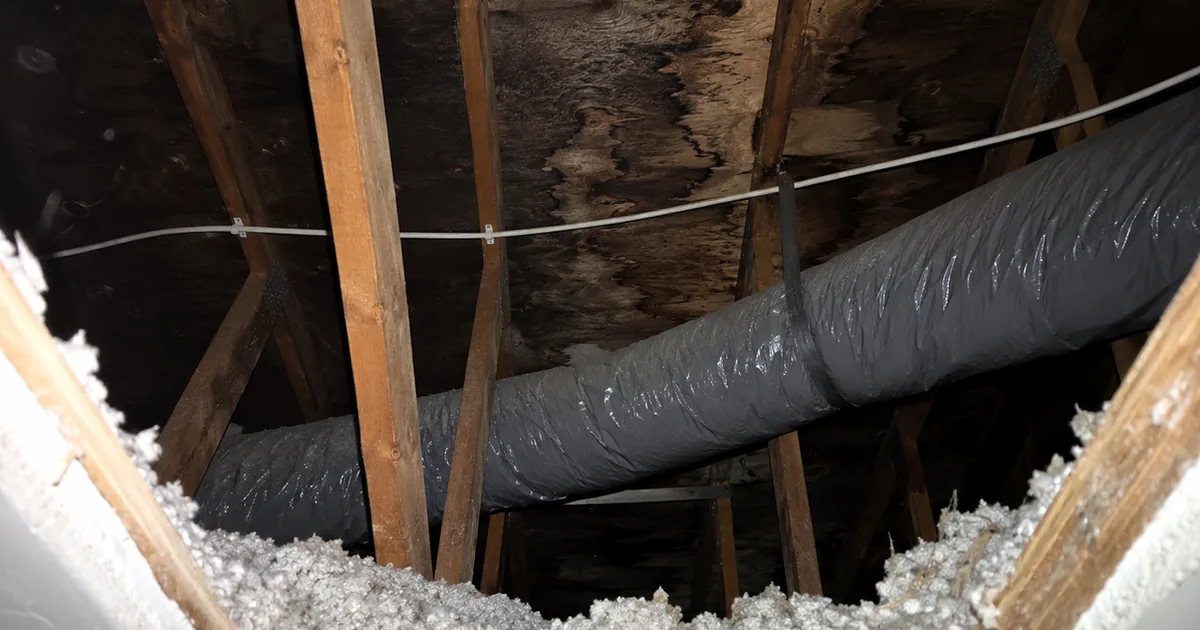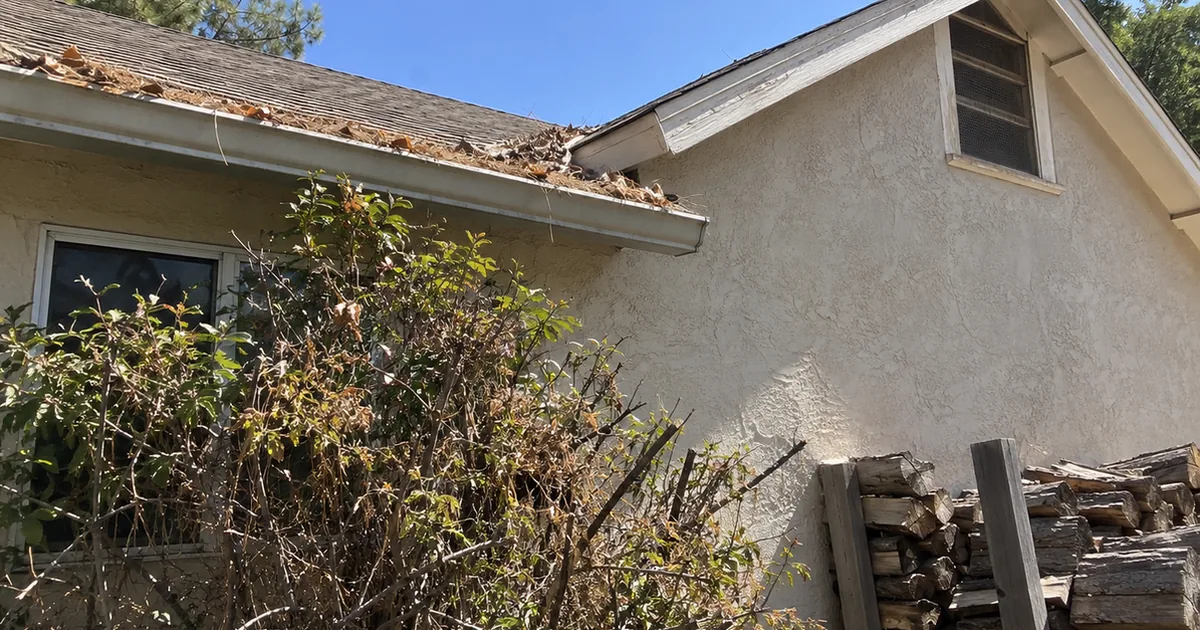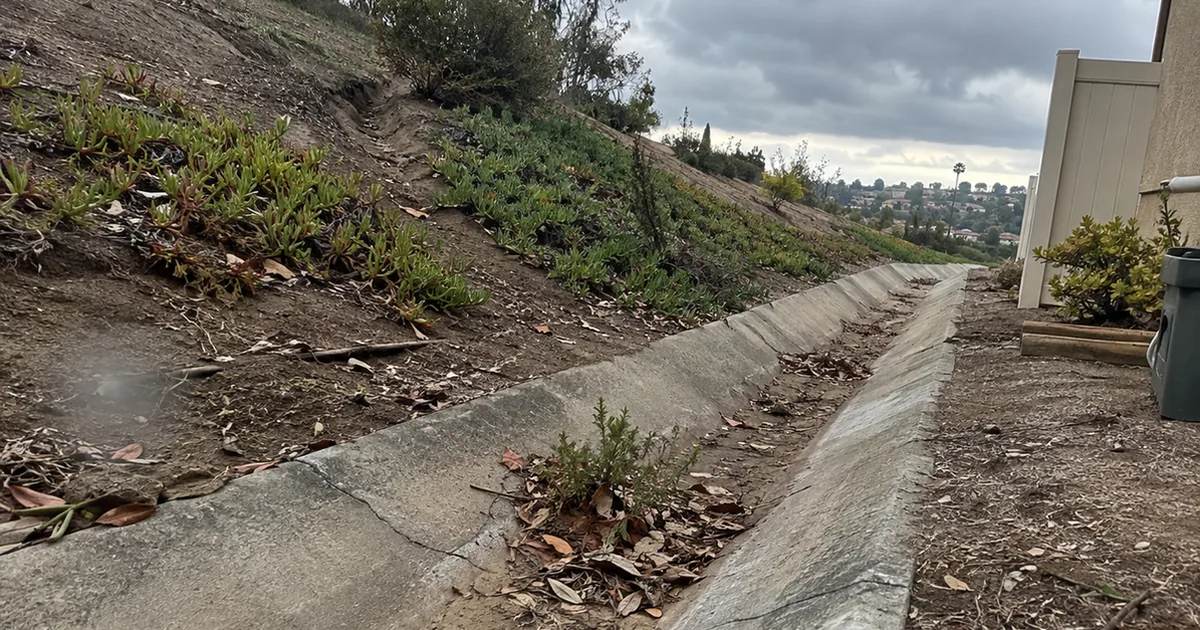
A hillside tract house in September. Dry ground. A concrete terrace drain, a V-ditch, crosses the back slope. It is half full of silt and leaves. A weed is growing through it.
One downspout empties onto bare slope soil. The roof looks fine from the drone pass. Nothing is wet, so nothing is leaking.
This is a composite of what we see, not one house. The report notes the silted drain and the downspout. Whether either one matters depends on rain nobody has seen yet.
NOAA says a strong El Niño is likely through early 2027
NOAA’s Climate Prediction Center kept its “El Niño Advisory” in place in its October 8, 2026 discussion.
Its synopsis states: “El Niño continues to strengthen, with a strong-to-very strong El Niño likely through January-March 2027 (remaining greater than an 83% chance).” The sea surface temperature anomaly in the Niño-3.4 region reached +2.1 C.
The CPC also placed the odds of a historic event, stronger than any El Niño since 1950, at 83% for October through December.
That is a large signal. It is not a promise about one house, one county, or one storm. The CPC says that with an event this large, the chances of El Niño-type impacts “are larger, though not guaranteed.”
The CPC’s September 17, 2026 seasonal outlook gives California a higher chance of wetter-than-normal conditions. Probabilities reach 50 to 60 percent near the coast in December through February, January through March, and February through April.
The next CPC ENSO discussion is scheduled for November 12, 2026. Conditions can change. The inspection issue does not. A dry report still needs to be read for the path water will take when it arrives.
Strong El Niño winters have still missed California
A strong El Niño does not guarantee a wet California winter. NOAA’s record shows why.
Nat Johnson wrote on NOAA climate.gov in 2023 that the 1997-98 forecast “performed very well.” The 2015-16 winter precipitation forecast “didn’t materialize as expected, especially in California.” It was “widely panned as a bust for that region.”
NOAA climate.gov reported in 2016 that 2015-16 precipitation was “barely above the long-term average in the state.” NOAA wrote in 2018 that “these impacts are not ensured during every El Niño, not even the strongest ones.”
The NOAA and RISA fact sheet hosted by NWS San Diego in December 2015 gives the regional distinction. During El Niño, winter precipitation “is often above normal across the southern third” of California. It has “not been consistent (both wet and dry) in central and northern” California.
California also experienced coastal flooding during the 1982-83 El Niño. That fact belongs in the conversation, but it does not turn a probability into a forecast for a particular property.
Tell a buyer to plan for a wet winter. Do not tell the buyer that a wet winter is certain. The reasonable preparation is the same either way. Find the water path. Clear the obstruction. Check the insurance timing.
California and Los Angeles County are acting before the first storm
The state and counties are treating the forecast as a reason to prepare now.
On October 9, 2026, the California Governor’s Office reported that the Department of Water Resources had stockpiled 4.4 million sandbags, more than 52,000 feet of “Muscle Wall” flood barriers, and 400,000 tons of rock at 68 locations. DWR is inspecting all 1,600 miles of levees in the State Plan of Flood Control.
The state told residents to sign up for alerts, know their flood risk, and never drive through floodwater.
On September 23, 2026, Los Angeles County Supervisor Hilda Solis issued a local emergency proclamation. The proclamation said, “El Niño could bring heavier rainfall and increase the risk of flooding, landslides and debris flows across Los Angeles County, and we cannot wait for the first storm to act.”
The county told residents to clear gutters and storm drains and inspect roofs for leaks.
None of that tells you whether one house has a sound roof, a blocked terrace drain, a wet crawlspace, or a slope problem. Public preparation is not a property inspection. A dry-season report still has to be read house by house.
A September inspection sees the hardware, not the water
A dry-season inspection can document the parts of the drainage system. It cannot show water moving through that system when the ground is dry.
Under the InterNACHI Standards of Practice roof section, we inspect “the gutters; the downspouts; the vents, flashing, skylights, chimney, and other roof penetrations.” The standard does not require inspection of underground downspout diverter drainage pipes.
The exterior section calls for inspection of “vegetation, surface drainage, retaining walls and grading of the property, where they may adversely affect the structure due to moisture intrusion.” It does not require us to inspect or identify geological, geotechnical, hydrological, or soil conditions.
In a foundation or crawlspace, we report “observed indications of active water penetration.” An inspection reports material defects observed on the date of the inspection.
That date matters. On a dry day, we see stains, silt lines, efflorescence, rust trails, and the shape of the ground. We note where water will go. We cannot watch it go there.
Our standard service includes a drone roof pass and FLIR infrared in every inspection. FLIR reads surface temperature. A wet spot can read cooler. A dry stain from last year can read like the wall around it. Infrared is another observation, not a rainstorm in a camera.
We send a same-day report. Findings are tagged in a 3D Matterport tour. That gives you a location and a condition to discuss before the contingency period closes. It does not create a history of how the property performs during rain.
A roof that looks sound in September may still leak in the first storm. A drain that looks like a minor maintenance item may overflow onto a slope. The report gives you the visible starting point.
Five places water goes wrong first in an El Niño winter
The first failures usually follow the existing water route. These are the five places we check first.
-
Roof drainage. Gutters fill with leaves. Downspouts clog or discharge at the foundation. The roof may remain intact while water lands in the wrong place. See our roof drainage and gutter guide.
-
Grading at the wall. The residential code asks for lots to drain surface water away from foundation walls, with the grade falling not fewer than 6 inches within the first 10 feet where that is possible. Where it is not possible, the code asks for drains or swales. Impervious surfaces within 10 feet are to slope at least 2 percent away. We look at the visible grade and report what we see. We do not turn that observation into legal advice. See the grading and surface drainage guide.
-
Slopes, terrace drains, and retaining walls. A silted V-ditch can overflow onto the slope. A weep hole that does not weep can indicate that the wall drainage is not relieving water as intended. We look for silt, blocked outlets, soil movement, cracking, and drainage paths. The deeper mechanisms are covered in the tract slope and retaining wall guide.
-
Burn scars. USGS says, “Even modest rainstorms can trigger dangerous flash floods and debris flows in steep burned areas.” Debris flows can occur “during the first storm following a wildfire,” and elevated susceptibility “may persist for several years.” USGS published post-fire debris-flow hazard assessments for the January 2025 Palisades and Eaton fires. See the debris flow and drainage guide.
-
Crawlspaces and below-grade walls. Standing water, efflorescence, and wet framing may appear below the living space. A French drain may be visible but outlet nowhere. We look for accessible signs and report what we can observe. See the crawlspace moisture guide and the French drain and subsurface drainage guide.
If the house has not been inspected yet, schedule an inspection before the first storm. Our inspection includes a drone roof pass. Read what a drone roof inspection sees before you schedule.
Six things agents should do with a dry-season report
Read the report for water movement, not just for damaged materials. Then take these steps.
-
Trace the water path. Start at the roof. Follow the gutters, downspouts, grade, slope drains, and crawlspace. Flag every finding that moves water or changes where water will collect.
-
Ask for the cheap fixes now. Clear gutters. Extend downspouts away from the foundation. Clean terrace drains and area drains. These are hours of work, not a renovation.
-
Check flood insurance timing now. FEMA says there is typically a 30-day waiting period for a National Flood Insurance Program policy to go into effect. Exceptions apply when coverage is purchased as required by a government-backed lender or is related to a community flood map change. Read the flood map changes guide. The California Department of Developmental Services said in its October 2026 El Niño fact sheet to “review flood insurance (standard policies often exclude flood).”
-
Ask about burn-scar alerts. If the house sits on or below a burn scar, ask the county about the USGS debris-flow assessment and the local alert system.
-
Treat inaccessible areas as unknown. If the inspection says a crawlspace or attic area was not accessible, that is the area where winter water can hide. Read what “not inspected” means in a report.
-
Use the contingency period if rain arrives. A follow-up look in or right after the rain can show what the dry inspection could not. It is an option when timing allows.
The report should not sit unopened in an email folder. An agent can search for every reference to drainage, moisture, grading, gutters, downspouts, retaining walls, crawlspaces, and inaccessible areas. The buyer can then decide which items need attention before the next storm.
The first rain gives you visible evidence at the showing
Look at the outside during the first rain, or immediately afterward. Start with the roof edge and finish at the foundation.
Watch for water sheeting over the gutter edge. Check whether downspouts discharge at the wall. Look for puddles against the foundation, mud fans below a slope drain, damp stains at the base of stucco, and a musty crawlspace vent.
Look at roof-to-wall transitions if they are visible from the ground. Kick-out flashing is one place where roof water can leave the roof edge and reach the wall incorrectly. See the roof-to-wall flashing guide.
These are visible signs. They do not replace an inspection or a geotechnical evaluation. They give you a reason to document the condition and ask a direct question while the water is present.
Five direct answers buyers ask about El Niño and inspections
Does El Niño guarantee a wet winter in California?
No. The CPC says El Niño-type impacts are more likely, not guaranteed. The 2015-16 winter underdelivered in California, with precipitation barely above the long-term average in the state.
Will the inspection tell me if the roof leaks?
It reports visible conditions on the inspection date. A dry roof can still leak in the first storm. We inspect the roof drainage components, penetrations, flashing, and other visible conditions required by the inspection standard, but we cannot observe rain during a dry inspection.
Does a home inspection evaluate landslide risk?
No. InterNACHI does not require identifying geological or soil conditions. A geotechnical engineer evaluates that question.
When should a buyer buy flood insurance?
Before the buyer needs it. FEMA says the typical waiting period for a National Flood Insurance Program policy is 30 days, with exceptions for government-backed lender requirements and community flood map changes.
What is the cheapest pre-storm fix?
Clear the gutters and extend the downspouts. The report may identify other drainage work, but those are the first simple items to address.
The odds favor preparation, not certainty
The odds favor a wet winter. They do not guarantee one.
A dry inspection shows the water path, not the water. Fix the cheap drainage items before November. Review flood insurance now. If the home is near a burn scar, ask about the debris-flow assessment and local alerts. If rain arrives during the contingency period, consider a follow-up look while the conditions are visible.
That is the useful response to the forecast. It does not depend on telling a buyer that every storm will be severe.
Use the report to act before the first storm
Start with what is included in every inspection, then read the inspection FAQ and how our inspection report works. We inspect across California, including La Cañada Flintridge, Mission Viejo, Tarzana, Lake Balboa and Simi Valley.
Before November, open the dry-season report, mark every item that moves water, and ask who will clear, extend, clean, or repair it. Do not wait for the first storm to discover that the terrace drain was full of silt.
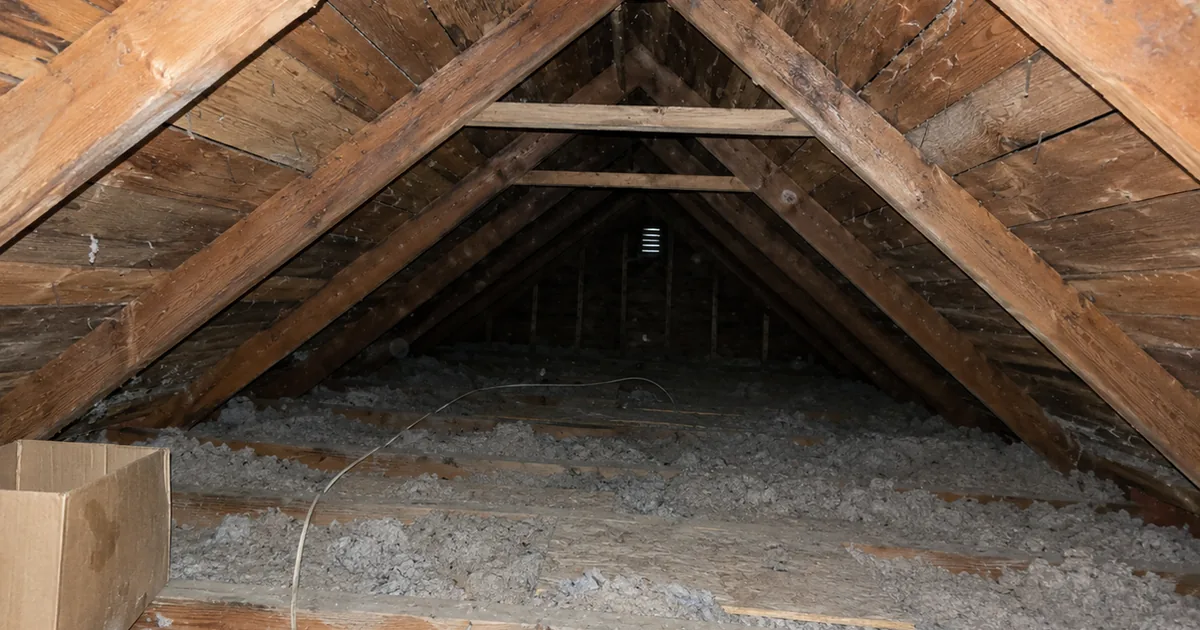
After a wet winter, the attic is where roof leaks leave their record. Our attic hatch guide explains the stains and ventilation signs we look for.
Read these drainage and flood guides next
- Lake Balboa roof drainage and gutter guide for gutters and downspouts.
- Tarzana grading and surface drainage guide for the six-inch fall and surface water path.
- La Cañada Flintridge debris flow and drainage guide for burn-scar exposure.
- FEMA flood map changes guide for insurance timing.