Thirty feet out, where nothing else in the inspection can reach
The camera runs clean for about thirty feet. Clay tile, dry, joints tight, the head sliding along without catching. Then the picture drops and goes half underwater, because the line is holding water in a section that should be draining. A few feet further on there is a joint gap with fine white roots hanging through it like a curtain, and just past that the head bumps up over a lip where one section has settled below the next.
Nothing else in that morning’s inspection showed any of this. Nothing else could. The fixtures all drained, the traps were fine, the accessible plumbing under the house looked like ordinary mid-century cast iron with ordinary mid-century corrosion. The house passed every test that a house can be given from the inside.
This is a composite of a situation we meet often rather than any one identifiable job, and it is the whole argument for the sewer scope in one paragraph. You are not buying a second opinion on the general inspection. You are buying a look at a separate system, with its own failure modes, that the general inspection is not built to see.
Why the general inspection does not cover it
The buried lateral sits outside a standard home inspection by written standard, not by anybody’s shortcut.
Our inspectors work to the InterNACHI Standards of Practice. Its general limitations state that the inspector is not required to inspect “underground items” or “underground utilities,” and separately that “septic systems or cesspools” are excluded. The plumbing section adds “wastewater treatment systems” to the list. The standard also says plainly that “an inspection will not identify concealed or latent defects,” which is about as direct a description of a pipe buried four feet under a lawn as you could ask for.
What a general inspection does do is run the drains. We fill sinks and tubs and release them, we flush toilets, we watch for slow drainage and for anything backing up at a lower fixture. That is a real test and it catches real problems. It is also a test of the system from inside the building envelope, and a lateral can carry everything a kitchen sink can throw at it while failing badly thirty feet past the foundation. Volume is the thing that finds a marginal line, and a bathroom sink is not volume.
So the scope is a separate service with a separate tool, which is the same division that applies to several other specialist scopes. Our guide to what a general inspection includes and where a specialist takes over sets out the rest of that boundary.
What the camera actually shows you
A push camera and a locator turn a vague worry into a marked spot on the ground.
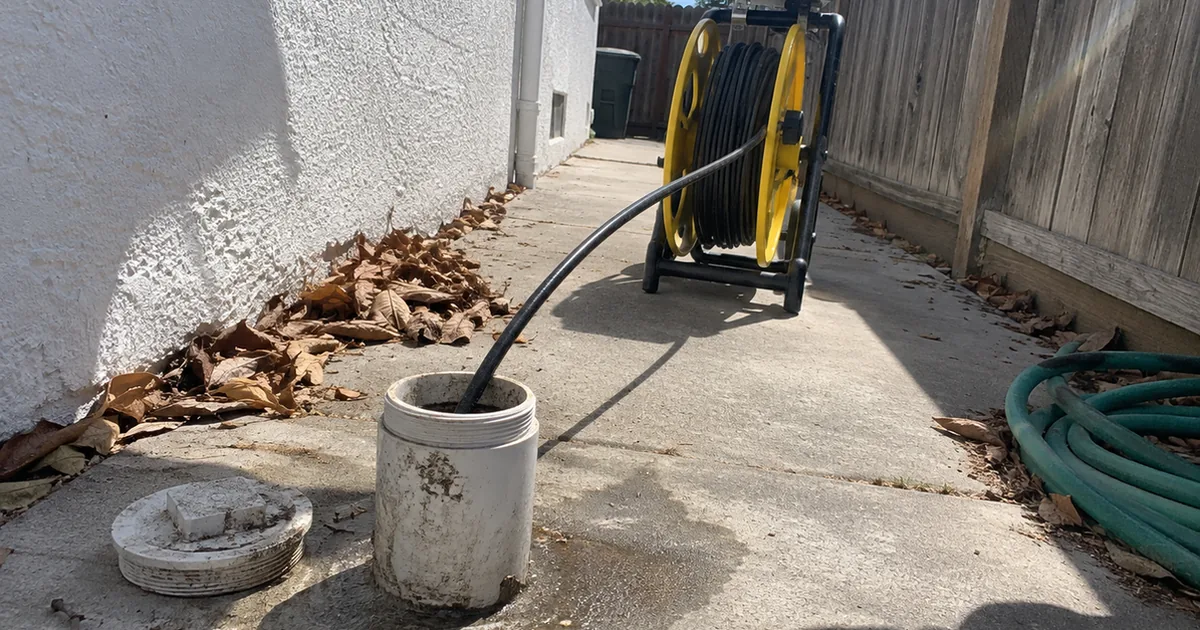
The tool is a flexible camera on a reel, fed into the lateral through a cleanout where one exists. Where there is no cleanout, and on a lot of older California houses there is not, the camera goes in through a pulled toilet. The head carries a locator transmitter, so when the operator finds something the position and depth can be marked on the surface above it. That is the difference between telling a buyer that something is wrong down there and telling them it is eleven feet from the porch, about four feet deep, under the corner of the driveway.
You get recorded video, so you see exactly what the operator saw, including the moment the head stops.
What shows up on that footage, in rough order of how often we see it: standing water where the line has lost pitch, a separated or offset joint, root mass coming through at a joint, heavy scale and corrosion narrowing a cast iron run, a crushed or deformed section, a belly that holds waste after every flush, and occasionally a stretch of pipe that simply is not there any more. A written summary cannot convey the difference between a clean run and a camera head climbing over a displaced joint. The video can.
What the camera cannot tell you
It cannot tell you how long the line has left, and anyone who says otherwise is selling something.
A scope is a record of the lateral’s condition on the day it was run. It is not a prediction. Soil movement, tree growth and the behavior of the ground around the pipe are outside what a camera can assess, and there is no honest way to convert a picture of a corroded joint into a number of years. We report what we see and we stop there.
It also cannot see past a blockage it cannot get through. If the head stops at twenty feet against a root mass or a collapsed section, everything beyond that point is unknown, and the report has to say so rather than implying the rest is fine.
A stopped scope is still worth what you paid for it. A camera that cannot pass twenty feet out has told you something urgent and specific about a line you were about to own, and it has given both sides in the transaction a concrete thing to price rather than a vague suspicion.
The reverse case deserves the same honesty. Open is not the same as sound. Plenty of laterals show roots, a shallow belly, corrosion or a displaced joint while still moving water fine today, and reading that difference is most of the value of having somebody experienced watching the screen. It is the same interpretive problem that runs through the rest of an inspection, which our piece on how to read a home inspection report works through in more detail.
The lateral is yours, and so is the bill
In most California jurisdictions the private sewer lateral belongs to the property owner, and in many of them that includes the run under the sidewalk and street out to the main.
You inherit the whole of it on the day you close. The buried section, whatever is wrong inside it, and the responsibility for fixing it. The sewer utility maintains the main. It does not take on the private lateral simply because part of that lateral happens to cross public ground.
That is why this question belongs inside the contingency period rather than after it. A clean kitchen and a working toilet answer nothing about what is happening beyond the foundation wall, and the accessible plumbing we can report on ends where the visible pipe does. Our article on how the California inspection contingency actually runs covers the timing, and if anyone is suggesting you give that period up in a competitive offer, read what a waiver really costs before you agree to it.
Agents should keep two things apart here. A seller’s regulatory paperwork may answer a compliance question. It usually does not answer the buyer’s condition question. Both can reasonably be asked for in the same transaction, and they are not duplicates.
In eight East Bay communities the timing is already decided for you
If the property is in Alameda, Albany, Emeryville, Oakland, Piedmont, El Cerrito, Kensington or the Richmond Annex, the East Bay Regional Private Sewer Lateral Ordinance puts a hard date on this. Berkeley runs its own separate program.
Three things trigger the requirement to obtain a Compliance Certificate: a sale or purchase of the property, building or remodeling work exceeding $100,000, and a change in water meter size. A valid Compliance Certificate, or a Time Extension Certificate, has to be in hand before escrow can close on a sale or a title transfer. For an agent that turns it into a calendar problem rather than a paperwork problem, and it is one worth raising in the first week rather than the last.
The certificate is not issued on paperwork alone. A licensed contractor performs a pressure verification test, either a hydrostatic water test or a low pressure air test, with an EBMUD inspector present to witness the result. A complete replacement of the lateral carries the certificate for 20 years. A repair, or a passed test with no replacement, carries it for 7.
Where the work cannot be finished before closing, a Time Extension Certificate buys 180 days from the date of issue and requires a refundable deposit of $4,500, which EBMUD typically returns four to six weeks after final compliance is reached. That deposit is real money sitting still during a purchase, which is another reason to find out early which side of the requirement a property falls on.
The point of the whole program, in EBMUD’s framing, is stopping rainwater and groundwater from getting into the sanitary sewer through cracked laterals and overwhelming treatment during storms. Which tells you exactly what the test is designed to measure, and leads directly to the next section. We work throughout this area, including El Cerrito, Oakland, Berkeley and the neighboring Richmond market.
A compliance certificate is not a condition report
The certificate answers one question, and it is not the question a buyer is actually asking.
EBMUD’s own wording is precise: “A Compliance Certificate is issued when a private sewer lateral (PSL) is shown to be leak-free.” Leak-free. That is the entire scope of the pressure test. It does not ask whether the line still has pitch, whether roots are working through a joint, whether a belly is holding waste after every flush, or how much service life is left in a run of eighty-year-old clay.
A lateral can hold pressure and still back up into the house. Those are different failure modes, and a test built to detect groundwater getting in is not built to detect waste failing to get out.
So a buyer who reads a compliance certificate as a clean bill of health has swapped a regulatory document for a condition assessment. Both are legitimate. They answer different questions, they cost different money, and there is nothing unreasonable about wanting both on an older house.
We already have a detailed article on how roots get into a lateral and what happens next, which covers the mechanism: where roots find the joint, what they do once they are inside, and what the repair options look like. This article is deliberately not about that. This one is about the purchase decision, which is whether to buy the scope at all, when it earns its fee and when it does not.
When a scope earns its fee, and when it does not
It earns its fee wherever the lateral carries real uncertainty, and there are properties where it does not.
Order it on older housing stock, on any lot with mature trees anywhere near the run, and on any house with a history of slow drains or backups however casually the seller mentions it. Order it where the visible plumbing is cast iron or the era suggests clay outside, which usually goes hand in hand with the galvanized supply and cast iron drain material we find inside those same houses. Order it on a property that has sat vacant, because a line that has not been used regularly tells a different story once flow returns. Order it after an addition or a remodel that moved plumbing. And order it anywhere a point of sale program applies, because you will be dealing with the lateral in that transaction regardless.
Site conditions feed into this too. A lot where surface water has been redirected toward the house over the years is a lot where the ground around the lateral has been getting wetter than the original grading intended, which is one reason we read grading and drainage as carefully as we read the plumbing.
We hold every add-on to the same test, which is whether there is a real question for the money to answer. It is the same reasoning we apply to consumer mold test kits and professional mold testing, where the honest answer for most buyers is also no.
The weaker case is a genuinely recent build, still inside its warranty period, with a short run to the main and no mature landscaping over it. We will not pretend that is a guarantee, because we do find defects in new construction laterals, including debris left in the line during construction. But the honest position is that the facts of the property change the value of the information, and a buyer does not have to order every add-on on the menu to have done this properly.
Book it alongside the general inspection so both sets of findings arrive together, early enough in the contingency period to act on them. Everything lands in the same-day report, within six to eight hours of the visit.
Quick answers
Can you scope it if there is no cleanout?
Usually yes. Where no accessible cleanout exists, the camera goes in through a pulled and reset toilet. We will tell you in advance if access looks like a problem on a particular property rather than discovering it on the day.
Does the scope come in the same report as the inspection?
The sewer scope is an add-on service run alongside the general inspection, and you receive the recorded camera footage along with the written findings. Seeing the video yourself matters here more than on most findings, because a displaced joint is much easier to understand watching than reading.
Who pays, the buyer or the seller?
Whoever orders it, and that is a transaction question rather than a rule. In practice the buyer usually orders it inside the contingency period. Pay at closing is available either way, so the fee moves into the closing statement through escrow.
The seller already has a compliance certificate. Do I still want a scope?
Often, yes. The certificate establishes that the lateral was shown to be leak-free under a pressure test. It reports nothing about pitch, roots, a belly, remaining service life, or anything past a blockage. On an older house those are exactly the things you want to know.
How early in the contingency period should I book it?
As early as you can. If the camera finds something, you will want time to get a repair quote, and in an EBMUD jurisdiction you may also be managing a certificate deadline at the same time. Leaving it to the last few days is how buyers end up choosing between a rushed decision and a time extension.
The honest summary
A sewer scope is worth ordering because the general inspection does not, and by its own written standard cannot, inspect the buried lateral. That gap is real, the pipe is yours the moment you close, and a camera is the only way to see inside it.
Do not mistake an EBMUD Compliance Certificate for a condition report. It establishes that a lateral was shown to be leak-free under a pressure test, which is a narrow and specific thing, and it is silent on most of what actually makes a lateral fail.
And do not order it reflexively on every property either. Older stock, mature trees, drainage symptoms, moved plumbing, vacant houses and point of sale jurisdictions are where the information is worth the money. Elsewhere it is a judgment call, and we would rather tell you that than sell you an add-on you did not need. Read through what the standard package already includes and the questions buyers ask us most, then book early enough that the answers arrive with time left on the clock. We cover the East Bay and the wider Bay Area, including San Francisco.
On a newly built house the plumbing standard carries its own four-year limit from close of escrow, which is one reason not to leave the lateral unexamined. The full set of deadlines is in a new California home comes with several clocks.
- When the Flood Map Under Your House Changes. Ground that stays wetter than the original grading intended is also the ground the buried lateral sits in, whatever the flood map says about the parcel.
- Sewer line repair plans on your utility bill. AB 1931 sets rules for these plans from July 2027, but a plan is not a camera.
The question changes shape entirely where there is no lateral to scope. In Byron the sanitary district covers roughly half a square mile and every property beyond it runs its own septic system, which needs a tank pump-out and a field assessment rather than a camera.
Lots with one or two backyard units often share a single lateral. Our article on AB 956 and two detached ADUs explains why that matters more after 2027.