A buyer on their fourth offer hears the same thing from everyone around them. The inspection contingency is why they keep losing. So they ask the reasonable next question. Does waiving it mean the seller is off the hook for everything?
The answer is that the seller was largely off the hook already. The California purchase agreement delivers the property in its present physical condition whether or not anybody waives a thing, so the question worth arguing about is not whether waiving makes the house as is. It already is. The question is what you are giving up when you give up the right to walk. That conversation is a composite of one we have constantly, not any single transaction.
As is is the default, not something a waiver creates
The California purchase agreement already delivers the property as is, in its present physical condition as of the date of acceptance, whether or not anybody waives anything.
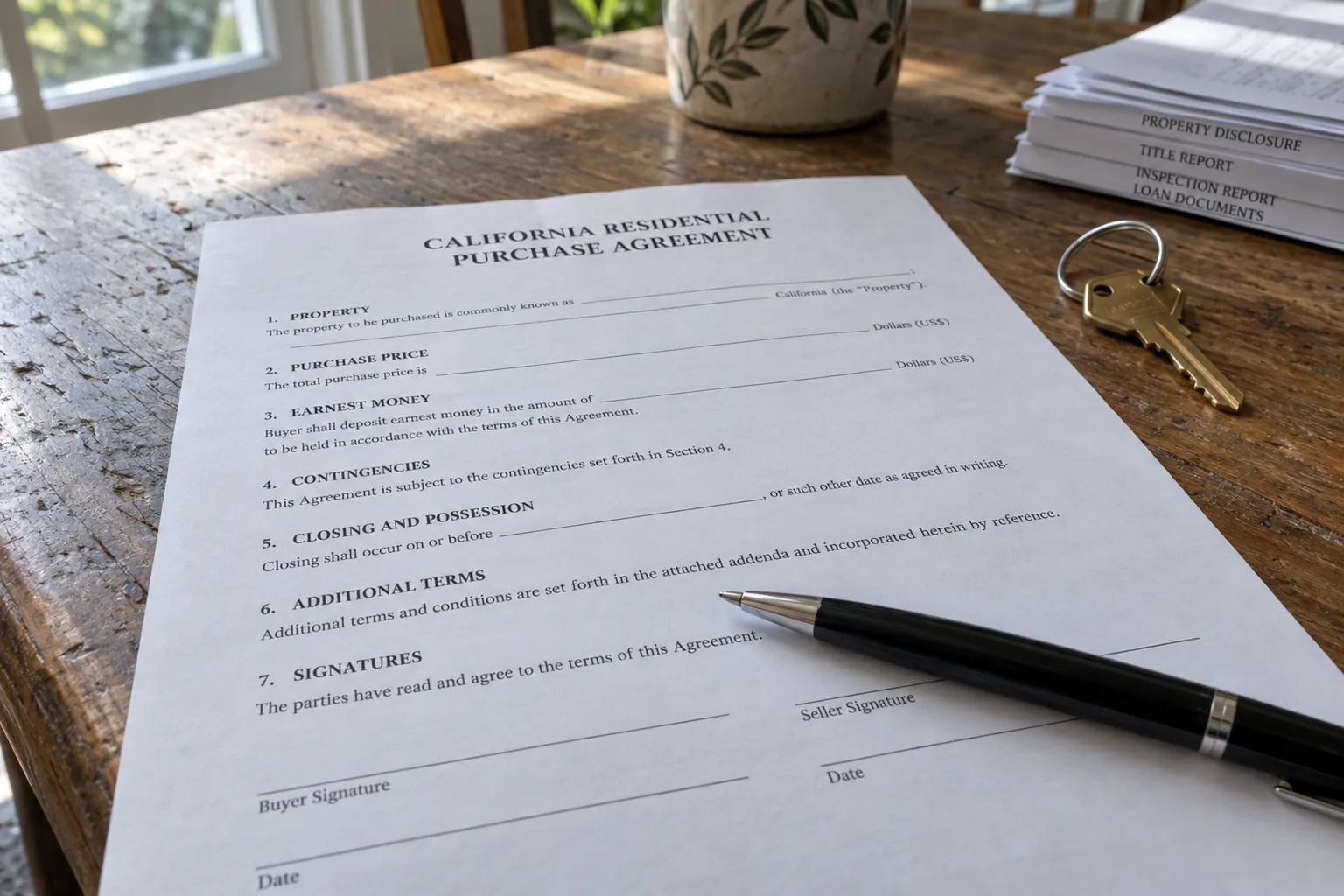
The Condition of Property on Closing provision says that unless otherwise agreed, the property is delivered “As-Is” in its PRESENT physical condition as of the date of Acceptance. It has to be kept in much the same condition it was in on that date, pool and landscaping included, and the seller has to clear out debris and personal property by close of escrow. That is the whole of the seller’s condition promise.
The form even defines the term for you. Under its definition of the as-is condition, the seller discloses known material facts and defects, the buyer has the right to inspect and, within the time specified, request repairs or exercise contingency cancellation rights, and the seller is only required to make the repairs specified in the agreement or otherwise agreed.
Read that twice. The seller was never promising a house in good condition. What the inspection contingency protects is not repair. It is the ability to leave.
The form itself tells the buyer to investigate
The purchase agreement does not treat investigation as optional, and it uses the word “strongly.”
The printed text: “Buyer is strongly advised to conduct investigations of the entire Property in order to determine its present condition. Seller and Agents may not be aware of all defects affecting the Property or other factors that Buyer considers important. Property improvements may not be built according to code, in compliance with current Law, or have had all required permits issued and/or finalized.”
The contingency table on the front carries its own view of the offer-stage version: “Removal or Waiver at time of offer is against Agent advice.”
None of that is our opinion. It is the printed position of the standard form both sides are signing, which is worth pointing out to a buyer who has been told the contingency is a formality. A waiver is still theirs to make. It is just not one the form describes as routine.
A waiver gives up the exit, and the deposit is what stands behind it
A waiver costs the contractual right to cancel over whatever the investigation would have found, and the deposit is what makes that right worth something.
How the period runs and how a contingency is actually removed is a separate subject, and the clock does not remove a California contingency the way most people assume covers it properly. This piece is about the decision.
What the waiver gives up is the Buyer’s Investigation right with a cancellation right attached to it. The investigation right itself is broad. The form lets the buyer conduct inspections, investigations, tests, surveys and other studies at the buyer’s expense, and names a general home inspection, a lead-based paint inspection, and a wood destroying pests and organisms inspection prepared by a registered Structural Pest Control company, among others.
The pest report has printed limits that surprise people. It covers the main building and attached structures and may cover detached structures. It does not include roof coverings, and it does not include water tests of shower pans on upper level units unless the owners of the property below the shower consent. What the WDO report actually says, and what Section 1 and Section 2 mean is the fuller version.
The form also states that buyer investigations do not include an assessment of the availability and cost of homeowner’s, flood or fire insurance. In much of California those are now the harder questions, and no inspection answers them. Which report answers which question sorts out who prepares what.
The deposit is the number, and the 3 percent cap has conditions
If a buyer walks after waiving, the deposit is what is exposed, and the ceiling on that exposure is 3 percent, but only if the liquidated damages provision was actually initialed.
The provision is operative only “By initialing in the space below,” and it carries separate initial lines for buyer and seller. Blank initials mean the clause is not in play. People sign around this line more often than you would expect.
Where it is initialed, it reads that if the buyer fails to complete the purchase because of the buyer’s default, the seller retains the deposit actually paid as liquidated damages, and that where the property is a dwelling of no more than four units with one of them intended for the buyer’s occupancy, the amount retained is no more than 3 percent of the purchase price, with any excess returned to the buyer. California Civil Code section 1675 is the statute underneath that, and it works the same way: below 3 percent the provision is valid unless the buyer proves the amount unreasonable, and above 3 percent the party defending the clause has to establish it was reasonable, judged on the circumstances when the contract was made and on any resale within six months of the default.
Then the practical part, which matters more than the cap. Release of those funds requires mutual, signed release instructions from both sides, a judicial decision, or an arbitration award. A buyer who is completely in the right can still spend months watching that money sit in escrow.
One adjacent trap is worth knowing. A large deposit does not automatically become the liquidated damages amount, because the form requires buyer and seller to sign a separate liquidated damages provision incorporating any increased deposit at the time it is made.
We inspect houses. We do not practice law, and a deposit fight is a conversation for an attorney.
The inspection contingency may be the wrong one to give up
Three separate contingencies are usually in play, and dropping the inspection one is not automatically the cheapest way to make an offer stronger.
The form runs separate lines for the loan, the appraisal, the investigation of property, insurance, seller documents, the title report, common interest disclosures, and leased or liened items such as solar panels. They are not a single switch.
If “No loan contingency” is checked, obtaining the specified loan is not a contingency of the agreement, and if the buyer does not get it and cannot buy as a result, the form says the seller may be entitled to the buyer’s deposit or other legal remedies. If “No appraisal contingency” is checked, the buyer cannot fall back on the loan contingency to cancel when the only reason for not obtaining the loan is that the appraisal came in below the contract price, provided the buyer is otherwise qualified and can meet the lender’s non-appraisal conditions.
Here is the comparison nobody makes out loud. An appraisal waiver costs cash at closing, and it is a number you can calculate in advance from what you have in the bank. An inspection waiver costs an unknown, because by definition nobody has looked yet. Buyers treat the two as interchangeable ways to sweeten an offer. They are not remotely the same bet.
A brand new house is its own case, and not the safe one people assume. Why new construction still earns an inspection sets out what turns up on a first-owner walkthrough.
Four ways to compete without waiving blind
Each of these gives a seller most of what a waiver signals, and none of them requires buying a house nobody has looked at.
Inspect before you write. Nothing stops a buyer from inspecting during the listing period with the seller’s cooperation, and an offer written afterward can waive knowingly instead of blindly. The cost is real: you are paying for an inspection on a house you may not get. Buyers working San Francisco or Oakland should be asking for that access well before the offer deadline, not the night before.
Shorten the period instead of removing it. A three or five day investigation period reads very differently to a seller than seventeen, and it keeps the cancellation right alive. That only works if the inspection is bookable and reportable inside the window, which is the entire reason same-day reporting exists. Ours lands within 6 to 8 hours. If you are compressing the period, get the appointment booked before the offer goes in.
Read the seller’s pre-listing report, then decide. More California sellers now put an inspection report into the disclosure package, and that is real information a buyer can act on before committing. The caveat is equally real. The seller ordered it, it carries a date, and a buyer is still entitled to their own look. How to read a report you did not order is worth doing before treating it as your inspection.
Waive, and then inspect anyway. The form carries a separate Informational Access to Property line printed right alongside the contingencies: “Buyer’s right to access the Property for informational purposes is NOT a contingency, does NOT create cancellation rights, and applies even if contingencies are removed.” A buyer who has already waived still gets to find out what they bought while there is time to price the work and line up trades, rather than discovering all of it in week three. For anyone who has never sat through one, what the appointment actually looks like takes the mystery out of it. Arranging that access in Berkeley or Walnut Creek works best in writing.
Three things a waiver cannot reach
Waiving the inspection contingency does not waive the disclosure clocks, the statutory disclosures, or the final walkthrough.
The form states that waiver of the statutory disclosures, the lead disclosures, the home fire hardening disclosure and the defensible space disclosure is prohibited by Law. A qualifying disclosure delivered after the offer is signed carries its own written termination right, 3 days after delivery in person or 5 days after delivery by mail or by a qualifying electronic record, and that clock runs separately from everything else in the file. Final Verification of Condition still happens, printed at 5 days prior to close of escrow.
The wider disclosure stack keeps growing, and what changed for agents this cycle is the current map of it. The full mechanics of the contingency clocks live in the companion piece. One housekeeping note: the current form is revision 7/24, and paragraph numbering moves between revisions, so check the revision date printed at the foot of the page you are holding rather than trusting a number somebody quoted you.
Two obligations that come with using the contingency
The investigation right is not free, and the form attaches two duties to it that buyers almost never hear about before they sign.
The first is delivery of reports. The buyer must give the seller, at no cost, complete copies of all investigation reports obtained, by the time specified or within 3 days after receiving the report, whichever is later, and that obligation survives termination of the agreement. So a buyer who inspects, finds something serious, and cancels has handed the seller a report the seller now holds for the next buyer.
The second is indemnity. The form requires the buyer to keep the property free and clear of liens, to repair all damage arising from the buyer’s investigations, and to indemnify and hold the seller harmless from all resulting liability, claims, demands, damages and costs.
There is a hard limit on the investigation itself, too. Without the seller’s prior written consent, a buyer may not make invasive or destructive investigations, with a narrow carve-out for the minimally invasive testing needed to prepare a pest control report, which itself may not include holes or drilling through stucco or similar material. That constraint is exactly why a mold sample answers a narrower question than people expect when the wall cannot be opened.
A full contingency does not entitle a buyer to take the house apart. Knowing that changes what the waiver is really costing, in both directions.
Quick answers
If I waive, can the seller refuse to let me inspect at all?
The informational access line says the right to access the property for informational purposes is not a contingency and applies even if contingencies are removed. It creates no cancellation rights, and the practical terms still get arranged with the listing side, so put the request in writing early.
My agent says as is means I should not bother inspecting. Is that right?
No. As is describes the condition the property is delivered in and the limits of the seller’s repair obligation. The same form strongly advises the buyer to investigate the entire property.
How much of my deposit is really at risk?
It depends on the signed agreement, the deposit actually paid, whether the liquidated damages provision was initialed, and the type of property. For a qualifying one to four unit dwelling with that provision properly initialed, the form limits what the seller retains to no more than 3 percent of the purchase price. The money can still sit in escrow until both sides sign release instructions or a court or arbitrator decides.
Is it better to waive the appraisal contingency or the inspection contingency?
There is no universal answer, but the two risks are shaped differently. An appraisal waiver creates a known cash obligation if the value comes in short. An inspection waiver leaves an unknown physical condition in a house nobody has examined.
Can I put the inspection contingency back once I have waived it?
Not on your own. A signed contract changes by agreement, so restoring a contingency takes the seller’s written agreement. An access appointment does not quietly restore a cancellation right.
The honest summary
As is was already the deal. The waiver is about the exit, the deposit is the number standing behind that exit, and the 3 percent cap only does its work if somebody initialed the right line.
The decision gets defensible when there is information behind it. Inspect before writing, shorten the period to something an inspector can work inside, read the seller’s report properly, or waive and use the informational access line to find out what you bought. The version that goes badly is always the same one. Nobody looked, the right to leave was gone, and the condition became the buyer’s problem in week three.
Before the offer goes in, ask the listing side for access, confirm an inspector can report inside the period you are proposing, and check the deposit line and the liquidated damages initials on the form in front of you. Then choose a risk you can describe out loud.
What an Inspection.re inspection includes sets out what a compressed timeline still buys you, the questions buyers ask most often cover the scope boundaries, and the way the findings are laid out is built for reading against a deadline.
One thing a compressed timeline does not buy you is the buried lateral, because that sits outside the standard scope whatever the deadline looks like. When a sewer scope is worth adding covers where that gap actually costs buyers money. And if a seller has waved a clean mold result at you to justify a short window, read what those results are actually capable of showing first.
What a Seller Gains by Inspecting First. Why some listings arrive with a report already attached, and what that changes about the offer you write.
The HOA Package You Have to Request. On a condominium, twelve months of board minutes arrive only if somebody asks, and a shortened window is exactly when nobody does.
Records That Move Slower Than Escrow. County environmental health files and CalRecycle facility records are the clearest example of a question a compressed timeline simply cannot answer.