A dish on a dresser has not diagnosed the house
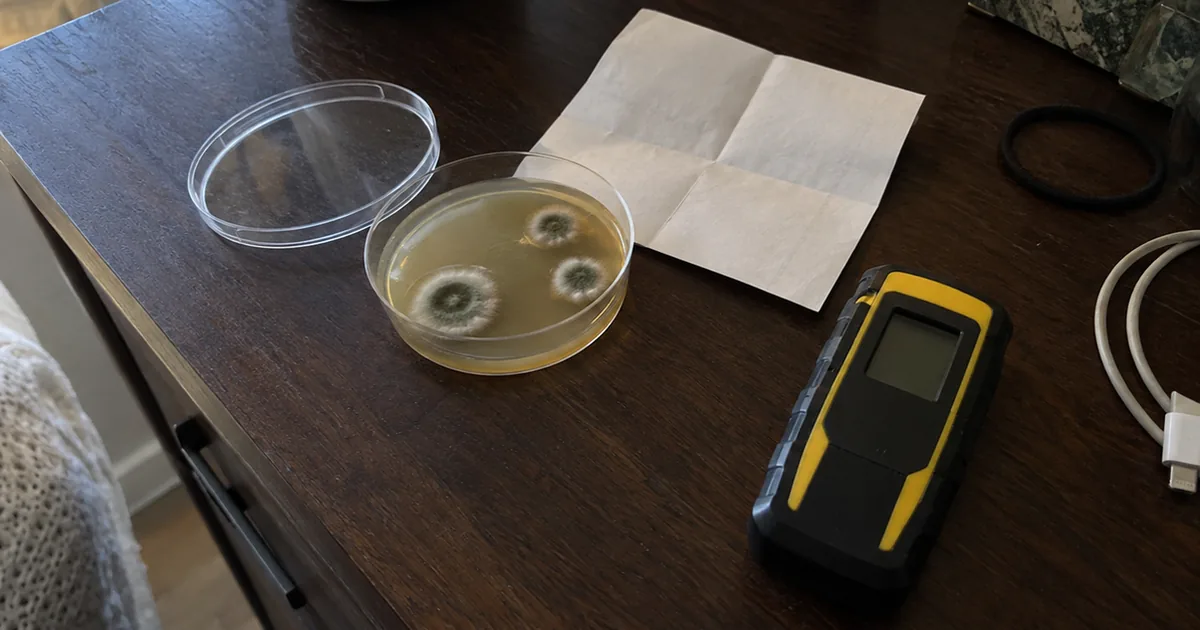
A buyer meets us at the front door holding a phone. On the screen is a photograph of a plastic petri dish with three fuzzy colonies on it, taken after the dish sat open on a bedroom dresser for two days. The question is always the same. Does this house have mold?
The honest answer is that the dish has not told us anything yet. What it has done is confirm that a building in California contains living fungal spores, which was never in doubt.
Meanwhile, the pinless moisture meter is reading high along the base of the wall under that same bedroom window, and the infrared camera is showing a cool band about eighteen inches up from the floor that stops exactly where the window trim starts. That is the finding. The dish is not. This is a composite of a situation we meet regularly rather than any one identifiable job, and it is worth walking through carefully, because the kit is cheap, the packaging is confident, and the conclusion people draw from it is usually wrong in one direction or the other.
What a home mold test kit actually measures
It measures what settles onto a dish, and nothing else.
The consumer kit is a shallow plastic dish filled with a nutrient growth medium. You open the lid, leave the dish exposed in a room for some stated period, close it, and wait several days for colonies to appear. Some kits stop there. Others invite you to mail the dish to a laboratory for an additional fee.
That is a gravity sample. It collects whatever happens to settle out of the air in one spot, over a period nobody controlled, at whatever temperature and humidity the room happened to be that afternoon. It does not sample a known volume of air. There is no pump, no flow rate, no calibration, so nothing that grows on it can be expressed as a concentration of anything. A colony count is a count of colonies on a dish. It is not a number per cubic meter of air, and it cannot be turned into one afterward.
The method is also selective in a way the box does not explain. Only fungi that are alive, and that will grow on that particular medium at room temperature, will ever show up. Anything that will not grow under those conditions is invisible to the test, including material that is dead and still capable of causing a problem for a sensitive occupant.
And there is no outdoor control. A professional air sample is taken in pairs, indoors and outdoors on the same day, because the whole exercise depends on comparison. The dish on the dresser has nothing to be compared against.
The dish was always going to grow something
Growth was the expected result, not the finding.
The EPA puts it plainly in its guidance for homeowners: “It is impossible to get rid of all mold and mold spores indoors; some mold spores will be found floating through the air and in house dust.” Open a dish of nutrient medium in any building anywhere and some of that material will land on it. Leave one open in a newly built house with no water intrusion at all and you will still get colonies.
So a positive result carries almost no information on its own. Three colonies do not establish a building condition. Thirty do not establish one either, because without a measured air volume and an outdoor comparison there is no way to say whether that number is unusual for that room, that season or that neighborhood.
The color is not a reading either. People photograph a dark colony and assume the worst, and we understand why, but the appearance of a colony on a nutrient plate tells you very little about what is growing behind a wall.
The question that does carry information is the physical one. Is there moisture in this building, where did it come from, and has it damaged anything?
There is no number for the house to fail
No test, cheap or expensive, can tell you that a house passed.
The EPA is explicit about this too: “Standards or Threshold Limit Values (TLVs) for airborne concentrations of mold, or mold spores, have not been set.” There are no federal regulations or standards for airborne mold contaminants. That is not an oversight anyone is about to correct. It reflects a genuine scientific position that spore counts do not map cleanly onto health outcomes.
Which removes the central promise implied by most kit packaging. A dish can produce colonies. A laboratory can identify what grew. Neither can compare the result to a pass line, because there is no pass line to compare it to.
The same limit applies at the expensive end of the market. Professional sampling produces better information about the air. It still cannot issue a verdict on a house.
The corollary matters just as much and gets less attention. A clear dish does not prove a house is dry. The plate may have sat in the wrong room, or been exposed at the wrong time, or simply failed to grow what was actually present. We have walked into houses with an active leak behind a shower wall and a perfectly clean test result on the kitchen counter.
What hiring somebody actually buys you
Control, calibration and a same-day outdoor comparison. Not a verdict.
Professional air sampling runs a pump at a known flow rate for a known time, which is what allows a result to be expressed per cubic meter. A paired outdoor sample is collected the same day, because the indoor number only means anything against the outdoor one. Then a laboratory analyzes it and somebody who has done this before interprets it. EPA’s guidance is that “sampling for mold should be conducted by professionals who have specific experience in designing mold sampling protocols, sampling methods and interpreting results,” and that is a fair description of the gap between that process and an open dish on a dresser.
We have already written about the professional end of this in detail, and the two pieces are deliberately different. Our companion article on what air sampling and surface sampling each actually answer is about laboratory method: which technique answers which question, and what California’s own health department says about the value of measuring at all. This article is about the product on the hardware store shelf and the decision a buyer makes standing in front of it.
Professional sampling has a firm ceiling even so. EPA notes that “in most cases, if visible mold growth is present, sampling is unnecessary,” and that surface sampling is most useful for determining whether an area has been adequately cleaned after remediation. That is a narrow, specific job. It is not the same as asking whether a house is safe.
California law looks for visible growth, not a spore count
California’s mold statute is a habitability standard enforced by code officials, and it has nothing to say about spore counts.
Senate Bill 655, signed in October 2015 and effective January 1, 2016, added visible mold growth to the list of substandard conditions in Health and Safety Code section 17920.3, treating it as a form of inadequate sanitation. The language it added covers “visible mold growth, as determined by a health officer or a code enforcement officer,” and excludes mold that is minor and found on surfaces that accumulate moisture as part of their properly functioning and intended use. In other words, the ring around a shower door is not a code violation.
The same bill added a definition of mold to Health and Safety Code section 17920: “microscopic organisms or fungi that can grow in damp conditions in the interior of a building.” Note what is absent from all of it. No numeric threshold. No sampling protocol. No test result of any kind. The determination is made by a person looking at the building.
That statute is aimed at rental housing and code enforcement rather than at a purchase inspection, and Civil Code section 1941.7 makes the rental framing clearer still: a landlord’s repair obligation for mold does not arise until the landlord has notice of the condition. A buyer is not a tenant and a home inspector is not a code enforcement officer. We report what we observe.
We do not practice law, and a reader with a genuine habitability or notice question should ask a lawyer rather than an inspector.
Where a kit is harmless, and where it does real damage
A kit is harmless as private curiosity and dangerous the moment money rides on it.
The obvious failure is taking a dish result into a negotiation. A photograph of colonies is not a repair estimate, a source, or a legal condition, and a seller’s agent will say so within about four seconds. You have spent credibility you needed for the findings that do hold up.
The expensive failure runs the other way, and it is the one we actually worry about. A buyer leaves a dish out, sees nothing grow, and quietly stops asking about the damp patch on the closet wall. The dish did not clear that wall. It was never capable of clearing that wall. But it felt like evidence, and it bought silence on the one question that was worth pursuing.
If the kit is already sitting on the counter, treat it as an observation and not a report. Keep the photograph if you like. Do not attach a pass, a fail, a cause or a dollar figure to it, and do not let it change what you ask us to look at.
We go looking for the water instead
The building tells you more than the dish does, and it tells you faster.
Our method is unglamorous and it works. FLIR infrared thermal imaging first, looking for temperature differences consistent with moisture behind finishes, because evaporating water reads cool. Then pin and pinless moisture meters to confirm whether the thermal pattern is actually wet or just a cold framing member. Then we trace it back toward a source: a failed shower pan, a flashing detail at a wall penetration, a crawlspace with no vapor barrier, a slab edge, a planter irrigated against a stucco wall for fifteen years. On a roof we fly it rather than guess, and we photograph the attic side of anything suspicious.
That sequence matches what the EPA actually recommends, which is that moisture control is the key to mold control, and that water-damaged materials should be dried within 24 to 48 hours to prevent growth in the first place. Find the water and the mold question usually answers itself.
Where the water comes from varies by region and by construction era, and it is worth knowing the local pattern before you tour. Coastal crawlspaces behave differently from inland ones, as our guide to marine layer moisture under raised foundations sets out. Areas with shallow groundwater bring moisture up from below rather than in from outside. And on newer stucco homes the usual entry point is a detail almost nobody looks at, which is why we wrote about weep screed and stucco terminations.
All of it lands in the same-day inspection report, with photographs, within six to eight hours of the visit. Our inspectors are InterNACHI Certified Professional Inspectors, and the standard package includes the infrared, the moisture meters, the drone roof pass and a 3D Matterport tour of the house.
Quick answers
Should I buy a kit before my inspection?
No. Put the money and the attention toward moisture and its source. If you want the test anyway, buy it after you know where the wet spots are, so it has an actual question to answer.
The kit grew something black. Should I be worried?
Not on that basis. Color on a nutrient plate is not a hazard rating. Tell your inspector where the dish was and what you noticed in that room, and let us go look at the wall.
The seller says a mold test came back clean. Is that enough?
No. Ask which method was used, whether an outdoor control was taken the same day, when it was done, and which rooms. A clean result from an uncontrolled method in the wrong room is not information. Our piece on what a general inspection covers and what needs a specialist walks through where these scopes divide.
Does a clear inspection report mean there is no mold?
It means we found no visible growth and no moisture readings above threshold in the accessible areas on that day. Mold spores are present in every building, per the EPA, so no report will ever say otherwise. Reading the difference between those two statements is most of the skill in interpreting an inspection report.
When in the escrow do I have to decide?
Early, because the clock is short and it runs from acceptance. The mechanics of that timeline are covered in our guide to how a California inspection contingency actually works, and if you are being pushed to give the contingency up entirely, read what a waiver actually costs first.
The honest summary
A home mold kit can prove that something grew on a dish in your house. It cannot tell you whether the house has a mold problem, and it cannot clear the house either.
We sell mold testing as a separate service, so we have every commercial reason to tell you to buy more testing. We would rather tell you the truth, which is that most buyers should spend the money on finding the water first. Testing earns its fee when there is a specific question behind it: verifying a completed remediation, investigating a complaint with no visible source, or documenting a condition for someone with a diagnosed sensitivity. Outside those cases it mostly buys a receipt.
That same standard applies to every add-on on the menu. We apply it to the other one buyers agonize over most, and our piece on whether a sewer scope is actually worth ordering says plainly which properties it earns its fee on and which it does not. Ask what question the money is buying an answer to. If there is no question, there is no answer worth paying for.
Start with what an inspection actually includes, check the detail of the standard package, read through the common questions buyers ask us, and book early enough that the findings arrive with time left on the clock. We work across the Bay Area from San Francisco and Oakland through the East Bay, and down the state through Los Angeles and San Diego.
Bring the photograph of the dish if you have one. Just do not bring it a conclusion.
Consumer test kits carry the same problem in the wildfire smoke context, where the question is composition rather than presence. See smoke damage in a house that did not burn for why the sampling method decides what a result can prove.