The buyer opens the video link at night on a phone. Ninety seconds of gray pipe. A dark ring. A picture that goes half underwater. Some white strands. Then the image stops moving.
They text their agent: “is this bad?”
The honest answer is that some of it is normal, some of it is a cleaning problem, and one part might be a structural problem. The video already tells you which is which if you know how to read it. This is a composite of situations we see, not one house.
Read the footage in three passes
First locate the camera. Then identify what you are seeing. Then judge how serious it is.
Watch it on a large screen. Detail is lost on a phone, especially when the camera is moving through water or passing a joint. It is the same pattern-first discipline we use for reading a thermal image from an inspection: name what is on screen before deciding what it means.
This is not a guide to deciding whether to order a sewer scope. We already cover whether a scope earns its fee for a California buyer. It is not a guide to how roots get into clay laterals either; that mechanism lives in our Santa Ana agent guide to root intrusion. This is about reading the footage already in front of you.
The first question is where the camera went
Under the InterNACHI Sewer Scope Inspection Standards of Practice, the scope covers the line “from the house at or near the foundation to the municipality’s or HOA’s tap or septic tank.”
That does not mean every video begins at the foundation or reaches the tap.
Access is from a proper cleanout or roof vent stack. The inspector notes if a cleanout is not visible or accessible. Under the standard, the inspector is not required to pull toilets, move personal items, climb a roof if unsafe, locate or mark defects, provide the length of the line, or scope underfloor or in-house portions.
Our service goes farther in two practical respects. Where there is no cleanout, we can enter through a pulled and reset toilet. Our camera head also carries a locator transmitter, so the position and depth of a finding can be marked on the surface.
The standard requires recording the entire video and providing it to the client. Your first reading task is simple: establish where the camera went in and whether it reached the tap or main.
If the video ends early, everything past the stopping point is unknown. It is not clear.
Older clay and cast iron laterals are common in places we work such as Santa Ana, Pasadena and Oakland. That does not tell you what is inside a particular lateral. The footage still controls what can be said about that line.
The distance counter turns a picture into a location
The footage counter tells you how far the camera head is from the access point. That is how a finding becomes a place on the ground.
Write down the counter reading every time the camera pauses at something that matters. Note whether the camera is moving toward the street, the house, or another access point. A finding at 12 feet from a cleanout is a different conversation from a finding at 62 feet, even if the screen looks the same.
NASSCO notes that PACP codes are entered with specific information such as percentages or clock positions. Clock position describes where around the pipe circumference a condition sits.
12 o’clock is the crown. 6 o’clock is the invert, the bottom where water runs.
A crack at 12 o’clock and a crack at 6 o’clock are not the same problem. The counter tells you where to look on the ground. The clock position tells you where to look inside the pipe.
A sewer scope is easier to discuss when the buyer, agent and plumber are looking at the same frame. “There was a bad spot somewhere in the video” is not a useful handoff. “At 38 feet, near 6 o’clock, the camera passes a visible opening” is.
A material change may be a feature, not a defect
Not everything assigned a PACP code is a defect.
NASSCO’s February 2018 Tech Tip, “Using GIS to Map PACP Data,” separates structural defect codes from operational and maintenance, or O&M, defects. It also identifies non-defective construction features and miscellaneous codes, including lateral locations, pipe material and size changes.
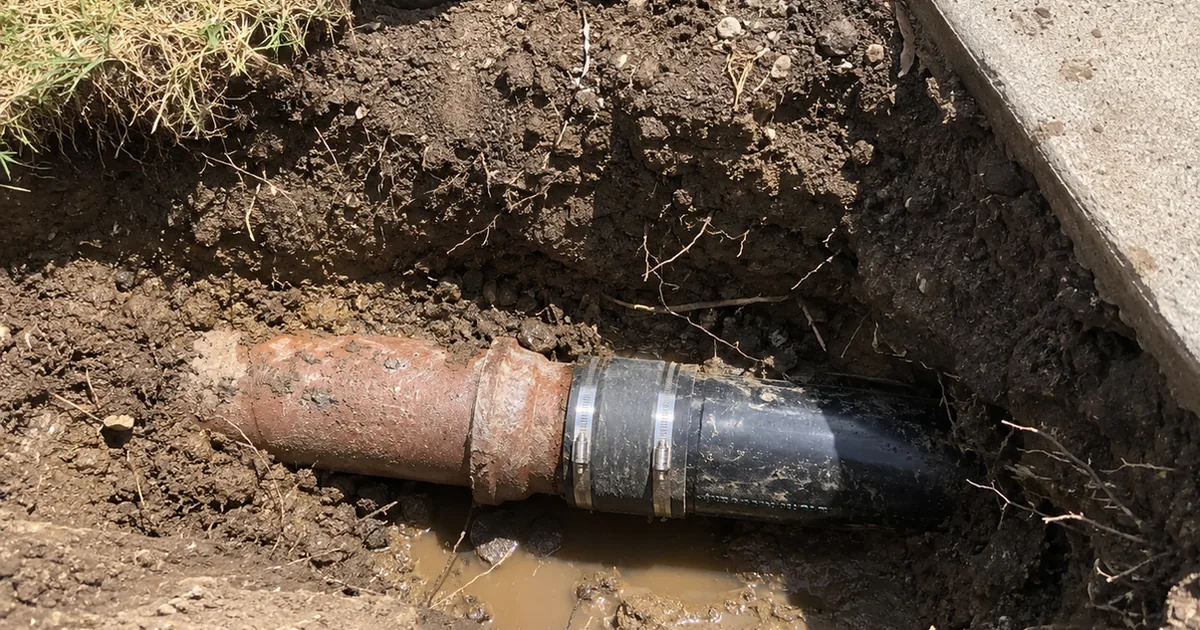
That distinction matters because buyers often panic at a change from clay to plastic pipe. A branch connection coming in from the side can also look like an intrusion or an opening when the camera approaches it.
A change from clay to plastic is a construction feature. A side connection is a construction feature. Note it. Do not call either one a structural failure without seeing a separate condition.
This is the first pass through the footage. Ask, “Is this a defect at all?” Do that before asking whether the defect is severe.
Roots and grease belong to the cleaning question first
Roots look like fine hair or a mat hanging at a joint. Grease looks like soft buildup at the water line. Scale in old cast iron narrows the bore, the same corrosion story we trace inside the house in our guide to galvanized supply and cast iron drain lines.
These are O&M findings. NASSCO describes O&M defects as conditions typically managed through jetting, cutting and reaming.
InterNACHI’s standard lists visible cracks, root intrusion, offsets over 1/4 inch, standing water over 1 inch, blockage or restriction, crushed, broken, separated or disconnected line, excessive rust or scale, excessive grease, deteriorated concrete, an egg-shaped line, a collapsed line, and delamination or deterioration among reportable conditions.
Roots enter through a gap. That means a root finding is also a question about the joint behind it. The roots are not the whole finding if they hide the pipe wall.
If roots or grease conceal the wall, the useful next step is a re-scope after cleaning. Hydro-jetting can clear the material so the structure underneath can be seen. Then decide whether the joint is open, whether the pipe is cracked, and whether the camera can continue.
If the wall is visible behind the roots or grease and there is no opening, the footage supports a cleaning question first. If the wall cannot be seen, the structure remains unknown.
We run sewer scopes as an add-on alongside the general inspection, with recorded footage and written findings in the same-day turnaround, within six to eight hours of the visit. Book a sewer scope with your inspection or call 1-888-88-INSP-9.
The crack becomes more serious as the pipe opens and moves
NASSCO’s Pipeline Assessment and Certification Program, or PACP, was developed with the Water Research Centre in Swindon, England. PACP assigns each defect a condition grade from 1 to 5. Grade 5 is the most significant. Grade 1 is a minor defect grade.
The grade comes from the PACP code, not from the operator’s opinion.
The ladder is easiest to see through one worked example. A single crack that is not visibly open and runs lengthwise is coded Crack Longitudinal, or CL, grade 2. If it becomes visibly open, it is Fracture Longitudinal, or FL, grade 3. If the pieces are displaced, it is Broken, or B, grade 4. If soil or a void is visible behind the broken pipe, the condition is grade 5. BSV means soil visible. BVV means void visible.
While watching, look for the step from a line on the pipe, to an opening, to pieces out of place, to dirt or a hole behind the pipe.
Two other structural patterns appear often.
An offset is a visible lip or ring at a joint where one section sits lower than the other. The camera may bump over it. InterNACHI identifies an offset over 1/4 inch as a reportable condition.
A belly is different. The picture goes underwater and later re-emerges. That indicates the pipe has lost slope and holds water. InterNACHI identifies standing water over 1 inch as a reportable condition.
A brief view of water at the bottom is not automatically a belly. The question is how much water remains and whether the camera later emerges from it.
A PACP grade does not decide replacement
PACP gives you a vocabulary. It does not give you a repair order.
NASSCO’s June 2016 Tech Tip, “PACP Condition Grades and Their Proper Application,” states that the grading system cannot account for material, changes in loading, voids and other external pipe conditions. Condition grade alone is inadequate for determining whether a pipe segment should be replaced or rehabilitated.
“The condition grades cannot take the place of an engineer’s judgement.”
A home purchase scope under the InterNACHI standard is not required to use PACP coding. PACP is what municipal crews use. Borrowing its logic helps you sort what you are seeing, but a PACP equivalent is not an engineering conclusion.
The scope also records condition on the day. It does not predict remaining life.
A liner follows the pipe it is installed in. It generally does not lift a belly. That is why a sag or a badly offset joint tends to push a bid toward excavation. The repair method is the plumbing contractor’s call.
For a repair opinion, use the right license. Sewer lateral repair is commonly C-36 Plumbing, and our guide to matching each inspection referral to a CSLB license class explains why that matters.
A sewer line repair plan sold on a utility bill is not a camera either. The footage and the physical condition of the lateral remain separate questions, whatever a plan document says.
Use the frame and the category before asking for a bid
The table below is a sorting tool. It does not replace a plumber’s opinion, an engineer’s judgment, or a re-scope when the pipe wall is hidden.
| What you see | Category | Reasonable next step |
|---|---|---|
| Material change or side connection | Construction feature | Nothing, note it |
| Roots or grease with pipe wall visible behind it and no opening | O&M | Cleaning, then decide whether to re-scope |
| Roots or grease hiding the wall | O&M, structure unknown | Re-scope after cleaning before deciding |
| Crack, not open | Structural, low grade, PACP 2 equivalent | Note it and ask a plumber’s opinion |
| Open fracture or displaced pieces | Structural, PACP 3 or 4 equivalent | Get a repair bid inside the contingency period |
| Soil or void visible, collapse, or camera cannot pass | Structural, PACP 5 equivalent | Treat as urgent. Everything beyond is unknown |
| Standing water over 1 inch or offset over 1/4 inch | Reportable under InterNACHI | Ask whether it is a belly or an offset and get a bid |
The last row requires care. Standing water over 1 inch is not the same visual condition as an offset over 1/4 inch. One may indicate lost slope. The other is a misaligned joint. Ask which condition is present and where it is located.
A camera that cannot pass is its own important finding. The obstruction may be a maintenance condition, a structural condition, or both. Until the camera gets beyond it, the downstream line is unknown.
Five questions belong on your escrow checklist
Ask these before the contingency period ends.
- Where did the camera go in, and did it reach the tap or main?
- At what counter readings are the findings?
- Is anything a construction feature rather than a defect?
- Do roots or grease hide the wall, and should the line be re-scoped after cleaning?
- Who is giving the repair bid, and what license do they hold?
The first question sets the boundary of what was actually inspected. The second gives a contractor a location. The third prevents a material change or side connection from being treated as damage. The fourth separates a cleaning question from an unanswered structural question. The fifth identifies who is making the repair recommendation.
Our walkthrough of how the California inspection contingency clock runs helps when setting those deadlines. A scope that ends before the tap cannot answer what lies beyond the stopping point, and a re-scope after cleaning needs time on the calendar.
Four questions buyers ask after watching the footage
Is any root intrusion a deal-breaker?
No. Root intrusion is an O&M finding that points to a joint gap. What matters is the structure behind it. If the roots obscure the wall, clean the line and re-scope it before deciding.
Does standing water always mean a belly?
Not always. A little water at the bottom is normal flow. The InterNACHI reporting threshold is standing water over 1 inch. Watch whether the camera goes underwater and later re-emerges, then ask whether the condition is a belly or something else.
Can I get the video file?
Yes. The standard requires the full video to be provided to the client. Ours comes with the written findings.
Does the general inspection cover the lateral?
No, by written standard. The buried lateral sits on the far side of the line we draw in what a home inspection covers and what needs a specialist.
Read the stopping point as carefully as the defect
A sewer scope is a record of what the camera reached on the day of the inspection. It can show a construction feature, a maintenance condition, or a structural defect. PACP grades help describe the progression from a closed crack to an opening, displaced pipe, and visible soil or void, but they do not decide repair or replacement.
Before the contingency period ends, save the full video, record the access point and every counter reading, identify anything hidden by roots or grease, and get the right contractor’s opinion for an open fracture, displaced pieces, soil, a void, collapse, a belly, or an impassable camera.
If you are booking now, see what our standard inspection includes, the questions buyers ask us most, and a sample of our same-day inspection report.