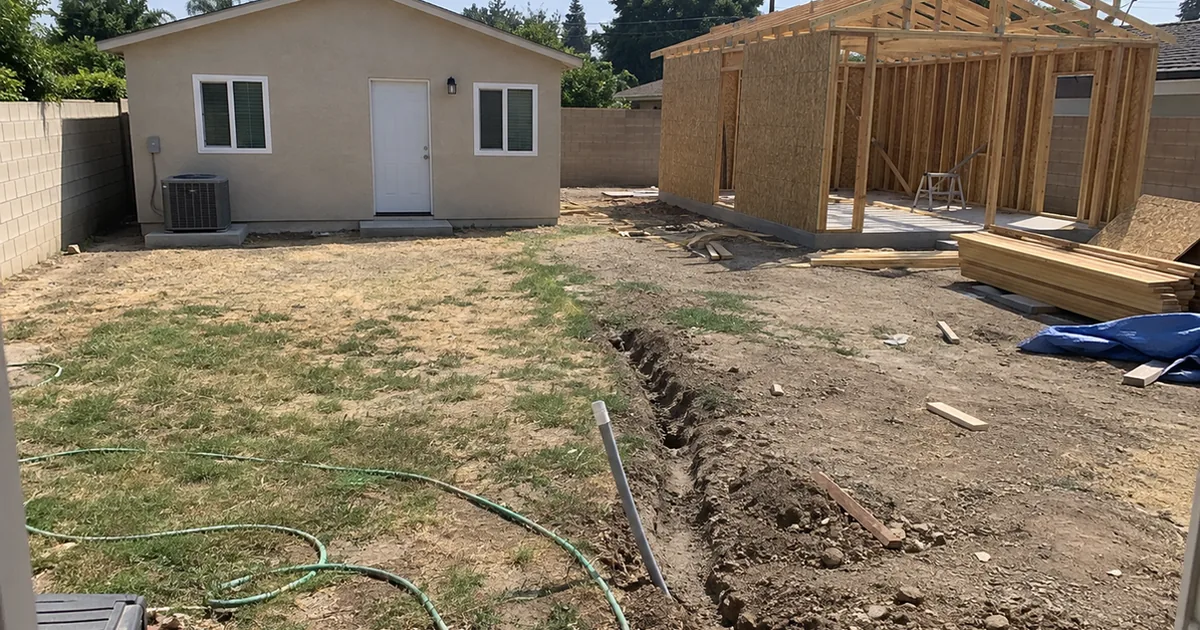
A listing advertises “room for a second ADU.” In the backyard, one detached ADU is complete and a second one is half framed. The buyer asks whether the new law makes that second unit automatically legal.
No. The law guarantees a path to ministerial permit approval. It does not turn completed work into permitted work. Permit history still decides what is legal.
That distinction matters on ordinary inspections. A finished unit can have clean drywall, working lights, and a kitchen that looks brand new. None of that tells you whether the city or county approved it. We report visible conditions and flag permit questions. You pull the records.
AB 956 lets a single-family lot carry two detached ADUs starting January 1, 2027
AB 956 takes effect January 1, 2027, because the Governor approved and filed it on September 29, 2026, without an urgency clause.
Assemblymember Sharon Quirk-Silva authored the bill, titled “Accessory dwelling units and junior accessory dwelling units.” It is Chapter 791, Statutes of 2026. The Governor included it in the September 29 housing bill signing release.
AB 956 amends Civil Code Sections 714.3 and 4751 and Government Code Section 66323. The change most buyers and agents will notice is in Government Code Section 66323.
Before AB 956, the ministerial approval list covered one detached, new construction ADU on a lot with a proposed or existing single-family dwelling. Starting January 1, 2027, paragraph (a)(2) covers:
“Two detached, new construction, accessory dwelling units that do not exceed four-foot side and rear yard setbacks for a lot with a proposed or existing single-family dwelling.”
That means a qualifying single-family lot can carry the primary house and two detached ADUs. The law brings detached ADUs in line with the two-unit treatment already available for attached ADUs, according to California YIMBY.
Brian Hanlon, CEO of California YIMBY and a supporter of the bill, called ADUs “a singular success story in California, as homeowners rush to build these popular, convenient, and affordable homes.”
Ministerial approval still comes with four-foot setbacks and size limits
Ministerial approval guarantees a permit review without a discretionary hearing, but it does not remove the physical limits in the statute.
For these two units, a city or county cannot require side and rear yard setbacks of more than four feet. A local agency may still impose a total floor area limit of no more than 800 square feet of livable space on each unit. The local agency may also apply the height limits in Government Code Section 66321.
For a detached ADU on a lot with a single-family or multifamily dwelling, the height limit is 16 feet. The limit is 18 feet if the lot is within one-half mile walking distance of a major transit stop or high-quality transit corridor. The limit is also 18 feet on a lot with a multifamily, multistory dwelling.
“Two detached ADUs” does not mean two structures of any size, placed anywhere the owner chooses. Four feet is a ceiling on what the city can demand, which is exactly why walls, roof edges, and utility equipment end up so close to the fence. The 800-square-foot figure is the cap a city may apply to each unit on this route.
There is another approval route in paragraph (a)(1). That provision remains one ADU and one junior accessory dwelling unit, or JADU, per lot, created within the proposed or existing space of the house or an accessory structure. It allows up to 150 square feet of expansion beyond an existing accessory structure, exterior access, and side and rear setbacks “sufficient for fire and safety.”
These are separate paths. A garage conversion or other existing-space project is not the same thing as two new detached structures. For a garage conversion, the fire separation questions can be different. The Fontana garage dwelling fire separation guide covers that issue from an agent’s point of view, and our Van Nuys guide to unpermitted additions and garage conversions shows the permit questions that come with them.
Two detached ADUs can cost the lot its guaranteed JADU
A lot with two detached, new construction ADUs is no longer guaranteed a JADU under the same ministerial approval rule.
AB 956 adds this trade-off: “A local agency is not required to ministerially approve an application for a building permit to create a junior accessory dwelling unit on the same lot where two detached, new construction, accessory dwelling units have been constructed.”
In plain terms, the lot can carry the house plus two detached ADUs, but the owner cannot assume the lot also gets a guaranteed JADU.
This is easy to miss in a listing description. “Three units possible” may refer to two detached ADUs plus a JADU, but AB 956 does not guarantee that combination after two detached ADUs are constructed.
Ask what the seller means. Is the third space a proposed JADU? Is it inside the house or an accessory structure? Is it a detached new construction unit? Are there permits for the existing work? The answer changes which statutory path is being discussed.
A room labeled “bedroom” also needs its own review. Bedrooms in ADUs still need egress. A buyer should not assume that a room is a legal bedroom because it has a closet, a door, or a bed. The Fremont guide to non-conforming bedrooms addresses that inspection problem.
AB 956 expands some covenant protections, but it does not erase HOA rules
The covenant change is narrower than many headlines suggest: AB 956 changes which single-family zoning lots receive protection, while reasonable restrictions remain allowed.
Civil Code Section 714.3 already voided a covenant, restriction, or condition in a deed, contract, security instrument, or other instrument that effectively prohibited or unreasonably restricted an ADU or JADU. Its reasonable restrictions exception already excluded “any fees or other financial requirements.” That sentence came through AB 130, effective June 30, 2025.
Civil Code Section 4751 already provided similar treatment for planned developments and their governing documents on the homeowners association side.
AB 956 changes both statutes from a lot “zoned for single-family residential use” to a lot “zoned to allow single-family residential use.” That reaches lots in zones where single-family use is allowed but is not the only allowed use. One example is a multifamily or mixed zone where a single-family house sits.
The change does not mean an HOA can never regulate an ADU. Reasonable restrictions remain permitted. A restriction is reasonable when it does not unreasonably increase the cost to construct, effectively prohibit, or extinguish the ability to construct an ADU or JADU. An HOA can still have reasonable architectural rules. It cannot impose a ban.
Read the chaptered text before relying on an online summary. Civil Code Section 4751 as chaptered still speaks of a “planned development.” Some summaries claim the change reaches every common interest development. The chaptered text we reviewed does not say that. Do not assume a rule for every condominium building. Ask HOA counsel about the governing documents and the project.
For a separate 2026 limit on HOA vetoes, see AB 1684 and HOA air-conditioning rights.
SB 1117 charges ADU impact fees only above 750 square feet
SB 1117 changes the impact fee calculation for up to two ADUs on a lot, and the new calculation applies only to the area above 750 square feet of interior livable space.
Senator Cervantes authored SB 1117. The Governor approved it on September 29, 2026. It is Chapter 809, Statutes of 2026, and it amends Government Code Section 66311.5. The law includes a statewide concern finding and applies to charter cities.
Under the existing rule, an ADU with 750 square feet of interior livable space or less is not subject to an impact fee. For an ADU above 750 square feet, the fee was charged proportionately to the square footage of the primary dwelling.
For up to two ADUs on a lot, SB 1117 changes the calculation. An ADU over 750 square feet is charged only on the area in excess of 750 square feet of interior livable space.
Illustration: an 800-square-foot ADU is assessed on 50 square feet rather than the whole 800 square feet.
The 750-square-foot number is not the same as the 800-square-foot ministerial floor area limit in AB 956. One number affects the impact fee calculation. The other is a possible local floor area limit for each detached ADU. Measured square footage matters for both conversations.
AB 956 does not allow a separate sale of an ADU
AB 956 leaves alone the general rule that an ADU may be rented separately but may not be sold or otherwise conveyed separately from the primary residence.
Government Code Section 66314, subdivision (d)(1), still says an ADU “may be rented separate from the primary residence, but shall not be sold or otherwise conveyed separate from the primary residence.” Narrow separate rules exist for condominium-style ADUs, so treat this as the general rule rather than an absolute one.
The new law also does not change the sprinkler provision. Under Government Code Section 66314, subdivision (d)(12), an ADU is not required to provide fire sprinklers if sprinklers are not required for the primary residence.
That means the absence of sprinklers in an ADU can be normal when the house has none. It is not, by itself, evidence that the unit is unpermitted. The applicable permit history and project conditions still matter.
AB 956 does not legalize an existing unpermitted ADU, finished or half built. A completed structure still needs its own record.
Two detached ADUs create visible utility and access questions
An inspection can identify conditions around two detached ADUs, but it cannot tell you whether either unit was permitted.
The four-foot side and rear strips often contain more than empty yard. We see eaves, gas meters, air-conditioning condensers, and water heaters crowded into that space. We note access and clearances. We do not survey property lines.
Electrical demand is another immediate question. Each added unit is a new load. We look at the main panel, the feeder or subpanel serving each unit, and whether the house service was upsized or simply tapped. Questions about panel capacity are flagged for an electrician. The Culver City older electrical panel guide explains why the panel deserves its own review.
Water and sewer connections can also serve more than one structure. Two ADUs often tie into one existing lateral. A California sewer scope is a separate service worth considering when the shared lateral is a concern.
We cannot tell you from looking at a unit whether the city or county approved it. We report what is visible and flag permit questions. The buyer pulls permit records from the city or county.
Inspection.re offers ADU inspections in markets including North Hollywood, where garage conversions and newer ADUs are common, and Baldwin Park, where there is heavy ADU and garage conversion activity. We also inspect ADU construction in Santee. Reports are delivered the same day with photographs. The inspection can include 3D Matterport, LIDAR floor plans, FLIR infrared as a moisture screening clue, and drone roof images.
LIDAR floor plans can help compare measured square footage with the 800-square-foot and 750-square-foot thresholds as a screening number. They are not a legal measurement. Inspectors are InterNACHI-certified. Here is what every inspection includes before any add-ons.
Agents should put six permit and utility questions in the file
Agents should document the units, permits, governing documents, measurements, and shared utilities before describing the property’s ADU potential.
-
Pull permits and finals for every unit. Do not rely on the seller’s description, an old listing, or the appearance of finished work.
-
Do not market “room for two ADUs” as approved. The future ministerial approval rule is not a permit for an empty portion of a lot.
-
Ask the HOA for current governing documents and any ADU rules. Read the actual documents, then ask HOA counsel about the project if the answer is not clear.
-
Check the JADU before assuming three units. Two detached ADUs can remove the guarantee of ministerial approval for a JADU on that same lot.
-
Note shared utility and sewer lines. Identify which panel, feeder, water connection, and sewer lateral serve each structure. Consider a sewer scope when the lateral is shared.
-
Get the measured square footage and compare it with the permits. Compare the measurement with the 800-square-foot and 750-square-foot thresholds, treating the result as a screening number rather than a legal determination.
Inspection.re also serves Garden Grove, where additions, conversions, and ADUs are not all permitted, and Los Angeles. You can see how our inspection report is laid out before you book.
Five answers cover most AB 956 questions
The short answers are direct, but each property still turns on its permits, measurements, zoning, and governing documents. Scheduling and scope questions are in our home inspection FAQ.
When does AB 956 take effect?
AB 956 takes effect January 1, 2027. The Governor approved and filed it with the Secretary of State on September 29, 2026. It has no urgency clause.
Does AB 956 legalize an existing unpermitted ADU?
No. It creates ministerial approval for qualifying new construction. It does not make an existing unpermitted ADU legal. Pull the city or county permit records.
Can my HOA still say no?
An HOA can still impose reasonable architectural rules and other reasonable restrictions. It cannot effectively prohibit or unreasonably restrict an ADU or JADU under the applicable covenant protections. Civil Code Section 4751 as chaptered still speaks of a planned development, so do not assume the rule applies to every common interest development without reviewing the text and asking HOA counsel.
Can I still add a JADU?
A JADU remains part of the existing-space approval path. But a local agency is not required to ministerially approve a JADU on the same lot where two detached, new construction ADUs have been constructed.
Can I sell an ADU separately?
Generally, no. An ADU may be rented separately from the primary residence, but it may not be sold or otherwise conveyed separately from the primary residence under Government Code Section 66314, subdivision (d)(1).
The permit record, not the backyard appearance, controls the next move
AB 956 makes two detached ADUs a ministerial approval category for qualifying single-family lots beginning January 1, 2027. It does not erase the four-foot setback ceiling, the local 800-square-foot cap, the 16-foot or 18-foot height limits, the JADU trade-off, or the permit record.
This is not legal advice. For a purchase or construction decision, review the chaptered statutes, the local records, and the governing documents with the appropriate city, county, or HOA counsel.
Do something different on the next ADU property. Pull permits and finals before calling a unit legal. Measure both detached structures before comparing them with the 750-square-foot and 800-square-foot figures. Ask whether the lot already has two detached ADUs before promising a JADU. Check the main panel, each feeder or subpanel, and the shared sewer lateral. If you need the visible conditions documented, call Inspection.re at 1-888-88-INSP-9.
Many backyard ADUs now arrive on a truck. The same September 29 signing changed the rules for those, too: AB 1815 and AB 2058 on factory-built housing.