When the word mold shows up in a report we wrote, the next phone call is usually about testing. A test is rarely the first move. The finding’s own words already say most of what happens next.
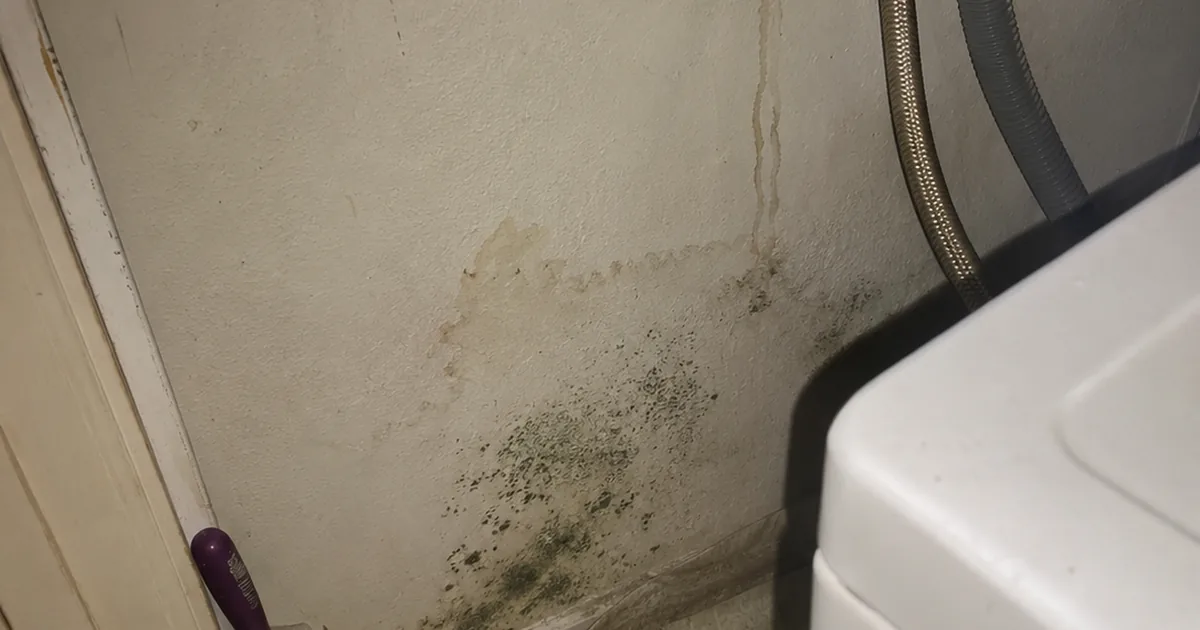
Your report may describe an old stain that was dry, an active leak, elevated moisture, suspected microbial growth, a musty odor, or a source no one could find. Those are different problems.
Match the wording to one of five situations, then match it to one call and one request, inside the contingency window. This is not legal or medical advice.
Read the exact words of the finding before you call anyone
The line in the report usually tells you three things: where the condition is, how wet the area was, and whether a source was found. Those three details decide the next step.
Our inspections are visual and follow the InterNACHI Standards of Practice. Those standards do not cover concealed or latent defects. A general home inspection is not a mold inspection, and it does not determine whether a substance is mold.
We report what we can see and measure. That may include visible suspected growth, staining, odor, moisture readings, and likely water sources. The wording matters. “Dry at time of inspection” is different from “elevated moisture.” “Source identified” is different from “source not determined.”
We carry a moisture meter and FLIR infrared. A thermal image shows a temperature difference. It does not show moisture, and it does not show mold. It tells us where to put the meter, which is why reading a thermal image comes before any mold test.
Our reports arrive the same day, within 6 to 8 hours. They can include a same-day report with findings tagged in place and a Matterport 3D tour. A buyer’s agent can send a contractor to the exact spot instead of describing a wall, room or ceiling from memory.
Look for these phrases:
- “dry at time of inspection”
- “elevated moisture”
- “active leak”
- “suspected microbial growth”
- “musty odor”
- “source not determined”
- the size and location of the affected area
A general inspection can describe the condition and point to the next question. It cannot answer every mold question. We explain what a general inspection can and cannot say about mold in a separate guide.
Five findings, five next calls
Most mold findings fall into one of five situations. Each one has a different first call and a different request to consider.
| What the report says | What it usually means | First call | Ask to consider on the request form |
|---|---|---|---|
| Old stain, dry at time of inspection, source identified | Water was there, and the material read dry that day | The seller, for paperwork on the past repair | Repair documentation, often no request at all |
| Active leak or elevated moisture, no visible growth | Water is getting in now | A licensed plumber or roofer for the source | Repair of the source by a licensed trade, then a dry re-check |
| Suspected growth on a small area with a known source | A patch under about 10 square feet next to a leak we found | The trade that fixes the source, then cleanup | Repair of the source plus cleanup, or a credit backed by a written quote |
| Suspected growth over about 10 square feet, after heavy water damage, from sewage water, or in the HVAC system | Bigger than a do-it-yourself job by EPA’s own guidance | An experienced mold remediation contractor, and possibly an assessment first | Professional remediation with post-remediation verification, a credit or price change, or a decision to cancel inside the contingency |
| Musty odor or staining with no source found, behind finished walls or floors | The water is hidden and the inspection reached its limit | A mold assessment professional or the right trade, which may need the seller’s written consent to open anything | Consent to further investigation, or more time in writing |
An odor-only finding may need a different path. Start with tracing a musty smell back to water.
If water arrives from outside after the first storms, see what the first rain shows.
For dampness under the floor, see what we check in a crawl space.
EPA’s 10 square foot line is about cleanup method, not about danger
EPA draws its size lines to choose cleanup methods. EPA says the lines are not based on health effects.
EPA’s “A Brief Guide to Mold, Moisture, and Your Home” says, “If the moldy area is less than about 10 square feet (less than roughly a 3 ft. by 3 ft. patch), in most cases, you can handle the job yourself”.
EPA also says, “If there has been a lot of water damage, and/or mold growth covers more than 10 square feet, consult EPA’s Mold Remediation in Schools and Commercial Buildings.” That guide focuses on schools and commercial buildings, but EPA says it “is applicable to other building types.”
Its Table 2 sorts remediation by total surface area affected:
- SMALL, less than 10 square feet
- MEDIUM, between 10 and 100 square feet
- LARGE, greater than 100 square feet
The same EPA page says the guidelines are based on the size of the affected area “not on the basis of health effects”. It also says, “When in doubt, caution is advised.”
The table is for damage caused by clean water. EPA says that if water is contaminated with sewage, OSHA requires protective equipment and containment.
EPA’s home guidance says, “If the water and/or mold damage was caused by sewage or other contaminated water, then call in a professional”.
EPA also says, “Do not run the HVAC system if you know or suspect that it is contaminated with mold - it could spread mold throughout the building.” If you have health concerns, EPA says, “consult a health professional before starting cleanup.”
Use the size to decide who does the work and how it is contained. Do not use the size to judge how sick a house is. A buyer is usually not the person doing cleanup during escrow anyway. The size mostly decides what you ask the seller for.
Fix the water first, or the mold comes back
The source repair is the repair. Cleanup without source repair is temporary.
EPA states, “The key to mold control is moisture control.” It also says, “If you clean up the mold, but don’t fix the water problem, then, most likely, the mold problem will come back.”
EPA says, “It is important to dry water-damaged areas and items within 24-48 hours to prevent mold growth.”
California’s Department of Public Health, in its 2011 Statement on Building Dampness, Mold, and Health, recommends identifying and correcting the source of water, drying or removing damp materials rapidly, and cleaning or removing the mold. It recommends against measuring indoor microorganisms to decide the level of health hazard.
See why California’s health department advises against measuring mold for the department’s position. The point here is the order of work: stop the water, dry or remove damp materials, then clean or remove the mold.
Your request should name the source first and the cleanup second.
“Repair the supply leak at the laundry box” is a source request. “Clean the suspected growth after the leak is repaired” is a cleanup request. Those are clearer than “fix mold.”
Use the right licensed trade. Which contractor license fits each referral can help separate a plumbing question from a roofing or remediation question.
When a mold assessment earns its fee during escrow
An assessment by a mold professional is worth ordering when the water is hidden or the area is large. It is usually not the first move when the growth and its source are already in plain view.
EPA says to make sure the contractor “has experience cleaning up mold”. It also says to “Check references” and ask the contractor to follow EPA’s Mold Remediation in Schools and Commercial Buildings, the guidelines of the American Conference of Governmental Industrial Hygienists, or the Institute of Inspection, Cleaning and Restoration Certification.
Write the question before you book the assessment.
Do you need to know where water is entering? Do you need to know what must be opened? Do you need a written scope for remediation? Do you need post-remediation verification after work is complete?
Ask the assessor to write down where the water is coming from and what should be opened. A lab result alone may not answer the question that is holding up your escrow decision.
Before you hire, ask whether the firm that assesses also sells the remediation. Decide whether you want those two jobs done by different people.
The California purchase agreement limits invasive or destructive investigations without the seller’s prior written consent. There is a narrow carve-out for the minimally invasive testing needed to prepare a pest control report. Do not open a finished wall or floor because a report made you curious. Ask for written consent when the next step requires it.
Inspection.re does not take mold samples. That is a separate, specialist service. See why a store-bought mold kit cannot answer that question before ordering one.
Turn the finding into a request the seller can answer
The request should name the source, the remedy and the proof you want back.
C.A.R. Form RR, public copy revision 12/18, lets the buyer check repair, credit, price reduction and pest work. The buyer can check more than one box.
The seller has no obligation to respond. A credit must be disclosed to the buyer’s lender. The form warns that a credit may not be enough to remedy all defects.
Check the revision on your own paperwork. Contract language controls your transaction, and questions about the form belong with your agent, broker or a real estate attorney.
If the seller agrees to all requests, Form RR makes that agreement conditional on the buyer removing the physical inspection contingency and the contingencies on a signed C.A.R. Form CR. It also includes a release of the seller and brokers regarding the disclosed condition.
A request does not stop the contingency clock. Only a written removal, cancellation or extension signed by both sides moves the date.
The default investigation period in the C.A.R. Residential Purchase Agreement, revision 12/22, is 17 days unless the contract says otherwise.
For growth over about 10 square feet, sewage water or a possibly contaminated HVAC system, ask for remediation by an experienced contractor, a written scope, and post-remediation verification before close. A credit or price change may be another request, backed by a written remediation quote.
For a musty odor or staining with no source found, ask in writing for consent to open the area or for an extension before the deadline.
Read how to ask the seller for repairs or a credit, which findings are worth asking about and whether a finding is a deal breaker or normal.
The seller’s side of the same moment is in what a seller can do when the buyer’s list arrives.
Disclosure, the seller’s knowledge, and the reports you hand over
Ask the seller in writing what they knew about past leaks and repairs. What the law requires them to disclose is a question for your agent, broker or an attorney.
California’s Toxic Mold Protection Act includes a seller disclosure section, Health and Safety Code 26140, written for sellers of commercial or industrial real property. It does not apply until the state health department adopts the standards and guidelines the Act calls for.
Its landlord disclosure section, Health and Safety Code 26147, has the same condition.
Civil Code 1102.8 says the specification of items for disclosure “does not limit or abridge any obligation for disclosure created by any other provision of law or which may exist in order to avoid fraud, misrepresentation, or deceit in the transfer transaction.”
Under RPA paragraph 12D, revision 12/22, the buyer gives the seller complete copies of all investigation reports, at no cost. That means a mold assessment the buyer orders will end up with the seller.
Do not interpret these sections yourself. Ask the agent, broker or a real estate attorney. We inspect houses.
The practical request is simple. Ask the seller for invoices, dates and photos for any past water repair the report points to. Ask your insurance agent in writing how the policy you are buying treats mold and water damage. Do not assume an insurance answer from a contractor, inspector or internet article.
If a buyer orders an assessment, keep the report in the transaction file. Under the agreement language above, it is not a private report that disappears after the buyer reads it.
Close the loop before you close escrow
Agreed mold work gets verified with paperwork and a dry reading, not with a promise.
The RPA Final Verification of Condition is, by default, 5 days before close of escrow. It is not a second inspection.
Inspection.re offers re-inspection after seller repairs. The buyer or buyer’s agent orders it, and whoever orders it pays. The flat rate is based on scope and quoted by phone at 1-888-88-INSP-9.
Use verifying repairs before close of escrow to frame the final check. For agents, a buyer’s agent’s first-day routing script puts mold findings in the specialist lane on day one.
Should we test before we ask for anything?
Usually not when growth and its source are visible. Testing earns its fee when the water is hidden or remediation needs verifying.
Is “suspected microbial growth” a confirmed mold finding?
No. A general inspection does not determine whether a substance is mold.
The phrase describes what was observed. It does not identify the substance by species, confirm a mold result or settle a health question.
Can the seller just paint over it?
Painting does not fix the water. Ask for the source repair and cleanup in writing, with invoices.
A new coat of paint can cover a stain while the leak remains. The request should identify the water source, the work to correct it and the proof you want after the work is done.
Can we walk away over mold?
Whether and how you can cancel depends on your contract and contingency. Ask your agent.
Size, source and cost are what decide whether it is a deal breaker. A dry stain with repair paperwork is a different transaction question from active moisture behind a finished wall with no source found.
Read the words. Fix the water. Ask with proof. Verify before close.
Call 1-888-88-INSP-9 or schedule an inspection. See what is included and the questions buyers ask us most.
We inspect across California, including Los Angeles, San Diego, National City, Temecula and San Francisco.
If the mold line shows up before you have made an offer, the pre-offer inspection guide covers the walk-away and price-in choices.
If the moisture behind a mold line traces back to the yard, the drainage and grading guide covers whether that is upkeep or a request to the seller.