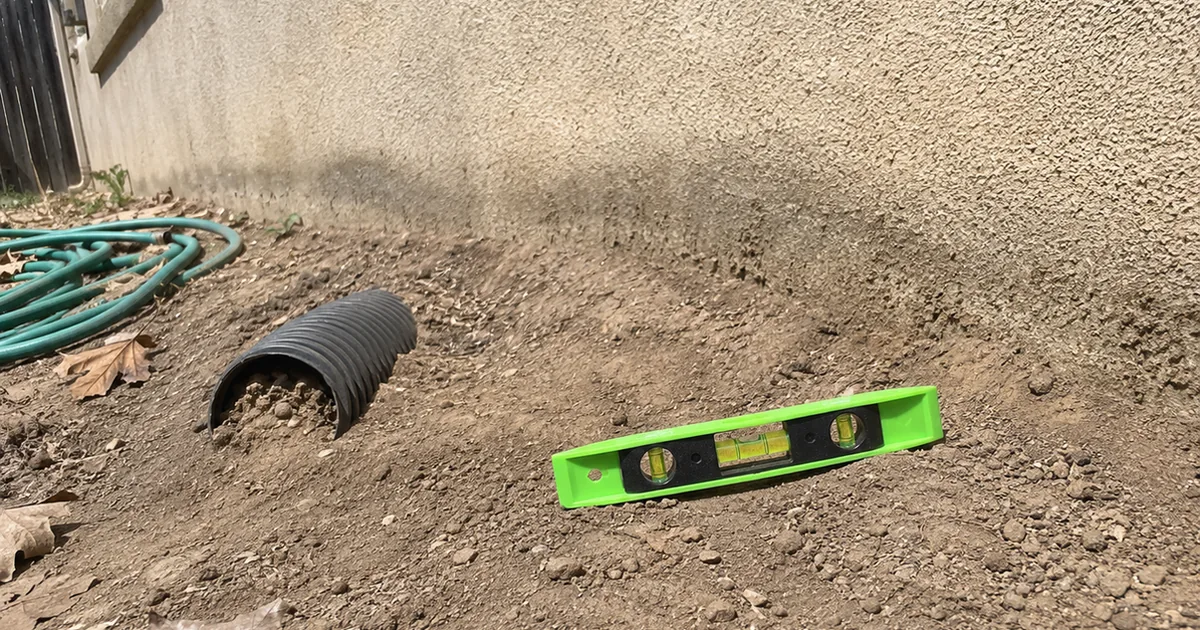
On an exterior walk, we start at the ground and look at which way the dirt falls. It is one of the first things we check, and one of the findings buyers ask about most.
A report line that says “drainage” or “grading” can mean a chore that costs nothing to fix after closing, or it can mean water is working on the foundation. Those are not the same decision.
Sort the line into upkeep, ask the seller, or specialist first. Then make the request in writing before the contingency ends. This is not legal or engineering advice.
The report names the water path; you decide who owns the fix
Our report tells you what water appears to be doing and where. It does not rule on whether the lot is correctly graded, and it does not design the fix.
The InterNACHI Standards of Practice, last revised October 2022, have the inspector look at vegetation, surface drainage, retaining walls and grading where they may affect the structure through moisture intrusion. They do not require the inspector to inspect geological, geotechnical, hydrological or soil conditions, or erosion-control measures. That is a visual job with limits, and the limits matter when you decide what to ask for.
If we see a problem, it goes in the report. We do not run a grading survey, and we do not pretend a home inspector is the same scope as a drainage contractor or a geotechnical engineer.
Our reports arrive the same day, within 6 to 8 hours, and can include a Matterport 3D tour with findings tagged in place. That helps a contractor or engineer go straight to the wall in question. See a same-day report with findings tagged in place.
For how water behaves during a storm, and what a dry-day visit cannot show, read what the first rain shows on an inspection. This guide is about the next step, the decision once the report is in your hands.
Three bins: upkeep, ask, specialist first
Most drainage and grading findings fall into one of three bins, and the bin sets what you do before the deadline.
| What the report says | Bin | What a buyer usually does, our field experience, not a rule |
|---|---|---|
| Gutters full of leaves, a missing splash block or downspout extension, soil settled a little at a fence line, irrigation overspray, no staining anywhere | Upkeep | Take it on after closing. Usually not worth a request |
| Grade or flatwork sloping toward the house along a wall, with splash-back, staining or pooling marks. A downspout piped into a buried line nobody can confirm. Soil or concrete piled against the base of stucco | Ask the seller | Ask for the condition to be corrected or for a credit backed by a written scope, then check the result after rain |
| Standing water against the foundation, damp or stained walls, efflorescence, water in a crawl space or garage, a retaining wall that leans or bulges, gullies on a slope, a history of repairs | Specialist first | Get a drainage contractor or the right licensed professional to look before the contingency deadline, then ask |
Bins are a way to avoid sending the seller a list that makes you look difficult. Sorting is also how the one serious line stops getting buried under fifteen small ones. Read how to ask the seller for repairs or a credit and which findings are worth asking about for the wider picture.
What counts as routine upkeep
Upkeep is anything you could fix with a ladder, a few parts and a weekend, where the report shows no sign that water has already done damage.
Clogged gutters, a downspout that stops short of where it should, a splash block that walked away and a bit of soil that has settled along a fence line all sit here. They are the owner’s job after closing, whoever the owner is. Spending a request on them can use up goodwill that you may need for a bigger line.
The test is evidence. Look for staining on the wall below the gutter, efflorescence, a dark band at the base of the stucco or damp soil that stays soft. If the report mentions any of those, the same downspout moves into the next bin, because now it is a condition with a consequence.
A request that covers every gutter on the house tends to leave the seller with little patience when the real finding comes up. A short list is easier to answer.
When it is a negotiating issue
A drainage line becomes a negotiating issue when the lot is directing water toward the house and the report shows signs it is arriving.
California Residential Code R401.3 gives the yardstick for new work. It says lots are to be graded to drain surface water away from foundation walls, and that “The grade shall fall not fewer than 6 inches (152 mm) within the first 10 feet (3048 mm).” Surface drainage is to go to a storm sewer conveyance or another approved point of collection that does not create a hazard.
Where lot lines, walls, slopes or other barriers make that fall impossible, the exception calls for drains or swales to carry water away from the structure. It also sets a minimum slope of 2 percent away from the building for impervious surfaces within 10 feet. The text we read is a 2025 California Residential Code excerpt. Check the edition your city has adopted.
That is a code for new construction. An older house was built under the rules of its day, and one that falls short of R401.3 is not automatically in violation of anything. We use the 6-inch figure as a yardstick to understand where water is likely to go, not as a legal test.
Three situations usually justify an ask:
- Patio, walkway or driveway slab that slopes toward the wall, with staining or splash-back on the wall above it.
- Soil, mulch or concrete banked against stucco or siding. City building department checklists for the 2022 California Residential Code, including Vacaville’s and Campbell’s, cite a weep screed clearance of at least 4 inches above earth and 2 inches above paved areas. A screed buried by soil or flatwork cannot do its job. Read how stucco weep screed moisture shows up.
- A downspout that goes into a buried pipe with no visible outlet. We can see where the pipe goes into the ground. We cannot report that it is open, connected or discharging at a safe place.
When to bring in a specialist first
Bring in a specialist first when the finding suggests water has already entered, moved the structure or damaged something you cannot see.
Standing water against the foundation, a damp crawl space or garage, efflorescence on a wall, a bowed or leaning retaining wall and gullies cut into a slope are not gutter chores. A cheap fix applied to the wrong cause is how a buyer pays twice.
A buyer’s request for a drainage fix needs three things to be answerable: where the water comes from, where it will go instead and who is responsible for the path. Where lot lines make a grade change impossible, the fix is a drain or swale, and that means a buried line or a channel whose route and outlet matter. Ask for the contractor’s written scope and a simple sketch of the route and the discharge point.
Neighbors complicate this. If the water arrives from the neighboring lot, or has to leave across it, the seller may not control the property where the fix belongs. Ask the seller in writing what they know about where the water comes from.
Cracks that sit near a wet wall are part of the same question. If you see both, read how to weigh a foundation crack next, and if water has left a stain or growth behind it, read what to do when mold appears in the report. For crawl spaces, access limits what we can see, as what we check in a crawl space explains.
For a subsurface system, a field example is what a French drain involves in Lemon Grove.
One visit does not prove how a lot behaves in every storm. A dry attic or yard on inspection day says little about a heavy night in January. If the report points to a drainage issue and the inspection happened dry, say so in your request and ask the contractor to look at it with the report in hand. Read what a “not inspected” line really means.
A thermal image does not measure drainage. We use FLIR infrared to look for moisture patterns, not to judge a grade. See what a thermal image can and cannot tell you.
Your lender may decide for you
On a financed purchase, the appraiser looks at grading and drainage too, and the lender can set conditions before you do.
The HUD Single Family Housing Policy Handbook 4000.1, the FHA handbook, says, “The Appraiser must check for readily observable evidence of grading and drainage problems.” It adds, “The Appraiser must make the appraisal subject to repair if the grading does not provide positive drainage away from the improvements.”
It also lists conditions that require an inspection by a qualified individual or entity, including “standing water against the foundation and/or excessively damp basements.”
The copy we read carries a transmittal effective date of October 15, 2019, so check the current version. These statements apply to FHA-insured loans. Other loan types have their own rules that we do not describe here.
Tell the loan officer about the finding before the appraisal, and ask in writing what that lender would require. You want to hear it before the contingency decision, not after an appraisal adds a second deadline. Ask your insurance agent separately how the policy treats water damage, since a lender answer and an insurance answer are different answers.
Write the request the seller can answer
The request should name the condition, the proof you want and the remedy, with the right amount of ask for the bin.
C.A.R. Form RR, public copy revision 12/18, lets the buyer check repair, credit, price reduction and pest work. The buyer can check more than one box. The seller has no obligation to respond. A credit must be disclosed to the buyer’s lender, and the form warns that a credit may not be enough to remedy all defects.
If the seller agrees to all requests, Form RR makes that agreement conditional on the buyer removing the physical inspection contingency and releasing the seller and brokers regarding the disclosed condition. Check the revision on your own paperwork.
For an ask-bin finding, name the location, attach the photo and request the correction with a specific result, such as water leaving the wall area and discharging to a stated point. For a specialist-first finding, ask in writing for the seller’s consent to the contractor’s visit, then make the repair or credit request once the written scope arrives.
A credit works better with a written scope and bid behind it. A number with no scope tells the seller nothing about what it covers and tells the lender nothing about what the money is for.
The California purchase agreement, the C.A.R. Residential Purchase Agreement revision 12/22, sets a default investigation period of 17 days unless the contract says otherwise. A request for repairs does not stop that clock. Only a written removal, cancellation or extension signed by both sides moves the date. If the contractor cannot come before the deadline, ask for the extension in writing.
Without the seller’s prior written consent, the buyer may not make invasive or destructive investigations. Digging along a foundation or opening a wall to look for a pipe counts. Get the permission first.
Weigh whether the finding is a deal breaker or normal. Most drainage findings are normal for California homes, and the exceptions are the ones where water has already entered.
For routing the report on day one, an agent can use a first-day routing script. The seller’s side of the same moment is in what a seller can do when the buyer’s list arrives.
Disclosure, history and the reports you hand over
Ask the seller in writing what they know about water, drainage, soil movement and past repairs. What the law requires them to disclose is a question for your agent or an attorney.
The statutory Transfer Disclosure Statement is Civil Code 1102.6. Ask your agent to show you what the seller wrote on it about water, drainage and soil, and whether anything in the report contradicts it. Civil Code 1102.8 says the specification of items for disclosure “does not limit or abridge any obligation for disclosure created by any other provision of law or which may exist in order to avoid fraud, misrepresentation, or deceit in the transfer transaction.”
Under RPA paragraph 12D, revision 12/22, the buyer gives the seller complete copies of all investigation reports, at no cost. A drainage contractor’s findings that the buyer orders will end up with the seller. Order them with that in mind.
Do not interpret these provisions yourself. Ask the agent, broker or a real estate attorney. We inspect houses.
Ask for earlier drainage work, permits, invoices and the dates, plus photos from before any regrading. A fresh patch of concrete or new soil against a wall is a question, not an accusation.
Verify before you close
Agreed drainage work gets verified by looking at it, ideally after rain, and by collecting paperwork.
The RPA Final Verification of Condition is by default 5 days before close of escrow. It is not a second inspection. A written claim that something was fixed is not the same as seeing where the water goes now.
Inspection.re offers re-inspection after seller repairs. The buyer or buyer’s agent orders it, and whoever orders it pays. The flat rate depends on scope and is quoted by phone at 1-888-88-INSP-9. Read verifying repairs before close of escrow.
Quick answers on drainage and grading findings
Is a downspout that ends at the foundation worth a request?
On its own, with no staining and no sign of water at the base, it is usually upkeep that a buyer can fix after closing. If the wall below it is stained or the slab edge holds water, it moves into the ask bin.
Can the seller refuse to fix drainage?
Yes. Form RR gives the seller no obligation to respond. Whether you cancel or accept depends on your contract and contingency, so ask your agent.
Does an older house have to meet the 6-inch rule?
No, not automatically. R401.3 governs new work. We use it as a yardstick for where water is likely to go, not as a legal test of an older house.
Should we get a contractor before the deadline?
If the report points to water entering, pooling against the foundation or a buried system with no visible outlet, yes, if the timing allows. If it does not, ask for an extension in writing.
Read the line. Look for the evidence. Sort it into a bin. Ask for the right amount, in writing. Verify after rain if you can.
Call 1-888-88-INSP-9 or schedule an inspection. See what is included and the questions buyers ask us most. We inspect across California, including Los Angeles, San Diego, Temecula, Riverside and San Francisco.