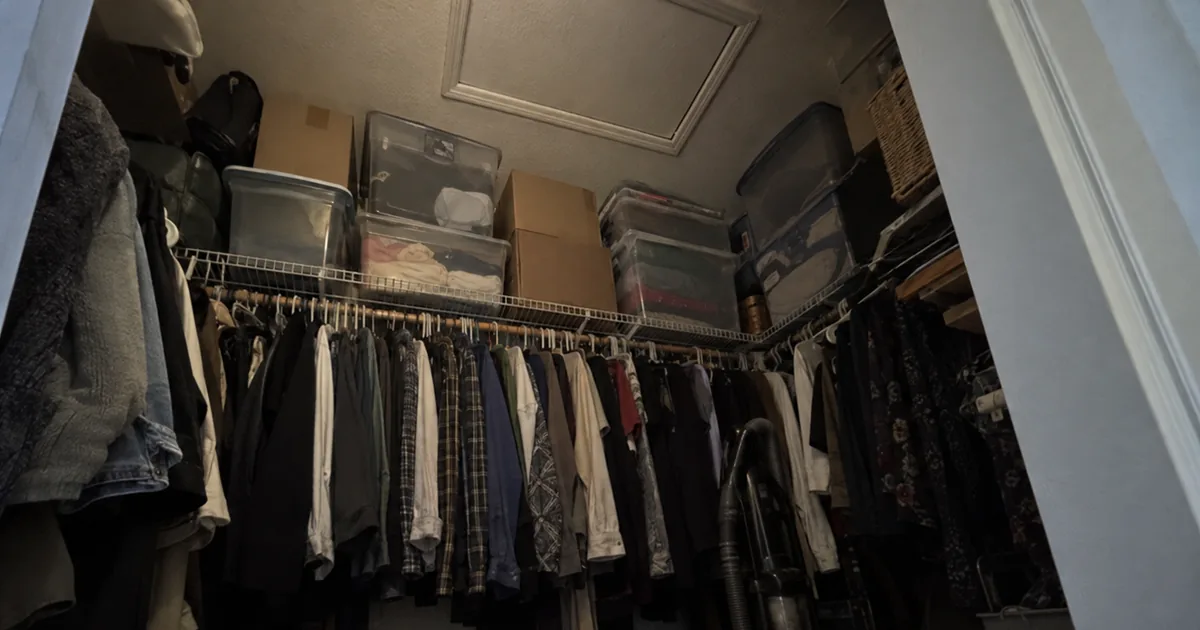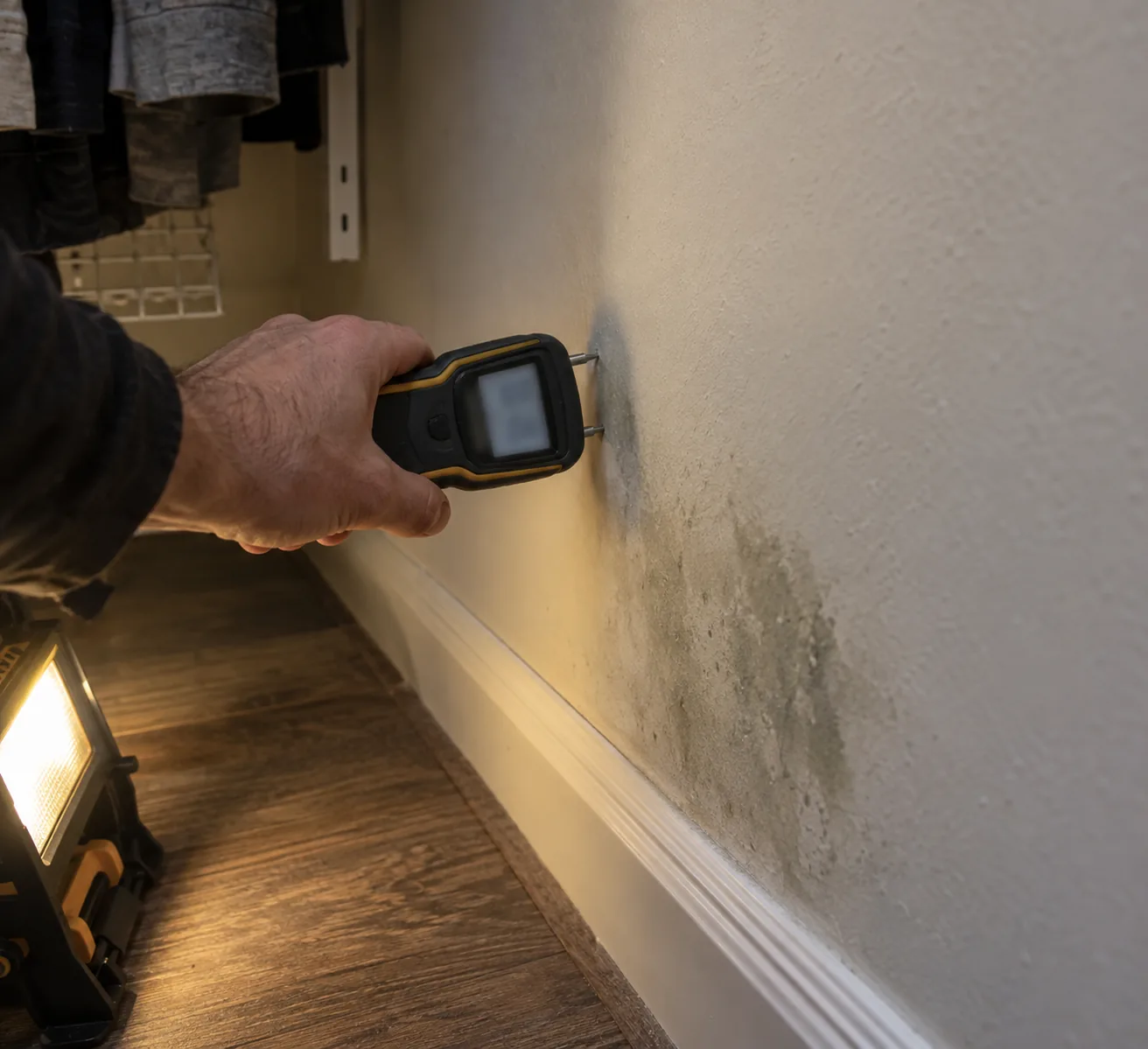
A buyer stands in a bedroom closet on an interior wall that shares framing with a bathroom. Low on the drywall, a soft gray bloom spreads about the width of a dinner plate. The question arrives the way it almost always does: “Can you test it?”
The honest answer is another question. Test it for what? A lab can tell you what is growing on that drywall. It cannot tell you why the drywall is wet, and the why is the repair. That closet is a composite of a finding that comes up constantly on California inspections, not a description of any one property.
The distance between those two questions is where most of the money spent on mold testing goes.
A surface test and an air test answer different questions
A surface test identifies what is growing on a surface. An air test estimates what is floating in the air at the moment the pump ran. Those are different questions, and neither one is a diagnosis.
Surface sampling covers tape lifts, swabs, and bulk samples. A bulk sample is a physical piece of the material itself, a chunk of carpet, insulation, or wall board sent to the lab intact.
EPA’s mold remediation guidance sorts samples into four categories:
- Air samples
- Surface samples
- Bulk samples, meaning chunks of carpet, insulation, wall board and similar material
- Water samples from condensate drain pans or cooling towers
An air sample is a fixed-volume pull through a collection cassette over a few minutes. It is a snapshot of one spot at one moment, and it answers a narrow question. At this moment, in this room, what was airborne?
The surface test answers a different narrow question. Is this growth, and roughly what is it? Useful, and it still does not identify the leak, the failed seal, the plumbing fitting, or the condensation that made the material wet in the first place.
The scope question sits underneath all of it, and what a general inspection does and does not say about mold is worth reading before anybody orders a sample.
An indoor spore count needs an outdoor control
An indoor spore count on its own is not a result. It becomes a result only when it is read against an outdoor sample taken the same day.
Mold is outdoors everywhere, all the time. A number with nothing to compare it to tells you nothing at all. EPA guidance is explicit that outdoor control samples are needed to avoid sampling pitfalls.
EPA gives the comparison a use after remediation: “After remediation, the types and concentrations of mold in indoor air samples should be similar to what is found in the local outdoor air.”
That comparison takes more than a pump and a lab invoice. EPA says sampling should be done by people with specific experience in designing mold sampling protocols, in sampling methods, and in interpreting results, and that inexperienced personnel often produce “misleading, confusing and useless results.” EPA directs that the analysis follow methods recommended by the American Industrial Hygiene Association or the American Conference of Governmental Industrial Hygienists.
The room matters. The outdoor control matters. The method matters. So does whoever reads the report at the end.
No mold number tells a California buyer that a house passed
No federal or California exposure limit exists for airborne mold, so no lab report can tell you that a house passed.
EPA states that “Standards or Threshold Limit Values (TLVs) for airborne concentrations of mold… have not been set,” and that there are no EPA regulations or standards for airborne mold contaminants. Which is why the same guidance says, plainly, “In most cases, if visible mold growth is present, sampling is unnecessary.”
California did try. The Toxic Mold Protection Act of 2001, Senate Bill 732, directed the state health department to determine whether permissible exposure limits for indoor mold could be set. In its 2005 report to the Legislature, the California Department of Public Health concluded that “sound, science-based PELs for indoor molds cannot be established at this time.”
More than two decades later, no permissible exposure limit for indoor mold is in force in this state. A report can identify what was in a sample. There is no California pass or fail number for it to be measured against, and a report that implies otherwise is telling you something the science does not support.
California’s health department recommends against measuring
California’s public health department recommends against measuring mold to decide how serious a problem is. This is the part almost nobody quotes.
The California Department of Public Health’s Statement on Building Dampness, Mold, and Health, issued in September 2011, concluded that the presence of water damage, dampness, visible mold, or mold odor in schools, workplaces, residences and other indoor environments is unhealthy. Then it said this:
“We recommend against measuring indoor microorganisms or using the presence of specific microorganisms to determine the level of health hazard or the need for urgent remediation.”
What CDPH recommends instead is three things. Identify and correct the source of water that may allow microbial growth. Dry or remove the damp materials, rapidly. Clean or remove the mold and the moldy materials.
The department goes further on the testing question: “the current practices for the collection, analysis, and interpretation of environmental samples for mold cannot be used to quantify health risks posed by dampness and mold in buildings or to guide health-based actions.” The evidence CDPH identifies as consistently related to adverse health effects is current or past water damage, damp materials, visible mold, and mold odor. Not the number of spores. Not the type.
That is a state health department speaking about how to assess health risk. We inspect houses. We do not practice medicine, and anyone with a symptom should be talking to their doctor rather than to a lab report.
“Black mold” is not a toxicity score
The species name on a lab report changes less than people expect, and CDPH says so directly.
The statement reads that “current consensus does not justify the differentiation of some molds (such as Stachybotrys species) as ‘toxic molds’ that are especially hazardous to healthy individuals.”
There is a real qualification inside that, and it is the useful half. Molds such as Stachybotrys grow only on very wet materials, so finding one can demonstrate damp conditions that could place occupants at increased risk. The finding is evidence of how wet the material has been. It is not a hazard rating.
None of which means dampness is harmless. The World Health Organization’s 2009 meta-analysis found building dampness and mold associated with roughly a 30 to 50 percent increase in a variety of respiratory and asthma-related health outcomes, and WHO’s 2009 guidelines recommended that exposure be “minimized.” The argument here is about what to measure, not about whether damp buildings matter.
A buyer who hears “it came back Stachybotrys” and a buyer who hears “it came back Cladosporium” should be asking the same next question. Where is the water coming from?
EPA says ERMI is a research tool, not a house test
EPA built the moldiness index that gets sold to homeowners, and EPA says it should not be used routinely in houses.
ERMI stands for Environmental Relative Moldiness Index. It analyzes DNA from mold in a dust sample using a method called Mold Specific Quantitative PCR. EPA built the scale from a standardized dust sample taken from each of more than 1,000 homes across the continental United States during HUD’s American Healthy Homes Survey, analyzing 36 indicator molds per sample and ranking the homes from lowest to highest. The scale runs from a low of approximately -10 to a high of about 30.
EPA’s September 2021 fact sheet on its own tool states: “ERMI has been peer reviewed for research purposes but has not been validated for non-research purposes. For this reason, EPA does not recommend the routine public use of ERMI in homes, schools, or other buildings.”
EPA adds that because the approach has not been validated through a multi-lab study, it cannot comment on the accuracy of information obtained from others using ERMI. Then the same fact sheet closes the loop in one sentence: “Inspection for water damage and mold remain the key to current EPA mold-assessment guidance.”
That is the agency that built the index, saying the walkthrough is still the instrument.
Four situations where testing genuinely earns its fee
Testing is worth paying for when there is a specific question a sample can actually close. There are four of those, and they are narrower than the marketing suggests.
First, post-remediation verification. Once remediation is finished, sampling is the standard way to check whether the work landed, and EPA supplies the benchmark: indoor types and concentrations should come back similar to the local outdoor air. This is the clearest legitimate use of an air sample in a house.
Second, a hidden source nobody will let you open. The California purchase agreement draws a hard line here. Without the seller’s prior written consent, a buyer may not make invasive or destructive investigations, with a narrow carve-out for the minimally invasive testing needed to prepare a pest control report, and that report itself may not include holes or drilling through stucco or similar material. So when the meter reads high behind an intact wall and no one will consent to opening it, a sample is sometimes the only instrument left in the bag. Water trapped behind a cladding system is the common version of that problem, and how a buried weep screed traps water behind stucco shows why the wall stays closed. Watch the calendar while you are at it, because all of this happens inside a contingency period that does not run on the clock people assume.
Third, documentation for a dispute or a disclosure. A dated sample with a chain of custody is a record, and records settle arguments. That is a paperwork reason. It is not a health reason, and it should not be sold as one.
Fourth, a written direction from a physician or an occupational health professional for a particular occupant. When that is the reason, the sampling design should come from them rather than from an escrow timeline.
Against all four, the counter-case is short. If there is visible growth with an obvious wet source, a test mostly buys a receipt for something already in front of you.
The inspection finds the water, not the species
A general home inspection is a visual inspection, and finding the water is the part that changes the outcome.
The real toolkit is unglamorous. A moisture meter on the suspect material, then on a dry control area of the same material a few feet away, because the reading only means something as a comparison. Infrared imaging to find temperature differences that suggest wet material or missing insulation behind a finished surface. Then the exterior, reading for where water is getting in.
Be clear about what infrared does, because it gets oversold. A thermal camera shows a temperature difference. It does not see moisture and it does not see mold. It tells you where to put the meter, which is a genuinely useful thing and a much smaller claim than the one usually made for it. What FLIR imaging actually detects, and what it does not covers the limits.
After that it is the usual list of reasons interiors stay damp. Bath fans terminating in the attic instead of outside, which is one of the most common findings in an attic. Negative grading and blocked area drains. Failed shower pans. Condensate lines. Crawlspace ground moisture, which behaves differently again depending on whether the water is arriving from below the slab or sitting under the floor in a coastal crawlspace.
We work this way in San Francisco, Oakland and Richmond, where the damp is marine, and in San Jose, where it is more often irrigation and plumbing. The boundary is the same everywhere. A general home inspection is not a mold inspection, and it does not determine whether a substance is mold. Which report answers which question, and who prepares each one is the map worth having before you spend anything.
Our reports land within 6 to 8 hours, which usually buys back a day or two at the front of the second round. If the moisture question is already live on a file, get the inspection on the calendar early rather than late.
Quick answers
The listing says there was a leak that was repaired. Should we test?
Not automatically. Ask what leaked, where the water went, whether the wet material was dried or removed, and whether the source itself was corrected. If the area reads dry and there is no visible growth or odor, an air sample is unlikely to add much beyond an invoice.
Our lender or insurer is asking for a mold clearance. Is that the same thing?
Not necessarily. Ask them exactly what document they want, who is permitted to prepare it, and whether they are asking for post-remediation verification. A clearance request is an underwriting or project requirement. It is not a California exposure limit, because there is not one.
How much of a house can an air test cover?
One sample covers one spot at one moment. It does not represent every room, wall cavity, crawlspace and attic in the building. More samples answer more location-specific questions, and none of them tell you where the moisture is coming from.
The report says “moisture stain, source not determined.” What do we do with that?
Treat it as an open building question rather than a mold result. Ask where the stain is, whether the material is wet now, and what should be opened or checked next. How to read a finding like that without over-reacting or under-reacting walks through the reasoning.
Can a home inspector tell me whether the mold is dangerous?
No. We report visible conditions, moisture readings and likely water sources. We do not assess medical risk, and we would be guessing if we tried. That conversation belongs with a physician.
The honest summary
The test tells you about the sample. The moisture reading tells you about the building. The repair follows the water.
If there is visible growth, find the source and deal with the wet material. If the source is hidden, document the limitation and decide whether consent to open it, a further inspection, remediation, or a properly designed sample is the thing that actually moves the file forward. A species name is not an answer to how bad the problem is, and neither is a single indoor spore count read on its own.
Before ordering any test, write down the question it is supposed to answer. If the only question is “do we have a problem,” start with the water instead.
That reasoning applies with even more force one step down the market. If you are looking at a hardware store kit rather than a professional sample, our companion piece on what a consumer mold kit actually measures explains why the dish was always going to grow something, and why a clean one proves nothing either.
The same split between an air sample and a surface sample applies to wildfire smoke residue, and California is now writing separate standards for each. Our guide to smoke damage in a house that did not burn covers what the Air Resources Board and the Department of Toxic Substances Control have been told to produce by the end of 2028.
What is included in an Inspection.re inspection sets out the moisture work we do as standard, the common questions buyers ask cover the scope boundary in more detail, and the format the findings arrive in is built to be read under a deadline.
After a flood, the muck out comes first. SB 1263 sets who may remove hazardous flood and fire debris after a declared disaster, starting in 2027.