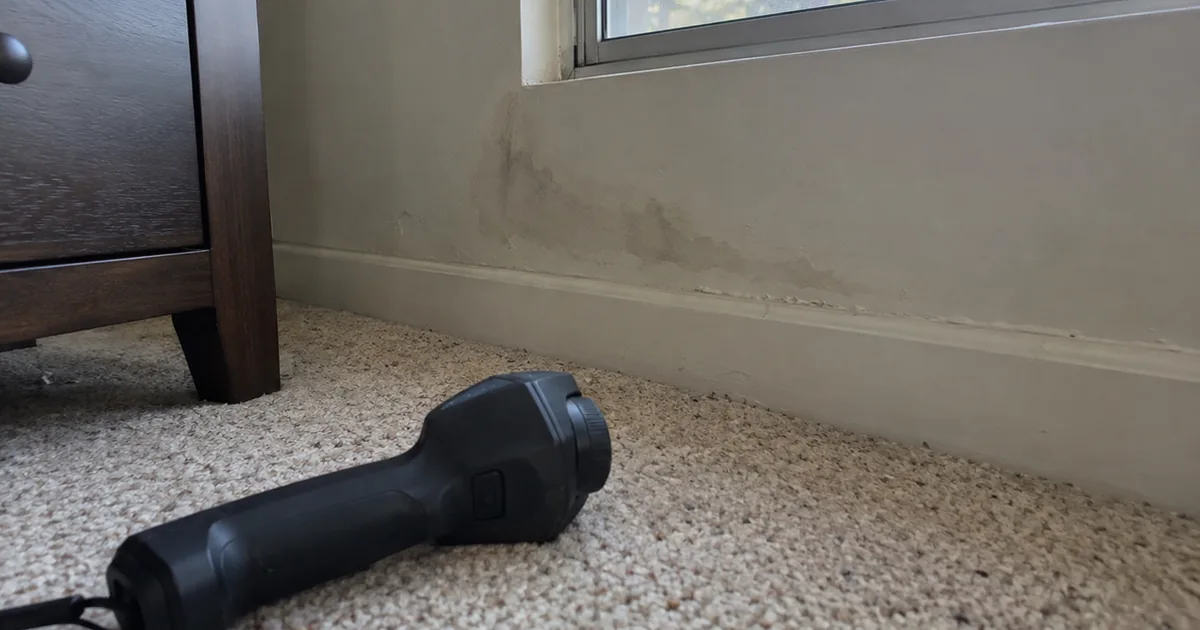
A bedroom exterior wall sits below an aluminum window. In the thermal image, a cool, irregular, blotchy patch spreads from the window corner toward the baseboard.
To the eye, there is only a faint watermark and slightly bubbled paint at the top of the baseboard. The cool patch is a question, not an answer. The moisture meter answers it. The drywall either reads wet, or it does not.
This is a composite of what we see, not one house.
A thermal image is a map of surface temperature, nothing more
A thermal camera records the temperature of the surface facing it. It does not identify water, insulation, or electricity by itself.
FLIR, now Teledyne FLIR, states that “A thermal imaging camera cannot ‘see’ moisture in walls, but it can detect subtle temperature differences and patterns that reveal the existence of water.”
That distinction matters. A wet area can cool as water evaporates. An electrical connection can heat under load. An insulated wall cavity can hold a different surface temperature from the framing around it. The camera records the result at the surface. It does not identify the material or failure behind that result.
The U.S. Department of Energy says temperature differences show up in a video or camera still image as whiter, warmer areas or darker, cooler areas. Energy assessors use those images to locate air leaks. With a blower door test, air leaks can show up as black streaks in the infrared image.
The colors are not a fixed code. They are a palette selected by the operator. Blue does not always mean a specific temperature, and red does not always mean a defect. Read the temperature scale bar on the side of the image before reading any color.
Entry-level thermal cameras resolve about a 1.5 C surface difference. High-end cameras can resolve as little as 0.02 C, according to FLIR. Resolution is not the same as diagnosis. A camera can display a small temperature difference without telling you why it exists.
A thermal image shows surface temperature only. It does not replace a recall check on panel breakers or a technician’s look inside a furnace, which is covered in our guide to the limits of a furnace inspection.
Every image needs a pattern, proof, and person
We read each thermal image in three steps.
First, we name the pattern. We note the shape, the edge sharpness, whether the area is warm or cool, and where it sits. A straight, evenly spaced stripe means something different from a blotch with irregular edges. A patch at a window corner raises a different question from a hot spot at a panel lug.
Second, we choose one confirming test. That may be a moisture meter at the cool spot and a dry reference spot nearby. It may be a look in the attic. It may be a load check on the circuit. It may be a second scan in different conditions.
Third, we identify the person who should address the confirmed issue. A roofer, plumber, window contractor, stucco contractor, electrician, or leak-detection specialist may be the right referral. We do not choose the contractor from color alone.
This order protects you from two common mistakes. The first is calling a specialist for a condition that is not present. The second is ignoring a real defect because the image looked too vague.
When a referral is needed, the license should match the work. We have a guide to which contractor license fits a referral.
Cool, blotchy, irregular areas usually mean moisture until a meter says otherwise
A cool, irregular patch is a moisture question. It is not proof of a leak.
FLIR explains that “As the water evaporates, the surface cools, meaning the wet areas appear colder than the dry areas.” That cooling can create a visible thermal pattern before the eye sees much damage.
The pattern we take seriously has irregular edges and often spreads downward from a source. Common locations include a window corner, a shower wall, or a ceiling below a bathroom. Moisture does not usually form a perfect rectangle with clean, straight edges.
The confirming test is a moisture meter. We check the cool spot. We check a nearby dry reference spot. We compare the readings rather than treating one number as an answer without context.
FLIR also warns that “Identifying a pattern that looks like moisture does not guarantee the presence of water… you should always use a moisture meter to confirm what the thermal camera has detected.”
If the reading is wet, the source determines the specialist. A roof-related pattern may call for a roofer. A plumbing pattern may call for a plumber. A window corner may call for a window contractor. A wall or exterior finish may call for a stucco contractor.
Shower walls are one of the most common sources, and our shower pan and tile leak guide covers that one. A confirmed wet reading also does not identify mold. Our piece on mold air testing versus surface testing explains what a mold test can and cannot answer.
Sharp-edged rectangles and stripes usually point to framing or insulation
Regular, evenly spaced stripes on a wall or ceiling are usually framing members conducting heat differently from the insulated cavities between them. That pattern is usually normal.
A full cavity-shaped rectangle that reads differently from neighboring cavities raises another question. The insulation in that bay may be missing or displaced.
The confirming test is physical access. We look in the attic when the area is accessible. We look at the wall bay when an appropriate opening or exposed area permits it. The thermal image tells us where to look. It does not tell us the insulation composition or its R-value.
The InterNACHI Standards of Practice do not require the inspector to identify the composition or R-value of insulation material.
ASTM C1060 is the standard practice for thermographic inspection of insulation installations in envelope cavities of frame buildings. It is qualitative. It helps find cavities where insulation is inadequate or missing. It does not turn a color pattern into an R-value measurement.
A scan can also be limited by the weather. That limitation belongs in the report rather than being silently treated as a clean result. We cover the attic side in our attic insulation and ventilation guide.
Streaks at edges show air movement only when pressure makes it visible
A dark streak along a window edge, outlet, top plate, or duct may indicate air movement. The pattern needs a pressure difference to show clearly.
The Department of Energy says that, with a blower door, air leaks show up as black streaks in the infrared image. ASTM E1186 covers air leakage site detection, including infrared inspection with building pressurization or depressurization. Its methods are qualitative. They locate leakage sites. They do not measure leakage rates.
Common locations include window and door edges, electrical outlets on exterior walls, top plates, and areas around ducts.
The Department of Energy also states that “Interior scans are more common, because warm air escaping from a building does not always move through the walls in a straight line.”
That is why a streak may appear some distance from the actual path through the assembly. Air can move along a cavity or around an obstruction before reaching the surface.
The confirming test is a pressure test, such as a blower door assessment, or a focused inspection of the suspected opening. A thermal scan without a pressure difference can miss a small leak. A visible streak without pressure testing still needs interpretation.
When the pattern is around ductwork, the next question may concern the duct system rather than the wall. Our ducted HVAC return guide covers that system.
California weather can limit insulation scans more than moisture scans
For this type of home inspection scan, FLIR says there should be at least a 10 C, or 18 F, difference between inside and outside temperatures.
Summaries of ASTM C1060 describe a similar 10 C, or 18 F, differential held for hours before and during the survey. The temperature difference creates the contrast that lets framing, cavities, and air movement appear.
On many mild California days, especially along the coast in spring and fall, the inside and outside of a house can sit closer together than 18 F. When that happens, insulation and air-leak patterns may be faint or missing.
That is a limit of the conditions. It is not proof that the walls are properly insulated.
Moisture scans rely on evaporative cooling at the surface. Electrical scans rely on current through a component. Neither depends as much on outdoor temperature, although neither is independent of all conditions.
We note the conditions. When the indoor and outdoor temperatures are too close, we say the insulation read is limited. We do not call the assembly clean because the camera showed little contrast.
A report may use “limited” for the same reason an inaccessible area is not described as defect-free. The condition prevented a reliable observation. See what “not inspected” and limited areas mean.
FLIR infrared is part of every inspection we do. We photograph findings in the same-day report and tag them in a 3D Matterport tour so you can see the exact wall. Schedule an inspection. Our overview of why infrared scanning matters covers the three kinds of scans we run.
A hot panel component must be compared with a similar component under similar load
A warm breaker or lug does not mean the same thing in every panel. The comparison matters.
FLIR says loose power connections “can cause circuits to generate much more heat than they normally should.”
The NETA table electrical thermographers use compares a component with a similar component under similar load. A difference of 1 to 3 C is a possible deficiency that warrants investigation. A difference of 4 to 15 C is a probable deficiency, with repair as time permits. More than 15 C is a major discrepancy, with immediate repair.
This is commercial-electrical guidance used here as a yardstick. It is not a home inspection rule.
A breaker or lug that reads warm only matters relative to its neighbor under similar load. An unloaded circuit can hide a bad connection. We look at the panel conditions, identify the comparison, and avoid treating one temperature number as a failure prediction.
The Infraspection Institute cautions that “Temperature differentials cannot be utilized to predict time to failure for an electrical device.”
The confirming test is an electrical evaluation under appropriate load and safety conditions. The person is a licensed electrician, C-10. Our guide to older electrical panels under load covers the panels where this comes up most.
Six patterns fool people before the confirming test
-
Reflections. FLIR states that “the temperature of shiny objects, like polished metal, will not be accurately measured by your thermal imager due to their low emissivity.” Highly polished copper or aluminum usually has emissivity below 0.10. Flat paint is about 0.90. Shiny surfaces act like mirrors and can show reflected heat, including the inspector’s own body heat.
-
Sun on a wall. Solar loading can warm one side of a house for hours. A warm exterior wall is not automatically a missing-insulation pattern or an electrical pattern.
-
Furniture or boxes. A cabinet, sofa, or stored box against a wall can leave a different-temperature shape after it is moved. The outline may look like a cavity or a moisture patch even though it records the recent obstruction.
-
A recent thermostat change. A thermostat that just changed, or supply air washing over a wall, can create a sharp cool or warm area. We ask what the HVAC system was doing before assigning meaning to the shape.
-
A dry old stain. A dry old stain may read like the wall around it. A cool image does not date a leak. A normal image does not clear an old stain. The confirming question is whether the area is currently wet, not whether the paint once changed color.
-
A warm, snaking line in a slab floor. It can be hot-water piping in use, radiant heating, or a slab leak. The confirming steps are to stop all hot water use, re-scan, and check the water meter for movement. If the concern remains, call a leak-detection specialist. Our slab leak guide walks through that sequence.
Quick FAQ about thermal images
Can a thermal camera see through walls?
No. It measures surface temperature only. In FLIR’s own words, the camera “cannot ‘see’ moisture in walls.” It sees what that moisture does to the surface.
Does a blue spot mean mold?
No. It means the surface is cooler within the selected palette. Proof of current moisture comes from a moisture meter. Mold questions require a separate test.
Is infrared required in a home inspection?
The InterNACHI home inspection Standards of Practice does not mention thermal imaging. We include it in every inspection anyway.
Why does my report say the insulation scan was limited?
The inside and outside temperature difference was too small that day. FLIR’s guidance calls for an 18 F difference for this type of scan.
Who do I call for a hot breaker?
A licensed electrician.
The honest summary is pattern, proof, person
A thermal image narrows where to look. It does not finish the investigation.
The meter answers whether a suspicious cool area is wet. The attic inspection answers whether a cavity contains insulation. The pressure test answers whether air is moving through an opening. The electrician answers whether a panel component needs repair.
Read the pattern first. Confirm it with the right test. Refer the confirmed condition to the right person.
Before you book, see what is included in every inspection, the inspection FAQ, and how our inspection report works. We inspect across California, including Lake Elsinore, Woodland Hills, Culver City and Aliso Viejo.
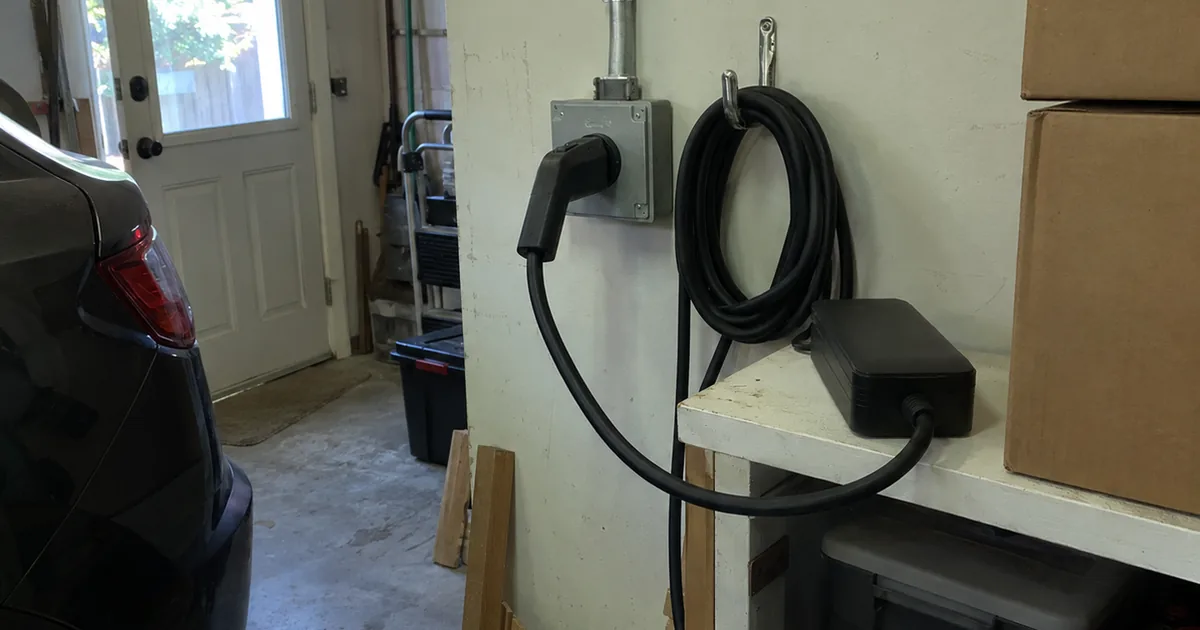
A warm breaker feeding an EV charger is a common case, and the charger circuit has three numbers worth checking.
Related reading
- Why infrared scanning matters, including what the camera can and cannot show.
- Lake Elsinore slab leak guide, including the re-scan and water-meter check.
- Woodland Hills attic insulation guide, including insulation patterns and attic access.
- Culver City older electrical panels guide, including thermal checks under load.
- How to read a sewer scope video, the same pattern-first reading applied to camera footage of the buried lateral.