When a report we wrote mentions a crack in a foundation, wall or slab, the first question buyers ask is how wide it is.
Width is the wrong first question. The report’s wording, the pattern, and whether anything else in the house moved say more.
Sort the finding into monitor, ask, or engineer-first. Then make the request in writing before the contingency ends. This is not legal or engineering advice.
The report flags movement; it does not rule on the structure
Our report tells you what we saw and whether it looks like possible movement. An engineer decides whether the structure is adequate.
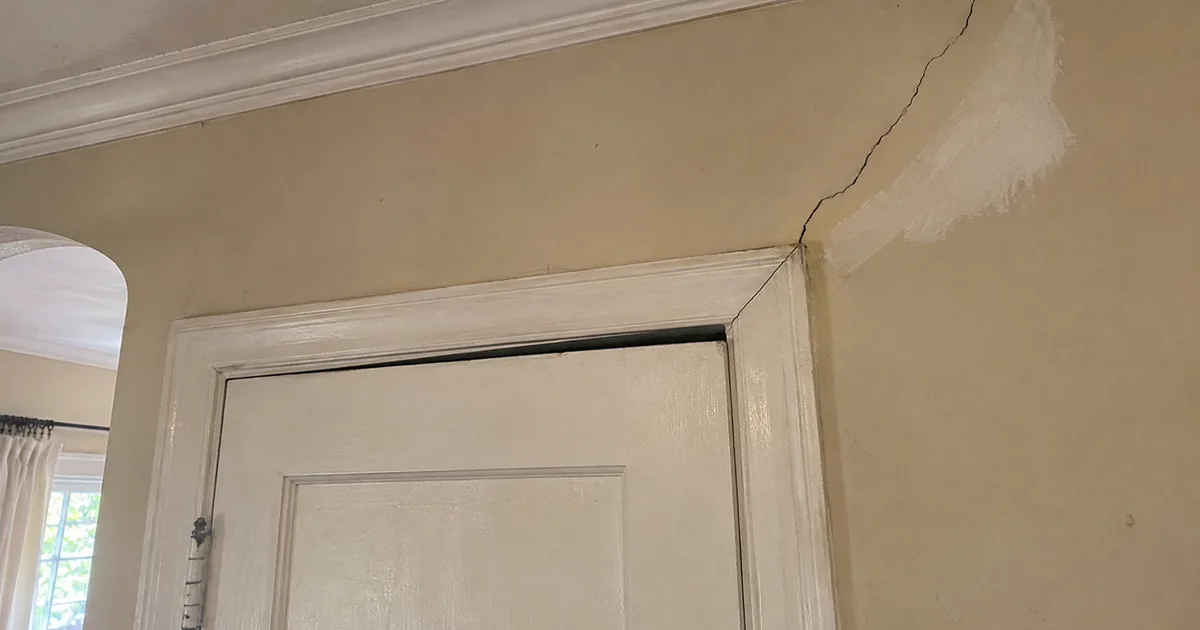
The InterNACHI Standards of Practice, last revised October 2022, say an inspector shall inspect “the foundation”, “the basement”, “the crawl space” and “structural components”. The inspector shall report as in need of correction “observed indications of possible foundation movement, such as sheetrock cracks, brick cracks, out-of-square door frames, and unlevel floors”.
That is a report of an observed condition. It is not an engineering conclusion.
The same Standards say the inspector is not required to “provide any engineering or architectural service” or “report on the adequacy of any structural system or component”. Their general limits also say, “An inspection is not technically exhaustive.” They say, “An inspection will not identify concealed or latent defects.” The inspector is not required to determine “the cause or reason of any condition”, and the home inspection covers “only those material defects observed on the date of the inspection.”
That wording matters when you read a foundation comment. A home inspection can identify a pattern that deserves attention. It cannot tell you that a structure is adequate for the life of the house.
Our reports arrive the same day, within 6 to 8 hours. They can include a Matterport 3D tour with findings tagged in place. That gives an engineer or contractor the exact spot to review, instead of sending someone through the house with a vague instruction to look for cracks. See a same-day report with findings tagged in place.
The three phrasings to look for are a crack noted with no other signs, “indications of possible foundation movement” with a recommendation for evaluation, and an area marked not inspected. The last one is not a clean bill. It means the report did not establish what was there. Read what a “not inspected” line really means before treating an area as cleared.
Five crack findings, five next calls
The pattern and the company it keeps matter more than any one measurement. Most findings fall into five situations.
| What the report says | What it often means, our field experience, not a rule | First call | Ask to consider on the request form |
|---|---|---|---|
| A single thin crack in a garage slab or a patio, no other signs | Often shrinkage or a control-joint-like crack that sits alone | Usually none. Note it and photograph it | Usually no request. Ask the seller what they know of its history |
| Cracks in stucco or drywall at window and door corners only, nothing else moved | Common cosmetic finish cracks, but corners are also where movement shows first | The inspector who wrote the report, to say whether doors and windows also look off | Often none. An evaluation if anything else shifts |
| Diagonal cracks with sticking doors, uneven door gaps, sloped floors or racked window frames | Indications of possible foundation movement, the exact wording of the Standards | A licensed structural engineer, before the contingency deadline | Written consent for the engineer to look, then repair or credit based on the engineer’s letter |
| A horizontal or stair-step crack in a block or concrete wall, or a wall that looks bowed | Often a wall being pushed by soil or water behind it | A licensed structural engineer, promptly | Engineer’s evaluation before the deadline, and repair under the engineer’s design, or a price change backed by a written scope |
| A crack with efflorescence, damp staining or water entry along it | A crack that is also a water path | The trade that fixes the water, and the engineer if movement signs are also present | Source repair plus the engineer’s answer on the crack, with a dry re-check |
If water is part of the finding, read what the first rain shows. A crack with staining or water entry is not the same question as a dry crack in a slab.
For cracks under the floor, access controls what we can see. Read what we check in a crawl space.
We do not use one width as a verdict. Pattern, location, and other movement signs count too. No code or standard cited in this article sets a width line for a buyer.
A thermal image does not measure crack movement. It shows surface temperature differences. We use FLIR infrared to look for moisture patterns around a crack, not to judge the structure. Read what a thermal image can and cannot tell you.
One visit cannot tell you whether a crack is moving
A single inspection shows a crack as it is that day. Whether it is still moving is a question an engineer answers with more than one look or with the structure’s own evidence.
The Standards say the inspection covers material defects “observed on the date of the inspection”. They also say it is not technically exhaustive. That means a report can document the location and related signs without telling you how the crack behaved before the inspection or how it will behave later.
The California purchase agreement, the C.A.R. Residential Purchase Agreement revision 12/22, sets a default investigation period of 17 days unless the contract says otherwise. A request for repairs does not stop the contingency clock. Only a written removal, cancellation or extension signed by both sides moves the date.
Ask the seller in writing when the crack first appeared, whether it has been patched or painted, and whether anyone has had it looked at. A fresh patch over an old crack is information.
If an engineer says “monitor”, that conclusion may not fit inside the contingency window. Decide before the deadline whether to ask for more time in writing, to price in the uncertainty, or to accept it. Read how the contingency timeline works and whether to waive it.
What to ask an engineer to answer, and who counts as one
Ask for a short written letter that says what caused the cracking, whether it is active, whether the structure needs repair, and what the repair scope is. Get that answer from a licensed engineer.
A structural engineer is not a contractor. Engineers are licensed by the California Board for Professional Engineers, Land Surveyors, and Geologists. Civil and Structural are separate license types. The license can be checked through the Department of Consumer Affairs search.
Many foundation repairs are bid by a General Building, B, contractor working from an engineer’s design. Foundation stabilization by injection falls under the D-30 classification. Those are different roles. The person who evaluates the condition may not be the person who performs the work.
The California purchase agreement also limits how the buyer investigates. Without the seller’s prior written consent, a buyer may not make invasive or destructive investigations. Get the permission before anyone opens a wall, removes material, drills, cuts or otherwise changes the property.
Write the question before you book:
“Is the cracking active, what is causing it, does it need repair, and what would the repair involve?”
Do not accept a bare “looks fine” if you are going to rely on it. Ask for the findings in writing.
Ask before you hire whether the firm that evaluates also sells the repair. Decide if you want those jobs done by different people. A written answer gives you something to compare against the request, the repair scope and the final verification.
Soil is often the reason a crack appears, and it varies by neighborhood. If you want to see how that plays out, we wrote about expansive clay in Menifee, graded-pad settlement in Irvine, settlement on old orchard land in Corona and post-tension slabs in Rancho Cucamonga. Those are place-specific, and this guide is about the decision after your report arrives.
Your lender may care before you do
On a financed purchase, the appraiser and lender can raise a foundation finding on their own. Ask the loan officer early.
The HUD Single Family Housing Policy Handbook 4000.1, the FHA handbook, says, “The Appraiser must perform a visual observation of the foundation and Structure of the improvements and report those results. If the Appraiser notes any structural issues, the Appraiser must address the nature of the deficiency in the appraisal where physical deficiencies or adverse conditions are reported and require inspection.”
It also says, “The Appraiser must examine the foundation for readily observable evidence of safety or structural deficiencies that may require repair.”
The mortgagee “must confirm that all foundations will be serviceable for the life of the Mortgage and adequate to withstand all normal loads imposed.”
The copy we read was last revised 08/14/2019. Check the current version. These statements apply to FHA-insured loans. Other loan types have their own rules that we do not describe here.
Tell the loan officer about the finding before the appraisal. Ask in writing what that lender would require. You want the lender’s answer before the contingency decision, not after an appraisal raises a separate question.
Ask your insurance agent in writing how the policy you are buying treats foundation and settlement damage. Do not assume that a lender answer and an insurance answer are the same answer.
For routing help, read a buyer’s agent’s first-day routing script. Structural findings belong in the specialist lane on day one.
Turn the finding into a request the seller can answer
The request should name the question, the proof you want and the remedy.
C.A.R. Form RR, public copy revision 12/18, lets the buyer check repair, credit, price reduction and pest work. The buyer can check more than one box. The seller has no obligation to respond.
A credit must be disclosed to the buyer’s lender. The form warns that a credit may not be enough to remedy all defects.
If the seller agrees to all requests, Form RR makes that agreement conditional on the buyer removing the physical inspection contingency and releasing the seller and brokers regarding the disclosed condition. Check the revision on your own paperwork.
For engineer-first findings, ask in writing for the seller’s consent to the engineer’s visit. Make the repair or credit request after the letter arrives, if the timing allows. If it does not, ask for a written extension.
Ask for repair by the right licensed contractor under the engineer’s design, with the engineer’s sign-off letter, receipts and any permit final the work needs. Or ask for a credit backed by a written scope and bid. A number without a scope does not tell the seller what the number covers or tell the lender what the transaction is funding.
For a thin stand-alone crack, a request to repair every crack in the wall is usually the kind that makes a buyer look difficult. Match the request to the evidence.
Read how to ask the seller for repairs or a credit, which findings are worth asking about and whether a finding is a deal breaker or normal.
The seller’s side of the same moment is in what a seller can do when the buyer’s list arrives.
Disclosure, history and the reports you hand over
Ask the seller in writing what they knew about cracks, patching and past repairs. What the law requires them to disclose is a question for your agent or an attorney.
Civil Code 1102.8 says the specification of items for disclosure “does not limit or abridge any obligation for disclosure created by any other provision of law or which may exist in order to avoid fraud, misrepresentation, or deceit in the transfer transaction.”
Under RPA paragraph 12D, revision 12/22, the buyer gives the seller complete copies of all investigation reports, at no cost. That means an engineer’s letter the buyer orders will end up with the seller.
Do not interpret these provisions. Ask the agent, broker or a real estate attorney. We inspect houses.
Ask for any earlier engineer reports, repair invoices, dates and permits, and photos from before a patch. Treat an unexplained fresh patch as a question, not an accusation.
Your engineer’s letter is also part of the file. Order it with the understanding that it may be provided to the seller under the purchase agreement. That is not a reason to skip the evaluation. It is a reason to ask for the answer you can stand behind.
Close the loop before you close escrow
Agreed foundation work gets verified with an engineer’s sign-off and paperwork, not with a promise.
The RPA Final Verification of Condition is by default 5 days before close of escrow. It is not a second inspection.
Inspection.re offers re-inspection after seller repairs. The buyer or buyer’s agent orders it, and whoever orders it pays. The flat rate is based on scope and quoted by phone at 1-888-88-INSP-9. Read verifying repairs before close of escrow.
Is a thin crack in the slab a reason to worry?
On its own, with no door, window or floor signs, it is usually a monitor-and-photograph item in our reports.
Photograph its location. Keep the report wording. Ask the seller what they know of its history. If another sign appears, the call changes.
Can we skip the engineer and just ask for a credit?
You can ask, but a credit without a written scope gives the seller nothing to price against. Ask for the letter first when time allows.
Does a patched or painted crack mean there is a problem?
It means someone dealt with it. Ask when, why and who. Painting does not stop movement.
Can we walk away over a foundation crack?
Whether and how you can cancel depends on your contract and contingency. Ask your agent.
The engineer’s answer and the cost picture are what usually decide it. A stand-alone crack, a crack with related movement signs, and a crack that carries water do not present the same decision.
Read the wording. Sort the pattern. Get the engineer’s answer in writing. Ask with proof. Verify before close.
Call 1-888-88-INSP-9 or schedule an inspection. See what is included and the questions buyers ask us most. We inspect across California, including Los Angeles, San Diego, Temecula, Riverside and San Francisco.
A crack seen before the offer changes how you write it, which the pre-offer inspection guide walks through.
A crack beside a wet wall raises the drainage question too, which this guide to drainage and grading findings sorts into what to ask for and what to fix yourself.