The Unit That Never Reaches Temperature: A Rancho Santa Fe Tankless Water Heater Guide for Agents
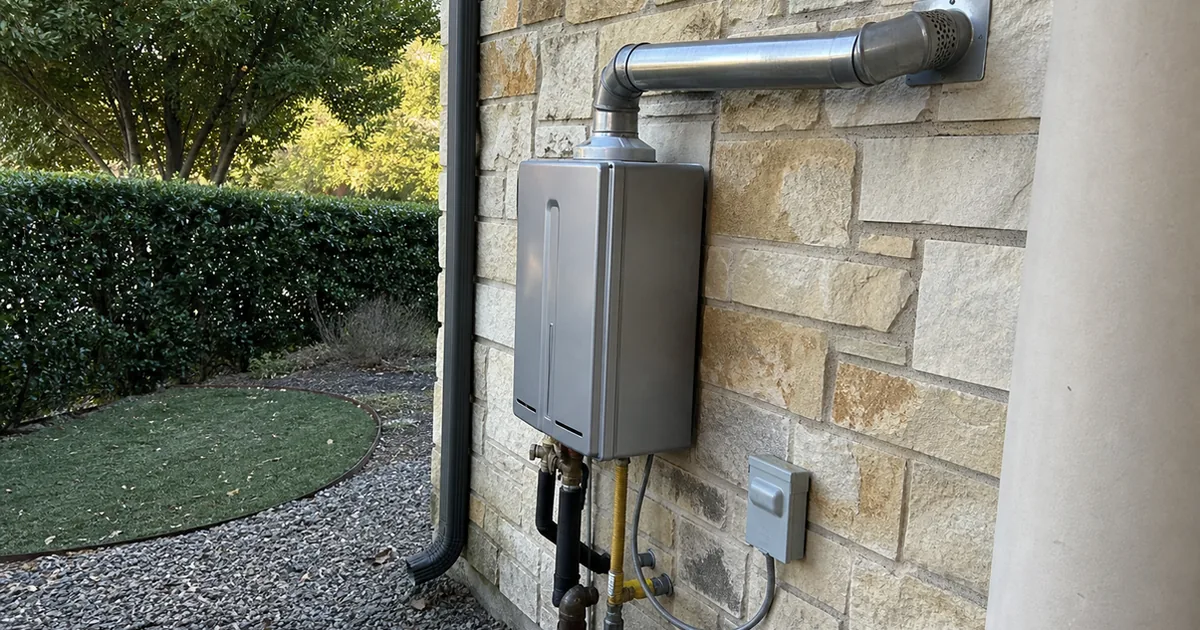
The estate was a Fairbanks Ranch remodel, a kitchen and primary suite renovation that had swapped out the original 50-gallon tank for a tankless unit somewhere along the way, the kind of upgrade a homeowner makes for the promise of endless hot water across a house with four bathrooms and a pool bath. The unit itself looked new and clean, mounted on the exterior mechanical wall behind a hedge. The problem was upstream. The gas line feeding it was the same three-quarter-inch run that had served the old tank for thirty years, sized for a fraction of the burner capacity the new unit actually needed, and on a cold morning with two showers running, the water never quite reached the temperature the thermostat was asking for.
We are describing this as a composite of what we see across several Rancho Santa Fe inspections a year on estates that have retrofitted to tankless water heating, not one identified property or job. The pattern repeats often enough on large remodeled homes in this market that it is worth understanding before an escrow, not during one.
This guide is for the agent working Rancho Santa Fe and the surrounding communities we also serve, including nearby Del Mar, Solana Beach, and Encinitas, where the same large-lot remodel market produces the same retrofit pattern. Here is what a tankless water heater actually needs to run correctly, what goes wrong when a retrofit skips a step, and how the finding usually plays out in escrow.
Why this matters for the agent
A tankless water heater is a genuinely different appliance from the tank it usually replaces, not a smaller, more efficient version of the same thing. It has its own gas-sizing requirements, its own vent category, its own condensate handling on higher-efficiency models, and its own maintenance schedule tied directly to water hardness. A buyer touring an estate with a “recently upgraded” water heater tends to hear that as a pure improvement and nothing more. An agent who understands what actually has to be true for that upgrade to work correctly can walk a buyer through a real finding instead of letting the word “tankless” alone carry the conversation.
Rancho Santa Fe adds two conditions that make this worth its own guide. First, the market’s large luxury estates and active remodel culture mean tankless retrofits are common, often added to serve expanded fixture counts across a big house rather than installed fresh with a new build’s properly sized gas service. Second, much of the area historically relies on well or hard groundwater, and tankless heat exchangers are considerably more sensitive to scale buildup than the large steel tank of a conventional water heater.
Tankless water heaters and tank water heaters are different appliances
Here is the distinction worth carrying into every conversation about a “new water heater” on a listing. A tank water heater stores forty to eighty gallons of hot water at all times, recovering slowly in the background, and its main safety-and-installation concerns are the ones covered in our Thousand Oaks water heater installation guide: seismic strapping, a properly discharging temperature-and-pressure relief valve, garage elevation and ignition-source clearance, and an expansion tank on a closed system. A tankless unit stores nothing. It fires a burner on demand and heats water as it passes through a heat exchanger, which means the burner has to be large enough to raise the full flow rate of water to setpoint in a single pass, instantly, every time a fixture opens.
That single difference drives everything else that can go wrong with a tankless retrofit, and it is why this is a distinct topic from tank water heater installation rather than a variation on the same defect list.
What actually goes wrong with a tankless retrofit
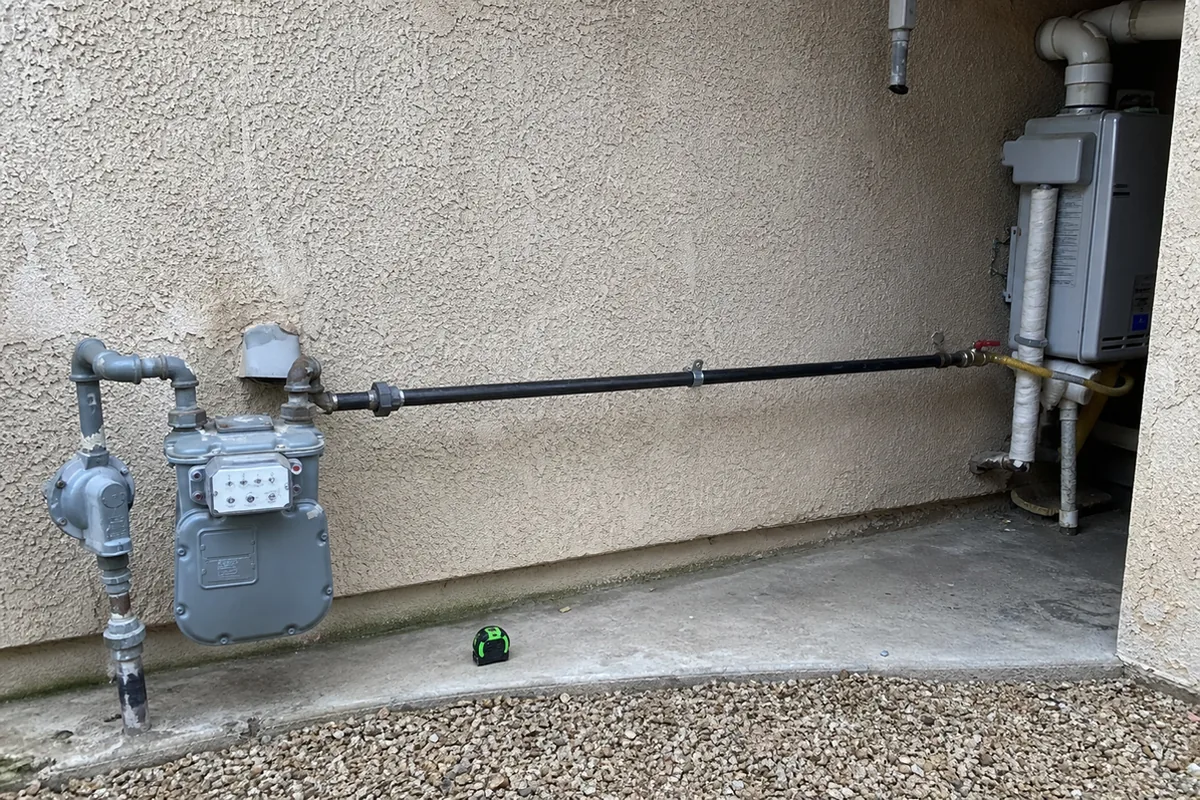
- Undersized gas line and service capacity. A tankless unit’s burner draws far more BTU input than the tank it replaced, often two to three times the input rating. If the gas line, meter, and regulator sizing were never recalculated for the new unit’s demand, the appliance cannot draw enough fuel to fire at full capacity, especially when another gas appliance runs at the same time. The result is exactly what it sounds like: water that never quite reaches setpoint, or a unit that intermittently derates itself under load. This is a gas-supply sizing problem, not a defective appliance.
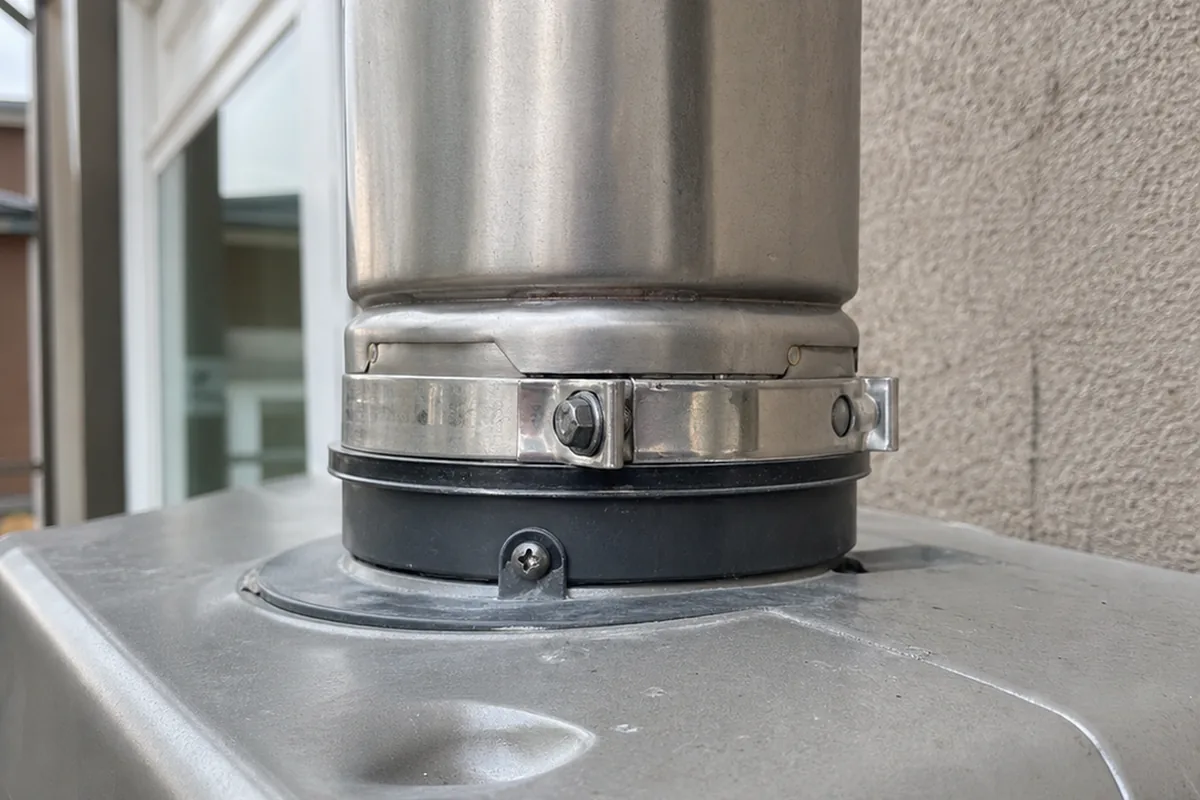
- Vent type mismatch. Tankless units are typically Category III or Category IV appliances, meaning the flue gas is under positive pressure and, on condensing models, cool enough to produce acidic condensate. That requires a vent system rated for the category and material specified by the manufacturer, commonly stainless steel or a specific listed plastic pipe for condensing units, run and terminated per the installation manual. A retrofit that reuses an old atmospheric water heater’s single-wall or B-vent flue, or improvises with the wrong pipe material, is a real venting defect with combustion-safety implications, not a cosmetic mismatch.
- Missing or undersized condensate drain and neutralizer. High-efficiency condensing tankless units produce acidic condensate that has to drain somewhere, usually through a neutralizer cartridge before it reaches a drain, sink trap, or condensate pump. A unit installed without that drain path, or with condensate routed directly into an unprotected drain, is a maintenance and corrosion problem that shows up gradually rather than immediately.
- Clearance violations. Tankless units have specific clearance requirements to combustibles, service access, and intake or exhaust termination points relative to windows, doors, and mechanical vents, all specified in the manufacturer’s installation manual. A unit crowded against a fence, mounted too close to a window that opens, or installed without the clearance needed to service it is a common finding on a retrofit squeezed into an existing mechanical alcove built for a smaller tank.
- Scale buildup in the heat exchanger from hard water. A tankless unit’s heat exchanger is a compact set of narrow passages, and mineral scale from hard water accumulates on those surfaces far faster, and with a much bigger performance impact, than in the open volume of a steel tank. Manufacturers specify a regular descaling schedule, often annually, using a pump and vinegar or a dedicated descaling solution circulated through service valves. On a property served by well water or naturally hard groundwater, common in parts of Rancho Santa Fe, a unit installed without a water softener or without any descaling history is a real and fairly predictable performance and longevity problem.
- The cold-water sandwich effect. Because a tankless unit only heats water while it senses flow, a person who turns a fixture off and back on quickly can experience a brief slug of lukewarm or cold water passing through the line before the unit re-fires and catches back up. This is a known characteristic of the technology rather than a defect on its own, but it is worth explaining to a buyer who might otherwise read it as a malfunction.
- Venting through combustible walls without proper firestop and clearance. Where a vent penetrates a framed wall on its way to termination, the penetration needs a proper firestop and clearance to combustible framing per the vent manufacturer’s listing. A retrofit that routes vent pipe through a wall cavity without addressing this is a fire-protection detail easy to miss once the drywall is patched back over it.
Schedule a Rancho Santa Fe inspection →
What agents should tell every buyer
Give these points to a buyer under contract on a Rancho Santa Fe property with a tankless water heater.
- Ask when the unit was installed and whether the gas line and meter were evaluated or upsized at the same time, not just the appliance itself replaced.
- Ask for the installation manual or a permit record if available. Clearance, venting, and condensate requirements are all spelled out by the manufacturer and vary by model.
- If the property is on well water or the buyer knows the area has hard groundwater, ask directly whether a water softener is installed and whether the unit has a documented descaling history.
- A tankless unit that runs on demand at multiple fixtures simultaneously in a large house is a real sizing question. Ask whether the unit is a single large unit or a multi-unit or recirculating setup designed for the home’s actual fixture count.
- The cold-water sandwich effect is normal for the technology. A buyer should not read a brief cold slug after a quick on-off cycle as a defect by itself.
- Ask about the vent material and condition if it is visible, particularly whether it appears to be the original tank flue reused rather than a vent installed for the new unit.
Red flags during showings
Some of this shows without opening a service panel.
- Water that runs lukewarm or fails to reach a comfortable temperature during a showing, especially with more than one fixture running.
- A tankless unit mounted with visibly inadequate clearance to a fence, wall, or window, or crowded in a way that would make service access difficult.
- A vent pipe that looks mismatched in material or diameter to the unit, or that appears to be an older single-wall flue reused from a prior tank installation.
- Visible mineral scale or white crust at any exposed water fitting near the unit, a sign of hard water in the system generally.
- No visible water softener on a property that otherwise appears to be on well or untreated groundwater.
- A condensate line that appears to terminate directly into an open drain with no visible neutralizer cartridge.
If we see these, we look closely at the gas line sizing, the vent material and termination, and the condensate path before the report goes out.
The negotiation playbook
When a tankless water heater finding surfaces in a Rancho Santa Fe escrow, the deal usually moves down one of a few paths.
The first path is a gas line and capacity evaluation by a licensed plumber, appropriate when the finding is about undersized supply rather than the appliance itself. This determines whether the fix is a line upsizing or a demand-management approach across the home’s other gas appliances.
The second path is a venting correction, warranted when the vent material, category, or termination does not match the unit’s listing requirements. This is a combustion-safety item and generally should not be deferred.
The third path is a service and descale by a qualified technician, appropriate when the unit is properly sized and vented but is underperforming due to scale, particularly on a well-water property with no softener.
The fourth path is a credit or informed acceptance, appropriate when the finding is limited and the buyer wants to proceed and simply plan for the softener and descaling cost themselves.
How the inspection actually catches it
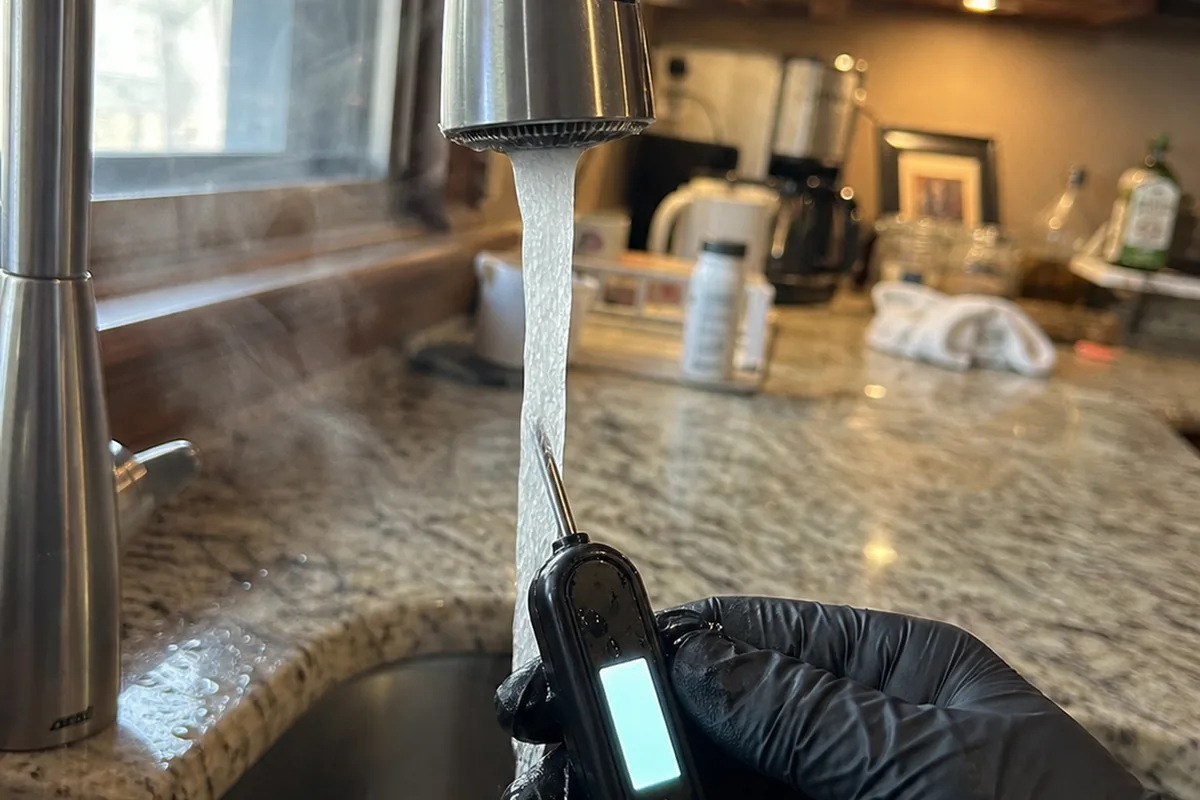
We test hot water delivery and temperature at multiple fixtures during every inspection, often the first sign of an undersized gas supply or a struggling unit before we look at the appliance itself.
We document the unit’s make, model, and visible age, note the vent material and routing where accessible, check clearances against what is visible at the installation, and look for a condensate path and neutralizer on condensing models. We check for the presence of a water softener and ask about descaling history as part of our standard interview when the seller or listing agent is available. We do not open the unit, test gas line capacity with a manometer, or perform a descaling service ourselves, all of which belong to a licensed plumber or gas specialist. Where we find a clear sizing, venting, or scale-related finding, we say so plainly and recommend that specialist scope, the same way our inspection report prioritizes findings for the buyer. Our what’s included page covers the full scope of every Rancho Santa Fe estate inspection.
Quick FAQ
Is a tankless water heater automatically better than a tank? Not automatically. It offers real advantages, on-demand hot water and no standby heat loss, but only when the gas supply, venting, and water quality are all matched to what the unit actually requires. An improperly sized retrofit can underperform a well-maintained tank.
Does this apply to every Rancho Santa Fe estate? No. Many properties still run a conventional tank, sometimes several, sized for the home’s fixture count. This guide applies specifically where a tankless retrofit has been done, which is common enough in this market’s remodel culture to check for directly.
How is this different from the water pressure and PRV issue covered elsewhere? Different system entirely. Water pressure and the pressure-reducing valve, covered in our Porter Ranch guide, is about the force of water arriving at the house. This is about the appliance that heats it, its gas supply, its vent, and its exposure to mineral scale. The two can coexist on the same property without being related.
Can a tankless unit be added later without touching the gas line? Sometimes, if the original service already has capacity to spare, but it should never be assumed. A licensed plumber has to evaluate total connected load against the meter and line size whenever a tankless unit is installed or a home’s total gas demand increases.
Should a buyer walk away over a tankless water heater finding? Almost never on the finding alone. What matters is which specific issue is present, gas sizing, venting, or scale, and what the repair or service scope actually costs relative to the property value. A well-documented finding is a negotiation point, not a deal-breaker.
The honest summary
Rancho Santa Fe’s remodel culture and hard groundwater make tankless water heater retrofits both common and, when done without matching the gas supply, venting, and maintenance schedule to the unit, a predictable source of underperformance. None of that means tankless is the wrong choice for a large estate. It means the retrofit has to be done completely, not just as an appliance swap behind the same closet door.
We test delivery at the fixtures, document the unit and its vent and condensate path, ask about water treatment and descaling history, and tell you plainly whether you are looking at a gas-sizing issue, a venting correction, or a maintenance item. That is the job on every tankless system we find in this market.
See what every inspection includes → · Read our FAQ → · Explore Rancho Santa Fe home inspections →
Related reading
- Backflow Prevention and Cross-Connection in Moreno Valley. Another plumbing topic that is documented on inspection but confirmed by a specialist, a cross-connection device rather than an appliance.
- Water Heater Installation Safety in Thousand Oaks. The tank water heater version of this topic: strapping, TPR discharge, garage elevation, and expansion tank.
- Water Pressure and the Pressure Reducing Valve in Porter Ranch. A different plumbing system entirely, the force of water arriving at the house rather than the appliance that heats it.
- Salt-Air AC Corrosion in Carlsbad. A different appliance and a different corrosion mechanism, useful context on how climate and water chemistry each shape appliance longevity in different ways.
- Backdrafting and Combustion Air in Norwalk. The combustion-air and venting question on natural-draft appliances, a category-III sealed-vent tankless unit is not part of this concern in the same way an atmospheric appliance is.
- HVAC Condensation in Solana Beach. A nearby North County coastal city where marine-layer humidity condenses on cold HVAC surfaces, a different mechanism from a water heater’s venting and gas sizing.
- How to Read a Home Inspection Report in California. How a finding like this gets prioritized and handed to the right specialist in writing.