An industry update from Inspection.re, premium home inspections across California.
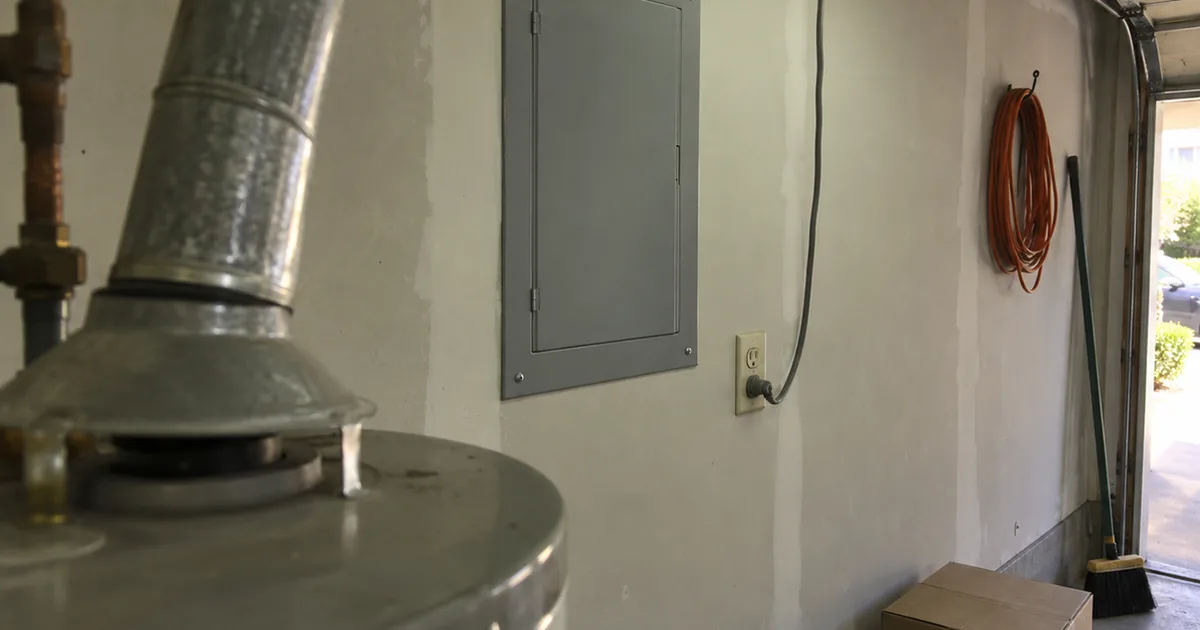
A Tri-Valley garage has a 40 gallon atmospheric-vent gas water heater on a raised platform. The data plate is legible. The input rating is under 75,000 BTU per hour. The date of manufacture is 2011. There is no 240 volt circuit anywhere near the unit. The nearest receptacle is a single 120 volt outlet shared with the garage door opener.
The seller’s agent asks whether the water heater must be replaced before closing because of “the 2027 ban.” No. This is a composite of a situation we meet often, not one identifiable property. The answer changes what both sides should actually be doing.
A home sale does not trigger replacement
A working gas water heater can remain in operation until it burns out or needs replacement. The rule is triggered when equipment is replaced, or purchased, not when a property is sold.
That is the Bay Area Air District’s wording in its April 2026 Regulatory Overview for the Rule 9-6 flexibility amendments. The District calls these point-of-purchase emission standards. The updated standards apply to new replacement appliances installed when an existing appliance reaches the end of its life and needs replacement, along with new equipment manufactured after the future compliance dates.
There is no sale trigger. There is no automatic retrofit requirement. There is no inspection certificate that makes a working water heater acceptable for sale.
A water heater may still have condition problems. It may leak, have damaged venting, lack proper seismic strapping, or show corrosion at the fittings. Those are inspection findings, and they are the ones that belong in a negotiation. They are not a replacement date created by the zero NOx rule. If you want the full picture of which appliances an inspection actually opens and reports, our guide to what a home inspection covers and what needs a specialist walks through the boundary.
The current schedule separates small tanks from tankless units
The current compliance schedule places water heaters less than 75,001 BTU/hr in the January 1, 2027 tier. The Air District’s Table 3, titled “Current Compliance Schedule for Rules 9-4 and 9-6,” states:
“January 1, 2027: Water heaters less than 75,001 BTU/hr (typically residential tank water heaters)”
“January 1, 2029: Residential and commercial furnaces”
“January 1, 2031: Water heaters between 75,001 and 2 million BTU/hr (typically commercial and multifamily as well as tankless units)”
The table carries this footnote: “(The above only applies to appliances manufactured after the noted date.)”
That footnote is the line most often missed. The date does not reach backward and make an older working appliance illegal. It applies to appliances manufactured after the listed date.
Tankless units are another common source of confusion. They sit in the 2031 tier, not the 2027 tier, under the current schedule.
Rule 9-4 covers “Nitrogen Oxides from Fan Type Residential Central Furnaces.” Rule 9-6 covers “Nitrogen Oxides from Natural Gas-Fired Boilers and Water Heaters.” The Board adopted the zero NOx amendments on March 15, 2023. Both rules were first adopted more than 30 years ago.
The Air District has proposed moving the smallest-unit date
The January 1, 2027 date is not settled for the smallest water heaters because Air District staff have recommended moving some of those units to January 1, 2031. Nothing has changed yet.
Staff released draft rule language and a preliminary staff report for Rule 9-6 flexibility amendments in July 2026. The 30 day public comment period closed on August 13, 2026 at 6 PM. The Board of Directors is tentatively scheduled to consider a decision on the amendments to Rule 9-6 in November.
The April 2026 Regulatory Overview states:
“For water heaters less than 35 gallons and hydronic units, staff recommend amending the compliance date to January 1, 2031 to allow for more time for market development and for the IWG to further evaluate technology readiness and costs at the appropriate time.”
A footnote says staff “is also considering setting this threshold at 30 gallons, based on feedback from manufacturers.”
That is a staff recommendation, not an adopted rule. Anyone quoting 2027 as settled for every small unit is quoting a number the Air District has itself proposed to change. Anyone saying the date has already moved is also wrong. The decision is not made. It is the same discipline we applied to California’s residential building code freeze: a proposal and an adopted rule are different things, and the gap between them is where most bad advice lives.
The proposed exemptions go with it. The same package would cover challenging installations caused by space constraints or the existing electrical system and panel upgrades, low-income qualified property owners, water heaters under 35 gallons, hydronic water heating systems, businesses with high-heat demand such as restaurants, healthcare facilities and dry cleaners, and temporary emergency gas water heaters installed by certified contractors. Staff estimate that “up to 38 percent of new water heater installations would qualify for exemptions,” with income-based eligibility accounting for approximately 18 percent and project or building constraints for another 20 percent. They recommend project-specific exemptions be granted “on a one-time basis per address or location,” plan a website where owners can request and immediately receive one, and note that “given the technical nature of the project specific exemptions, some participation from licensed contractors would be required.” None of that is a blanket permission to install any gas appliance. The Air District and the Board control the rule and its exemptions.
The rating plate holds the two numbers that matter
The water heater’s input rating and date of manufacture are the two facts that determine which replacement tier may affect it. Both are found on the appliance, usually on the rating plate or through the serial number.
The input rating is stated in BTU per hour. The 75,001 BTU/hr line is the tier boundary. A common residential 40 or 50 gallon tank sits well under it.
Tank capacity in gallons is also stated on the plate. That number matters because the proposed flexibility uses a less-than-35-gallon threshold, with staff also considering 30 gallons based on manufacturer feedback.
The date of manufacture is often encoded in the serial number rather than printed as a date. The encoding differs by manufacturer. We report what the plate and serial show. If the encoding is ambiguous, we say so rather than guessing.
Inspection.re reports carry tagged photographs of the rating plate, delivered the same day. The numbers are in the file instead of in somebody’s memory. Our sample inspection report shows how appliance data lands in the document.
Reading a rating plate tells you the tier. It does not tell you how long the unit has left. We do not predict remaining service life.
Gas stoves, ovens and dryers are outside these rules
Gas stoves, ovens and dryers are not covered by Rules 9-4 and 9-6. The Air District states that the rules “do not apply to gas stoves, laundry drying, or any other appliance that may use natural gas.” Its myths table repeats the point: “The rule does not apply to stoves, ovens, nor dryers.”
The rules are also not an electrification or decarbonization mandate. The Air District states that the purpose is reducing regional NOx emissions and the fine particle formation associated with them.
Applicability is not based on building type or installation date. It is based on BTU rating and date of manufacture.
“Zero NOx” does not mean the rule simply says every covered appliance must be electric. The only appliances currently meeting the zero-emission standard are electric. If a natural gas appliance demonstrates that it meets the standards, the Air District says it would be allowed. Gas is not stated to be categorically banned.
Furnaces follow a different date. Rule 9-4’s zero NOx date is January 1, 2029, two years after the current water heater date. An ultra-low NOx standard for residential fan-type central furnaces already applied from January 1, 2024. That sits alongside the separate federal refrigerant transition we covered in the R-410A changeover and what it means at a California inspection, which affects the cooling side of the same equipment closet.
Civil Code 1102.6j puts awareness on the seller’s disclosure
Beginning January 1, 2026, a seller of a single-family residential property covered by the statute must disclose known state or local requirements or restrictions concerning the future replacement of existing gas-powered appliances transferred with the property.
Senate Bill 382, authored by Becker, was approved by the Governor on September 22, 2024, and added Civil Code section 1102.6j. The statute requires that “the seller of a single-family residential property subject to this article shall disclose, in writing, the existence of any state or local requirements or restrictions relating to the future replacement of existing gas-powered appliances that are being transferred with the property to the extent they or their agent are aware of those requirements or restrictions.”
For this section, a gas-powered appliance includes, but is not limited to, appliances fueled by natural gas or liquid propane.
The duty is to disclose awareness of a requirement. It is not a duty to replace anything. It does not make the water heater a condition of sale.
The same bill added Civil Code 1102.6i, a separate written electrical system notice that also begins January 1, 2026. The two sections do different jobs, and we broke the electrical one down in California’s new electrical disclosure.
Questions about wording and delivery belong with the agent, broker and transaction file. Inspection.re does not prepare or review disclosures.
The electrical panel may control the replacement cost
When the replacement is a heat pump water heater, the question that usually decides the cost is electrical, not plumbing.
The Air District estimates the average incremental cost to install a heat pump water heater for a “standard” project at approximately $3,500. The incremental retail cost of a heat pump water heater compared to a new natural-gas fired unit ranges from $600 to $1,600. The remaining difference is additional labor to install the unit.
The District’s proposed exemption list specifically names “existing electrical system or panel upgrades” as a qualifying challenging installation. That is a direct signal that electrical limitations are part of the replacement problem. It is the same capacity question that shows up on older stock in our guide to undersized electrical service and fuse capacity, and the same panel question behind obsolete Federal Pacific and Zinsco panels.
During an inspection, we document the condition and capacity picture. That includes the service size at the panel, whether spare breaker space is visible, whether a nearby 240 volt circuit is present, and the physical clearance around the existing water heater. We also document the unit itself and its visible installation conditions.
We do not perform a load calculation. We do not design a circuit. That is an electrician’s work, and it belongs in a bid, not an inspection report.
In the Tri-Valley garage described above, the shared 120 volt receptacle does not answer the electrical question. It simply shows why the existing installation should be documented before anyone promises a replacement path. Inland from the bay, in Livermore and Pleasanton, that garage is often a detached or tucked-under space with a single circuit and a long run back to the panel, and in Dublin’s newer stock the panel is usually larger but the water heater sits in a closet with almost no clearance around it.
An inspection documents the appliance, not the regulation
An inspection reports the water heater and its visible installation conditions, not whether a future replacement qualifies under an exemption.
The report includes the rating plate data, venting arrangement and condition, seismic strapping, temperature and pressure relief valve and discharge piping, drain pan and termination, combustion air, clearances, and visible corrosion or leakage at the fittings and tank base. The same type of physical review applies to the furnace. Our what’s included page lists the systems we open and operate on every job, and the installation-safety deep dive covers the strapping, discharge and venting items in detail.
The report does not decide whether a replacement will qualify for an exemption. It does not predict what the Board will decide in November. It does not establish what a contractor will charge.
Those questions belong to the Air District, a licensed contractor and the permit record. Cities across California are also experimenting with how they verify appliance work at all, which is the subject of AB 1738 and remote inspections for water heaters, heat pumps and solar.
A visual inspection also has limits. We can report what is visible and readable. We cannot determine hidden deterioration inside a tank or promise that a unit will keep operating. We do not turn the manufacture date into a service-life forecast.
If a water heater is old enough that replacement is likely inside a couple of years, that is a repair-credit conversation now. It is a conversation about condition and age, not about a compliance date.
Quick FAQ
Do I have to replace my gas water heater in 2027?
No. A working existing water heater can remain in operation until it burns out or needs replacement. The current 2027 schedule applies to covered new appliances manufactured after the noted date.
Does selling my house trigger the rule?
No. The Air District says the rule is triggered when equipment is replaced, or purchased, not when a property is sold. The seller may have a disclosure duty if aware of applicable replacement requirements or restrictions, but that is not a replacement duty.
My water heater is tankless. Which date applies?
Tankless units are listed in the January 1, 2031 tier under the current compliance schedule. The table identifies water heaters between 75,001 and 2 million BTU/hr as typically including tankless units.
Does this apply to my gas stove?
No. The Air District states that the rules do not apply to stoves, ovens or dryers. The rules concern the covered equipment described under Rules 9-4 and 9-6.
What actually determines whether my replacement is affected?
The appliance’s BTU rating and date of manufacture are the main facts. Tank capacity also matters for the proposed less-than-35-gallon flexibility, with staff considering a 30 gallon threshold. More questions of this kind are answered on our FAQ page.
The rule starts at burnout, not at sale
The rule bites when a covered water heater reaches the end of its life and is replaced, not when a home changes hands. The current 2027 date is real for units under 75,001 BTU/hr, while the Air District has proposed moving it to 2031 for units under 35 gallons. A Board decision is tentatively set for November.
Read the rating plate and serial number. Photograph them. Record the electrical conditions before the sale contingency closes. If the appliance needs a closer look, get the existing unit properly documented and send disclosure questions to the agent, broker and transaction file. We inspect across the Bay Area, including Oakland, San Francisco and the Tri-Valley, and the appliance section of the report reads the same way in all of them.
Related reading
-
California’s new electrical disclosure: the other Civil Code section Senate Bill 382 created, and why a notice is not an inspection.
-
Water heater installation safety: strapping, discharge piping, venting and garage elevation, item by item.
-
AB 1738 and remote inspections: how some California jurisdictions now verify water heater and heat pump permits.
-
The R-410A refrigerant change: the parallel transition on the cooling side of the same equipment.
-
Who Decides What the Building Code Means. A replacement appliance still needs a permit, and which conditions a building department attaches to that permit varies by jurisdiction.
-
AB 2313: The Gas Company May Pay You to Quit Gas. A separate state law: an electrification incentive instead of a replaced gas service line, from 2028.
If the replacement is a heat pump water heater, the permit side changes too: SB 222 caps the permit fee at $150 and adds asynchronous inspections.