The Hose Bib With No Guard: A Moreno Valley Backflow Prevention Guide for Agents
The property sat on just under an acre off Perris Boulevard, a horse setup with a barn, a small paddock, and a drip irrigation system feeding a row of fruit trees along the fence line. The irrigation had been added by a previous owner, tied into the house’s main supply line ahead of the water meter’s own backflow protection, with no device of its own at the connection point. Nobody had done anything wrong on purpose. The system worked fine every day the water was flowing forward. The risk only shows up the day it is not, when a break in the street main or a fire hydrant draw drops supply-side pressure and the water in that irrigation line, sitting in contact with soil, fertilizer, and standing water in a stock tank, gets pulled backward into the same pipe that feeds the kitchen faucet.
We are describing this as a composite of what we see across several Moreno Valley inspections a year on larger properties with wells, irrigation systems, or livestock setups, not one identified property or job. The pattern repeats often enough on this city’s bigger lots that it is worth understanding before an escrow, not during one.
This guide is for the agent working Moreno Valley and the surrounding communities we also serve, including nearby Perris, Riverside, and San Jacinto, where the same larger-lot, irrigation-heavy, and ag-adjacent property mix produces the same cross-connection pattern. Here is what backflow prevention actually is, what an inspector can and cannot certify about it, and how a finding usually plays out in escrow.
Why this matters for the agent
Most buyers have never heard the term “backflow prevention” until an inspection report uses it, and the word “cross-connection” means nothing to them at all. That gap matters because the failure mode is not intuitive. A buyer understands a leaking pipe. A buyer does not automatically understand that water can travel backward through a pipe under the right pressure conditions, carrying whatever it touched on the way, potentially back into the house’s own drinking water supply. An agent who can explain that mechanism in plain terms, and who knows what device is supposed to be present and where, turns a confusing report item into a clear, manageable finding.
Moreno Valley adds a specific reason this comes up more here than in a typical suburban tract city. The city has a real share of larger residential lots, active irrigation systems for landscaping and small orchards, private wells on some older and rural-edge parcels, and a genuine equestrian and small-acreage culture, particularly toward the east side of the city and the unincorporated pockets nearby. Every one of those features is a potential cross-connection: a point where the potable water system touches something that is not potable water.
What backflow and cross-connection actually are
A cross-connection is any point where a potable water system is physically connected, even temporarily, to a source of non-potable water: an irrigation system, a pool fill line, a well, a boiler loop, a stock watering trough, even a garden hose left submerged in a bucket of soapy water. Under normal conditions, water only flows one direction through that connection, out of the potable system and into the non-potable one, so the connection is not a problem by itself.
Backflow is what happens when that direction reverses. There are two distinct mechanisms, and it is worth an agent knowing both because they call for different protection.
Back-siphonage happens when pressure on the supply side of the connection drops below atmospheric pressure, for example during a water main break, heavy fire-hydrant draw, or the utility shutting down a section of main for repair. A vacuum forms and, exactly like a straw, pulls whatever is on the other side of the open connection backward into the supply line.
Backpressure happens when the pressure on the non-potable side of the connection is higher than the supply pressure, for example a boosted irrigation pump, a pressurized boiler system, or an elevated tank, and simply pushes water back the wrong way through the connection.
Either mechanism can pull contaminated water, fertilizer and pesticide residue, standing pond or trough water, or non-potable well water back into the same pipe that supplies drinking water fixtures inside the house. This is why plumbing code requires a backflow prevention device at every cross-connection, sized and rated to the level of hazard the connection actually presents.
The device types an inspector will actually see
Backflow devices come in a few common configurations, and the right one depends on how serious a hazard the connection represents. An agent does not need to memorize the code tables, but knowing what each device looks like helps translate a report finding into something a buyer can picture.
- Atmospheric vacuum breaker (AVB). The simplest device, commonly a small cylindrical fitting threaded onto a hose bib or installed on an individual irrigation zone valve. It only protects against back-siphonage, not backpressure, and it has to be installed above the highest point of use on that line, typically a minimum height above grade specified by the manufacturer and code. An AVB cannot have a shutoff valve downstream of it, because that would defeat its ability to vent to atmosphere.
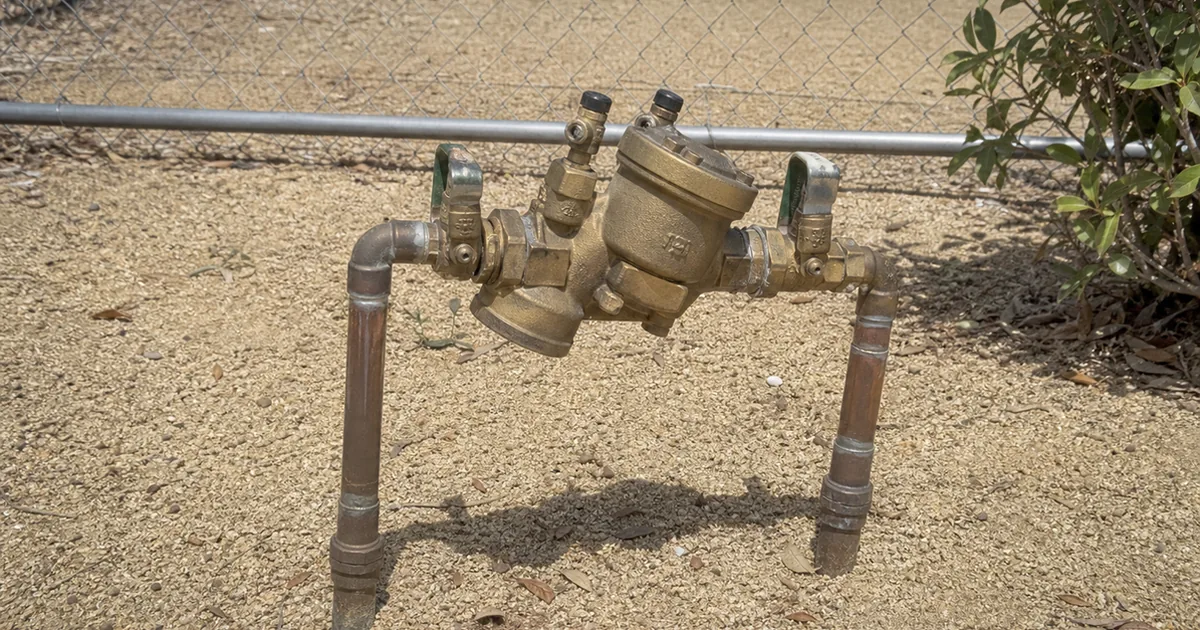
- Pressure vacuum breaker (PVB). A step up from an AVB, used on a full irrigation system rather than a single hose bib. It includes a spring-loaded check and an air-inlet valve, tests under pressure, and is a testable, code-recognized assembly on most residential irrigation mainlines.
- Double-check valve assembly (DC or DCVA). Two independent check valves in series, protecting against both back-siphonage and moderate backpressure. This is a common device on residential irrigation systems and on connections judged a low-to-moderate hazard.
- Reduced-pressure zone assembly (RPZ or RP). The highest level of protection available for residential use, with two check valves and a relief valve that dumps water to atmosphere if either check fails, so a failure is visible rather than silent. This is the device typically required on a well connection, an ag or irrigation cross-connection judged a higher hazard, or any connection where contamination risk is greater. RPZ assemblies are also the device most often subject to a required annual test by a certified backflow tester, a local code and water-purveyor requirement that varies by jurisdiction.
Schedule a Moreno Valley inspection →
What actually goes wrong
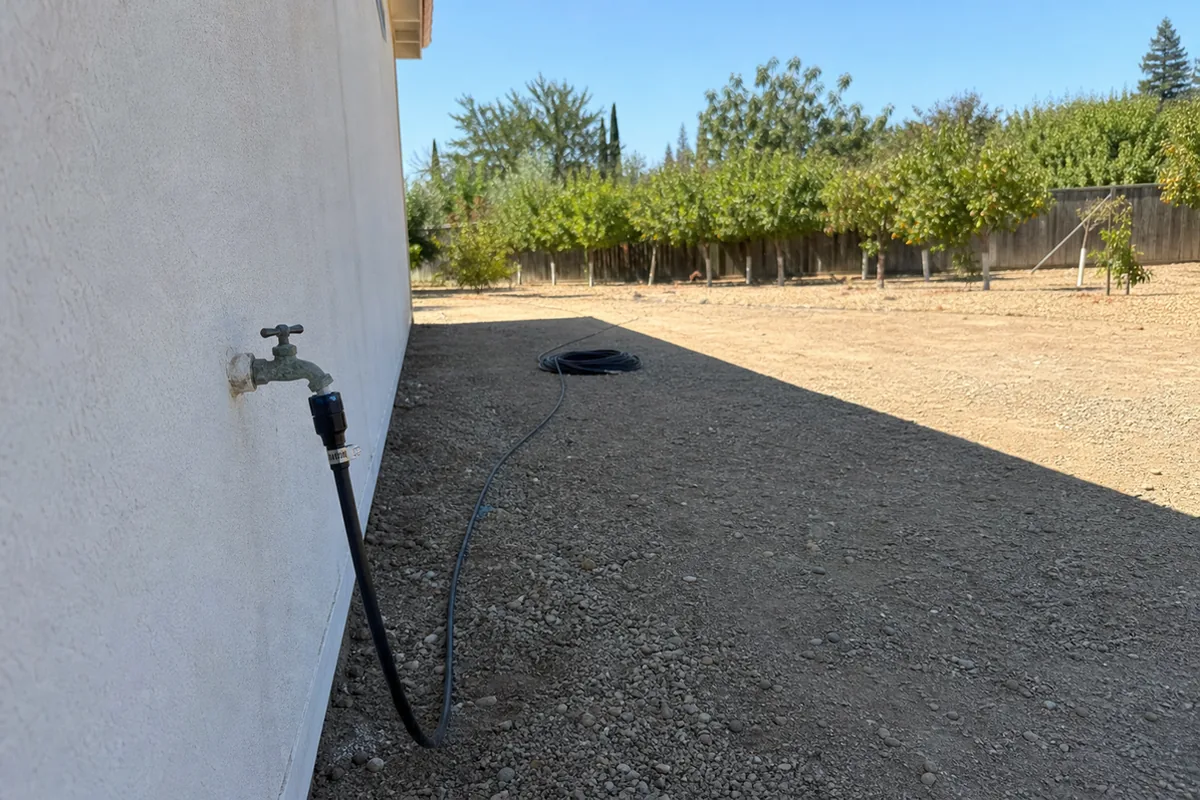
- No vacuum breaker at all on a hose bib or irrigation zone. The single most common finding on older stock and DIY irrigation additions. A bare hose bib with a hose left attached and submerged in a bucket, trough, or pool is a textbook cross-connection with zero protection.
- A device installed below the required height above grade. An AVB relies on its position above the highest downstream outlet to function. One installed too low, or one that has settled with grading changes over the years, may not actually protect against back-siphonage even though it is physically present.
- A bypassed, removed, or jumpered check assembly. Sometimes a device is removed for a repair and never reinstalled, or bypassed because it was restricting flow, leaving the connection with no protection at all while everything still looks plumbed correctly at a glance.
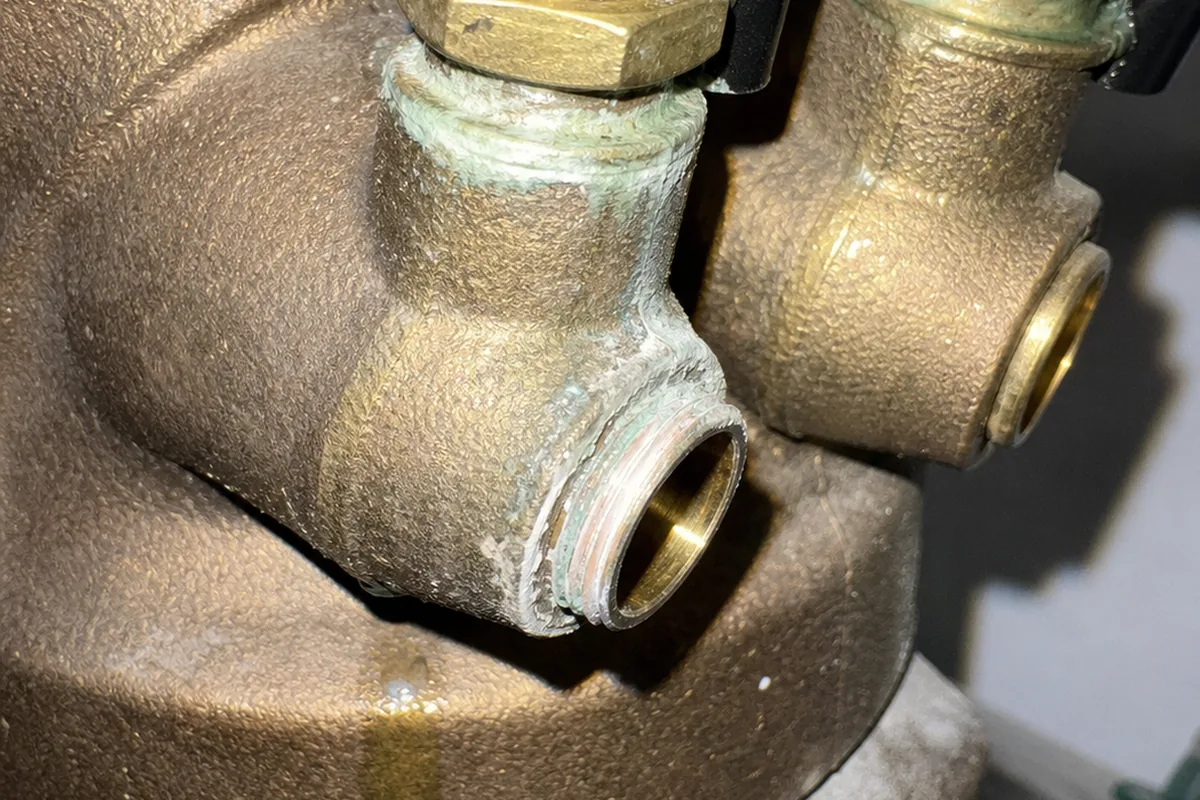
- Corroded or leaking test cocks and unions. RPZ and DC assemblies have small test cocks used by a certified tester to check each check valve. Corrosion, a stuck cap, or a slow weep at these fittings is a visible sign of age and a reason to recommend testing sooner rather than later.
- An irrigation system tied in ahead of any protection. The Perris Boulevard composite above: an irrigation main tapped into the house supply line upstream of the meter’s own backflow protection, or upstream of where a device was ever installed, so the entire irrigation system is an unprotected cross-connection regardless of what happens further downstream.
- A well or private water source cross-connected to the public supply without an approved air gap or RPZ. Less common inside city limits than on the unincorporated ag-adjacent edges nearby, but it is the highest-hazard version of this finding and always warrants a specialist evaluation.
- A missing or expired annual test tag on an RPZ assembly. Where local code and the water purveyor require annual testing, a device with no visible test tag, or one several years expired, is a compliance gap even if the device appears to be functioning.
What agents should tell every buyer
- A backflow device’s presence and general condition can be visually documented on a home inspection, but the device’s actual pass/fail performance can only be verified by a certified backflow tester using calibrated test equipment. The inspection is not a substitute for that test.
- If the property has an irrigation system, ask whether it has ever been tested or serviced, and whether the seller has any record of a backflow test, particularly if an RPZ assembly is present.
- A property with a well, a pool fill line, or livestock watering should be treated as having a higher cross-connection risk by default, and any hose bib without a visible vacuum breaker is worth pointing out during a showing.
- This is a plumbing code and water-quality issue, not a structural or cosmetic one, and it is usually inexpensive to correct compared to most other inspection findings, an important point for negotiation.
- Local water purveyors, not just the state plumbing code, often set their own annual testing and device-registration requirements. A buyer should ask the local water agency directly rather than assume a single statewide rule applies everywhere.
- None of this is about whether the water currently tastes or looks fine. Cross-connection risk is about what could happen under specific pressure conditions, not a day-to-day water-quality complaint.
Red flags during showings
Some of this is visible without any special equipment.
- A hose bib with a hose permanently attached, especially one submerged in a bucket, trough, pool, or spa.
- Any visible irrigation valve box or backflow device with a cracked, missing, or zip-tied-shut cover.
- A brass assembly with test cocks near the front hose bib or the side yard where an irrigation main enters the house, worth asking about even if it looks intact.
- Corrosion, mineral staining, or a slow drip at a device’s test cocks or relief port.
- Any well head, stock tank, or pond visible on the property, all of which raise the cross-connection question even before checking for a device.
- A missing or clearly out-of-date test tag zip-tied to an RPZ assembly.
If we see these, we document the device type, location, and visible condition, and we flag whether testing or further evaluation by a certified backflow tester is warranted.
The negotiation playbook
When a backflow finding surfaces in a Moreno Valley escrow, the deal usually moves down one of a few paths.
The first path is installing a missing device, appropriate when a hose bib or irrigation zone has no vacuum breaker at all. This is typically a small, inexpensive fix and rarely holds up a closing.
The second path is a certified backflow test, appropriate when a device is present, appears intact, but has no test record or an expired one. This confirms whether the device is actually functioning, not just physically installed.
The third path is device replacement or upgrade, warranted when a device is clearly failed, corroded through, or judged undersized for the hazard level of the connection, for example a bare DC assembly on what should be an RPZ-protected well or ag connection.
The fourth path is a credit or informed acceptance, appropriate when the finding is minor, such as a slightly low-mounted AVB on a single hose bib, and the buyer wants to proceed and address it after closing.
How the inspection actually catches it
We walk the full exterior of every Moreno Valley property looking specifically at hose bibs, irrigation valve boxes, and any point where a secondary water source, a well, a pool, livestock watering, meets the plumbing system. We document the presence, apparent device type, and visible condition of any backflow assembly we find, including corrosion, missing covers, and test tag status.
We do not perform a certified backflow test ourselves. That requires calibrated gauge equipment and a state or local certification specific to backflow testing, a different scope from a general home inspection, the same boundary we describe in our tankless water heater guide for appliance-specific specialist work. Where we find a missing device, a device installed incorrectly, or a device that looks aged and untested, we say so plainly in the report and recommend the appropriate specialist scope. Our what’s included page covers the full exterior and plumbing scope of every Moreno Valley inspection.
Quick FAQ
Is a missing vacuum breaker on a hose bib a big deal? It is a real, code-recognized deficiency and a genuine cross-connection risk, but it is also one of the least expensive things on this list to correct. It is worth documenting and fixing, not a reason to panic.
Does every property with irrigation need an RPZ assembly? No. The required device depends on the hazard level of the connection. A simple landscape irrigation system with no chemical injection may only require a double-check assembly or a pressure vacuum breaker. A well, an ag connection, or a system with fertilizer injection typically requires the higher-protection RPZ.
Who actually tests these devices? A certified backflow tester, typically a specialized plumber or a dedicated testing company, using calibrated equipment to verify each check valve and relief mechanism functions correctly. This is separate from a home inspection.
Is this the same issue as water pressure problems covered elsewhere? No. Our Porter Ranch water pressure guide covers water arriving at the house too hard, from the street toward the fixtures. Backflow is the opposite direction, water being pulled or pushed backward into the supply from a connection at the property. They are different failure directions on the same plumbing system.
Should a buyer walk away over a backflow finding? Almost never on the finding alone. What matters is which device is missing or failed and what correcting it actually costs, which is usually modest relative to the property value. A well-documented finding is a negotiation point, not a deal-breaker.
The honest summary
Moreno Valley’s larger lots, active irrigation systems, and ag-adjacent properties make cross-connections a real and checkable finding here in a way that is less common on a typical small-lot tract property. None of this means the water on a given property is unsafe today. It means the property has a connection point that needs the right protection in place, tested on the schedule the local water agency requires, so that a pressure event somewhere in the system does not become a water-quality problem inside the house.
We document every hose bib, irrigation connection, and visible backflow device on every inspection, and we tell you plainly whether a device is present, appears intact, and looks tested, or whether it warrants a certified tester’s attention before you close. That is the job on every larger-lot property we inspect in this market.
See what every inspection includes → · Read our FAQ → · Explore Moreno Valley home inspections →
Related reading
- Water Pressure and the Pressure Reducing Valve in Porter Ranch. The opposite failure direction on the same plumbing system, water arriving too hard rather than being pulled backward.
- Tankless Water Heater Venting in Rancho Santa Fe. Another appliance-and-fixture-specific plumbing topic where the inspection documents condition but a specialist confirms performance.
- Copper Pinhole Leaks in Tustin. A different plumbing failure mechanism, corrosion pitting rather than cross-connection risk, useful context on how water chemistry shapes different findings.
- How to Read a Home Inspection Report in California. How a finding like this gets prioritized and handed to the right specialist in writing.
- Generator and Transfer Switch Safety in Hemet. A backup-power electrical topic from a neighboring Inland Empire city, unrelated to plumbing but a useful companion on the visual-inspection-versus-specialist boundary.