A freshly turned-over house is going on the market. Every hallway and bedroom has a brand-new combination smoke and carbon monoxide detector with a small digital readout. A plug-in gas and CO detector sits in the kitchen outlet.
Everything is new. Everything beeps when someone presses the test button. The seller believes the alarm item is finished.
This is a composite of situations we see, not one house. Some of those exact device types were the subject of federal warnings this summer. The test button proves that the horn sounds and the battery has power. It does not prove that the sensor will detect smoke or carbon monoxide.
Four federal actions targeted online combination detectors between June and August 2026
The CPSC issued one recall and three stop-using warnings involving combination smoke and CO or gas and CO detectors sold mostly through online marketplaces.
On June 25, 2026, the CPSC announced the Treatlife Technology recall, CPSC recall number 26-582. The affected Treatlife Smoke and Carbon Monoxide Detectors are white, circular, and operated by AA batteries. They have a colored light and a test button.
The bottom of the unit shows FCC ID “2ANDL-XR3” and a manufacture date in a format such as “2023.DEC.02.” About 20 units were sold exclusively through Amazon.com from November 2025 through April 2026 for about $40.
The hazard is direct. The alarm can fail to alert consumers to a fire. The remedy is a full refund. CPSC tells owners to keep using the alarm until a replacement is installed. After that, write “recalled” on the unit, remove the batteries, and dispose of it.
On July 9, 2026, the CPSC warned about JNHCD combination smoke and CO detectors sold on Amazon.com, eBay.com, and Sears.com. The notice lists 14 Amazon ASINs. The detectors can fail to alert consumers to smoke and fire.
The China-based seller did not respond to CPSC’s requests for a recall. CPSC says to stop using the detectors immediately. Do not sell them. Do not give them away.
On August 20, 2026, the CPSC warned about “4 in 1” plug-in natural gas and carbon monoxide detectors, model KH158. The warning covers 376,974 units sold from June 2024 through July 2026 on Amazon.com, eBay.com, AliExpress, microcenter.com, and snapklik.com. The listed price range was $13 to $140.
The devices were sold under 18 brand names:
ARIKON, ELECOIN, FLUNGSKY, HAOKESITE, Hembisen, JNHCD, KAKIMENT, KH Alert, KOABBIT, NICGOL, NORJAN, OUMEBIU, Sooguard, Vilfet, Vzmcov, WESHLGD, XLA Alert, and YOJOCK.
The KH158 devices are white, gray, or black plastic. They have a digital display, a “SELF-TEST” button, and three indicator lights: green for power, yellow for fault, and red for alarm.
CPSC is aware of 91 reports that the detector failed to alarm despite dangerous carbon monoxide or gas levels. The manufacturer, Shenzhen Kanghua Shengshi Industrial Co., doing business as KH Alert, has not agreed to a recall.
A separate warning issued the same day covered TJTFJS 2-in-1 CO and smoke detectors, model TJ00907. These white plastic detectors have a digital display and were sold on Amazon.com, Walmart.com, Kmart.com, Sears.com, and Desertcart.com. They can fail to alert to smoke and fire. The seller did not respond to CPSC recall requests. The warning number is 26-708.
JNHCD appears in both the July warning and the KH158 brand list. That is one reason brand names are not a reliable identifier. Read the model number and the listing details.
A warning is not a recall, so most owners should expect no refund
Three of the four federal actions are warnings, not recalls. The sellers refused or failed to respond to CPSC, so there is no refund program, no replacement program, and no customer service contact arranged through the warning.
The practical remedy is to take the device down and buy a different one.
Only the Treatlife action is a recall with a refund. CPSC’s instruction for the Treatlife unit is to keep using it until a replacement is installed, then mark it “recalled,” remove the batteries, and dispose of it. Do not apply that instruction as a reason to keep using one of the other warned devices.
CPSC advises consumers to buy carbon monoxide detectors that meet the UL 2034 safety standard. Smoke detectors should meet UL 217. A combination unit should carry markings for both standards.
The price on the online listing is not a safety certification. A digital display is not a safety certification. A successful push test is not a safety certification.
California has a listing gate, and two physical clues expose some questionable units
California’s own standard is a useful yardstick for what a California alarm looks like. Health and Safety Code section 13114(b)(1) says a person may not market, distribute, offer for sale, or sell a fire alarm system or fire alarm device in California unless it has been approved and listed by the State Fire Marshal.
Section 13263(b) applies the same basic gate to carbon monoxide devices. A person may not market, distribute, offer for sale, or sell a carbon monoxide device in California unless the device and its instructions have been approved and listed by the State Fire Marshal.
Under section 13263(a)(1), the State Fire Marshal operates a certification and decertification process that considers effectiveness and reliability, including the device’s propensity for false alarms. The process also reviews the manufacturer’s instructions against building standards concerning number and placement.
The listing runs through the State Fire Marshal’s Building Materials Listing program. Listing is based on certification by a State Fire Marshal approved nationally recognized testing laboratory.
A shipped-from-overseas marketplace listing does not pass through that California gate before it lands at a front door. We have not checked every listing, and we are not stating that a particular warned model is or is not listed.
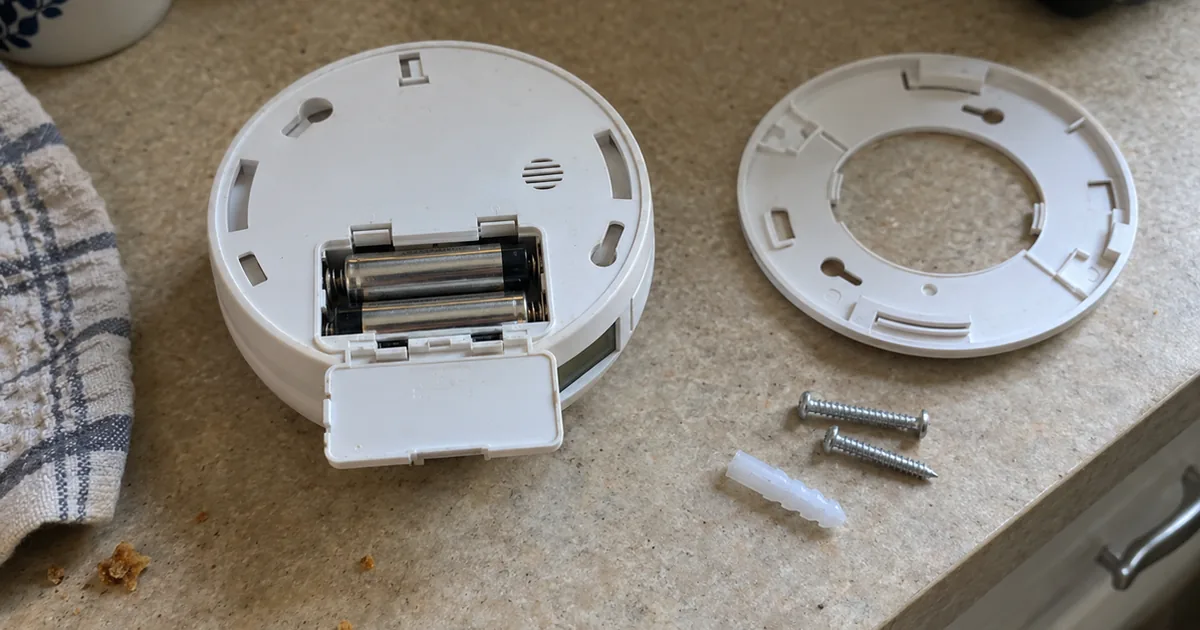
The label is on the back. You have to twist the unit off its base plate to read it.
The first physical clue is a battery door with replaceable AA cells on a battery-only smoke alarm or smoke and CO combination unit. Since July 1, 2014, a smoke alarm that operates only by battery must contain a nonreplaceable, nonremovable battery capable of powering it for at least 10 years to be approved and listed under Health and Safety Code section 13114(b)(2)(A).
That makes an openable battery compartment with swappable AA cells a strong sign that the unit was not made to California’s listing requirements. It is a strong sign, not proof. Hardwired units with a backup battery are a different case. The State Fire Marshal can also make exceptions for some interconnected and wireless devices.
The second clue is a missing manufacture date. Since January 1, 2015, smoke alarms must display the date of manufacture, provide a place to write the installation date, and include a hush feature under section 13114(b)(3).
The recalled Treatlife unit shows why the date matters. Its manufacture date appears on the bottom in a format such as “2023.DEC.02.” If you cannot find a manufacture date after removing the alarm from its base, stop treating the device as a completed alarm installation.
If you want another set of eyes on the devices before listing, schedule an inspection.
Six checks can clear the alarm question before the listing goes live
-
Take down each combination unit and read the back. Look for the model number, FCC ID, and manufacture date. Compare those details against the four CPSC notices. Search cpsc.gov for the model, not just the brand name.
-
Check every plug-in gas and CO detector with a display. If it has a digital display, a “SELF-TEST” button, and green, yellow, and red lights, look for model KH158 on the label.
-
Replace battery-only units with openable battery doors. A smoke alarm with an openable door and AA cells should be replaced with a sealed 10-year unit.
-
Buy marked devices through a normal retail channel. Look for an established manufacturer and markings for UL 217 for smoke detection and UL 2034 for carbon monoxide detection. A combination unit should carry both markings.
-
Do not leave warned units for the next owner. Do not donate them. Do not resell them. Do not put them in the garage with the idea that someone else can decide later. CPSC says not to sell or give away the warned devices.
-
Keep the receipt and photograph the replacement label. The receipt shows when the new devices were purchased. The label photo shows the model and markings. That answers the question before someone asks it during escrow.
The fastest approach is physical, not digital. Remove the unit. Read the back. Photograph the label. Check the model against the CPSC notice. Then replace the questionable device before the house is being shown.
The alarm statement in a sale leaves little room for a warned device
The California Association of Realtors purchase agreement gives required installation of smoke alarms and carbon monoxide devices its own short line in the time table. The printed default is seven days after acceptance. Unless exempt, the seller delivers written statement or statements of compliance before close of escrow.
A seller signing that statement over a device CPSC has told people to stop using is in an uncomfortable spot. The unit may be new. It may look clean. It may pass the push test. Those facts do not answer whether the device can detect smoke or carbon monoxide.
This is a practical inspection point, not legal advice. The agreement language, the property’s facts, and any exemption can affect what is required. The simple property decision is still clear: do not leave a warned unit installed when the alarm statement is being prepared.
For agents, the label photograph belongs in the file with the replacement receipt. For sellers, the replacement should happen before the final walk-through becomes a search for missing or questionable devices.
The alarm guards the source, not just the ceiling
An alarm is the last line. It is not a repair to the condition producing the hazard.
Look past the ceiling and identify what the alarm is guarding. A gas water heater and its venting can matter. A tankless water heater and its venting can matter. A furnace can matter. An attached garage can matter.
Our guide on where the alarms go and what expires covers placement, counts, and expiry. This article deliberately does not repeat those subjects.
For the equipment and building conditions around the alarm, see tankless water heater venting, garage to house fire separation, and water heater installation problems we find.
A functioning alarm cannot correct blocked, damaged, or improperly installed equipment. Replacing the detector is the immediate product fix. The source still needs to be inspected on its own terms.
An inspection can identify the alarm, but it cannot certify the sensor
A home inspection is a visual, noninvasive examination. We note the presence and location of alarms, the manufacture date, and whether the unit appears disabled. When we take a combination unit down to read its date, the label goes into the report photos, so the model can be checked against the CPSC notices.
We do not certify that an alarm will detect smoke or carbon monoxide. A push test proves the horn and battery. It does not prove the sensor.
That boundary matters when a device looks new. Inspectors can identify the label, find a missing date, see an openable battery compartment, and report an apparent concern. We cannot turn a home inspection into a laboratory test of the sensing element.
Our reports come back the same day with photos. Each finding is tagged inside a 3D Matterport tour, so an agent can show a seller exactly which ceiling has the questionable unit.
See how to read the report and what an inspection covers and what needs a specialist.
Recalled products are not new territory for inspectors. The Federal Pacific and Zinsco panels are the older example. The inspection task is the same in one useful respect: identify the product, document its condition and location, and give the client a specific next action.
Quick FAQ on the 2026 alarm warnings
Does the test button prove the alarm works?
No. It proves that the horn sounds and the battery has power. It does not prove that the sensor will detect smoke or carbon monoxide.
Is every combination detector sold online unsafe?
No. The problem is specific models. Check the label, compare the device with the CPSC notices, and buy a device marked for UL 217 and UL 2034 through a normal retail channel.
The seller of my warned unit will not answer. Can I get a refund?
For the three warnings, CPSC says the sellers have not agreed to a recall. There is no stated refund program. Replace the device.
Can a California seller just leave the old units up?
Treat a warned unit as not working and replace it before the compliance statement. Do not sell it, donate it, or give it away.
How do I report a failure?
Report it at SaferProducts.gov or call the CPSC hotline at 800-638-2772.
The cheapest device in the house is easy to buy wrong
The fix costs little compared with the disruption caused by discovering the problem during escrow. Remove the unit from the base plate. Read the label. Check the model. Replace the questionable device. Keep the receipt and the replacement photograph.
Review what is included in every inspection, our inspection FAQ, and a sample inspection report.
We inspect statewide, including Ontario, Los Angeles, San Francisco, and Temecula.
Related reading
- The Cheapest Thing That Stops a Closing: Ontario Smoke and CO Alarms covers alarm placement, counts, and expiry.
- Tankless Water Heater Venting covers the venting conditions around tankless equipment.
- Federal Pacific and Zinsco Panels covers an older recalled-product issue inspectors still find.
- How to Read a Home Inspection Report in California shows how to use the report and its photographs.