When we write up a furnace or air conditioner that is clearly older, the buyer’s first question is whether it is about to die and whether the seller has to pay for a new one.
A report cannot answer either question. Age is not a defect by the inspection standard we work under. The decision is how to plan for the system.
Sort it into three groups: runs and looks old, runs with a defect, or did not run. Then decide whether you need an ask, a written bid, or a budget line before the inspection contingency ends. This is not legal advice or HVAC-contractor advice.
The report records that it ran, not how long it will last
A home inspection reports whether the heating and cooling systems operated with normal controls. It does not predict their remaining life.
The InterNACHI Standards of Practice, last revised October 2022, says under Section 3.4 that the inspector shall inspect “the heating system, using normal operating controls.” The inspector shall report as in need of correction “any heating system that did not operate” and “if the heating system was deemed inaccessible.”
The same section does not require the inspector to “determine the uniformity, temperature, flow, balance, distribution, size, capacity, BTU, or supply adequacy of the heating system.”
Section 3.5 covers cooling. The inspector shall inspect “the cooling system, using normal operating controls.” The inspector is not required to “operate equipment or systems if the exterior temperature is below 65° Fahrenheit, or when other circumstances are not conducive to safe operation or may damage the equipment.” The inspector is also not required to “examine electrical current, coolant fluids or gases, or coolant leakage.”
Section 2.1 item 8 states: “An inspection does not determine the life expectancy of the property or any components or systems therein.”
The standard also says under Section 1.2 on material defects: “The fact that a system or component is near, at, or beyond the end of its normal, useful life is not, in itself, a material defect.”
Section 2.2 does not require the inspector to determine “the age of construction or installation of any system, structure or component of a building”.
So an old system that ran will often read as “operated,” sometimes with a note about visible age. That sentence is not a clean bill for the next five years. It records what happened during the inspection.
If a one-line HVAC comment leaves you unsure what it covers, how to read each section of the report separates an observation from a limit.
Our reports arrive the same day, within 6 to 8 hours, and can include a Matterport 3D tour with findings tagged in place, so a contractor can be sent to the exact closet or attic. See a same-day report with findings tagged in place.
Age is a number you read from the equipment, and it is not exact
The data plate on the equipment is where age comes from. Decoding a serial number is a job for the manufacturer’s own lookup or a technician.
The U.S. Department of Energy’s 2022 “Energy Saver Guide” says to “Consider replacing your existing heating system if any of the following are true.” Its list includes:
- “Your heat pump or air conditioner is more than 10 years old”
- “Your furnace or boiler is more than 15 years old”
- “Your equipment needs frequent repairs and your energy bills are going up”
- “Some rooms in your home are too hot or too cold”
- “Your heating or cooling system is noisy”
The DOE’s 2016 Energy Saver home-cooling infographic lists a central air conditioner “LIFE SPAN: 15-20 years.”
Those are general planning figures for the type of equipment. They are not a prediction for the unit in this house. They do not come from our inspections.
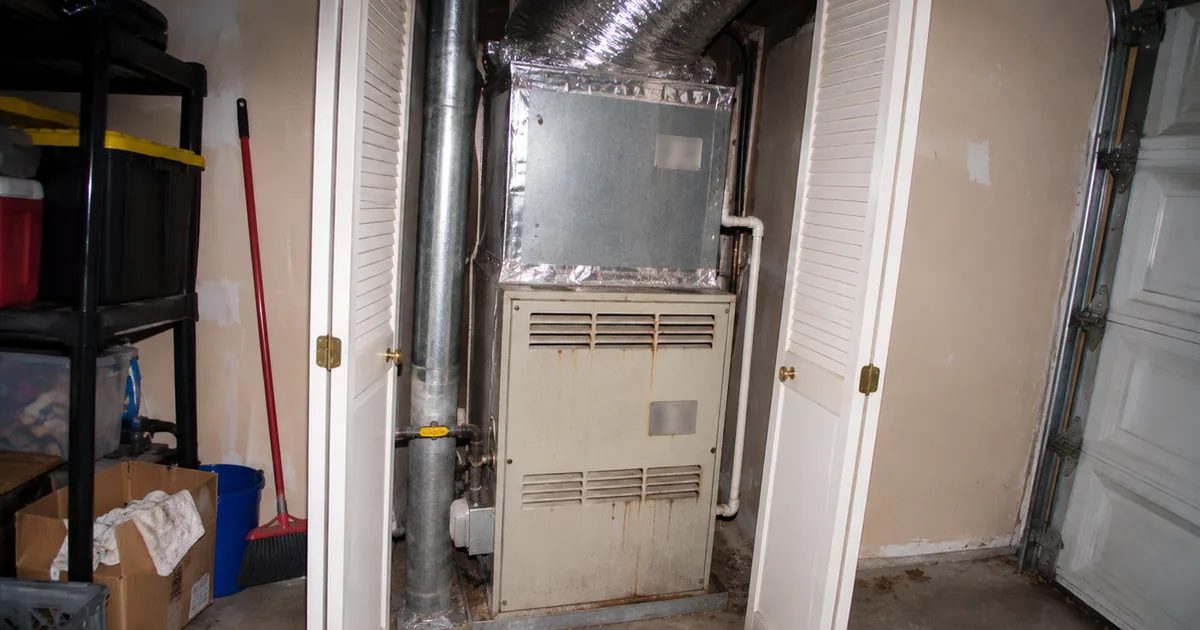
Start with the manufacture date shown on the data plate in the report photos. Then ask whether the indoor and outdoor units were installed together. Split systems often have two plates with two dates.
Do not assume age from cabinet condition. A clean old unit and a dirty young one both exist.
Serial-number date codes differ by manufacturer. Ask the HVAC technician to confirm the date rather than decoding it yourself.
The age matters because it changes the buyer’s planning conversation. It does not answer whether the system has a defect today. A 15-year-old air conditioner that operated normally is a different report finding from a 15-year-old air conditioner that did not operate or has a failed part.
Five report wordings lead to five different moves
Most HVAC lines in a report fall into five situations, and each leads to a different move.
| What the report says | What it means | Usual move |
|---|---|---|
| Operated normally, equipment is older, no defect noted | The visible check passed, and the age is a budget fact, not a repair item | Plan and budget; consider a written bid; usually no repair request |
| Operated, with a specific defect noted, such as weak airflow, short cycling, noise, rust or staining, a failed part, or water at the indoor unit | A defect on top of age | Ask a licensed HVAC contractor to evaluate in writing before the deadline, then repair, credit or price change from that scope |
| Cooling not operated because outdoor temperature was below 65 F, or heating not run, or no access, power or gas | Operation is unknown | Ask the seller in writing for access and a run, or an HVAC evaluation, while the contingency is open |
| A room that stays hot or cold, or ducts that look disconnected, crushed or uninsulated in an attic or crawl space | A distribution problem, not only a box problem | Have the contractor look at ducts as well as equipment, and read the duct testing point below |
| The report mentions an older indoor unit paired with a newer outdoor unit, or the reverse | A possibly mismatched system | Ask the contractor whether the two units are matched and what a change-out would involve; see the refrigerant guide |
Furnace safety questions involving the heat exchanger and carbon monoxide are in what an inspector can and cannot tell you about a furnace. Refrigerant and mismatched systems are in what the R-410A change means for a listing.
FLIR infrared helps us see surface temperature patterns. A cold ceiling stripe, for example, can suggest a leaking or uninsulated duct. It does not measure airflow, refrigerant charge or remaining life. See what a thermal image can and cannot tell you.
The wording controls the next phone call. A row one system calls for planning. A row two system calls for written evaluation. A row three system calls for access, operation or an HVAC evaluation before the deadline.
An old system that works is usually a budget item, not a repair request
Because age alone is not a defect under the standard, a request that says only “furnace is old, please replace it” gives the seller little reason to say yes. It can also make the buyer look difficult.
The public copy of C.A.R. Form RR, revision 12/18, lets the buyer check repair, credit, price reduction and pest work. More than one box can be checked.
The seller has no obligation to respond. A credit must be disclosed to the buyer’s lender. The form warns that a credit may not be enough to remedy all defects.
If the seller agrees to all requests, Form RR makes that agreement conditional on the buyer removing the physical inspection contingency and releasing the seller and brokers regarding the disclosed condition. Check the revision on your own paperwork.
Ask for a repair or credit when there is a specific defect or an unknown, such as a row two or row three finding. Tie the request to a written contractor scope.
For a row one system, treat age as a price and planning conversation. Have it before the offer is final where possible, or put it in the buyer’s first-year budget. Do not give a dollar number. This article gives no price because none of the sources we cite gives a California price. Get written bids.
Use how to ask the seller for repairs or a credit, which findings are worth asking about and whether a finding is a deal breaker or normal when you shape the conversation.
The seller’s side is covered in what a seller can do when the buyer’s list arrives.
Get a written HVAC scope before the clock runs out
If the system is old or did not run, the useful document is a written evaluation or bid from a licensed HVAC contractor, ordered while the contingency is open.
The California Residential Purchase Agreement, revision 12/22, sets the default investigation period at 17 days unless the contract says otherwise. A request does not stop the clock. Only a written removal, cancellation or extension signed by both sides moves the date.
The Contractors State License Board says: “anyone who contracts to perform work on a project that requires a building permit, or uses employee labor or worker(s), or contracts for work valued at $1,000 or more for combined labor and materials costs must hold a current, valid license from CSLB.”
CSLB’s C-20 classification is “Warm-Air Heating, Ventilating and Air-Conditioning Contractor.” It “fabricates, installs, maintains, services and repairs warm-air heating systems and water heating heat pumps … air-conditioning systems complete with air-conditioning unit; and the ducts, registers, flues, humidity and thermostatic controls and air filters.”
CSLB offers an online license check.
The DOE’s Energy Saver Guide says your contractor should provide information on “Safety and cost effectiveness of repair versus replacement,” “Required permits and building code compliance” and “Calculations for proper sizing for your home.”
The DOE also says “an oversized air conditioner performs less efficiently and effectively than a smaller, properly sized unit.”
Ask the contractor to put these items in writing:
- The equipment’s age from the data plate
- What works
- What does not work
- Repair versus replacement
- What a change-out would include, including permit, duct testing and sizing
Get the written scope while the 17 days are running. If it cannot arrive in time, decide before the deadline whether to ask for an extension in writing.
This article gives no price. Ask for written bids.
Use which license fits each referral and how the 17 days and removal work before you make the call.
A change-out in California triggers permit and duct work, so price it that way
Replacing a system in an existing California home is not just swapping boxes. The Energy Code can require a permit, duct sealing and field verification.
The California Energy Commission’s “2025 Single-Family Heating, Ventilation, and Air Conditioning (HVAC)” FAQ states: “Installation of a space conditioning appliance (other than a plug-in room appliance) requires a building permit.”
It also states: “Replacing the outdoor unit (or indoor unit) of a split system by itself will trigger the duct sealing and field verification requirements.”
If the ducts are not being replaced, the existing duct system “needs to be tested by the installer and an ECC-Rater to have no greater than 10% total leakage or 7% leakage to outside”.
If that cannot be met, “a smoke test and visual verification may be conducted by an ECC-Rater to verify that all accessible ducts have been sealed.”
“Field verification and diagnostic testing (FV&DT) is mandatory for all newly constructed single-family buildings and is prescriptively required for most HVAC additions and alterations.”
The page adds that “The building owner, builder, and some types of installers are responsible for completing FV&DT”.
“New HVAC systems require load calculations.”
Refrigerant charge verification is prescriptive in all climate zones for heat pumps and in climate zones 2 and 8 through 15 for air conditioners. Removing an old system requires refrigerant recovery by a technician holding an EPA 608 Type II or Universal certificate.
The CEC says buildings with permit applications on or after January 1, 2026 must comply with the 2025 Energy Code.
CSLB says no building may be altered unless a permit is obtained from the building official. Requirements vary by city and county, so check the local building department. The CEC page we read does not say who pulls the permit in a replacement, so ask each bidder.
Ask any bidder whether the bid includes the permit, the duct leakage test and the third-party verification. Ask whether the bid assumes ducts that already pass. A bid that leaves these out may not be comparable.
Ask the seller whether the current equipment was installed with a permit and whether a final exists. An unpermitted old change-out is a question to raise with your agent, not something to accuse.
We do not decide what any city requires.
If a heat pump is the plan, our SB 222 guide covers the heat pump permit rules that start to apply from 2027. Check the current status.
Ask the seller what they know and what paper exists
Ask in writing for the install date, service records, any permit final, warranty paperwork, what has been repaired and whether the system has had problems.
Civil Code 1102.8 says the specification of items for disclosure “does not limit or abridge any obligation for disclosure created by any other provision of law or which may exist in order to avoid fraud, misrepresentation, or deceit in the transfer transaction.”
Under RPA paragraph 12D, revision 12/22, the buyer gives the seller complete copies of all investigation reports, at no cost. That means a contractor’s written evaluation the buyer orders will end up with the seller.
Do not interpret these provisions. Ask the agent, broker or a real estate attorney. We inspect houses.
The answers also tell you what to budget. A seller who has a service record every year and a permit final tells you more than one who says “it always worked.”
Treat a gap as a question, not an accusation.
If the attic or crawl space could not be reached, read what a “not inspected” line really means. The air handler or ducts may be in one of those areas.
Plan the first year, then close the loop
For an older system that passed, the buyer’s plan is a written bid in the drawer, a service visit after closing and a replacement line in the budget.
The RPA Final Verification of Condition is by default 5 days before close of escrow. It is not a second inspection.
Inspection.re offers re-inspection after seller repairs. The buyer or buyer’s agent orders it, and whoever orders it pays. The flat rate is based on scope and quoted by phone at 1-888-88-INSP-9. See verifying repairs before close of escrow.
Is a 15-year-old air conditioner a reason to cancel?
On its own, age is a planning item in most of our reports, not a deal breaker. The answer changes if it did not run, shows a defect or the bid you get changes your math.
Should I ask the seller to replace it?
You can ask, but a request built only on age rarely lands. One built on a written contractor scope for a specific defect is stronger.
Does a home warranty change this?
Do not assume it does. Read what a plan covers and excludes before you rely on it, and ask your agent.
Can an inspector tell me how many years are left?
No. The standard says an inspection does not determine life expectancy, and no one can promise a number from one visit.
Read the age. Sort the wording. Get the scope in writing. Ask with proof. Plan the budget.
Call 1-888-88-INSP-9 or schedule an inspection. See what is included and the questions buyers ask us most. We inspect across California, including Los Angeles, San Diego, Temecula, Riverside and San Francisco.