An industry update from Inspection.re, premium home inspections across California.
A buyer closes on an older house. Five months later, a letter arrives from the water utility offering to replace the service line. The buyer reads it twice, then calls the agent. Why was this defect not disclosed?
The honest answer is that the letter may not be a defect notice at all. Federal rules require water systems to make that offer within six months after a change in property ownership. The sale itself starts the clock.
This is a composite illustration of a question California agents are going to start getting, not a specific Inspection.re job. The letter arrives after closing. The utility contacts the new owner. The agent is often the first person that owner calls.
The rule that makes a sale the trigger
Within six months of a change in property ownership, the water system must offer full service line replacement to the new property owner. That obligation comes directly from the EPA’s final Lead and Copper Rule Improvements.
The next deadline is one year after the ownership change. By then, the system must make a “reasonable effort” to obtain the property owner’s consent where that consent is required for legal access to complete the work.
“Reasonable effort” has a specific meaning here. The water system must make at least four attempts to engage the owner, using at least two different communication methods. EPA examples include an in-person conversation, phone call, text message, email, written letter, postcard, or door hanger.
The new owner is the person the system must reach. Not the former owner, and not the listing agent. That contact lands after the transaction, when the agent may consider the file closed and the client still wants an explanation.
The system must also continue annual notification for service lines known or potentially containing lead, whether or not it obtains access.
Prepare buyers for that before closing. A letter arriving months later does not, by itself, mean anyone concealed a defect.
What a service line actually is, and where it stops
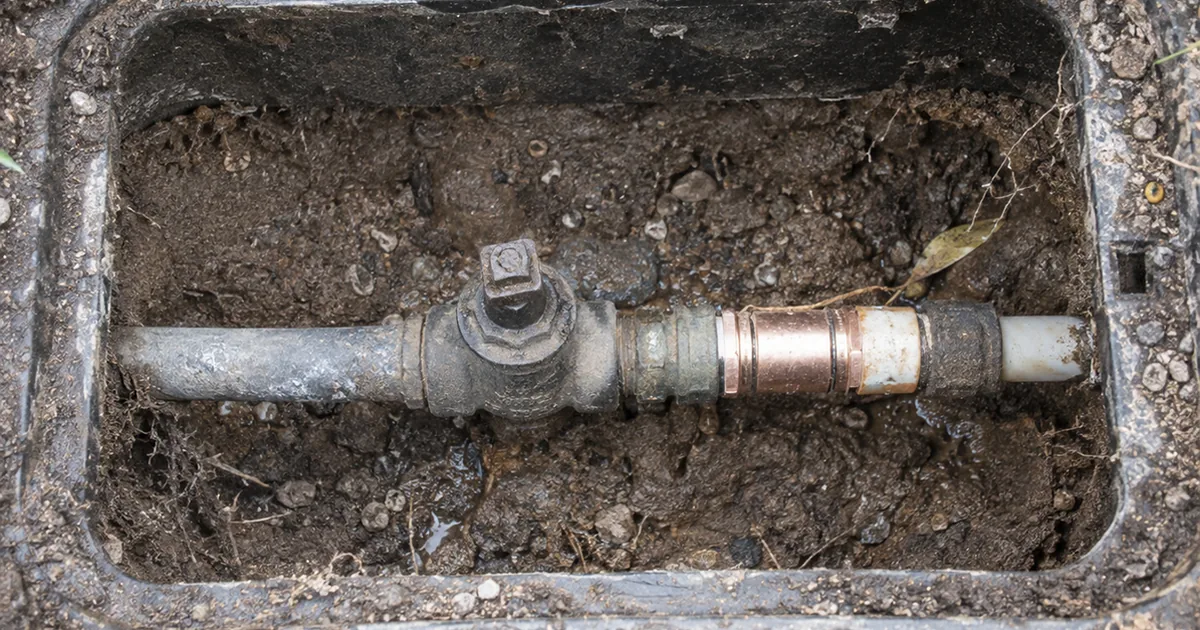
A service line is the pipe between the water main or other distribution conduit and the building inlet. That is the EPA definition, and the endpoints matter.
Picture the route. The water main is in the street, a short connection may attach the service piping to it, and the line then runs to the point where water enters the building.
A lead service line is one made of lead, or with any portion made of lead, and a lead-lined galvanized service line is also defined as a lead service line. The whole run does not have to be lead for the category to apply.
A galvanized service line is made of iron or steel dipped in zinc to resist corrosion and rusting. That describes the material, not the line’s history, and history is what decides its category.
A connector, also called a gooseneck or pigtail, is a short bendable segment used between service piping, typically where the service line meets the main. Under the rule it cannot exceed 3 feet.
The connector carries its own material category in the inventory, separate from the service line. Water systems must replace lead connectors under their control when they meet them during planned or unplanned infrastructure work, though that replacement does not count toward the mandatory rate.
Galvanized pipe in the yard is not the galvanized pipe in the basement
They are different pipes in different places, and the federal rule does not treat them alike. Galvanized premise plumbing is the steel supply piping inside the house. A galvanized service line runs from the main to the building inlet.
The distinction becomes more important with “galvanized requiring replacement,” usually shortened to GRR. A galvanized service line is GRR if it currently is, or ever was, downstream of a lead service line. It is also GRR if it is currently downstream of a service line whose lead status is unknown.
History controls the category. The line in the yard may be galvanized steel, but the water system must also determine what was upstream from it. EPA makes the default explicit: “If the water system is unable to demonstrate that the galvanized service line was never downstream of a lead service line, it is a GRR service line.”
None of this turns galvanized piping inside the house into a GRR service line. Interior piping sits beyond the building inlet, so it is premise plumbing rather than the buried line this rule covers. The interior problem is real and worth its own attention, and we have written separately about what aging galvanized and cast iron supply piping does inside an older house and about galvanized supply lines alongside knob and tube wiring. Neither of those is this.
A house can have clean copper throughout the accessible interior and still be fed by a GRR service line, and the reverse happens too. One does not establish the other. Copper has its own failure modes regardless, as pinhole leaks in copper supply lines show.
Unknown is a category, and it is a large one
“Unknown” is a formal inventory category, not an oversight or a blank field. A lead status unknown service line is one whose material has not been demonstrated to be lead, GRR, or non-lead.
A water system may therefore carry an address in its inventory without having established what the full run is made from. The designation proves neither lead nor non-lead. It records that the determination has not been made.
Water systems must identify the material of all unknown service lines by their mandatory service line replacement deadline. Until that work is completed, an individual listing can sit on a line the utility itself has not characterized.
Connectors are categorized separately, as “Lead,” “Non-lead,” “Unknown,” or “No connector present.” An address may therefore carry one status for the line and another for the connector.
For an agent, report “unknown” as unknown. Do not translate it into “lead,” and do not soften it into “probably fine.”
The dates that actually matter
November 1, 2027 is the pivot date for the baseline inventory and the service line replacement plan. Any water system with at least one lead, GRR, or unknown service line must submit a replacement plan to the State by that date.
The work began earlier. Under the 2021 Lead and Copper Rule Revisions, water systems had to develop and submit an initial inventory by October 16, 2024. That inventory covered all service lines regardless of ownership and categorized them as lead, non-lead, GRR, or unknown.
Program year 1 runs from November 1, 2027 through December 31, 2028. Every program year after that follows the calendar year.
Water systems must fully replace all lead and GRR service lines under their control within 10 years, unless the system qualifies for a deferred deadline or the State imposes a shorter deadline. Systems must meet a cumulative average annual replacement rate of 10 percent. A system first assesses that rate at the end of program year 3, on December 31, 2030, and annually after that.
Updated inventories must be submitted and posted online after program year 1, by January 30, 2029, and every January 30 after that.
This is a decade-long program, not a single mailing cycle. Records will change, unknown entries will get categories, and new owners will keep receiving offers for years.
You can look up the address before you list it
The service line inventory is public, and starting with the baseline inventory it must identify each service line and known connector by street address. If no street address is available, the system may use a unique location identifier such as a block, GPS coordinates, intersection, or landmark.
Systems serving more than 50,000 people must post the inventory online. Smaller systems can post it online or make it publicly accessible another way. EPA examples include providing it by mail or making it available at the water system’s office.
Identify the water system serving the property, search or request its service line inventory, and read the service line and connector entries for the address separately.
Some systems will not publish a long address list at all. A system with no lead, GRR, or unknown service lines and no lead or unknown connectors may instead publish a written statement saying so, with a general description of how it reached that determination, and is not required to file annual updates. If it later finds a lead or GRR line or a lead connector, it must notify the State within 60 days.
Treat the inventory as the water system’s current record. It is a living dataset, revised as materials are identified and work is completed, and it is not a guarantee about buried material at a specific parcel.
Save the result in the transaction file. If the entry says unknown, preserve that wording. If the address is absent, contact the water system rather than assuming absence means non-lead. This matters most in the oldest parts of a market. A nineteenth century county seat like Martinez, where the downtown core long predates modern service materials, is a different research problem from a city built largely in one postwar wave, such as Pleasant Hill, or from a river town like Antioch whose oldest and newest districts sit on opposite landforms.
Replacing it can raise lead at the tap first
Service line replacement can temporarily increase lead in drinking water. EPA explains that replacement work “can break apart corrosion scales and cause temporary increases in lead in drinking water.”
The point is counterintuitive. Work intended to remove a lead or GRR line disturbs deposits inside the piping, and particles released during that disturbance can reach the tap before flushing addresses the condition.
After both full and partial replacements, the system must notify affected consumers that they may see a temporary increase in lead levels because of the work, and give them its contact information.
The system must also provide written instructions for flushing the service line and premise plumbing to remove particulate lead. It must provide a pitcher filter or point-of-use device certified to reduce lead by a certifier accredited by the American National Standards Institute. Six months of replacement cartridges and use instructions must come with it.
Those measures must occur before the line returns to service, and the system must later offer a follow-up tap sample between three and six months after completion, tested for lead.
A full replacement has a strict definition. The entire length of the service line, on both the customer side and the water system side, must be non-lead when the work is complete.
Partial replacement means replacing any portion of a lead or GRR service line while leaving any length of lead or GRR line in service. Those partial replacements are prohibited except during an emergency repair or in coordination with planned infrastructure work affecting the line, such as water main or meter replacement. A project solely intended to replace lead and GRR lines under the replacement program is not treated as that kind of infrastructure work.
If a partial replacement occurs, the system must install a dielectric coupling between the remaining portion and the replaced portion to prevent galvanic corrosion. That coupling is not required when the replacement line is plastic.
Partial replacements do not count toward the system’s mandatory replacement rate. The rule is aimed at complete removal, not a short new segment attached to material left in place.
What a home inspection can and cannot tell you about this
The service line is buried, so a visual, non-invasive home inspection cannot see it. It runs between the water main in the street and the building inlet, including areas below the yard, sidewalk, and street that are outside an inspector’s view. The same buried line is what many utility-billed repair plans cover, and AB 1931’s new rules for those plans do not change the fact that nobody has looked at it.
An inspection can identify visible piping material where the water supply enters the structure. It can note visible material at the meter and at accessible connections. Where appropriate, an inspector can scratch-test and magnet-test accessible pipe to help distinguish lead, galvanized steel, copper, and plastic. That work sits inside the plumbing scope we run on every job.
We document visible corrosion and the condition of accessible premise plumbing. Those observations are useful, but they describe only the pipe reachable on inspection day, and the report says so in those terms.
An inspection cannot determine what is buried in the yard or under the street, cannot establish the material along the full run, and cannot determine lead levels in water or clear a property of lead.
Water testing is a laboratory matter, not a visual finding. Inspection.re does not test drinking water for lead on a general home inspection, does not certify service line material, and does not speak for the water system.
Lead paint and lead dust are different subjects. Lead paint is a surface-coating hazard, and it drives its own process on older stock, as our guide to lead paint in pre-1978 houses explains. Lead dust clearance levels are measured through dust wipe sampling in and around the house, and those federal numbers changed in January 2026.
This rule concerns lead in drinking water arriving through buried piping. Different medium, different federal program, different measurement. A service line inventory does not replace lead paint or dust work, and a paint finding says nothing about a buried water line.
Quick answers
My buyer got a letter from the water utility after closing. Is this a defect nobody disclosed?
No. The letter may have been sent because the ownership change triggered a federal duty. Within six months after that change, the water system must offer full service line replacement to the new owner.
Can you tell me during the inspection whether the service line is lead?
No. We cannot see or identify the full buried run. We can report accessible pipe at the building entry, meter, and visible connections, including appropriate scratch and magnet tests. Check the water system’s public inventory for the address-level record. Our frequently asked questions cover what else falls outside a general inspection.
The house has copper plumbing. Does that settle it?
No. Copper premise plumbing inside the house is separate from the buried service line. The service line can still be lead, GRR, unknown, or non-lead regardless of the visible interior piping.
Should my seller replace the service line before listing?
Ask the water system. A full replacement requires both the customer side and the system side to be non-lead, and partial replacements are restricted to narrow circumstances, so the system has to address its own access, records, and planned work.
Does this replace lead paint testing on an older house?
No. Lead paint and dust involve surface coatings and dust wipe sampling. This program concerns drinking water and buried service piping. One does not answer the other.
The honest summary
A change of ownership triggers a replacement offer to the new owner within six months. November 1, 2027 is the pivot for baseline inventories and replacement plans, and the public address-level inventory is the practical tool for transaction work.
Before you list or write an offer, identify the water system, pull the inventory entry, and report the category exactly as shown. Use the inspection for visible piping conditions, not to declare what is buried or whether the water contains lead. If you are reading a condition report for the first time, our guide to reading a California inspection report explains what the plumbing section is and is not saying, and Concord and the rest of central Contra Costa County are covered on the same terms.
On the gas side, a different 2026 California law applies: AB 2313 and gas service line alternatives.