We inspected a two-story in the Shadowridge area of Vista a few months back. Built around 1986, second owner, original plumbing. The home showed well. New paint, updated kitchen counters, fresh landscaping out front. The listing agent was already talking about multiple offers.
Then we opened the water heater closet.
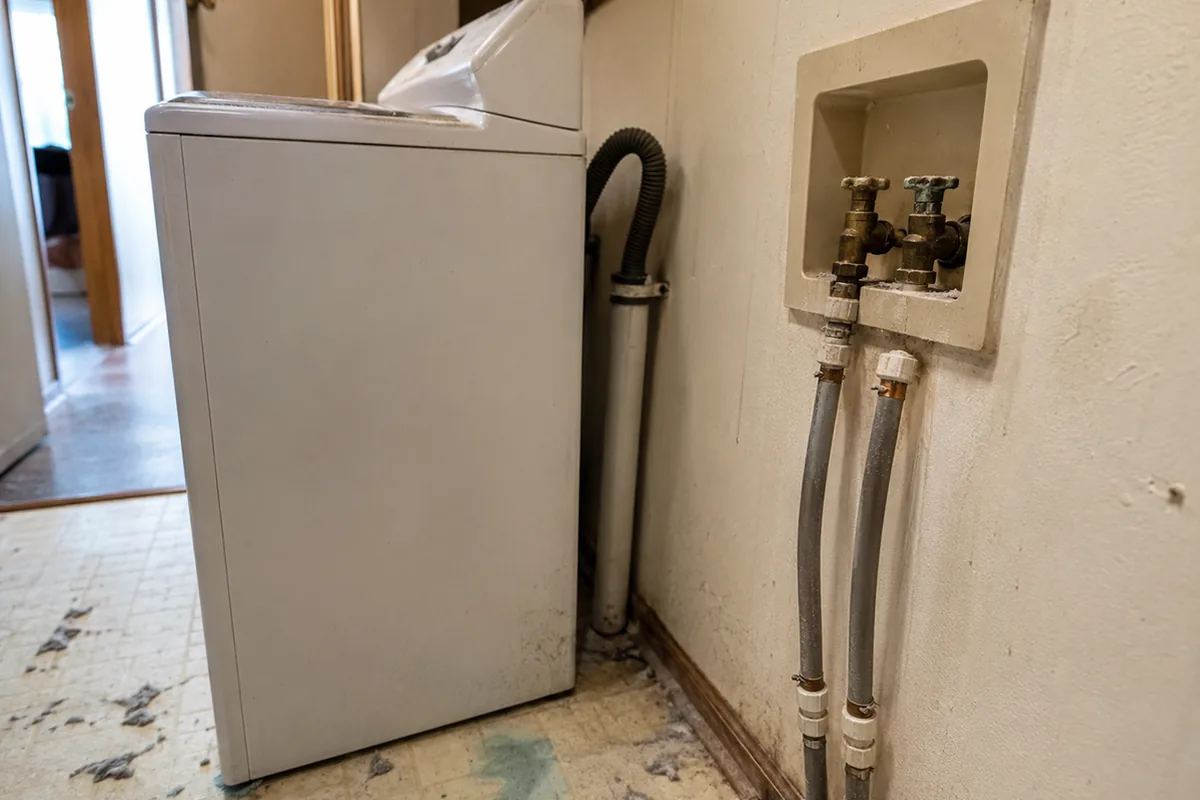
Gray plastic supply lines running to the water heater, with white acetal fittings and copper crimp rings at the connections. Polybutylene. We followed the lines into the garage, then checked behind the washer in the laundry alcove. Same gray pipe feeding the washer valve box. The main water supply from the street was PB too, visible where it came through the slab at the garage wall. The whole house was plumbed with it.
The buyer had never heard of polybutylene. The listing agent had heard of it but thought the class-action settlement from the 1990s meant the pipes had been replaced. They had not been replaced. They were still there, carrying water under pressure to every fixture in the house.
Here is how that one played out. We documented the polybutylene supply system, the acetal fittings, and the overall condition in the same-day report with photos of every accessible run. The buyer’s agent took two repipe bids back to the seller, and the two sides settled on a credit large enough to cover a full copper repipe after closing. The deal closed on schedule. The plumbing was never a dealbreaker. It became a line item both sides could price, instead of a flood risk nobody had accounted for.
Schedule a Vista inspection · Same-day report · Pay-at-closing available
Why this matters for the agent
Polybutylene piping is not a cosmetic issue you can negotiate past with a small credit. It is a recognized failure-prone plumbing material with a class-action history, an insurance complication, and a real chance of reshaping the deal.
Three things tend to be on the line. First, the buyer’s homeowner insurance carrier may refuse to write the policy, or may write it only with a repipe deadline and a higher premium, once polybutylene is disclosed. Second, a full repipe runs well into five figures for a typical two-story Vista home, which is money neither the buyer’s down payment nor the seller’s net proceeds accounted for. Third, a polybutylene fitting that fails while the home is occupied does not drip. It splits. The resulting flood can cause tens of thousands in water damage in the time it takes someone to find the main shutoff.
If you work Vista, especially the Shadowridge master plan and the tracts along Shadowridge Drive and Sycamore Avenue built between 1980 and 1995, you will run into this. That fifteen-year window is when polybutylene was the default supply piping for production builders across California. The older homes in Vista’s downtown core predate it. The newer construction east of Melrose and along Bobier Drive came after builders stopped using it. The homes right in the window are the ones to watch. Agents who pin the build year first, then look for the gray pipe, stay ahead of the finding. The same build-year awareness applies to the hazardous electrical panels that showed up in a slightly earlier generation of North County homes.
What polybutylene piping actually is
Polybutylene is a gray plastic resin used to manufacture water supply lines installed in American homes from roughly 1978 to 1995. The pipe itself is flexible, easy to run through walls, and was significantly cheaper than copper at the time. Builders loved it. It went into an estimated six to ten million homes nationwide during that window.
The pipe comes in two forms. Interior supply lines are typically 1/2-inch or 3/4-inch gray tubing running from the main shutoff to every fixture. Exterior service lines run from the water meter at the street to the house. Both can be polybutylene in the same home, or a home might have PB inside with a copper service line, or the reverse. We check both when they are accessible.
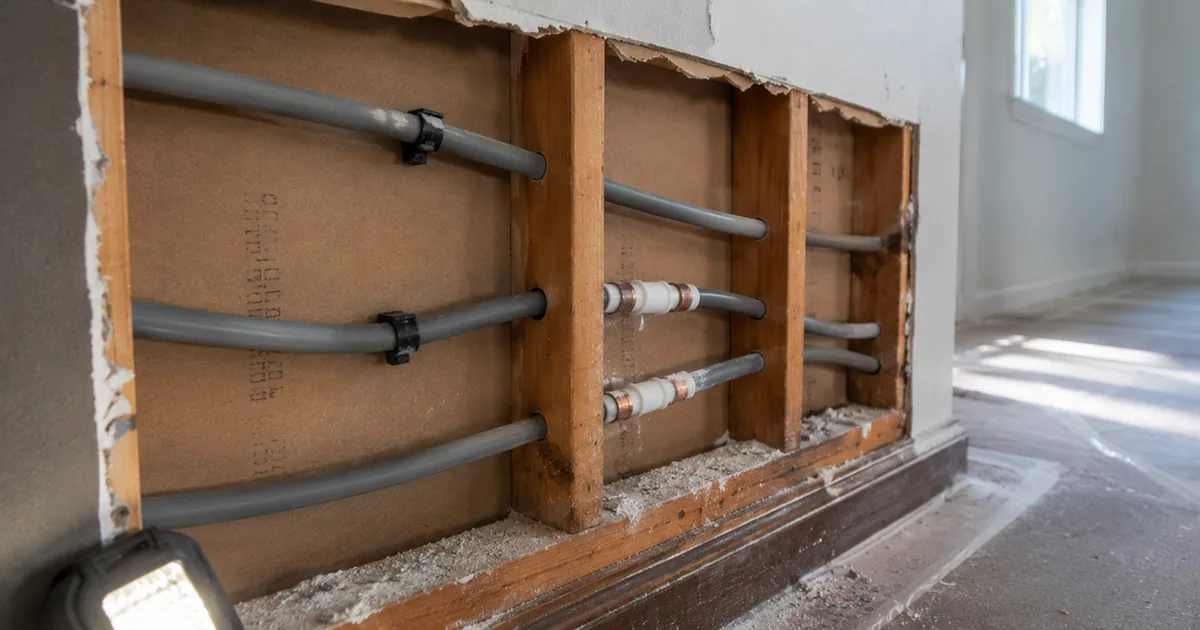
The material is identifiable by its color (gray, sometimes a blue-gray), its flexibility, and the stamping on the pipe itself. Most PB pipe is stamped “PB2110” along its length. The fittings are the critical detail. Early installations used acetal (plastic) fittings, which are the ones most associated with failure. Later installations switched to metal insert fittings with copper crimp rings, which hold up better but do not eliminate the underlying material concern. We note the fitting type in the report because it changes the risk profile and the conversation with the insurance carrier.
This is a different issue from the galvanized steel and cast iron drain lines found in older California homes. Galvanized corrodes from the inside over decades. Polybutylene fails at the fittings, often without visible warning, and the failure mode is sudden rather than gradual.
Why these gray pipes give out
The failure is at the fittings and at points of stress, not usually in the middle of a straight run. Polybutylene reacts to oxidants in treated municipal water, particularly chlorine and chloramine, which are present in every public water system in San Diego County including the Vista Irrigation District supply.
Over years of exposure, chlorine degrades the pipe wall from the inside out. The degradation is not visible from the exterior of the pipe. The pipe looks fine on the outside while the interior surface becomes brittle and micro-fractured. When the degradation reaches a critical point, the pipe or fitting splits under normal operating pressure. No warning drip. No slow seep. A split fitting under 40 to 80 psi of water pressure produces a full-volume leak that can dump hundreds of gallons before anyone notices.
The acetal fittings are the weakest link. The plastic insert fittings installed in early polybutylene systems (roughly 1978 to 1989) degrade faster than the pipe itself. They crack at the barb where the pipe seats over the fitting, and the crack propagates under pressure until the connection fails. Homes with acetal fittings are at higher risk than homes with later metal insert fittings, which is why we photograph the fitting type and call it out specifically in every report.
The class-action lawsuit (Cox v. Shell Oil, settled in 1995) acknowledged the failure mechanism and established a claims fund for affected homeowners. That fund closed in 2009. Homeowners who did not file a claim before the deadline have no recourse through the settlement. The existence of the lawsuit does not mean the pipes were fixed. It means the manufacturers paid a settlement. The pipes are still in the walls of every home that was not repiped.
What agents should tell every buyer in 1980s-1990s Vista homes
A short list buyers writing offers on Shadowridge-era Vista homes should hear from you before they go into escrow.
- The water supply lines could be polybutylene. It is verifiable on the inspection report, and we check it at the water heater, the laundry connections, under accessible sinks, and at the main service entry rather than guessing from the exterior.
- If it is PB, plan on a repipe. The cost depends on the home’s size, number of stories, slab versus crawlspace, and how many walls need to be opened. Have the buyer pre-qualified for a repair budget above what the offer assumed.
- Call the buyer’s homeowner insurance carrier early. Ask specifically whether polybutylene supply piping affects underwriting. Get the answer in writing before the contingency period ends.
- Do not let anyone tell the buyer that replacing a few fittings fixes the system. The pipe material itself degrades from the inside. A fitting swap addresses one failure point while the rest of the system continues to deteriorate. The only permanent fix is a full repipe to copper or approved PEX.
- If the seller discloses prior plumbing work, ask whether the polybutylene was replaced entirely or just patched at a leak location. Partial repairs are common and they do not resolve the system-wide risk.
If you want a one-page version of this checklist for your buyers in the pre-offer window, ask us and we will send it.
Spotting polybutylene at a Shadowridge showing
You do not need to open walls to flag a candidate home at a showing. Add these to your mental walk-through on anything built between about 1978 and 1995 in Vista.
- The home was built in the polybutylene window. Build year is the first and most reliable filter. Shadowridge’s Phase I through Phase III tracts, plus the developments along Thibodo Road and Warmlands Avenue, sit squarely in this range.
- Gray plastic pipe visible at the water heater connection, at the laundry hookups behind the washer, or under bathroom and kitchen sinks. The pipe is a distinctive gray or blue-gray, flexible, and usually stamped with “PB2110.”
- White plastic fittings (acetal) at the connections rather than metal inserts. This is the higher-risk configuration and worth noting.
- Water stains on ceilings, walls, or baseboards that do not have an obvious source. PB failures can happen inside walls and go undetected until the drywall shows damage.
- A saucepan, bucket, or towel placed under a sink connection. Homeowners sometimes manage a slow PB leak for months rather than calling a plumber.
- Evidence of spot repairs, particularly sections of copper or PEX spliced into an otherwise gray piping system. This tells you someone already had a failure and patched it rather than repiping.
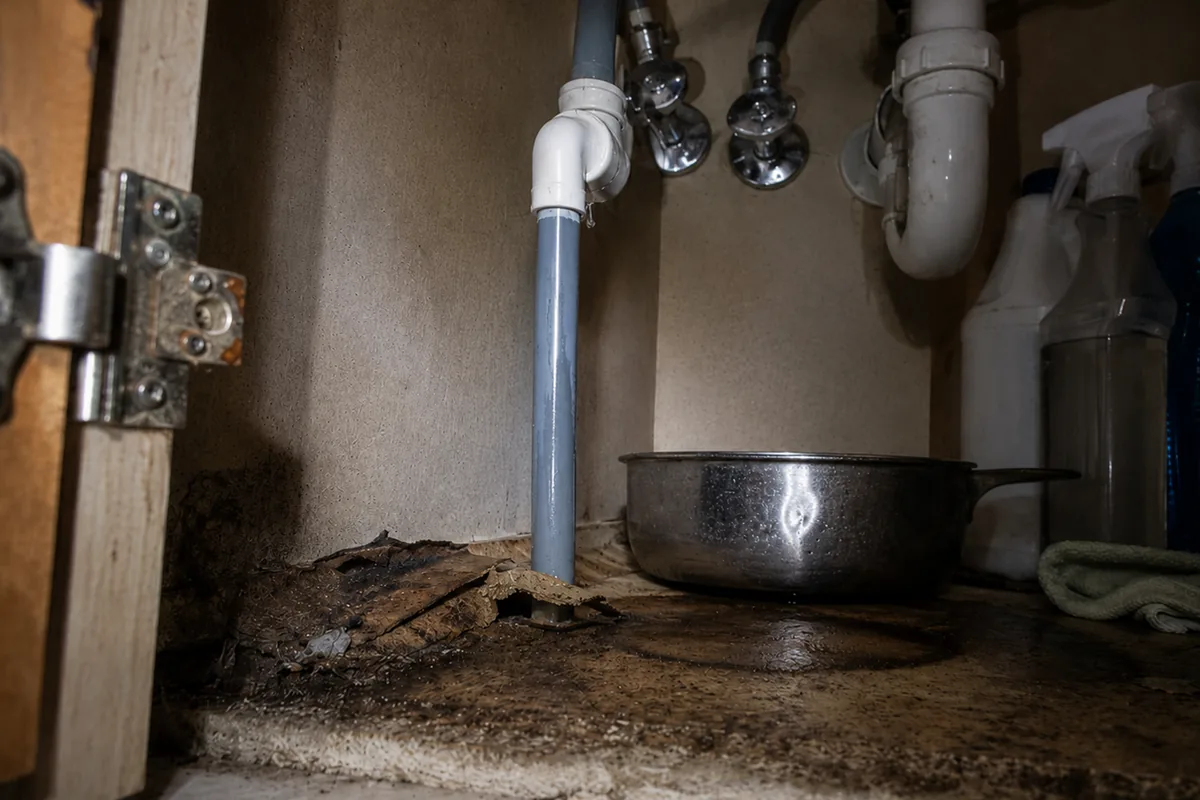
None of these prove the plumbing will fail tomorrow. All of them are reasons to make the inspection contingency real and to read the plumbing section of the report closely.
How polybutylene plays out in a Vista escrow
Vista polybutylene deals tend to resolve one of four ways. Knowing them in advance lets you steer instead of react.
Seller repipes before closing is the cleanest but the least common, because a full repipe takes several days, requires permits, involves opening walls, and produces dust and disruption the seller would rather not manage while showing the home. When it happens, insist the work is permitted, that it covers the entire supply system rather than just the accessible runs, and that a re-inspection confirms the scope before closing.
Seller credits the buyer to handle it after closing is the most common outcome. Size the credit to a real bid from a licensed plumber, ideally two bids, scoped to a full copper or PEX repipe. The written bid is the document that anchors the negotiation, so push for it before the credit amount is finalized. A typical full repipe for a 1,500 to 2,000 square foot two-story Vista home runs in the range of $8,000 to $15,000 depending on access, number of fixtures, and whether drywall repair is included in the plumber’s scope. Larger homes or homes on slabs with no crawlspace access run higher. The same credit-versus-remediation structure applies to the aluminum wiring negotiation in older East County homes.
Buyer walks under the inspection contingency happens too, especially with first-time buyers who cannot absorb a five-figure repair on top of closing costs. The earnest money is protected under the contingency. Your job as the buyer’s agent is to make sure they understand that walking is an option and what the timeline looks like.
Deal closes with no remediation is the worst of the four, because the buyer inherits a plumbing system with a documented failure history, a potential insurance complication, and a flood risk that can materialize without warning. If the buyer wants the home and the seller will not budge, document the buyer’s informed decision in writing and recommend a repipe inside the first six months of ownership. A middle path worth proposing is an escrow holdback for the repipe cost, completed by the buyer’s plumber on a defined timeline after closing.
How the inspection actually catches it
A standard walkthrough that only looks at fixtures will miss polybutylene, because the pipe is behind the walls. Catching it requires checking every accessible exposure point.
We look at the water heater connections first, because the supply lines there are almost always visible. Then we check the laundry hookups behind the washer, the supply lines under every accessible sink, and the main water service entry where the line comes through the foundation wall or slab. In homes with unfinished garages or accessible crawlspaces, we can trace longer runs and check for signs of prior leaks, mineral deposits at fittings, or splice repairs.
We photograph the pipe, the fittings (acetal versus metal insert), and any visible damage or prior repairs. The fitting type matters because it changes the urgency. We note the stamping on the pipe when it is readable. We also run thermal imaging where accessible, because an active leak inside a wall produces a temperature differential the camera picks up before the drywall shows staining. That said, thermal imaging finds active moisture, not future failures. We are honest about that distinction. The camera does not predict when a fitting will crack. It finds the ones already leaking. For hidden hazards in the electrical system rather than the plumbing, our infrared scanning guide covers how the same thermal approach catches hot connections behind cover plates.
Combined, the visual identification, the fitting-type documentation, and the thermal check give you a report finding you can take into the negotiation with specifics rather than generalities.
Quick FAQ for buyers and agents
Is polybutylene piping always going to leak? Not every home with PB has had a failure, and some PB systems have been running for 30-plus years without a visible leak. The problem is that the degradation is internal and invisible. “No leaks yet” is the present condition, not a prediction. The actuarial data from the class-action era and from insurance carriers treats PB as a when-not-if material.
Does replacing the fittings fix it? Replacing acetal fittings with metal inserts reduces the highest-risk failure point but does not address the chlorine degradation of the pipe wall itself. The only permanent fix is a full repipe to copper or PEX. Spot repairs at leak locations are patches, not solutions.
What does a full repipe cost in Vista? For a typical 1,500 to 2,000 square foot two-story home, expect $8,000 to $15,000 for a complete repipe to copper or PEX, including permit, labor, and basic drywall patching. Larger homes, slab-on-grade construction, and multi-story layouts push the number higher. Get two written bids before the negotiation.
Will homeowner insurance refuse the policy? Some carriers will decline. Some write it with a polybutylene exclusion, a higher deductible for water damage, or a repipe deadline. Some write it without comment. The variability is the problem, so the buyer should call their target carrier early and get the answer in writing before the contingency expires.
Is this common in Vista specifically? Yes. Vista’s Shadowridge master plan was built in phases from the early 1980s through the early 1990s. The surrounding tracts along Thibodo, Warmlands, and Sycamore were built in the same window. This puts a large portion of Vista’s housing stock inside the polybutylene era. The same pipe shows up across the street in Carlsbad’s La Costa tracts, in parts of Oceanside built during the same period, and down in the South Bay’s EastLake-era tracts, covered in our Chula Vista polybutylene guide.
The honest summary for agents
If you work Vista and you write offers on homes built between 1980 and 1995, you are going to encounter polybutylene piping. The cases caught during the inspection contingency are negotiations. The cases caught after closing, with a split fitting and a flooded living room, are lawsuits and insurance claims.
The inspection that finds it is not the one that glances at the fixtures and moves on. It is the one that checks every accessible exposure point, photographs the pipe and the fittings, notes the fitting type, and runs thermal imaging to catch any active leaks already hiding in the walls. The same-day report gives you the documentation before the contingency clock runs out. Sellers dealing with polybutylene should also read our 5 things to fix before listing for the seller-side view of material findings like these.
Schedule a Vista inspection or see our full inspection scope before you book. Want to see what the finished report looks like? Here is a sample inspection report. Common questions are answered in the FAQ.
Related reading
- Escondido Federal Pacific and Zinsco guide – the hazardous panel brands installed in the same era of North County homes
- El Cajon aluminum branch wiring guide – a similar hidden-system hazard in older East County homes, and the escrow playbook
- Coronado knob-and-tube wiring guide – the older wiring hazard behind remodeled finishes in pre-1940 homes
- Pasadena galvanized and cast iron plumbing guide – the other hidden plumbing hazard in older California homes
- Why infrared scanning matters in California homes – how thermal imaging catches active leaks and hot connections
- Long Beach knob-and-tube and galvanized pipe guide – the older wiring and supply-line hazards that surface in Long Beach historic homes, and the insurance angle
- How to read a home inspection report in California – what buyers and agents should focus on in the report
- 5 things San Diego sellers should fix before listing – the seller-side view of findings like these
- Oceanside manufactured home inspection guide: the North County neighbor’s signature inspection question, where the build type changes the whole report
- Copper pinhole leaks in Tustin: the same whole-system supply-line failure in copper instead of gray polybutylene, and the same repipe answer
- Fullerton WDO report guide: another lender-facing finding, where the Section 1 versus Section 2 split decides what must be fixed to close
- Porter Ranch water pressure and regulator guide: the system-pressure force that wears out gray polybutylene and every other supply line ahead of its time
We also inspect across North County: Carlsbad, Oceanside, Escondido, and San Marcos. Same full-scope package, same same-day report. For San Marcos’s own terraced hillside pattern, see our San Marcos retaining wall guide.
Book a Vista home inspection or schedule directly · Same-day report · Pay-at-closing available · See what is in the box on our sample report page