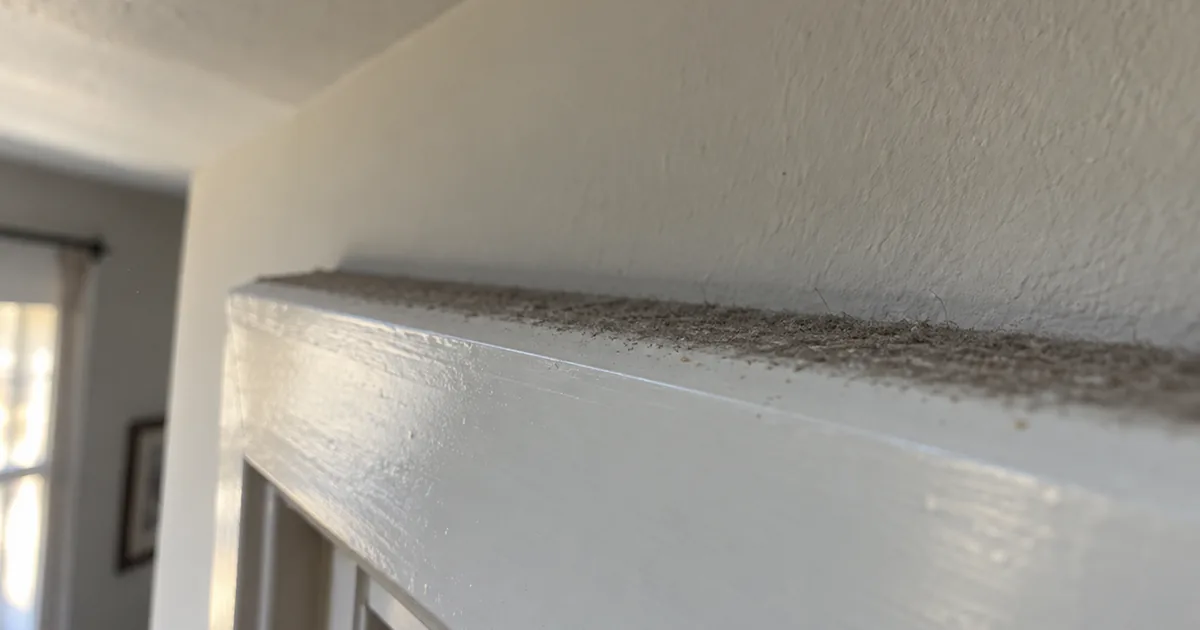
A house a few streets outside a burn perimeter can look untouched from the street, and the listing photographs can be honest. Inside, the smell is faint and hard to place, stronger in the closets and the back bedroom than in the open living space. On top of the door casings, where nobody wipes, there is a fine grey deposit. The same deposit is on the ceiling fan blades and inside the return air plenum at the filter slot. The system ran through the fire and after it.
None of that is a home inspection finding in the ordinary sense. We can describe it. We cannot tell you what is in it. This is a composite of a situation we meet often rather than any one identifiable property. Until September 2026 that gap was also, for a lot of homeowners, an argument with an insurer.
Two wildfire recovery bills now reach the house that survived
On September 15, 2026, the Governor signed a package of wildfire recovery bills, and two of them concern what is inside a house that survived.
AB 1642, authored by Harabedian, directs the Department of Toxic Substances Control and the State Air Resources Board to develop standards and guidance for testing, remediating and restoring contamination from wildfire smoke in homes. AB 1795, authored by Gipson, is the insurance side. It requires insurers to pay for lead and asbestos testing and remediation in smoke-damaged homes, along with full cleanup and restoration to preloss condition. Two other bills in the same package concern mortgage forbearance and mortgage relief, and are not the subject here.
Most coverage of these bills is written for a fire survivor filing a claim. A buyer and an agent have a different question. What should you ask about a surviving house near a burn scar that is now on the market? The answer starts with the claim file, the cleanup records and the parts of the house where smoke settles. It sits alongside the other half of California’s wildfire response, the Zone 0 ember-resistant zone the Board of Forestry adopted in August 2026, which is about keeping the fire off the house rather than about what the fire left behind.
AB 1795 changes who has to prove the smoke damage
AB 1795 creates a rebuttable presumption. A presumption is a rule about who has to prove what.
The bill adds Insurance Code sections 2060.1 and 2060.2. Section 2060.1 establishes the definitions and the presumption, and section 2060.2 sets out payment obligations and inspection requirements. The statute says:
“If wildfire smoke, ash, soot, char, or combustion byproducts are present in a surviving residential property in the wildfire impact zone after a wildfire, then smoke damage in the property is the result of that wildfire.”
That does not mean the insurer automatically pays every claim. It changes the starting position. Before, the homeowner could be pushed to show that the residue came from that wildfire rather than from a fireplace, a candle, cooking or a previous fire. Under the presumption the starting position is that it came from the wildfire, and the insurer is the one who has to show otherwise.
The rule is tied to a surviving residential property in a wildfire impact zone. It is not a general rule about every house that smells smoky. We are not lawyers and we are not adjusters. This is a description of what the statute says, not legal or insurance advice.
Testing is now named as a covered cost
Testing is named as a covered cost, which it frequently was not before.
Section 2060.2(b) requires insurers to cover “the cost of the sampling and testing that is necessary to restore a damaged property to its preloss condition.” AB 1795 also requires coverage of full cleanup and restoration to preloss condition.
The bill sets payment timing: actual cash value within 30 days of inspection, replacement cost within 30 days of completion of restoration. It also provides that insurers “shall not terminate coverage for additional living expenses for a covered smoke damage claim … until the property has been restored to preloss condition and cleared for human occupancy.”
“Cleared for human occupancy” implies that somebody has to do the clearing. That is not a phrase a general home inspection report can supply, and our inspection report does not pretend to.
AB 1795 also adds training and certification requirements for insurance adjusters under Insurance Code section 14048 and for public adjusters under section 15009.2, which matters because smoke contamination is a technical question and the person estimating it has not always been trained on it.
The two bills are linked. AB 1795 “shall become operative only if Assembly Bill 1642 of the 2025-26 Regular Session is enacted and becomes effective on or before January 1, 2027.” The insurance duty is built on the standards that AB 1642 orders up.
California is still waiting for its own smoke cleanup standard
California does not currently have its own cleanup standard for wildfire smoke contamination in a house. AB 1642 is the instruction to write one.
The bill adds Chapter 6.9.2 to Division 20 of the Health and Safety Code, sections 25402.1 through 25402.7. The Department of Toxic Substances Control must develop and adopt regulations on lead and asbestos testing, remediation and restoration by December 31, 2028, and must publish guidance on additional contaminants by the same date. It must produce guidance for schools by July 1, 2028, with the State Department of Education. The State Air Resources Board must publish guidance on levels for indoor air contaminants following residential smoke damage, also by December 31, 2028.
Until those regulations are adopted, existing federal and state standards apply. The bill identifies federal lead dust action levels, along with California and federal asbestos standards. We wrote about the federal side of that when the EPA dust-lead clearance levels tightened, and those are the numbers doing the work in the meantime.
AB 1642 defines “wildfire” as “a wildland-urban interface fire, an urban conflagration, or a forest fire.”
The deadline is the end of 2028. Anyone buying or selling before then is working in the interim period, under borrowed standards written for other purposes. That is not a reason to skip testing. It is a reason to be careful about what a test result actually means.
Lead and asbestos follow the houses into the fire
Lead and asbestos got named first because of what burns when a neighborhood burns, not because of what burns in a forest.
An urban conflagration burns houses. California houses built before 1978 commonly carry lead-based paint, and houses of a similar era commonly carry asbestos in floor tile, sheet flooring backing, pipe and duct insulation, certain textured finishes and cement products. When those houses burn, that material does not stay on the parcel. Our guides to lead paint in pre-1978 homes and to asbestos-containing materials cover where both of them live in an ordinary California house. AB 1642’s definition of wildfire includes “an urban conflagration,” which acknowledges the difference between a forest fire and a fire moving through a built neighborhood.
Our scope is narrower. We report the presence of suspect materials by age and appearance. We do not test for lead or asbestos. Those are separate scopes with separate qualifications and separate laboratories, which is the line our guide to what an inspection covers and what needs a specialist draws in detail.
A report can say that a painted surface, floor covering or insulation appears consistent with a material that may contain lead or asbestos. It cannot turn that observation into a laboratory result. A buyer should not treat the observation as one, and a seller should not treat its absence as a clean bill of health.
The list extends past the two named contaminants
Lead and asbestos are the regulated pair, but the guidance list names several more.
DTSC must publish guidance for the CAM 17 heavy metals, cyanide, lithium, manganese, dioxins and furans, and polycyclic aromatic hydrocarbons. Lithium appears on a wildfire list because batteries and stored energy systems are now ordinary household contents. The list is not limited to materials that were part of the original house.
The State Air Resources Board piece concerns indoor air contaminant levels, which is a different measurement from a surface wipe or a settled dust sample. A surface wipe asks about material collected from a defined surface. A settled dust sample asks about dust collected from a location. An air sample asks about what is present in the air during the sampling period. One does not prove what the other proves.
That distinction matters when somebody tells you a house was “tested.” Ask what was sampled, where, which laboratory handled it and what the result is being used to establish.
Smoke residue settles where nobody cleans
Smoke residue accumulates where nobody cleans, and it concentrates in the mechanical system.
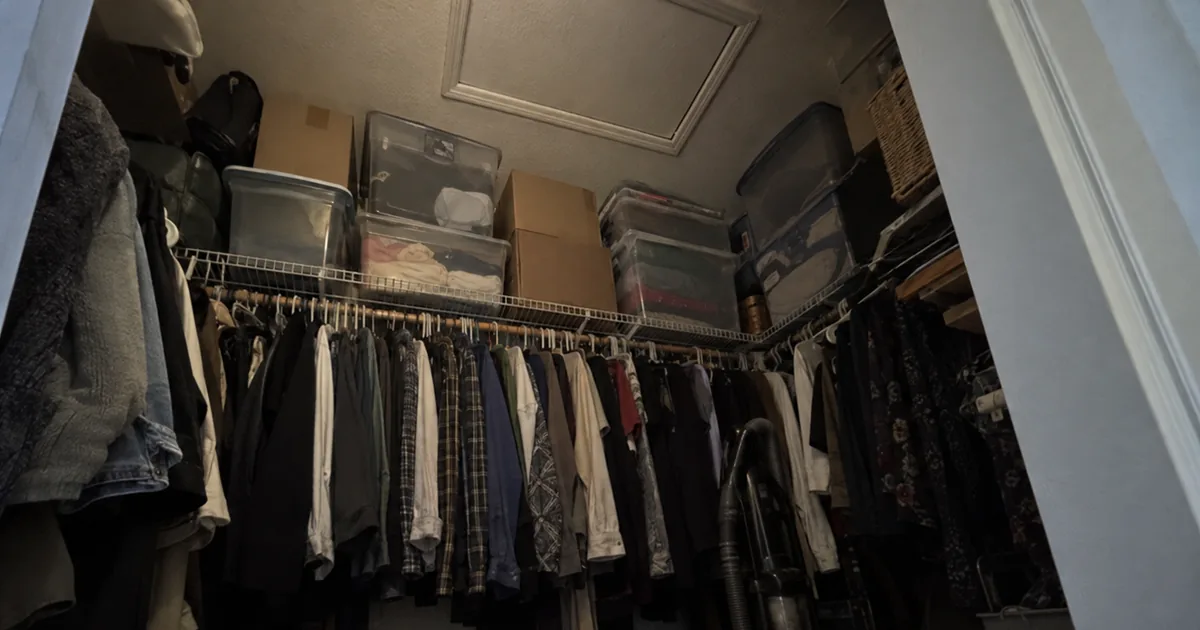
Look at the tops of door and window casings, the tops of baseboards, the upper faces of ceiling fan blades, the tops of upper cabinets and the tops of picture frames. Those horizontal surfaces collect what routine cleaning misses. Closets, drawers and enclosed soft-goods spaces matter too, and odour is usually strongest there because no air exchange carries it away.
The mechanical system is the part buyers overlook. The return air plenum, the filter slot, the blower wheel and the supply registers all sit in the path of moving air. If the system ran during or after the fire, it moved the air in the house through the ductwork and deposited what was in it. On a house where the return air path was already undersized or leaky, that transport happens through more of the building cavity than the designer intended.
Attic insulation matters because the attic is ventilated to the outside by design. Soffit, ridge and gable vents are open to whatever was in the air, and our guide to attic insulation and ventilation explains a path that works just as well at bringing particulate in. Crawlspaces and subfloor insulation have the same problem, and are not protected simply because they sit below the living space.
A grey film reads as one thing. A fine, even deposit on high horizontal surfaces in a house near a burn perimeter reads as another. We can describe deposit, distribution and odour, and we can say where it concentrates. We cannot tell you its composition by looking at it, and no inspector who tells you otherwise is being straight with you.
A home inspection cannot issue a smoke clearance
A general home inspection is not an environmental assessment, and it is not a clearance.
We do not perform lead sampling, asbestos sampling, settled dust sampling, indoor air sampling or post-remediation clearance. We do not issue a certificate that a house is “cleared for human occupancy,” which under AB 1795 is the condition that keeps additional living expense coverage running. We are also not adjusters and we do not estimate claims. Nothing here is legal or insurance advice.
What we can do is document condition, deposit and odour room by room with photographs, open the air handler and report what the filter slot, plenum and blower look like, and enter the attic and crawlspace where accessible to report the insulation condition. The report comes the same day, which matters when an inspection contingency is short, and what is in it is written so a specialist can pick up where we stopped.
An inspection is a snapshot. A house cleaned before listing can present very differently from the same house three weeks earlier, and cleaning visible surfaces does not clean a duct system. That is why a general inspection and specialist testing answer different questions. The same split applies to mold, which is why we separate air testing from surface testing rather than treating a sample as a verdict.
Ask for the claim file before you order another test
Ask for the paper, then decide whether to test.
Ask the seller directly whether a claim was filed on the property for that fire and what it covered. A claim history is a document, not a guess. Ask whether remediation was performed, by whom, under what protocol and whether there was post-remediation verification, and ask for the report rather than the summary. Ask specifically whether the duct system was cleaned or replaced, and whether attic insulation was removed and replaced or left in place. Those are the expensive items, and the two most often skipped.
Check the natural hazard disclosure and the seller’s disclosures, and read them against the burn perimeter rather than against the address. Insurance is moving on this ground too, and our guide to California’s 2026 wildfire insurance laws and home hardening covers what carriers are now rating and discounting.
If the answers are thin and the house is inside or near a wildfire impact zone, order specialist testing during the contingency period rather than after it. The cost of a test is small against the cost of a duct system, an attic insulation replacement and a contents cleaning. If you are unsure how a finding like that should read on paper, our guide to reading a California inspection report covers the difference between an observation and a recommendation.
A house that did not burn can still be a house with a bill attached. The only way to know is to have the right specialist look, not the generalist.
Quick FAQ
The house did not burn. Do I need to worry about smoke damage?
Ask what happened inside the house, not only whether the structure burned. Check for odour and deposits on high horizontal surfaces, in closets, at the filter slot, inside the return air plenum, in the attic and in the crawlspace. A general inspection can document those conditions, but it cannot identify the material in a deposit.
Does AB 1795 mean my insurer has to pay for testing?
AB 1795 creates a presumption that smoke damage in a surviving residential property in a wildfire impact zone resulted from that wildfire when smoke, ash, soot, char or combustion byproducts are present, and it requires coverage for sampling and testing necessary to restore the property to preloss condition. The bill is linked to AB 1642, and becomes operative only if AB 1642 is enacted and effective on or before January 1, 2027. Confirm the current status with your carrier or your own counsel rather than with us.
Is there a California standard for how clean is clean?
Not yet. AB 1642 requires regulations and guidance by December 31, 2028. Until those are adopted, existing federal lead dust action levels and California and federal asbestos standards apply.
Can a home inspection test for smoke contamination?
No. We do not perform lead, asbestos, settled dust or indoor air sampling, and we do not perform post-remediation clearance. We document condition, deposits and odour, inspect accessible parts of the air-handling system, and report accessible attic and crawlspace conditions. A qualified specialist handles the testing, and our inspection FAQ explains where we hand off.
I am buying near a burn area. What should I do first?
Ask for the claim history and the remediation paperwork. Find out whether a claim was filed, what it covered, who performed the work, what protocol was used and whether post-remediation verification exists. Ask whether the ducts and attic insulation were cleaned, replaced or left in place.
The honest summary
The two bills together move California from a state where a homeowner argued about whether smoke damage counted to a state that is writing down what to test for and who pays for the test. The standards themselves are not due until the end of 2028, so anyone transacting before then is in the interim, using federal and state standards written for other purposes.
For a buyer the practical consequence is not complicated. A surviving house near a burn perimeter is worth asking harder questions about than its appearance suggests, and the questions are about paperwork and ductwork.
Ask for the claim history. Ask for the remediation report. Look at the filter slot, the return air plenum, the attic insulation and the crawlspace before you decide what the clean photographs mean.
Related reading
- Zone 0 Is Adopted. Nothing Has Taken Effect Yet, the other half of California’s 2026 wildfire response, about keeping the fire off the house in the first place.
- California’s 2026 Wildfire Insurance Laws and Home Hardening, what carriers are rating, discounting and requiring.
- Fire-Hardening a Historic Home in Sierra Madre, roof, vent and eave work on an older house at the wildland edge.
- What a Home Inspection Covers, and What Needs a Specialist, where the general report stops and a laboratory starts.
- The FAIR Plan Says Smoke Damage Must Be Seen or Smelled, a different smoke question: not a sale disclosure, but what one insurer’s own policy language requires before it pays a claim.
- California Will Define a Hardened Home, the two September 2026 laws that order a state hardening standard and a voluntary certificate for existing houses.
We inspect across the Bay Area and California, including Piedmont, Kensington, Sierra Madre and Malibu.
A house that burned and was removed raises a different question. Our guide to SB 1263 and who may remove hazardous disaster debris covers the ash out record on a cleared or rebuilt lot.