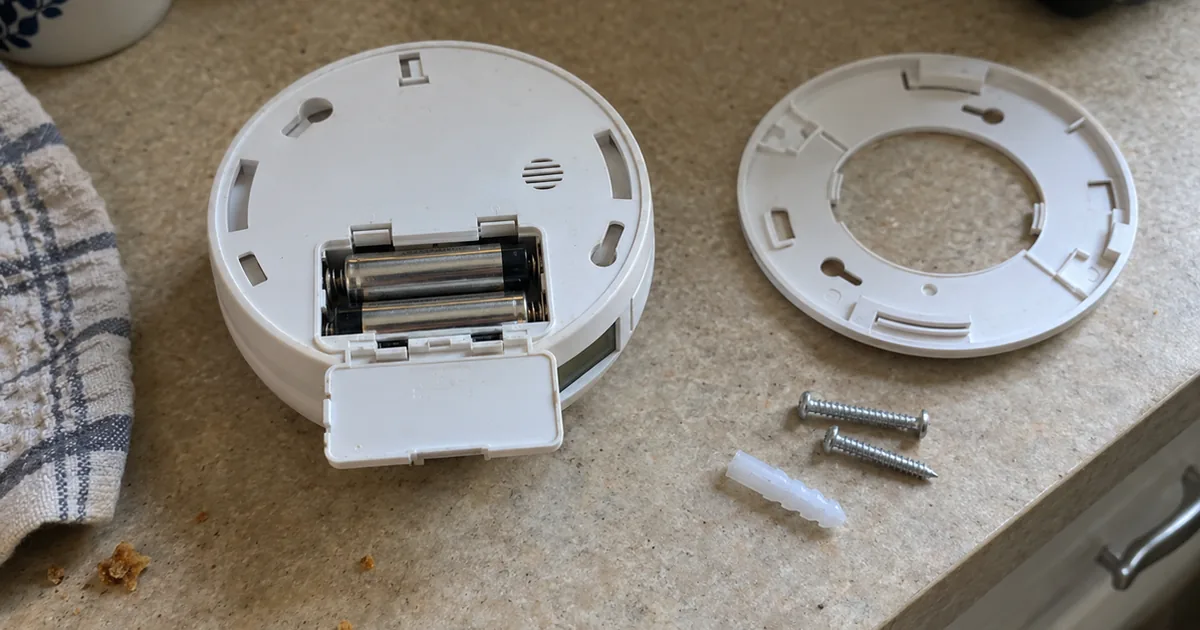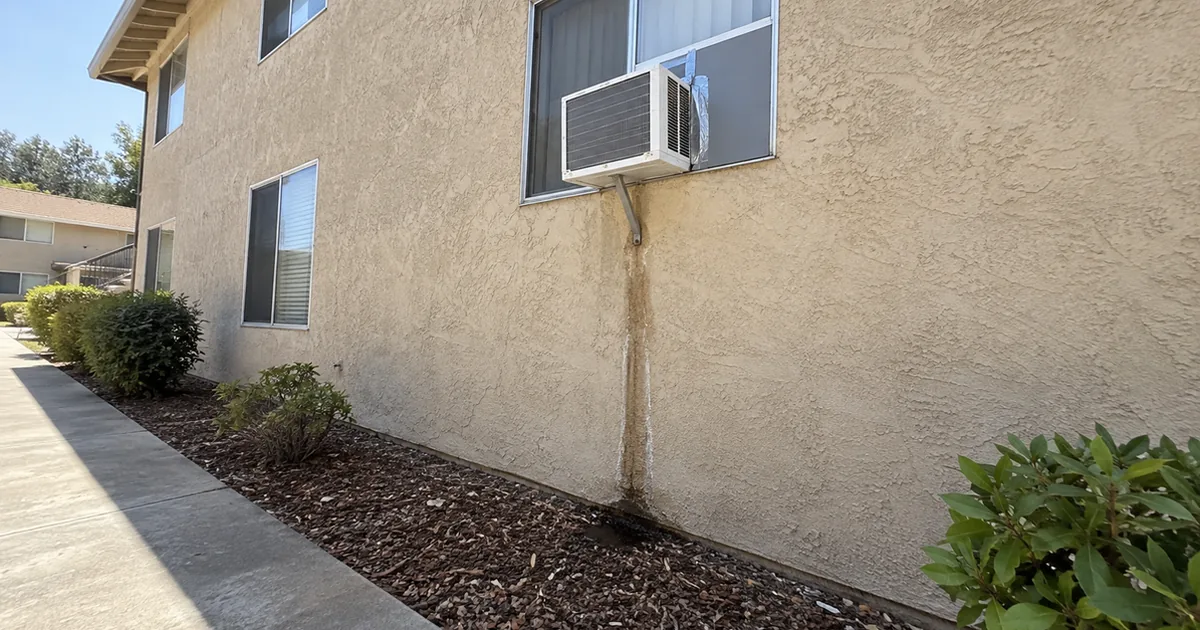
An upstairs unit in an inland HOA complex in August. A window air conditioner sits in the bedroom slider. Foam board and tape fill the leftover gap. A metal bracket is screwed into the stucco. Below it, a dried brown drip stain runs down the building wall and into the common-area planter.
The seller has two violation letters from the association. The buyer wants to know whether the unit can stay and who owns the stain.
This is a composite of situations we see, not one property. Starting January 1, 2027, California law changes the first question. The HOA generally cannot ban a code-compliant cooling system. The second question stays difficult. Water damage, electrical work, permits, and responsibility do not disappear because the association loses its ban.
AB 1684 takes effect January 1, 2027
AB 1684 adds Section 4738 to the California Civil Code, inside the Davis-Stirling Common Interest Development Act. Governor Newsom signed it on September 30, 2026. It is an ordinary non-urgency statute, so it takes effect January 1, 2027.
Assembly Member Chris Ward of San Diego authored the bill. Assembly Members Connolly and Kalra coauthored it. The measure passed without a dissenting vote at every recorded step identified in the Senate Judiciary Committee analysis, including a 74-0 vote on the Assembly floor and a 9-0 vote in the Senate Housing Committee.
This is not legal advice.
Section 4738 applies to a cooling system in a member’s separate interest. That can include equipment installed in a condo, townhome, or other property governed by a common interest development association. It also reaches restrictions written into governing documents, architectural guidelines, and certain documents affecting a sale or transfer.
The Senate Judiciary Committee analysis estimates that California has 51,700 common interest developments housing about 14.5 million people. The figure cites the Foundation for Community Association Research. The law therefore affects a large number of older buildings, newer planned communities, and the transactions that move through them.
A cooling system can be a window unit, heat pump, or fan
Section 4738 defines “cooling system” broadly. It may include a portable air-conditioning unit, a window air-conditioning unit, a swamp cooler, any evaporative cooler, a cooling fan system, a heat pump, or any other technology that reasonably creates an internal temperature cooling benefit.
The system must meet applicable health and safety standards and requirements imposed by law. Section 4738(a) protects a cooling system that complies with all applicable state and local building codes. The law does not turn unsafe work into compliant work.
The location still matters. A unit in a bedroom window has a different effect from a heat pump mounted on a patio wall. One may affect a common area, an exclusive use common area, or a neighbor’s separate interest. The definition identifies cooling equipment. It does not erase the physical consequences of installing or operating it.
The code requirement also matters for sellers. Tape, foam board, a bracket, and a working compressor do not prove that the installation complies with building codes. They show what is there. The permit and inspection record, if one is required, answer a different question.
An HOA cannot ban the cooling system or pick your contractor
After January 1, 2027, a provision in governing documents or architectural guidelines is void and unenforceable if it prohibits or restricts the installation, upgrade, replacement, or use of a cooling system that complies with all applicable state and local building codes.
The rule reaches more than a direct sentence saying, “No air conditioners.” An architectural rule that effectively blocks a code-compliant system can be a restriction under the statute. The author told the Senate Judiciary Committee that many HOAs ban window units visible from the street, restrict where a cooling system may go, or set a maximum decibel level for exterior units. The review process itself can also be slow.
Section 4738(b) covers a covenant, restriction, or condition in a deed, contract, security instrument, or other instrument affecting transfer or sale. If that provision effectively prohibits or restricts a cooling system, it is void and unenforceable.
Section 4738(c)(1) gives the association a direct list of things it cannot do. It cannot prohibit or restrict a member from installing, upgrading, replacing, or using a cooling system in the member’s separate interest. It cannot charge a fee in connection with the system. It cannot require a specific cooling system, system type, contractor, or product. It cannot claim a rebate, credit, or commission. It cannot require the member to remove a cooling system or prevent replacement or an upgrade of an existing system.
The restrictions join other protections already found in Davis-Stirling. California law already protects electric vehicle charging stations, television antennas, low-water landscaping, and accessory dwelling units from certain HOA bans. AB 1684 adds cooling systems to that list.
AB 806, authored by Connolly and enacted as Chapter 343 of the Statutes of 2025, made a similar change for mobilehome parks. AB 1684 addresses common interest developments.
The two exceptions are a law violation and a missing permit
An association can still restrict the work if it establishes one of two exceptions. First, the installation, upgrade, replacement, or use would violate federal, state, or local law. Second, a permit from a designated permitting authority is required and has not been granted.
The word “establishes” places the issue on the association’s side of the dispute. A general preference for a cleaner exterior is not one of the listed exceptions. A documented code violation or an ungranted required permit is different.
“Permit” includes any electrical, building, or other permit required by law for work associated with the cooling system. A permitted heat pump or ducted system still needs its required permits. A window unit usually does not require a local building permit, but the building department decides what the work requires.
A local noise ordinance remains law. The Senate analysis identifies HOA maximum decibel rules as one type of restriction described by the author. How courts will read noise rules under Section 4738 has not been tested. An association cannot assume that a blanket decibel cap in its governing documents controls. An owner cannot assume that the statute overrides a local noise ordinance.
When a heat pump does need a permit, the inspection side of that permit is changing too. Our explanation of how AB 1738 changes permit inspections for heat pumps covers remote video inspections for that kind of work.
The physical record matters in both disputes. Inspection.re photographs where each unit sits, what the equipment drains onto, and the visible condition around the installation. Reports are delivered the same day. See what every inspection covers.
The association keeps damage responsibility, and it follows the buyer
Section 4738(e) preserves the association’s right to hold the owner responsible for certain damage. That responsibility applies when the cooling system affects a common area or an exclusive use common area.
The member remains responsible for repairing damage to the common area, exclusive use common area, or another member’s separate interest if the damage was caused by installation, operation, maintenance, or removal of the cooling system. The rule also applies to “any successor to that member’s separate interest.”
That last phrase is the part buyers should read twice. The responsibility can follow the property to the next owner. A buyer may inherit responsibility for a stain on a building wall, a damaged planter, a wet patio, or damage inside a neighboring unit if the statutory conditions are present.
The association may also require a licensed contractor to install, maintain, and repair a system that affects those areas. That licensed-contractor rule does not apply to a portable unit, a window unit, an evaporative cooler, or any cooling system that does not require a local building permit.
The exception does not make every window installation harmless. It means the specific licensed-contractor requirement in Section 4738(e)(2) does not apply to those systems. The owner can still be responsible for damage caused by the installation, operation, maintenance, or removal.
The association may also require the owner to disclose the cooling system and the owner’s related responsibilities to prospective buyers. When it does, that disclosure gives the buyer another item to compare against the physical inspection, the seller’s other disclosures, and the HOA records.
Read the HOA documents with the equipment in mind. Reserve information may show a building with aging exterior walls, roofs, electrical equipment, or other common elements that could be affected by an installation. Our review of HOA reserve disclosures explains why those records belong in a property review.
Windows raise a related issue. California has a separate HOA rule addressing certain window replacement permits and approvals. See SB 908’s window replacement rules. A buyer should not treat every exterior opening, bracket, or attachment as a minor cosmetic detail.
Water and wiring cause more trouble than the air conditioner
The damage is usually water and wiring, not the unit itself. Condensate from window units and mini-split heads can drip onto stucco, walkways, or a neighbor’s patio. A dry brown stain is evidence of a past condition. It does not identify who caused it or who must repair it.
A drain hose can terminate over a planter. It can discharge onto a walkway. It can send water toward a wall instead of away from it. Condensation issues in coastal equipment are discussed in condensation problems in Solana Beach HVAC systems.
Mini-split line sets create another point of entry. The lines pass through the wall. A bracket can penetrate stucco. Poor sealing around either opening can let water into the wall assembly. The visible equipment may operate normally while the building envelope takes on water.
Window units create electrical questions. They may be connected to extension cords. They may share an overloaded bedroom circuit. A breaker that has not tripped does not prove that the circuit is properly configured for the equipment.
A window unit placed in the only window of a bedroom can block the escape opening. Whether that conflicts with code is the building department’s call. We report the blocked opening. The buyer, seller, agent, and local authority then have a concrete condition to address.
Evaporative coolers create a different set of observations, especially on roofs. Their installation, water supply, drainage, and roof penetrations need attention. Desert buyers can review Palm Springs evaporative cooler inspections for the conditions that show up in those systems.
The Community Associations Institute’s California Legislative Action Committee opposed AB 1684 in the Senate Judiciary analysis. It said many associations are 20 years and older and “may not have the electrical capacity to handle multiple requests” for air conditioning. It also asked who pays if capacity must be upgraded. The bill does not answer that question.
That concern is most concrete in older buildings with small services or limited distribution equipment. The building’s electrical service needs to be evaluated rather than assumed. The same basic issue appears in undersized electrical service in San Marino homes, although every property requires its own review. The circuit question is not unique to cooling, either: plug-in balcony solar under SB 868 raises it from the other direction.
A standard home inspection does not test every window unit
We note and photograph a window unit, but the inspection standard does not treat it as the home’s cooling system. Under the InterNACHI Standards of Practice, the inspector inspects “the cooling system, using normal operating controls.” The inspector describes the thermostat location and cooling method and reports a cooling system that did not operate.
The standard does not require the inspector to “inspect portable window units, through-wall units, or electronic air filters.” It also does not require the inspector to operate cooling when it is below 65 degrees Fahrenheit outside. The inspector is not required to determine capacity or BTU adequacy.
For a central system, the inspection focuses on observable operation and conditions at the time of inspection. Our guide to central air conditioning defects in Perris describes the types of conditions that can be reported in that setting.
Refrigerant information also has limits. A system’s refrigerant type, age, and service history are not the same thing as a finding that the system cools adequately. See the R-410A refrigerant change for the refrigerant issue that can arise during a property review.
Inspection.re inspectors are InterNACHI-certified. They use normal operating controls when the system falls within the inspection scope. They provide same-day reports with photographs. They also use FLIR infrared scanning as a screening clue only, not proof of a defect.
A 3D Matterport scan records where equipment sits relative to walls and windows. That can show a bracket beside a slider, a unit in a bedroom opening, or equipment positioned over a walkway. It does not replace a permit record or a building department determination.
See a sample inspection report for how those observations appear in a report.
Agents should put the cooling system in the transaction file
Treat the cooling equipment as part of the property record, and put these six questions in writing.
- Ask the HOA for any open violation or architectural file on the unit’s cooling system.
- Ask whether the installation needed a permit and obtain the final permit or other available record.
- Read the inspection notes on drainage, wall penetrations, and circuits.
- Read the successor-responsibility language and any disclosure the association requires.
- Get in writing whether portable and window units convey with the property.
- On an older building, ask the board whether electrical capacity has been studied.
Start these questions before removing contingencies. A violation letter may describe a rule that becomes unenforceable on January 1, 2027. It may also identify a separate problem, such as water damage, an unpermitted electrical alteration, or an installation that affects common property.
This hits first in inland complexes in Riverside, master-planned HOAs in Irvine, desert condos in Palm Springs, and tract HOAs near Perris. The equipment changes. The file questions do not.
Quick FAQ
When does AB 1684 take effect?
January 1, 2027.
Can my HOA make me take out a window unit?
Not after January 1, 2027, unless one of the statutory exceptions applies. The system still must meet applicable health and safety standards and legal requirements.
Can the HOA require a licensed contractor?
Only for a system requiring a permit and affecting a common area or exclusive use common area under the rule in Section 4738(e)(2). That rule does not apply to portable units, window units, evaporative coolers, or systems that do not require a local building permit.
Who pays if my AC damages the building?
The association can hold the owner responsible for damage caused by installation, operation, maintenance, or removal. The responsibility can apply to a successor owner.
Does a home inspection check window AC units?
The InterNACHI Standards of Practice do not require inspection of portable window units or through-wall units. Our FAQ explains the inspection scope in plain language.
The honest summary
AB 1684 takes away a broad HOA ban on code-compliant cooling systems. It does not remove building codes, local permits, noise ordinances, electrical limits, drainage problems, or responsibility for damage.
The responsibility can follow the cooling system and the separate interest. It can reach the common area, an exclusive use common area, or a neighbor’s separate interest. It can transfer to the buyer.
Ask for the HOA file. Verify the permit question. Read the drainage and wiring observations. Treat the cooling system as part of the transaction.
To book an inspection that photographs every cooling unit and what it drains onto, call Inspection.re at 1-888-88-INSP-9.
Also signed September 30, 2026: SB 996 on manufactured home definitions.
Another 2026 law narrows what an association can block: AB 956 on ADUs and HOA covenants.
Another association law signed the same week changes the money side: AB 2050 requires HOAs to fund reserves from 2032, with a 15 percent transfer when the 30-year projection falls below zero.
Two more association laws from the same session sit beside this one: SB 222 voids HOA rules that block a heat pump or a gas-to-electric swap, and SB 1267 changes who pays for a member’s EV charger in the garage.