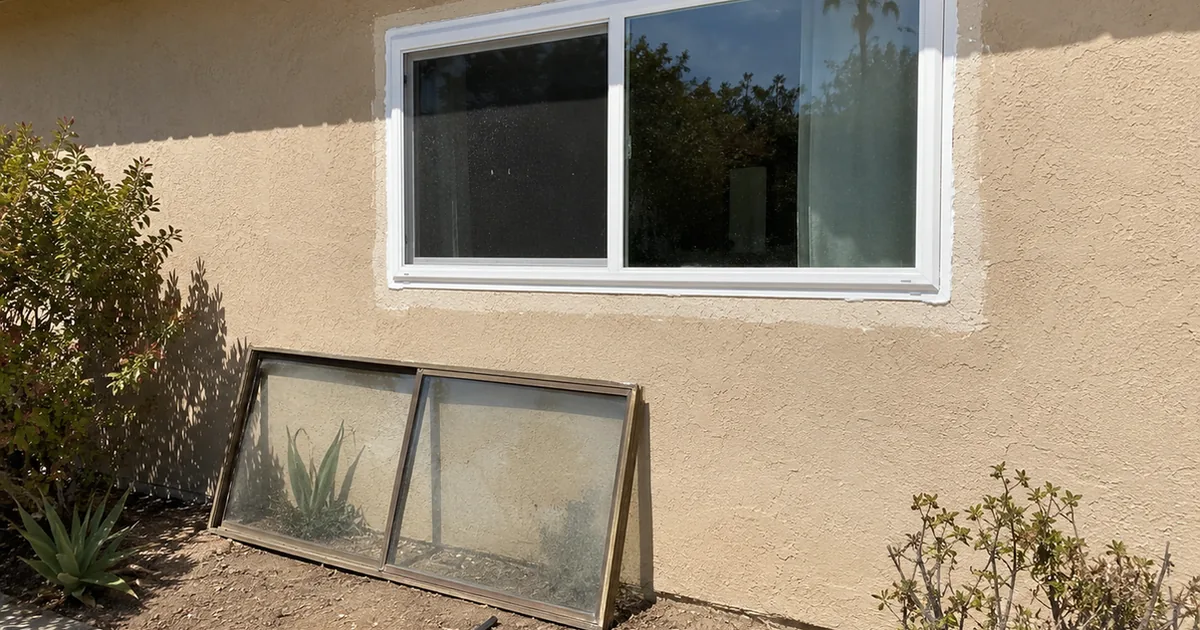
A 1970s single-story stucco house is listed with “new dual-pane windows throughout.” The frames are bright white vinyl set into the old openings. A fresh bead of sealant runs around each one, with a band of patched stucco outside. Inside, the sliders glide and lock.
The small window beside the front door is plain annealed glass. There is no etched safety mark in any corner. The bedroom counted in the listing has the same small opening it always had. The seller cannot produce a permit record. The windows are new. Whether the work was right is a different question.
This is a composite of a situation we meet often, not any one identifiable property. A new California law, SB 908, signed on September 29, 2026, is about to make this kind of project faster to approve. That is good news for comfort and energy bills. It also means more houses will reach the market with replacement windows, and the law is explicit that faster approval does not mean lower standards. That is the part buyers and agents should read closely.
SB 908 takes effect on January 1, 2027
SB 908, by Senator Scott Wiener of San Francisco, is a new California law that makes cities, counties and homeowners associations approve like-for-like residential window replacements instead of putting them through discretionary review.
It reached Governor Newsom on August 31, 2026, and his office listed it among the housing bills he signed on September 29, 2026.
Because SB 908 is an ordinary, non-urgency statute signed in 2026, it takes effect January 1, 2027. It adds Government Code Section 65850.73, which covers cities and counties, and Civil Code Section 4754, which covers homeowners associations.
The Legislature declared that retrofitting windows in existing residential buildings with windows meeting current California Energy Code standards is “critical to reducing energy consumption and achieving the state’s climate goals.” It also declared the matter one of statewide concern rather than a municipal affair, which is the language that brings charter cities inside the rule too.
This is not legal advice. Inspection.re does not give legal advice.
The stated problem was cost and delay, not quality
The problem the bill’s author described was the cost and delay of replacing older windows, not permission to install work that fails the code.
Senator Wiener’s May 19, 2026 release cites a U.S. Department of Energy estimate that 30 percent of home heating energy escapes through windows. The same release says historic wood-framed windows cost roughly $40,000 for a whole-house job, nearly double the roughly $20,000 cost of modern fiberglass, aluminum or vinyl alternatives. Those are the release’s figures, not ours, and we do not quote window prices. It names complex permitting, historic preservation requirements and HOA restrictions as the barriers.
Senator Wiener said, “Updating your home to be more comfortable and energy efficient should be easy and straightforward. Too often, it’s anything but. The permitting process itself should be part of the solution to this problem, not one of the biggest barriers to fixing it.”
On inspections, the older stock is familiar. Single-pane aluminum sliders from the 1960s and 1970s are among the most common windows we open on California inspections. Failed seals on early dual-pane units are the other regular finding, the one our Costa Mesa guide to fogged dual-pane windows walks through. A replacement window can address poor operation, heat transfer and failed seals. It cannot correct an opening that was wrong before the replacement.
“Same size, same location” is the definition that controls
The law covers only a narrow, specific job, and the definition is the most important thing in the bill.
A residential window replacement project replaces existing windows in a residential building with windows of the same size and in the same location. The work must require no physical alterations beyond the installation and must fully comply with the California Building Standards Code, Title 24.
A bigger opening, a new window where there was wall, or a window turned into a door is outside it, and still goes through whatever process the city already uses.
Same size, same location is also why a replacement does not fix a bedroom that never had a proper escape opening. The new window fills the old hole. If that hole was too small or the sill was too high for a sleeping room, the new window inherits that problem. Our Pacific Palisades egress guide covers the escape-opening dimensions in detail, and the Fremont guide to non-conforming bedrooms explains why a failed opening puts the bedroom count itself in question.
A change of style in the same opening can change the result. A slider swapped for a casement, or a casement swapped for a slider, changes the clear opening a person can actually climb through. The measurement has to be taken again, not assumed.
Cities and counties must approve qualifying projects administratively
Cities and counties must administratively approve an application for a qualifying residential window replacement project, with no discretionary review and no hearing.
A denial requires written findings, based on substantial evidence, that the project would have a “specific, adverse impact upon public health or safety” and that there is no feasible way to mitigate it.
Any conditions are limited to objective conditions addressing that specific health or safety impact. The law does not give a city an open-ended chance to revisit design preferences.
There is a historic exception. The law does not reach a building individually listed on the California Register of Historical Resources or on a local register, except for a local listing made primarily because of the building’s age. The listing must also predate the application.
Administrative approval is still approval. SB 908 changes how a permit application is reviewed. It does not say that a homeowner can skip the permit or skip the building department’s inspection. The same pattern runs through AB 1738, the remote-inspection law signed earlier in September: the state changes how the permit process works, and the permit itself stays.
An HOA can keep only narrow controls over replacement windows
An HOA can no longer effectively block an owner from installing Energy Code compliant replacement windows, although it keeps some narrow controls.
A deed, contract or governing document provision that effectively prohibits or restricts an owner of a separate interest from completing a residential window replacement project with California Energy Code compliant windows is “void and unenforceable.”
The law defines compliant windows by reference to the mandatory requirements for fenestration products and exterior doors in Section 110.6 of the California Energy Code, Title 24, Part 6.
An association may still impose reasonable installation restrictions. Those restrictions cannot significantly increase cost or significantly decrease energy efficiency. The law defines “significantly” as more than 10 percent in each case.
Reasonable aesthetic restrictions are allowed only in multifamily buildings of more than 20 units. They do not apply to townhomes under this rule.
The association must approve a compliant application within 45 days or the application is deemed approved. That result does not apply if the delay is because the association reasonably asked for more information.
The location of the window matters. Where the windows sit in common area or exclusive-use common area, the owner must agree in writing to meet the association’s aesthetic and installation standards. The owner must hire a licensed contractor, obtain the required permits and take on the maintenance and liability costs.
For a condo buyer, that agreement and the liability it carries may follow the unit. Ask the association for the approval file and the signed agreement, alongside the reserve documents our piece on HOA reserve disclosures covers.
The bill does not relax the building code
SB 908 says in plain words that the replacement must comply with the whole building code.
The statute requires compliance with all applicable provisions of the California Building Standards Code, Title 24, “including, but not limited to the California Residential Code, California Building Code, California Fire Code, California Wildland-Urban Interface Code, and the California Energy Code.” Our overview of the 2025 California Building Standards Code explains how those parts fit together.
For a typical house, that includes the glass itself. Glass in locations treated as hazardous, such as beside a door, near a tub or shower, or low and large near a walking surface, has to be safety glazing. Tempered glass carries a permanent etched mark in a corner. That is how an inspector checks it in the field.
Energy Code compliance is where the NFRC rating label on a new window matters. The label is normally removed after installation. The paperwork, not the glass, is the proof of the product rating.
Homes in mapped fire hazard areas have another layer. Wildland-urban interface standards set tougher requirements for exterior windows in those areas. A buyer in a fire zone should ask for the product documentation. The replacement being new does not answer that question. Windows are also one of the items the state’s coming home hardening standard and certification program will have to address.
Federal lead rules still apply. Under the EPA Renovation, Repair and Painting rule, 40 CFR 745, homes built before 1978 are covered. Window replacement is specifically excluded from the “minor repair and maintenance” exemption. That exemption otherwise covers work disturbing 6 square feet or less of painted surface per room inside, or 20 square feet or less outside.
Any size of window replacement in a pre-1978 home needs an EPA or state certified firm using certified renovators. SB 908 does not change that federal requirement. Our Burbank guide to lead paint in older homes covers why window work is the classic trigger.
An inspection checks the window, not the permit record
An inspection checks how the windows work and how they were installed, window by window. It does not determine whether a permit exists.
Every operable window should open, close and latch. We look for sashes that bind, slider weep holes painted over or packed with debris, missing safety marks where the location calls for them, and fogging between panes.
Outside, retrofit windows in stucco are commonly set into the old frame opening with a flange that laps the stucco and relies on sealant. We look at that sealant line and the gaps at the corners. We look for staining or bubbled paint below the sill, a classic sign that water is getting behind the replacement.
Inside, stained sills and swollen drywall returns show where something may have gone wrong. A moisture meter reading under the sill can add information when the area looks suspicious. Infrared scanning can help show a wet or drafty band around a frame, but it is a screening tool, not proof.
Sleeping rooms get measured regardless of how new the window is: the clear opening and the sill height.
The report comes the same day with photographs of each window condition. The 3D Matterport scan records window locations and sizes, which helps a buyer compare the observed openings against the permit record later. Our sample inspection report shows how those window notes are laid out.
We are not the building department. We do not certify code compliance, and we cannot see the flashing hidden behind a finished stucco patch.
Faster approval makes the paper trail more important
Ask for the paper, because faster approval should mean there is more of it, not less.
Buyers should ask for the finaled permit, the product documentation with the NFRC ratings, the contractor’s license and, on a pre-1978 house, the lead-safe renovation record. In an HOA, ask for the association approval and any signed maintenance agreement.
Sellers whose windows were replaced without a permit have practical choices that should be discussed with the local building department and their agent. Those choices may include a permit after the fact or clear disclosure. Our guide to pre-listing inspections for sellers covers when finding this out early helps. This is not legal advice, and Inspection.re does not give legal advice.
Agents should make “new windows” in a listing mean something checkable. Six things to tell every buyer:
-
Ask whether a permit was obtained, and get the finaled permit if there is one.
-
Ask for the NFRC product documentation rather than relying on the words “dual-pane” or “energy efficient.”
-
Read the inspection for safety glass near doors, tubs and large low panes, and whether the etched marks were observed.
-
Have bedroom openings measured rather than assuming a new window provides a compliant escape opening.
-
Look at the exterior sealant line and for stains or bubbled paint below the sills.
-
On a pre-1978 house, ask for the lead-safe renovation record.
The most common gap we see is not a bad window. It is a good window with no paper behind it. A permit record, a product document and an association file answer questions that a clean white frame cannot. That holds from a stucco ranch in Costa Mesa to a hillside house in Pacific Palisades to a Victorian flat in San Francisco, where the historic-register exception may also come into play.
Quick FAQ
When does SB 908 take effect?
SB 908 takes effect January 1, 2027. It was signed on September 29, 2026, as an ordinary, non-urgency statute.
Does SB 908 mean I no longer need a permit?
No. The change is that a city or county must approve a qualifying project administratively, without discretionary review or a hearing. Administrative approval is not the same as no permit, and the bill does not remove the building department’s inspection.
Can my HOA still say no?
Only in narrow ways: installation restrictions that stay within the 10 percent cost and efficiency limits, aesthetic restrictions in buildings of more than 20 units that are not townhomes, and a 45-day clock after which a compliant application is deemed approved.
Does SB 908 apply to a historic house?
Not if the building was individually listed on the California Register or a local register before the application, unless the local listing rests primarily on the building’s age.
Will a home inspection tell me if the windows were permitted?
No. A home inspection reports condition and installation details that can be observed. The building department holds the permit record. Ask for the finaled permit and compare its information with the windows and openings at the property. Our FAQ covers more on where an inspection’s scope ends.
The honest summary
SB 908 takes the discretion out of approving a like-for-like window swap. That is a reasonable trade for energy and comfort.
It does not lower the standard the window has to meet. The bill says so in its own text, and it keeps the applicable building code in place.
The resale market will see more houses with new windows. The difference between a good job and a fast one will show up in the paperwork, the sealant line and the bedroom measurements, not in the listing copy. Tighter new windows can also change how an older house breathes, which is why our Norwalk guide to backdrafting and combustion air lists replacement windows among the causes.
Check the permit, check the product documents, look at every sealant joint and measure every sleeping-room opening. See what’s included in every inspection, or call 1-888-88-INSP-9 to book one.
The same pattern arrived for cooling a day later. AB 1684 voids most HOA bans on air conditioners and heat pumps from 2027, and window units are often the first thing installed in an old slider.
The September 29 housing signings also touched ADUs. Read what AB 956 changes for HOAs and backyard units.
For what the association itself must set aside for shared components, see how AB 2050 changes HOA reserve funding in 2032.