The Cooler Nobody Winterized: A Palm Springs Evaporative Cooler Inspection Guide for Agents
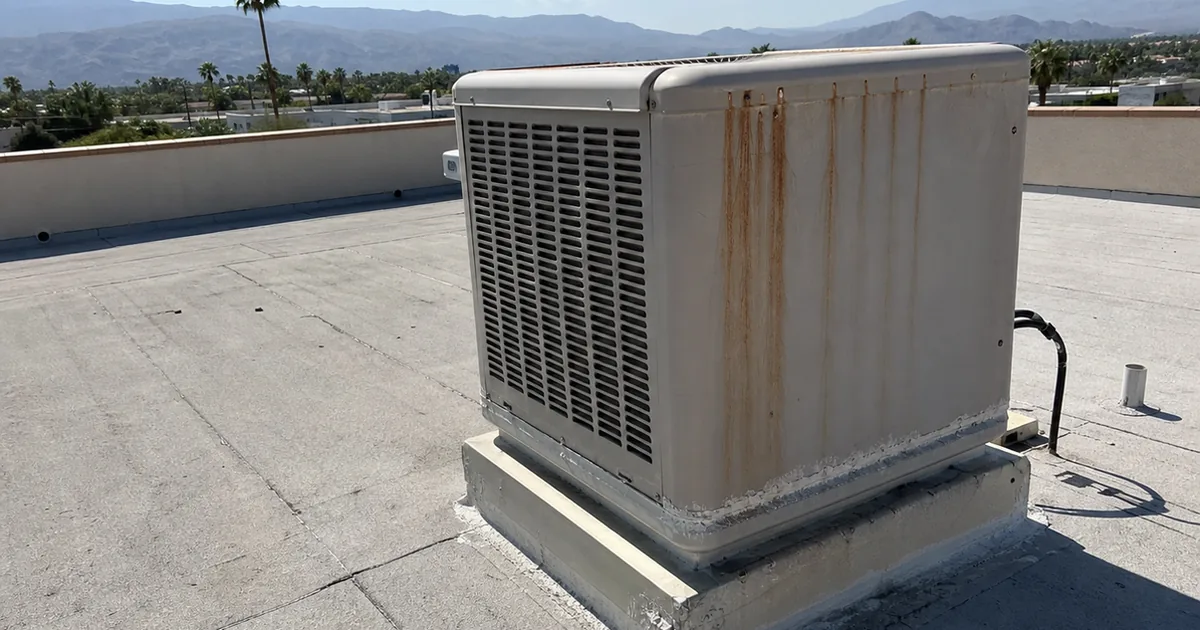
The house was a Twin Palms-era post-and-beam, the kind of place with a flat roof, a low fascia line, and a listing photo set that made the whole street look like 1962. On the roof, hidden behind the parapet where nobody looks from the street, sat an evaporative cooler cabinet the size of a dorm-room refrigerator, rusted through at the base and packed with a decade of mineral scale on its cooling pads. The damper that was supposed to close it off in winter had been left open since some previous owner stopped using the unit, and the ceiling below it, in a guest bedroom, had a water stain radiating out from the duct boot that nobody had connected to anything on the roof.
We are describing this as a composite of what turns up across several Palm Springs inspections a year on homes running an evaporative cooler alongside or instead of refrigerated air conditioning, not one identified property or job. The pattern is common enough in this market to deserve its own explanation, because most agents working here have never had to think about how a swamp cooler actually works or fails.
This guide is for the agent working Palm Springs and the broader Coachella Valley desert market, where dry heat and a large stock of mid-century homes and casitas make evaporative cooling a real, still-functioning piece of the mechanical system on a meaningful share of listings, not a relic nobody uses. Here is what an evaporative cooler actually is, what goes wrong with one over time, and how the finding usually plays out in escrow.
Why this matters for the agent
Evaporative cooling only works in a genuinely dry climate, and Palm Springs is one of the few Southern California markets dry enough for it to matter. That single fact explains why this system is still installed here as a real cooling source rather than a novelty. A buyer coming from a coastal or Los Angeles market has probably never seen one and has no context for what it is, what it costs to run, or what it costs to fix. An agent who can explain the basic mechanism in plain terms, and who knows what a home inspector is actually checking on the roof, keeps a straightforward mechanical finding from turning into a confused, oversized objection at the worst point in escrow.
The stakes are real but usually modest. A failed or neglected evaporative cooler is rarely a structural problem. It is a maintenance and moisture problem that, left long enough, becomes a roof-penetration and ceiling problem. Catching it early, and understanding whether the home has a working refrigerated system as a backup, changes how a buyer should read the finding.
What an evaporative cooler actually is
An evaporative cooler, commonly called a swamp cooler, cools air by passing it through water-saturated pads and letting the water evaporate, which pulls heat out of the air stream the same way sweat cools skin. A small pump circulates water from a reservoir pan up to a distribution line at the top of the unit, the water trickles down through cellulose or aspen-fiber pads, and a blower pulls outside air through the wet pads and pushes it into the house through ductwork, typically with the stale interior air pushed back out through open windows or a dedicated relief vent rather than being recirculated.
The reason this only works in a dry climate is that evaporation itself requires low humidity in the surrounding air. In a humid environment the air is already close to saturated and cannot absorb much more moisture, so the cooling effect collapses. In Palm Springs’ desert air, particularly in the shoulder seasons and even through much of summer before the monsoon humidity arrives, the effect is real and the operating cost is a fraction of refrigerated air conditioning, since the unit is mostly running a pump and a blower motor rather than a compressor.
Most installations here are roof-mounted, a single cabinet unit set on a curb over a ceiling penetration, feeding one central duct trunk or, on older homes, several individual ceiling registers. Some homes run the evaporative cooler as the sole cooling source. Others, especially where a refrigerated system was added later, run it as a supplemental unit for the shoulder seasons when it can do the job at a fraction of the electrical cost of the compressor-based system.
What actually goes wrong with one
Evaporative coolers fail in a fairly predictable set of ways, almost all tied to water, minerals, and time.
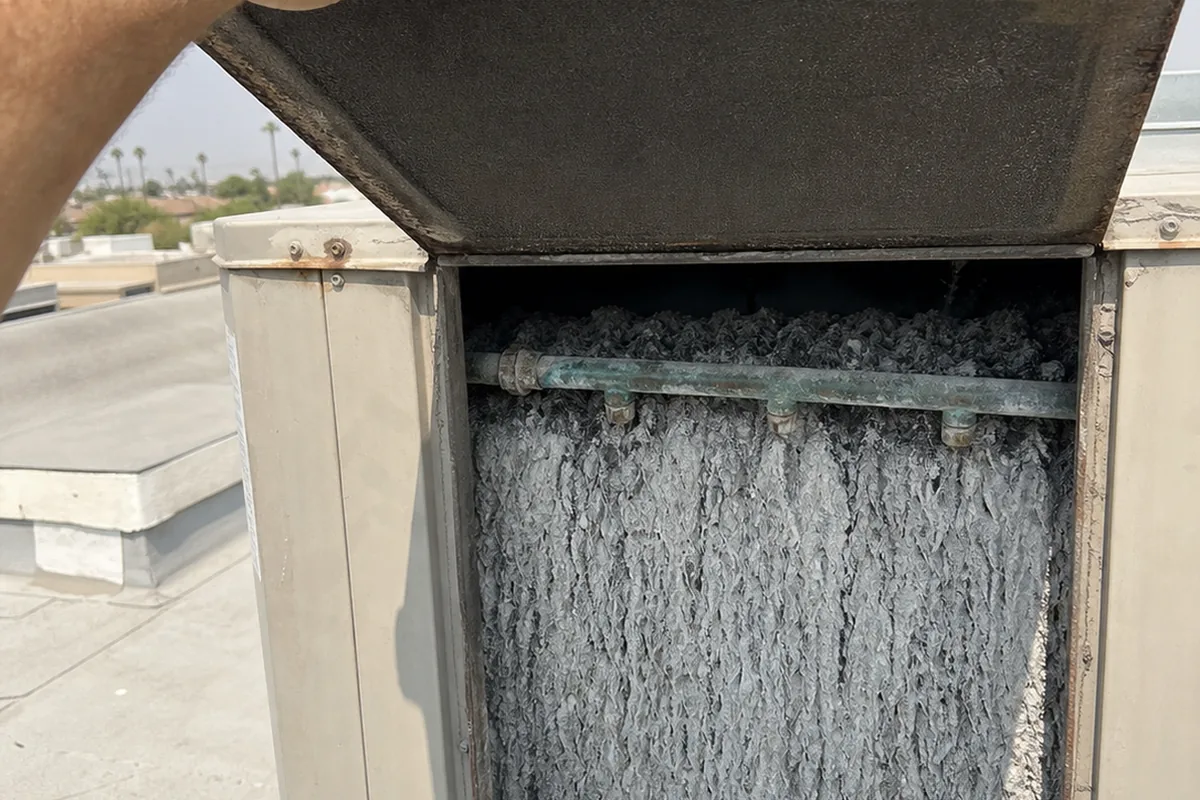
- Mineral and scale buildup on the pads and pump. Palm Springs water carries dissolved minerals, and every gallon that evaporates off a cooling pad leaves its mineral content behind. Over a season or several, the pads crust with scale, water flow through them drops, and cooling performance falls off even though the unit still runs and still sounds fine.
- Algae and rot in the reservoir pan. Standing water sitting in a warm cabinet grows algae and organic slime if the pan is not drained and cleaned on a regular cycle, particularly at the end of a season before shutdown. A neglected pan smells, clogs the pump intake, and accelerates corrosion of the pan itself.
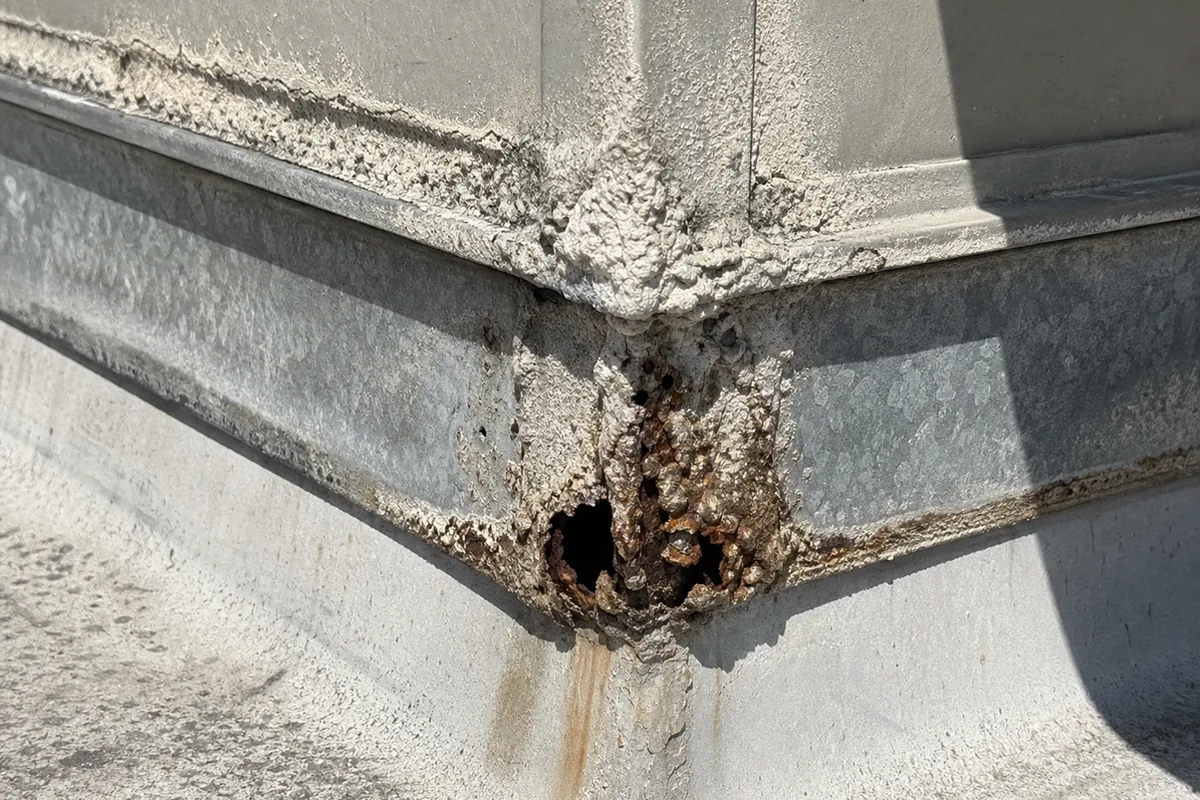
- Rusted-through cabinet on a roof-mounted unit. The steel or galvanized cabinet sits outside, in full sun, wet on the inside from normal operation and exposed to desert temperature swings on the outside. Given enough years, seams and the pan itself rust through, and a rusted pan can leak water down into the roof assembly around the curb rather than draining where it is supposed to.
- Undersized duct or damper causing pressure imbalance. An evaporative cooler needs air to leave the house as fast as it enters, usually through open windows, louvered relief vents, or a dedicated exhaust damper. Where that path has been closed off, sealed up in a remodel, or never sized correctly, the house pressurizes, air stops moving through the pads efficiently, and the system underperforms no matter how clean the pads are.
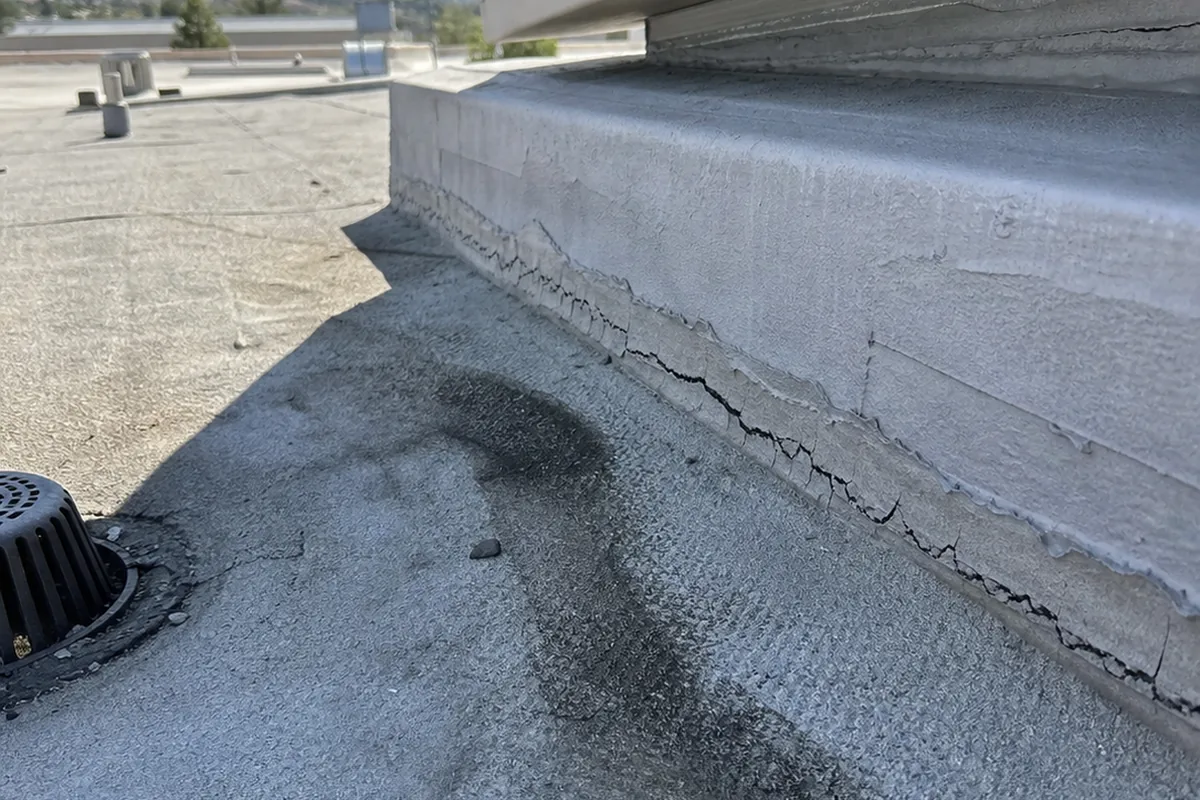
- Roof penetration and flashing leaks around the curb. The unit sits on a curb that penetrates the roof membrane, the same category of weak point as any rooftop HVAC curb or skylight. Cracked or dried flashing sealant, a curb that has shifted slightly, or a unit that was reset without resealing the base are all real sources of a slow leak that shows up as a stain on a ceiling well before anyone connects it to the roof.
- Seasonal shutdown and winterization gaps. In the off season the cooler’s damper is supposed to close, sealing the roof opening the way a closed window would. An open or stuck damper left uncovered through the winter lets cold outside air, dust, and occasionally pests into the duct system and the house, and it is one of the more common findings we log on a cooler that has not been actively used in a year or more.
- Corroded electrical at a roof-mounted unit. The pump and blower motor both run on line voltage delivered to a rooftop location that gets wet by design. Corroded connections, a cracked disconnect box, or wiring insulation that has degraded in the heat and moisture cycle are electrical findings specific to this kind of equipment.
Schedule a Palm Springs inspection →
What agents should tell every buyer
Give these points to a buyer under contract on a Palm Springs property with an evaporative cooler, whether it is the sole cooling source or a supplemental unit.
- Ask directly whether the unit is actively used, seasonally shut down and maintained, or effectively abandoned in place. The answer changes what to expect from an inspection finding.
- A swamp cooler only performs in low humidity. It is not a substitute for refrigerated air conditioning during the monsoon-humidity weeks, and a buyer expecting full-house comfort from it alone in August will be disappointed regardless of its condition.
- Ask when the pads were last replaced. Pads are a wear item with a service life measured in one to a few seasons, not a permanent component.
- If the home also has refrigerated air conditioning, ask how the two systems interact and whether the relief vents needed for the evaporative cooler conflict with a sealed system designed for the compressor unit. Pool equipment on the same property, covered in our Beverly Hills pool and spa safety guide, deserves the same direct attention as the cooling system.
- A rusted cabinet or pan is a real repair or replacement item, not cosmetic. Ask for the unit’s approximate age and whether replacement has already been discussed.
- Any ceiling stain near a roof-mounted cooler location deserves a direct look at the roof curb and flashing, not an assumption that it is old and resolved.
Red flags during showings
Some of this shows without getting on the roof.
- A ceiling stain or discoloration on a bedroom or hallway ceiling roughly below where a roof-mounted unit would sit.
- A musty or mineral smell near a duct register that only shows up when the system runs.
- Visible rust streaks running down an exterior wall or fascia below a roof-mounted cabinet.
- A cooler that runs but produces only lukewarm air, a sign of scaled pads or a failed pump rather than a working system.
- Windows in rooms served by the cooler that appear permanently sealed or painted shut, which defeats the relief-air path the system needs.
- A visibly corroded or open electrical disconnect box near the roof unit.
If we see these, we get eyes directly on the roof-mounted unit, the curb, and the duct connection.
The negotiation playbook
When an evaporative cooler finding surfaces in a Palm Springs escrow, the deal usually moves down one of a few paths.
The first path is a service and descale, the least expensive option when the unit is mechanically sound but scaled or fouled. A qualified HVAC or swamp-cooler technician cleans or replaces the pads, flushes the pan, and checks the pump and float valve.
The second path is unit replacement, warranted when the cabinet itself is rusted through, the motor has failed, or the unit has clearly exceeded its service life. Replacement cost is generally modest compared to a refrigerated system replacement.
The third path is roof and flashing repair, when the finding is really about the curb and penetration rather than the cooling equipment. This routes to a roofing contractor rather than an HVAC technician.
The fourth path is a credit or seller-side service call before close, appropriate when the unit works but has clearly not been serviced in a season or more.
How the inspection actually catches it
We access the roof on every Palm Springs inspection where a roof-mounted evaporative cooler is present, using the drone survey to document the general roof condition and a direct visual inspection of the unit itself where roof access allows it safely.
We document the cabinet’s physical condition, including rust, and note whether the water distribution system, pump, and pads are present and in serviceable condition where visible without disassembling the unit. We check the curb, flashing, and roof penetration around the base for cracking, gaps, or evidence of past water intrusion, and we trace any interior ceiling staining back to its most likely source. We check that the seasonal damper is present and operable, and we test the unit’s basic operation where power and water are on at the time of inspection. We do not disassemble the pump, replace pads, or diagnose water chemistry, all of which belong to an HVAC or evaporative-cooling specialist. Where we find active leaking, significant corrosion, or a unit that does not run, we say so plainly and recommend that specialist scope, the same way our inspection report prioritizes findings for the buyer. Our what’s included page has the full scope of every Palm Springs inspection.
Quick FAQ
Is an evaporative cooler outdated technology, or is it still a legitimate cooling source? Still legitimate in a genuinely dry climate. Palm Springs’ desert air is one of the few Southern California environments where it performs well, and many homes run one alongside refrigerated air conditioning for lower-cost shoulder-season cooling.
Does a rusted cooler cabinet mean the roof itself is compromised? Not automatically. The cabinet and the roof membrane are different components. A rusted cabinet is a sign the unit needs attention. Whether the roof penetration around it has also failed is a separate question we check directly.
Can a home rely on an evaporative cooler alone through a Palm Springs summer? It can handle much of the season, but performance drops noticeably during the humid monsoon weeks in late summer. Many owners run a refrigerated system for that stretch and the evaporative cooler the rest of the year.
How is this different from a standard central air conditioning inspection? A refrigerated system inspection focuses on the compressor, refrigerant circuit, and coil condition. This is a different mechanism entirely, water and evaporation rather than refrigerant, with its own wear pattern: pad scale, pump and pan condition, and the roof curb it sits on.
Should a buyer walk away over an old evaporative cooler? Almost never on the unit alone. What matters is whether it still functions, whether the roof penetration around it is sound, and whether any ceiling staining traces back to an active leak or an old, resolved one.
The honest summary
Palm Springs is one of the few markets in this state where an evaporative cooler is still a genuine piece of the cooling system rather than a curiosity, and the desert’s dry air is exactly why it still works. What fails over time is predictable: scaled pads, a fouled pan, a rusted cabinet, a stuck damper, or a roof penetration that was never resealed after the last time the unit was reset. None of that is a reason to panic over a listing, and none of it should be waved off as harmless either.
We get on the roof, document the unit and the curb around it, trace any ceiling staining to its actual source, and tell you plainly whether you are looking at a service call, a replacement, or a roofing repair. That is the job on every Palm Springs roof we walk.
See what every inspection includes → · Read our FAQ → · Explore Palm Springs home inspections →
Related reading
- Mid-Century Modern Home Inspection in Sherman Oaks. Flat roofs, post-and-beam construction, and radiant-slab considerations on the same era of home.
- Attic Insulation and Ventilation Under Extreme Heat in Woodland Hills. A different heat-driven mechanical system finding, the thermal envelope rather than the cooling equipment itself.
- Pool and Spa Safety in Beverly Hills. The other near-universal mechanical system on a Palm Springs lot.
- How to Read a Home Inspection Report in California. How a finding like this gets prioritized and handed to the right specialist in writing.
- Central Air Conditioning Defects in Perris. The refrigerated cooling equipment this desert market often runs alongside an evaporative cooler, and what can go wrong with it in the same hot inland climate.