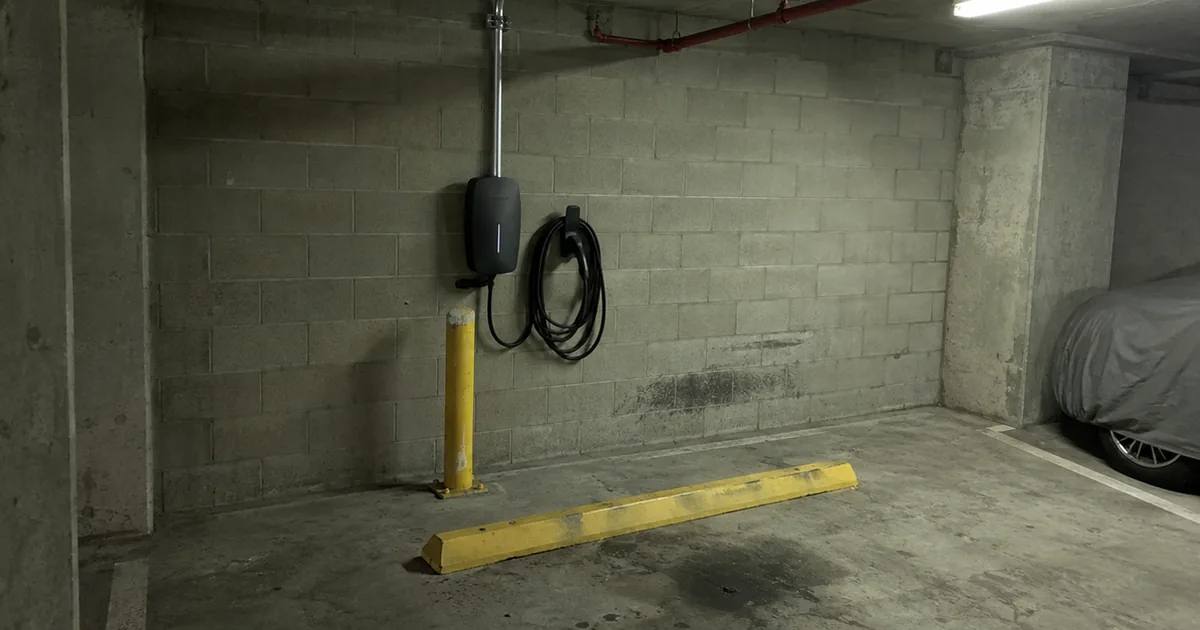
A condo listing with a Level 2 wall charger mounted on the concrete wall at the seller’s assigned stall in a shared parking garage. Conduit runs along the ceiling back toward the unit’s electrical service. The listing photos call it a feature.
Nobody in escrow has asked who owns the charger, who insures it, or who pays if it damages the garage. In California, the answer is mostly “you do, once you close.” SB 1267 adds to that list on January 1, 2027.
This is a composite of situations we see, not one property. This is not legal advice.
SB 1267 adds use damage and installer indemnity on January 1, 2027
SB 1267 amends Civil Code Section 4745, the Davis-Stirling Act section covering electric vehicle charging stations in common interest developments.
That includes condos, townhome HOAs, and planned developments. Senator Ben Allen authored the bill. The Governor approved it, and the Secretary of State filed it on September 20, 2026, as Chapter 350, Statutes of 2026. It is an ordinary statute. It takes effect January 1, 2027.
The bill passed the Senate Housing Committee 10-0 on April 7, 2026. The Senate Judiciary Committee passed it 13-0 on April 28. The full Senate passed it 36-0 on consent on May 7. The Assembly passed it on August 24, 2026.
Support came from the Community Associations Institute California Legislative Action Committee, the Electric Vehicle Charging Association, and the Alliance for Automotive Innovation. The final Senate floor analysis lists no opposition on file.
The Senate floor analysis puts the subject in a large housing context: more than 50,000 common interest developments in California, with more than 4.8 million housing units. That is about one-quarter of the state’s housing stock.
SB 1267 makes three changes to Section 4745.
First, the owner and each successive owner of a charger in a common area or exclusive use common area were already responsible for costs of damage from installation, maintenance, repair, removal, or replacement. SB 1267 adds damage resulting from the charger’s “use.”
Second, new subdivision (f)(5) states: “The installer of the electric vehicle charging stations shall indemnify or reimburse the association or the members for loss or damage caused by the installation.”
Third, new subdivision (l) states: “Except in the case of gross negligence by the association, it is the intent of the Legislature to provide an association that has complied with this section with civil liability protection for injuries and damages emanating from an electric vehicle charging station or its use that the association does not own.”
That last provision is a statement of legislative intent. Courts have not tested how they will apply it.
The Senate version would have allowed an HOA to require the owner to sign a maintenance and indemnity agreement transferring liability to the owner. Assembly amendments removed that requirement before passage.
The author’s statement to the Senate identified the concern: “Privately owned chargers can create liability for an association for injury or damage that occurs in common area spaces. While increased adoption of EVs over time has not shown any significant risk of damage or injury, the lack of certainty can be worrying for HOAs.”
California has revised charger liability rules three times since 2011
California first barred HOA rules that prohibit EV chargers in 2011.
SB 209, authored by Corbett and enacted as Chapter 121, Statutes of 2011, also required an owner installing a charger in a common area to carry an umbrella liability policy of $1,000,000. The development had to be named as an additional insured.
SB 1016, authored by Allen and enacted as Chapter 376, Statutes of 2018, removed the $1,000,000 amount. It also removed one of the two provisions requiring the HOA to be named as an additional insured.
SB 770, also authored by Allen and enacted as Chapter 525, Statutes of 2025, removed the remaining named additional insured requirement. The stated reason was that insurance for chargers was too hard to obtain.
SB 1267 follows that change. The Senate floor analysis says the bill is meant to keep “the recent change in the duty to insure” from leaving “a liability gap for HOAs.”
The Senate Judiciary analysis also flagged an open question: “it is unclear how this may affect an owner’s ability to obtain the required insurance.”
That caveat matters to a buyer. The charger still carries an insurance duty under Section 4745. The rules about who must be named on the policy changed. The buyer’s insurance agent should review the actual coverage before contingencies are removed.
The buyer inherits more than the charger itself
The owner and each successive owner of a charger in a common area or exclusive use common area is responsible for the charger’s continuing costs and risks.
Those responsibilities include the costs of damage to the charger, the common area, the exclusive use common area, or other separate interests. Before SB 1267, the listed sources included installation, maintenance, repair, removal, and replacement. Beginning January 1, 2027, “use” joins that list.
The owner also pays to maintain, repair, and replace the charger until it is removed. If it is removed, the owner pays to restore the common area. The owner pays the electricity cost.
The owner must disclose the charger’s existence and these responsibilities to prospective buyers. That duty follows the charger to each successive owner.
The charger owner must maintain a liability coverage policy at all times. The original applicant provides a certificate of insurance within 14 days after approval. That owner and each successor owner must provide the certificate annually after that.
The insurance rule applies whether the charger is in the unit or in a common area. No liability policy is required for an existing standard NEMA alternating current power plug, meaning an ordinary outlet.
For a buyer, the practical question is simple: what exactly are you agreeing to own?
You should get the charger disclosure in writing. You should get the current insurance certificate. You should see the HOA approval and any license agreement. If the disclosure package says nothing about the charger, ask before removing contingencies.
Read the HOA package with the charger in mind. Our explainer on how HOA reserve disclosures work after the SB 1238 veto covers the rest of that package. It does not replace the charger records.
An HOA may restrict the charger, but it cannot simply ban it
An HOA rule that effectively prohibits or unreasonably restricts a charger in an owner’s unit or designated parking space is void.
A designated parking space can be a deeded space, an exclusive use common area space, or a space specifically designated for that owner. The HOA may impose reasonable restrictions. Those restrictions cannot significantly increase the cost or significantly decrease the efficiency or performance of the charger.
When HOA approval is required, the application is processed like an architectural modification. The application must be in writing. If the HOA does not deny it in writing within 60 days, the application is deemed approved, unless the delay results from a reasonable request for more information.
A common area or exclusive use common area charger brings additional written conditions. The owner must agree to follow the HOA’s architectural standards, use a licensed contractor, provide the insurance certificate within 14 days, and pay the installation and electricity costs.
A charger in a general common area, rather than an exclusive use area, for one owner is allowed only when installation in the owner’s designated space is impossible or unreasonably expensive. In that situation, the HOA enters a license agreement with the owner.
The HOA may install chargers for all members. It may create a new parking space for a charger.
An HOA that willfully violates Section 4745 owes actual damages plus a civil penalty of up to $1,000. A prevailing homeowner plaintiff receives reasonable attorney’s fees.
The charger must meet applicable health and safety standards. It must be designed in compliance with the California Building Standards Code.
That rulebook matters when you see a charger already installed. A listing photo does not show whether the application was approved, whether the space is exclusive use, or whether the charger sits in the general common area under a license agreement.
A home inspection shows the charger, not every legal or electrical answer
A standard home inspection reports visible conditions. It does not decide whether the charger complies with every code or HOA requirement.
Under the InterNACHI Standards of Practice, the inspector is not required to determine “compliance with codes or regulations.” The inspector is also not required to “measure or determine the amperage or voltage of the main service equipment, if not visibly labeled.”
The InterNACHI electrical section lists service equipment, panels, and devices. It does not call out EV charging equipment by name. A standard inspection does not test the charger with a vehicle.
In a garage stall, we photograph how the charger is mounted. We look at whether the conduit and cable are protected where a car bumper or door can hit them. We document where the conduit appears to run, whether toward the unit’s panel, a separate meter, or a common electrical room.
We photograph whether a breaker in the unit’s panel appears to serve the charger. We look for visible damage to the slab, wall, or ceiling near the conduit run. We look for loose or unsupported wiring.
We do not trace circuits behind finished surfaces. We do not open common electrical rooms when we are not given access.
Inspection.re uses InterNACHI-certified inspectors. Reports are delivered the same day with photos. FLIR infrared scanning is a screening clue only. Heat at a breaker or connection is a reason to call an electrician. It is not a diagnosis.
The inspection also includes a 3D Matterport scan of the unit. You can review a sample inspection report and see what every inspection covers.
Electrical capacity is often the background question in an older building. Read what SB 382 changed about electrical disclosures and the guide to undersized electrical service in older San Marino homes.
The garage itself creates another set of visible questions. The discussion of garage fire separation problems in Fontana provides attached garage context. Plug-in balcony solar under SB 868 covers another plug-in electrical question in a shared building.
Agents should collect six charger records before contingency removal
Agents should collect these six items before the buyer removes contingencies:
- The HOA’s written approval for the charger, and the license agreement if it sits in general common area.
- The seller’s written disclosure of the charger and the owner responsibilities under Civil Code 4745.
- The current certificate of insurance the seller gave the HOA, and a call to the buyer’s own insurance agent about continuing that coverage.
- The installer’s name and contractor license number, since the installer now owes indemnity for installation damage.
- The permit and final sign-off for the charger circuit, if the local building department required one.
- The electricity arrangement: which meter the charger is on, and how the seller has been paying for it.
Decide before removing contingencies whether the buyer wants to keep the charger or ask the seller to remove it and restore the area. The inspection contingency timeline matters because these questions cannot be left for the closing table.
The installer’s information is not just a historical detail. SB 1267 assigns the installer an indemnity or reimbursement duty for loss or damage caused by the installation. That does not answer every question about the condition of an older charger, but it gives the buyer a reason to identify who performed the work.
The electricity arrangement also belongs in the file. A charger connected to the unit’s panel raises a different record question than one connected to a separate meter or a common electrical room. The inspection can document what the visible conduit appears to do. The records should identify how the electricity has actually been billed.
Shared parking makes charger records part of the sale file
Chargers show up in high-rise and garden condos in San Francisco, master-planned HOAs in Irvine, townhome communities in San Jose, coastal condo buildings in Long Beach, and HOA complexes in Walnut Creek.
The physical setup changes from building to building. The record questions do not. Who owns the charger? Which parking right supports it? What did the HOA approve? Which meter supplies it? Who has been paying for the electricity? What insurance certificate is on file?
SB 1267 is one of several 2026 HOA laws affecting buyers and sellers. AB 1684 bars HOA bans on code-compliant cooling systems from 2027. Read AB 1684 and HOA air conditioning rules.
AB 2050 sets HOA reserve funding duties from 2032. Read AB 2050 and HOA reserve funding.
If you are new to reading the report itself, start with how to read a California home inspection report.
Quick FAQ
When does SB 1267 take effect?
January 1, 2027.
If I buy a condo with the seller’s charger in the garage, is it my responsibility?
Under Section 4745, the duties run to each successive owner of the charger: damage costs, maintenance, restoration after removal, electricity, annual insurance certificate, and disclosure when you sell.
Does the HOA still have to allow chargers?
Yes, in the owner’s unit or designated parking space, subject to reasonable restrictions. A 60-day deemed approval rule applies.
Who pays if the installer damaged the garage?
SB 1267 requires the installer to indemnify or reimburse the association or members for loss or damage caused by the installation.
Will the home inspection test the charger?
No vehicle test. We report visible mounting, protection, wiring, and damage. See our FAQ.
The honest summary
SB 1267 is a small change on top of an older rulebook: “use” joins the damage list, the installer now owes indemnity, and the Legislature states an intent to protect HOAs that follow the rules.
The bigger point for buyers is the older rule: the charger’s duties transfer to whoever owns it next. Get the paper, call your insurance agent, and read the garage photos.
To book an inspection that photographs the charger, the conduit run, and the panel it comes from, call Inspection.re at 1-888-88-INSP-9.
Another 2026 law limits what an association can block on the electrification side: SB 222 on heat pumps and gas-to-electric swaps.