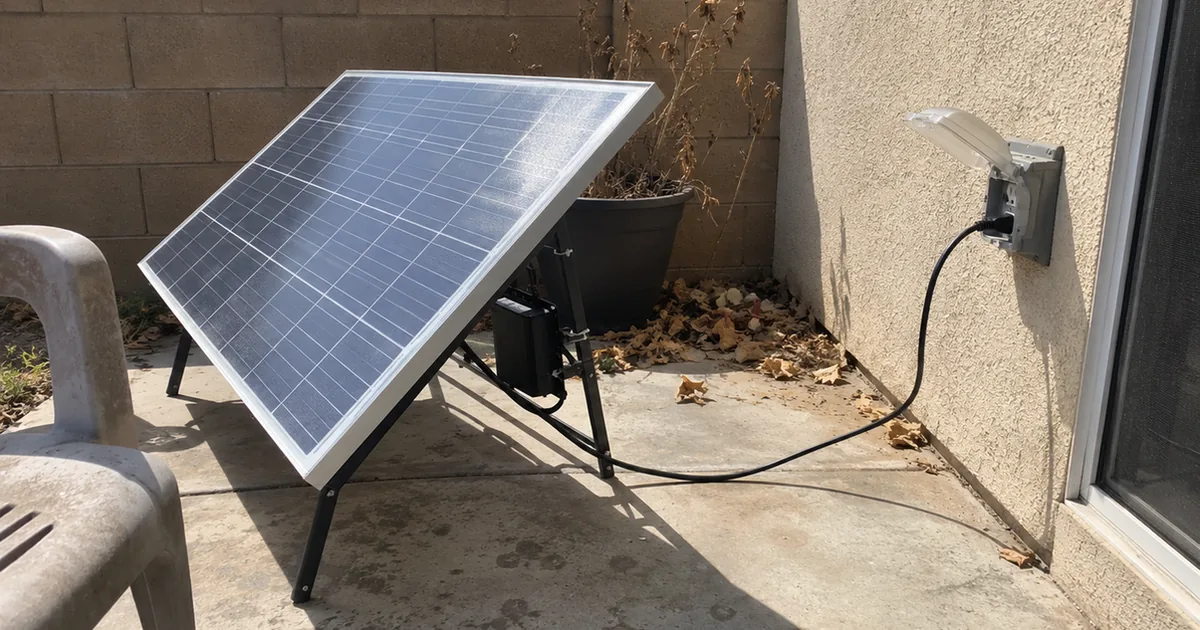
A ground-floor condo listing says “solar panel included.” On the patio, one panel leans on a folding metal stand. A small microinverter box is zip-tied to the back. A black cord crosses the concrete to an exterior wall receptacle. The bubble cover is open with the plug in.
There is no permit and no utility paperwork, because a plug-in panel never had either. The seller sees free power. The buyer asks what they are actually buying.
This is a composite of situations we see, not any one property. Governor Newsom signed SB 868 on September 30, 2026. That question is about to become common.
SB 868 starts on January 1, 2027
SB 868 takes effect January 1, 2027, because it is an ordinary non-urgency statute. Senator Scott Wiener introduced the bill, with Assembly Member Schultz as principal coauthor. The author calls it the Plug and Play Solar Act.
The Governor’s legislative update records the signing date as September 30, 2026. The bill adds Chapter 13, Portable Solar Generation Devices, to the Public Utilities Code. The new sections are Public Utilities Code Sections 8530 through 8532.
The Legislature states that “Electricity is an essential resource, especially on hot summer days.” It also states that interconnection fees and processes “can add substantial costs and time” to customer-sited solar.
That is the problem SB 868 addresses. It does not create a general exemption for every solar panel connected to an outlet. It creates a narrow category for a defined device.
This is not legal advice.
The effective date matters for transactions. A device installed before January 1, 2027 does not become a qualifying device just because the new law exists. The product still has to meet the definition. The utility rules in Section 8531 also have a January 1, 2030 endpoint unless the Legislature acts again.
The definition has six requirements, not one
A portable solar generation device must meet all six conditions in Section 8530(c). Missing one condition means the device does not qualify.
The first limit is output. The device must have a maximum aggregated AC output of no more than 1,200 watts per dwelling. “Aggregated” matters. The limit applies to the total for the dwelling, not to each panel or each kit.
The second condition is the connection method. The device must be designed to be connected to and disconnected from the building’s electrical system through a receptacle. The bill is aimed at a receptacle-connected device, not a rooftop array with a permanent electrical connection.
The third condition is its purpose. The device must be intended to offset the customer’s onsite electricity consumption.
The fourth condition is code compliance. It must meet the most recent National Electrical Code and California Electrical Code.
The fifth condition concerns certification. The device must be certified as a plug-in photovoltaic system by Underwriters Laboratories, or by an equivalent nationally recognized testing laboratory.
The sixth condition concerns outages and backfeed. The device must include a UL-certified, or equivalent-certified, feature that isolates it from the building’s electrical system so it cannot backfeed the grid during a power outage.
All six conditions work together. A device that satisfies five of them does not qualify. Section 8531(d) says a device that misses any condition does not receive the exemptions.
The 1,200-watt limit is not an abstract number. At 120 volts, 1,200 watts divided by 120 volts equals 10 amps. That is the arithmetic. It is also why the circuit and receptacle remain part of the inspection conversation.
A two-panel setup cannot be treated as two separate 1,200-watt allowances at one dwelling. The total AC output is the number that matters under the definition. The product paperwork needs to identify what the complete system is and what its AC output is.
The utility cannot demand approval for a qualifying device
Until January 1, 2030, Section 8531 exempts a qualifying device from all interconnection requirements imposed by state law, the California Public Utilities Commission, an electrical corporation, or a publicly owned utility.
That exemption includes an interconnection agreement. A utility cannot require approval before the owner installs or uses the qualifying device. It cannot charge a fee related to the device or the electricity it feeds into the building. It cannot require extra controls or equipment for that device.
The utility may require notice through “a simple online registration form.” The form may ask for the address, make, model, and size. Notice is not approval.
That distinction belongs in the file. Registration tells the utility about the device. It does not turn the device into a utility-approved product, and it does not replace the six conditions in Section 8530(c).
Rooftop and ground-mounted systems follow a different path. The Assembly Utilities and Energy Committee’s analysis describes investor-owned utility interconnection as governed by the California Public Utilities Commission’s Electric Rule 21. SB 868 creates a separate treatment for a qualifying portable device connected through a receptacle.
The exemption is also temporary as written. Section 8531’s exemptions expire January 1, 2030 unless the Legislature acts again. A buyer looking at a device today should not treat the statutory date as a permanent promise about future utility rules.
A certified complete kit is the catch
The difficult question is whether the product is certified as a complete plug-in photovoltaic system. The committee’s June 2026 analysis said the market did not yet have one.
The Assembly Utilities and Energy Committee’s analysis for its June 10, 2026 hearing said UL certifies many components. It also said that, to the committee’s knowledge, no commercially available plug-in solar product had full system certification as the bill requires.
The analysis pointed to UL 3700, an outline of investigation for interactive plug-in photovoltaic equipment. It also pointed to a UL Solutions certification framework announced in January 2026.
That was the state of the market as of the June 2026 analysis. It may change before or after January 1, 2027. A product company may obtain certification. A new complete kit may reach the market. The paperwork still has to match the statutory definition.
A kit bought online today may not meet the definition. If it does not meet the definition, it receives none of the exemptions. The owner cannot select the utility exemption while ignoring the certification requirement.
Section 8532 adds a later sales rule. Beginning January 1, 2030, a receptacle-connected portable photovoltaic device that does not meet conditions (4) through (6) may not be sold or offered for sale in California.
Those conditions are the code requirement, complete-system certification, and the certified isolation feature. Until then, a noncompliant kit can still be sold. It just does not qualify for anything in SB 868.
A listing description saying “plug and play” is not certification paperwork. A UL mark on one component is not necessarily certification of the complete plug-in photovoltaic system. Ask for the product’s exact documents.
If a listing includes a plug-in system, our inspection photographs the setup and tests the receptacle it uses, with a same-day report. See what every inspection includes.
Overload and energized plug blades explain the caution
Electricians and utilities were cautious because a plug-in system can change how current moves through an existing branch circuit. The committee analysis described specific overload, receptacle, and backfeed concerns.
A late 2025 UL Solutions white paper, “Interactions of Plug-in Photovoltaic with Protection of Existing Power Systems,” described the risk of overload current damaging conductors, insulation, or equipment on the circuit. It identified fire or shock risk as a result. The paper discussed solutions including a dedicated circuit with a unique plug-in solar receptacle.
The branch-circuit issue is straightforward. The breaker in the panel sees current coming from the utility side. Current from a panel plugged in at the far end of the circuit is not counted by that breaker in the same way. That is why a dedicated circuit keeps coming up.
A dedicated circuit gives the solar device a circuit intended for that connection. It does not turn an uncertified product into a qualifying device. It does not answer every question about the receptacle. It is the circuit idea discussed by UL and the committee, not a finding about any particular product.
The committee analysis also noted that standard U.S. receptacles are not fully touch-safe. Plug blades can be energized while being inserted or removed. German receptacles are recessed.
According to the same analysis, Germany started with a 600-watt limit and later raised it to 800 watts, and Utah was the first U.S. state to authorize plug-in solar without utility approval.
Investor-owned utilities preferred keeping these devices under Rule 21. They also raised concerns about export to the grid. The isolation feature in SB 868’s definition addresses the outage backfeed issue, but the device still has to meet every other condition.
The patio setup matters here. An open bubble cover, an ordinary outdoor receptacle, a cord lying across concrete, and a panel secured to a folding stand each present a visible condition to inspect. None of those observations proves that the device qualifies under SB 868.
The inspection checks the receptacle, not the panel’s output
We inspect the house’s receptacle and wiring, not the panel’s output.
The InterNACHI Standards of Practice do not require inspectors to inspect photovoltaic solar collectors or other private electrical supply sources. They do require testing a representative number of receptacles and testing GFCI devices where possible.
The standards call for reporting receptacles with incorrect polarity, missing covers, GFCIs that are not properly installed or do not operate, and evidence of arcing or excessive heat. Those are house electrical observations. They are not a certification of the solar device.
Inspection.re uses InterNACHI-certified inspectors. Reports are delivered the same day with photographs. FLIR infrared scanning can show a warm receptacle or connection as a screening clue. It is not proof of a defect.
In practice, we note whether the outdoor receptacle is GFCI-protected and tests correctly. We note whether the outdoor cover stays closed and weatherproof with the plug inserted. We look for scorch marks and a warm faceplate.
We also note cords pinched in a door or window track. We note extension cords or power strips between the panel and the wall. We note panels propped against a surface or strapped to a balcony rail.
Those details tell you what is present at the property. They do not tell you whether the product has complete-system certification. We do not certify the device, measure its output, or confirm that it is UL-listed as a complete system. The buyer should ask for the paperwork.
See how the report lays out electrical notes. Our Redlands guide to AFCI and GFCI protection explains the protection questions that often appear in electrical reports. Our infrared scanning guide explains what that scan can and cannot show.
The electrical disclosure questions California sellers already face under SB 382 are a separate part of the transaction. A plug-in solar device makes the receptacle and its condition more visible. It does not eliminate the seller’s other disclosure responsibilities.
A plug-in panel is not a permitted rooftop system
A plug-in device is not a permitted rooftop system. It is designed to be unplugged, and the usual setup has no building permit, no interconnection agreement, and usually no lease or solar contract.
The absence of a rooftop contract is part of the distinction. So is the physical setup. A panel on a patio or balcony, connected through a receptacle, is not the same property feature as a roof-mounted system connected through a permanent installation.
The purchase contract should say whether the device stays. A seller may regard the panel as personal property. A buyer may assume “solar panel included” means the panel, stand, microinverter, cord, and any other equipment remain. The contract needs to settle that point in writing.
Do not price it like rooftop solar. SB 868 removes certain utility paperwork and fees for a narrow device. It does not assign rooftop-system value to a patio panel.
Rooftop systems raise different questions about the roof underneath. See rooftop solar retrofits and the roof underneath. The remote-permit law for rooftop solar is covered in AB 1738 and remote inspections.
SB 868 says nothing about landlords or homeowners associations. That is a contrast with cooling, where AB 1684, signed the same day, voids most HOA bans on air conditioners. Whether older California solar-rights statutes reach a plug-in panel is a question for a lawyer. Condo owners should read their HOA rules first.
The author told the committee that California has roughly 14 million rental units, about 40 percent of households, and pitched the bill to renters and condo owners. That audience includes people who may not control the roof, the utility account, or the exterior receptacle.
Older circuits deserve a closer look. A Culver City guide to older electrical panels explains why panel age and circuit condition belong in the inspection conversation. A plug-in panel on an older circuit may deserve an electrician’s look.
Aluminum branch wiring raises a separate concern. See the El Cajon guide to aluminum branch wiring. A plug-in panel on an aluminum-wired circuit may also deserve an electrician’s look, depending on what the inspection finds.
Agents should put six questions in the transaction file
Agents should treat the device as a product, an electrical connection, and a contract item.
- Ask for the product’s certification paperwork as a complete plug-in PV system.
- Ask whether it was registered with the utility if the utility requires it.
- Confirm in writing whether the device conveys.
- Read the inspection’s notes on the receptacle and GFCI.
- On older wiring or a crowded panel, ask an electrician about a dedicated circuit.
- Remember that a device that does not meet the definition gets none of the exemptions.
The places this will show up first are likely to include condo patios in San Diego, apartments-turned-condos in Los Angeles, and flats in Oakland.
The listing language should be precise. “Solar panel included” does not identify the complete system, its output, its certification, its registration status, or whether it conveys.
Quick FAQ
When does SB 868 take effect?
January 1, 2027.
Do I need a permit or utility approval?
A qualifying device does not require utility approval or utility fees under SB 868. The utility can require online registration. The bill is silent about building permits, so it does not answer that question.
Can I plug in more than one panel?
Only up to 1,200 watts AC aggregated per dwelling.
Is any kit on the market compliant?
As of the June 2026 committee analysis, no commercially available plug-in solar product was known to have full system certification. Check the paperwork.
Will a home inspection test my plug-in solar?
No. We test the receptacle and wiring and report what we see. See our FAQ.
The honest summary
SB 868 removes utility paperwork and fees for a narrow, certified device. It does not make every panel sold online a qualifying device.
It also does not change the wiring behind the outlet. Read the certification, check the receptacle, decide in writing whether it stays.
To book an inspection, call 1-888-88-INSP-9. For the other rule changes reaching listings this cycle, see our 2026 California laws roundup for agents.
Two more bills signed the same day reach the house from other directions: AB 2313’s gas line electrification offer and SB 996 on manufactured home definitions.
The garage version of the same shared-building question: SB 1267 on EV chargers in HOA common areas.