An attached two-car garage sits on a 1990s tract house. The inspector presses the wall button. The door closes. A hand-sized object breaks the photo-eye beam, and the door reverses. The report says the opener “operated” and the safety sensors “reversed the door.”
This is a composite of typical findings, not one house.
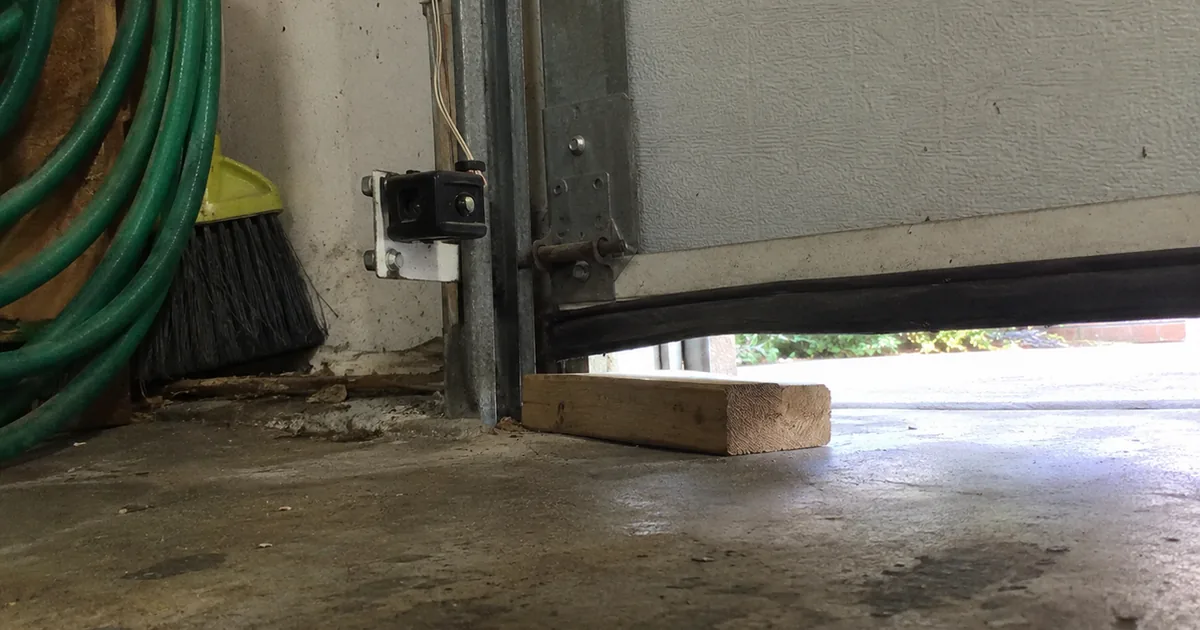
What did not happen is just as specific. Nobody laid a block of wood under the door and let it come down on it. That is a different test. The report does not claim that test occurred.
October is also when California utilities can shut off power ahead of strong wind events. A buyer may ask whether the garage door opens when the power is out. That question is separate from whether the inspector operated the opener during the inspection.
The inspection report can say “operated” without claiming contact reversal
The report may tell you that the opener worked with its normal controls. It may tell you that the photo-eye sensors reversed the door. It does not, under the inspection standard, certify that the door reverses when it makes contact with an obstacle.
That distinction matters before you remove an inspection contingency. Read the actual garage line. Do not treat the word “operated” as a statement that every safety function was tested.
The inspection standard includes the photo-eyes and excludes pressure reversal
The InterNACHI Residential Standards of Practice, section 3.10, requires the inspector to inspect garage vehicle doors and the operation of garage vehicle door openers using normal operating controls.
The same section requires the inspector to describe the garage vehicle door as manually operated or installed with a garage door opener. It also requires the inspector to report photo-electric safety sensors that did not operate properly as needing correction.
That is the in-scope safety check. The inspector operates the door. The inspector observes the photo-eye system. If the photo-electric sensors fail to reverse the door, the condition is reported.
The same section says the inspector is not required to verify or certify the proper operation of any pressure-activated auto-reverse or related safety feature of a garage door.
There are two different safety systems:
- The photo-eye beam, which is within the standard and reported when it fails.
- The contact reversal, which the standard expressly leaves outside the required inspection.
The broader distinction between a home inspection and a specialist’s work is explained in this guide to what a home inspection covers and what needs a specialist. The garage opener is a good example of that boundary. The inspector can report what the standard calls for. A technician performs the test the standard does not require.
Federal rules treat contact reversal as primary protection
The federal rule gives the two systems different jobs.
Federal rule 16 CFR Part 1211 applies to all residential garage door operators manufactured on or after January 1, 1993 for sale in the United States. It requires inherent primary entrapment protection. A downward-moving residential garage door must initiate reversal within 2 seconds after contacting the obstruction.
When that federal test is performed on the floor, the test object is 1 inch high.
The same rule requires a secondary layer of protection. That layer may be one of three things:
- A constant-pressure control that must be held down within line of sight of the door while lowering it.
- A connection for an external secondary entrapment protection device, such as a photoelectric sensor or edge sensor.
- Built-in secondary protection on certain combination systems.
The federal rule also addresses a switch or relay malfunction that causes loss of entrapment protection. In that situation, the operator must become inoperative at the end of the opening or closing operation and keep the door within 1 foot of the uppermost position.
The plain meaning is direct. Contact reversal is the primary protection. The photo-eye is the backup. The home inspection standard includes the backup sensor check but does not require certification of the primary contact reversal.
Do not turn that into a claim that the opener is unsafe merely because the inspection report does not contain a contact-test result. The standard does not require that result. It tells you to get the missing test from the person responsible for servicing or repairing the opener.
California required automatic reversal before the federal rule
California passed AB 3600 in 1990. The measure, authored by Polanco and listed as Chapter 1336, Statutes of 1990, required automatic garage door openers to be manufactured with an automatic reverse safety device and sensor to protect young children from being trapped under garage doors.
Congress followed with entrapment protection requirements for openers manufactured for the United States after 1993.
The Assembly Committee on Housing and Community Development analysis of SB 969, hearing date June 27, 2018, summarizes California’s existing law. An opener sold or installed in a residence must have an automatic reverse safety device that meets the applicable Underwriters Laboratories standard. It must also have a tactile edge sensor, optical sensor or similar device that, when activated, causes a closing door to open and prevents an open door from closing.
That history explains why the report has two separate questions in it. The photo-eye is not a decorative accessory. It is part of the required secondary protection system. The automatic reverse device is a separate requirement with its own contact test.
A garage also has another life-safety boundary that appears in a different inspection question: the door between the garage and the house. Agents can review that issue in the guide to garage fire separation for Fontana properties. Do not combine that door with the vehicle door or the opener. They are different components and different findings.
California assigns the 2-inch test to the garage door technician
The 2-inch contact test belongs to the person hired to service or repair the residential automatic garage door opener.
The Assembly analysis states that any person hired to service or repair a residential automatic garage door opener must test the ability of the garage door to reverse upon contact with a rigid 2-inch-high obstacle. If the opener fails, a warning label must be attached to the opener.
State law also prohibits installing a replacement residential garage door onto an existing opener that fails this test.
That gives a buyer a concrete request. Ask the garage door technician to perform the contact test and provide the result in writing. You are not asking the home inspector to perform a test the inspection standard excludes. You are asking the technician to document a test California law already expects that technician to perform.
The numbers must stay separate. California law uses a rigid 2-inch obstacle for the service or repair test. The federal rule describes a 1-inch test object when the test is performed on the floor. Those are different numbers from different documents.
Do not write “test the 1-inch or 2-inch block” in a repair request. Name the test you want. For a California service or repair visit, request the reversal test against the rigid 2-inch obstacle.
If the garage was blocked, the door could not be operated, or power was unavailable, the report may contain no opener result at all. This guide explains how inaccessible areas are reported during a home inspection.
SB 969 covers newer openers and battery backup
SB 969, authored by Dodd, was chaptered on September 21, 2018.
Beginning July 1, 2019, automatic garage door openers manufactured for sale, sold, offered for sale or installed in a residence in California must have a battery backup function designed to operate when activated because of an electrical outage.
On and after July 1, 2019, a replacement residential garage door cannot be installed in a manner that connects it to an existing opener that does not meet that requirement. A violation carries a civil penalty of $1,000.
The bill followed the 2017 Northern California wildfires. The fires killed 43 people and forced thousands to evacuate. The Assembly analysis reported that at least five people lost their lives during the evacuation because they could not drive out of their garages during power outages.
Strong winds can accelerate wildfires. Utilities often shut off power before those conditions arrive. That is why the October outage question is not theoretical for a California buyer.
SB 969 does not, by itself, make an older opener without a battery illegal to keep using. The law reaches openers sold or installed from July 1, 2019. Replacing the garage door is the trigger that pulls an old opener into the requirement.
The inspection report may not tell you that the opener has battery backup. Ask about it and confirm it. Do not infer battery backup from the fact that the opener ran during the inspection.
The report tells you which garage question was actually answered
The garage line can answer several different questions, and each answer has a different meaning.
It may say the door was operated with the opener. It may say the garage was blocked and the door was not operated. It may describe the door as manually operated. It may state that the photo-eye sensors reversed the door. It may report that the sensors did not operate properly.
Inspection.re reports are delivered the same day with photographs. The Matterport 3D tour carries tagged findings, so you can look again at the opener, the sensors and the door hardware after the inspection. Inspection.re inspectors are InterNACHI-certified.
The report’s wording remains the controlling detail. “Operated” means the opener was used with its normal controls. “Sensors reversed the door” means the photo-eye check produced that result. Neither phrase means contact reversal was verified.
The report also does not turn the battery question into an assumption. If you need to know whether the opener has battery backup, ask about that feature and confirm it separately.
A buyer who is still within the inspection period should also check the California inspection contingency timeline and removal rules. The garage question has to be answered before the deadline that controls the buyer’s decision, not after it.
These report lines call for different actions
| What the report says | What it means | What to do before the contingency is removed |
|---|---|---|
| Photo-eyes reversed the door, with no other notes | The in-scope sensor check passed. Contact reversal was not verified by the standard. | Ask whether the opener has battery backup. If a door technician is coming anyway, ask for the 2-inch reversal result in writing. |
| Photo-eye sensors did not operate properly | The report identifies a safety correction within the inspection scope. | Request repair by a garage door technician and request the written reversal test result. |
| Door was not operated because the garage was blocked or power was off | The opener’s operation is unknown. | Have the door operated before removing the contingency. |
| Opener is present and the buyer plans to replace the door after closing | State law ties a replacement door to a compliant opener. | Resolve the opener question before ordering the replacement door. |
| Door is described as manually operated | There is no opener to test. | Verify the condition of the door itself. There is no opener entrapment test to confirm. |
The table does not turn the inspection into a service visit. It tells you what the report supports and what remains unanswered.
A failed photo-eye sensor is not the same finding as a missing contact-test result. A blocked garage is not a failed opener. A manual door is not an opener with a dead battery. Keep those facts separate in the repair request and in the transaction file.
Your repair request should name the test and the backup question
A seller request should identify the service provider, the test and the documentation. It should not simply say “fix the garage door.”
Please have a garage door technician service the automatic garage door opener before the inspection contingency is removed. The technician should perform the reversal test against the rigid 2-inch obstacle required for anyone servicing a residential automatic garage door opener in California. Please confirm whether the opener has a working battery backup. Provide the service findings and test results in writing.
The right license class matters for the work being requested. Use this guide to match a California contractor license to the referral.
The proof should match the repair. If the request says the photo-eyes were repaired, the paperwork should address the photo-eyes. If the request says the opener was serviced and the 2-inch reversal test was performed, the paperwork should state the result of that test. The repair verification guide for California escrow covers that matching process.
If the technician reports a failure, the written result gives the parties a specific fact to address. It also tells the buyer whether the warning-label requirement was triggered. Do not accept a vague statement that the opener is “fine” when the request asked for a named test.
A battery does not answer every outage question
Not every garage door opener has a battery. A buyer should know where the manual emergency release is on the opener trolley and how the door is lifted by hand before an outage occurs, not during one.
The battery-backup question concerns the opener’s operation during an electrical outage. The manual release concerns how the door can be disconnected from the opener and lifted by hand. They are related to the outage problem but are not the same answer.
Backup power elsewhere in the house is a separate installation question. This guide addresses generators and transfer switches. Wildfire preparation is also separate. Buyers can review California’s Zone 0 requirements or the guide to defensible space in Wildomar.
Ask the technician to confirm whether the opener has a working battery backup. Learn the manual release before the weather creates an evacuation problem. Do not wait for the power to fail to discover how the door operates by hand.
Read the garage line before you remove the contingency
Read the garage line for the test that was performed. “Operated” and “sensors reversed” are not “contact reversal verified.”
Ask the seller for a garage door technician’s written 2-inch test result. Ask whether the opener has a working battery backup. If the door was not operated, have it operated before the contingency is removed. If the photo-eyes failed, request a repair and paperwork that addresses that exact failure.
For inspection questions outside the standard, use the items included in an Inspection.re inspection page and the inspection FAQ. The sample inspection report shows how findings and photographs are presented.
Inspection.re serves buyers and agents in Los Angeles, San Diego, Temecula and Oakland. On your next file, do not write “garage opener passed” unless you know which test that sentence describes. Write down the sensor result, request the technician’s 2-inch contact-test result, and confirm the battery question before the decision deadline.