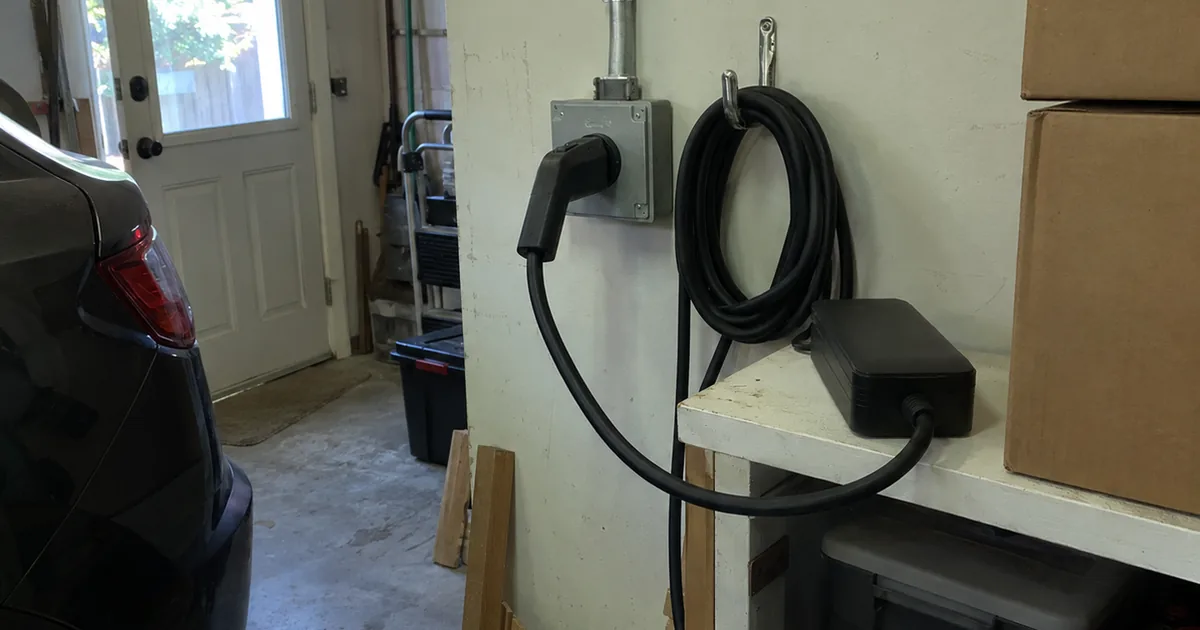
A listing photo shows a charger in the garage and the remarks say “EV ready.” The garage has a portable charging unit plugged into a 240-volt range-style receptacle in a gray metal box. The cable is coiled on a hook. Conduit runs up the wall. A two-pole breaker sits at the bottom of the panel.
The buyer asks two questions. Is this safe to use every night? Was it installed right?
This is a composite of typical findings, not one house. The inspection can answer part of that.
The charger circuit is a continuous load, so the breaker has to be larger than the charging current
The electrical code treats electric vehicle charging as a continuous load, and the overcurrent protection is sized at not less than 125 percent of the equipment’s current rating.
The 2025 California Electrical Code, Title 24, Part 3, adopts the 2023 National Electrical Code with California amendments. It took effect January 1, 2026. An installation completed earlier was performed under an earlier edition. An inspection report reads the equipment in front of the inspector. It does not rule on which code edition applied when the work was done.
NEC 2023 section 625.42 states:
“Electric vehicle charging loads shall be considered to be continuous loads for the purposes of this article.”
That rule affects the breaker size. Equipment rated at 40 amps needs overcurrent protection of at least 50 amps, because 40 times 1.25 is 50.
NEC 2023 section 625.40 also requires each outlet installed to supply electric vehicle supply equipment greater than 16 amperes or 120 volts to be supplied by an individual branch circuit. That is the dedicated circuit rule. The exception allows a branch circuit to feed multiple chargers when an energy management system or adjustable chargers are used as the code permits.
A large breaker does not automatically make a charger installation correct. The breaker, conductors and charger setting still have to agree with the equipment instructions.
The number stamped on the breaker handle is the first number to read
The first number is the breaker ampere rating, read from the breaker handle in the panel.
The inspector also notes whether it is a two-pole breaker and whether it appears to serve its own circuit. The label in the panel directory may say “EV charger,” “garage outlet” or something else. That label is handwriting. The number stamped on the breaker handle is the one that counts.
A two-pole breaker supplies the two ungrounded conductors used for a typical 240-volt circuit. The visible inspection also looks for the circuit conductors and their markings where the panel cover is removed as part of the inspection. A buyer should not remove the panel cover or touch the wiring.
The circuit’s location in the panel does not establish that the installation was permitted. A breaker added at the bottom may be new, old, correctly installed or incorrectly installed. The visible equipment gives the inspector facts to report. The permit record addresses the installation history.
Panel workmanship can create a separate finding. A breaker may be the correct size for the charger and still have a connection or installation problem. See the panel workmanship guide for the type of condition that can affect a circuit independently of its intended load.
The charger’s setting must agree with the breaker and the installation manual
The second number is what the charger is set or rated to draw.
One widely installed hardwired charger, the Tesla Gen 3 Wall Connector, publishes this breaker-to-output table in its installation manual:
| Breaker | Maximum output | Approximate power at 240 volts |
|---|---|---|
| 60 amps | 48 amps | 11.5 kW |
| 50 amps | 40 amps | 9.6 kW |
| 40 amps | 32 amps | 7.6 kW |
| 30 amps | 24 amps | 5.7 kW |
| 20 amps | 16 amps | 3.8 kW |
| 15 amps | 12 amps | 2.8 kW |
The manual says the circuit breaker size is programmed into the unit during commissioning. That setting lives in the charger. A visual inspection can compare the installed breaker with the manufacturer’s table, but it cannot read the programmed setting off the wall.
Ask the seller or installer for the commissioning setting. Keep that information with the closing documents.
The manual also specifies minimum 6 AWG, 90 degree C rated copper conductors for maximum power, copper wire terminations only, and an equipment-grounding conductor run with the circuit conductors. Each Wall Connector must be on its own branch circuit when there are several.
Other manufacturers publish their own tables. The principle is the same. The breaker, conductors and charger’s setting have to agree with the manufacturer’s installation instructions.
A 50-amp breaker and a charger set to draw 40 amps match the Tesla table. So does a 60-amp breaker on a unit set for 48 amps. The number on the breaker alone does not tell you what the charger is programmed to draw.
A plug-in charger needs GFCI protection at its EV receptacle
The third number is not an ampere number. It is the presence or absence of GFCI protection at a receptacle used for EV charging.
NEC section 625.54, introduced in the 2020 NEC, states:
“In addition to the requirements in 210.8, all receptacles installed for the connection of electric vehicle charging shall have ground-fault circuit-interrupter protection for personnel.”
A plug-in charger connected to a 240-volt receptacle installed for EV charging is supposed to be on a GFCI-protected receptacle circuit. The inspector can look for a GFCI breaker or GFCI device and can press its test button where it is accessible and safe.
A hardwired charger is different. The Tesla Gen 3 Wall Connector manual lists ground-fault circuit interruption as “Integrated, no additional required” and states: “do not install a GFCI circuit breaker.”
That means the same garage can be correct with no GFCI breaker or incorrect with no GFCI breaker. A hardwired unit with integrated protection can be installed on a standard breaker. A plug-in unit on a receptacle used for EV charging requires GFCI protection. The finding depends on which one is on the wall.
The California GFCI and AFCI guide covers related protection requirements. It does not change the first question here: identify whether the charger is hardwired or plugged in.
The inspection can read the visible equipment, but it cannot prove charging capacity
The inspection can report the breaker rating, whether the breaker is two-pole, whether the circuit appears dedicated, visible conductor markings where the cover is removed, GFCI presence, receptacle mounting and condition, conduit and cable protection along the garage wall, cord strain and damage, and the charger’s mounting.
It cannot determine whether the home’s service has capacity for the charger plus the home’s other loads. A load calculation is an electrician’s job. It also cannot read the programmed setting inside a hardwired charger, confirm conductor sizing hidden in walls, or test charging performance.
Capacity is a separate question for California transactions. Read the SB 382 electrical disclosure guide when the sale raises electrical disclosure questions or future EV charging load. Read the undersized service guide when the panel or service appears small for the home’s existing loads and the charger together.
An infrared camera adds another visible check. Inspection.re’s FLIR infrared camera can show a warm breaker or termination as a surface temperature pattern. That pattern prompts an electrician visit. It does not measure current and does not diagnose the cause. Reading a thermal image of a panel covers what a warm breaker can and cannot tell you.
Inspection.re provides a same-day report with photos. A Matterport 3D tour with tagged findings lets the panel and charger be revisited after the inspection. The inspections are performed by InterNACHI-certified inspectors.
The report can say what was visible on inspection day. It cannot convert a wall-mounted charger into proof of service capacity or charging speed.
A finaled permit answers the installation-history question
The permit record answers a question the visual inspection cannot: whether the local building department has a record of the work and a final inspection.
California has required cities and counties to approve EV charging station installations through an expedited, streamlined permitting process since AB 1236. The law added Government Code section 65850.7 and was approved by the Governor on October 8, 2015. Local building departments publish a checklist for it.
Ask for the permit number. Ask whether the permit was finaled.
A permit issued is not the same as a permit finaled. The permit verification guide explains that distinction. A final inspection by the local building department leaves a different record from a permit that was issued and never completed.
The permit does not replace the inspection. The inspection does not replace the permit record. Keep both.
If the seller cannot produce the record, ask for the installer information and a C-10 electrician’s evaluation. A C-10 electrical contractor is the license class for this work. The California contractor license guide explains where that class fits.
These report findings call for different actions
The report finding tells you what to ask for before the contingency is removed.
| What the report shows | What it means | What to ask before the contingency is removed |
|---|---|---|
| Breaker rating matches the charger’s published table and a permit was finaled | The visible pieces agree | Keep the permit record and the charger’s commissioning setting with the closing documents |
| Breaker is larger than the charger’s published rating allows | The breaker may not protect the circuit as the manufacturer intends | Ask for a C-10 electrician’s evaluation |
| Plug-in charger is on a receptacle with no GFCI protection | This is a reportable correction under 625.54 for receptacles installed for EV charging | Request correction by a licensed electrician |
| Breaker or termination is warm on the thermal image | This is a surface temperature pattern, not a diagnosis | Request an electrician to evaluate it under load |
| No permit is found for the charger circuit | The installation history is unknown | Ask the seller for the installer and permit, or ask for an electrician’s evaluation |
A mismatch should not be described as a charging-speed problem. The inspection does not test charging speed. It should be described as a visible mismatch, missing protection, unknown installation history or thermal pattern, followed by the appropriate request.
The permit and manufacturer documents matter even when the equipment looks new. New paint on a garage wall does not establish when the circuit was installed. A clean receptacle does not establish that the wiring behind it matches the charger’s rating.
A shared garage adds HOA and common-area rules
A charger in a shared garage raises a separate ownership and approval question under Civil Code section 4745.
That section governs member-installed chargers in common areas. The SB 1267 condo EV charger guide addresses that process. A buyer should ask for the association approval and related records in addition to the electrical permit record.
The panel and the charging location still matter
The charger circuit is only one part of the garage review.
For small lithium-ion batteries, charging location is a separate fire-safety topic. See the lithium-ion charging guide. Also check the panel and breakers against known recalls using the recalled electrical panels guide.
A charger can match its published table and still be connected to a panel that needs separate attention. The charger review does not erase other electrical findings.
Replace “EV ready” with three numbers and one permit question
Do not accept “EV ready” or “charger included” as an inspection finding.
Ask for the breaker ampere rating. Ask what the charger is rated or programmed to draw. If it plugs into a receptacle, ask whether that receptacle has GFCI protection. Then ask for the permit number and whether the local building department finaled it.
Keep the inspection report, the permit record and the seller’s commissioning setting in the same file. Our sample inspection report shows how panel photos and tagged findings appear. Review what the inspection includes and the inspection FAQ to confirm what the inspection can and cannot report.
Inspection.re serves buyers, sellers and agents in Los Angeles, San Jose, Irvine and Temecula.