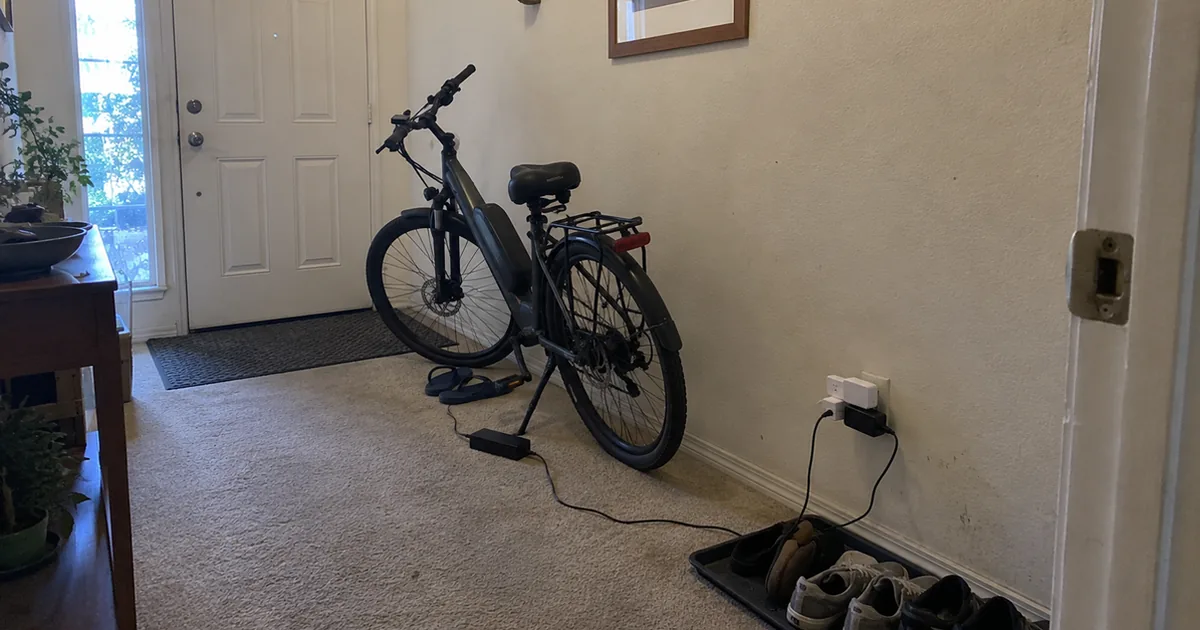
A 1990s tract house entry hallway. An e-bike with a frame-mounted battery is parked against the wall beside the front door, partly blocking the path to it. Its charger brick sits on the carpet. The cord runs to a low wall outlet with a plug-in outlet multiplier, and a second charger is connected to that.
Shoes sit on a tray beside the charger. Nothing in the electrical section of the report is wrong. The receptacle tests fine. The problem is the location.
This is a composite of what we see, not one house.
Fire Prevention Week 2026 puts the charger in the inspection conversation
NFPA’s Fire Prevention Week runs October 4 to 10, 2026. The theme is “Charge into Fire Safety,” the second year in a row that NFPA has focused the campaign on lithium-ion batteries. The reported tagline is “Safe Charging Is a Superpower.”
NFPA’s 2026 tip sheet, “Lithium-Ion Batteries in Your Home,” says these batteries “can overheat, start a fire, or explode if overcharged or damaged.” The sheet organizes its advice around BUY, CHARGE, and RECYCLE.
Buy only listed products. Look for a safety certification mark such as UL, ETL, or CSA. Use the cables that came with the product. If you need a new charger, buy it from the manufacturer or use one the manufacturer approved.
Charge on a hard surface. Do not overcharge the battery. Unplug the charger or remove the battery when it is fully charged.
Stop using the device right away if the battery smells strange, gets too hot, makes popping noises, or changes shape or color. If it is safe to do so, move it away from anything that can catch fire and call 9-1-1.
Do not throw lithium-ion batteries in the trash or regular recycling.
Nearly all of that concerns behavior and purchase choices. An inspector cannot see whether someone leaves a charger running overnight. We cannot see whether a replacement cable came from the manufacturer. We cannot determine from a visual inspection whether a battery is internally damaged.
We can see where the charging happens. That location is part of the physical house, the same way an obstructed stairway or blocked bedroom escape window is part of the physical house.
Federal reports put nighttime charging on the warning list
The Consumer Product Safety Commission reported in a December 19, 2022 letter that, from January 1, 2021 through November 28, 2022, it received reports from 39 states of at least 208 micromobility fire or overheating incidents. Those reports included at least 19 deaths: five involving e-scooters, 11 involving hoverboards, and three involving e-bikes.
A CPSC staff report published in April 2026 attributed 19 e-bike deaths to 13 lithium-ion battery fire incidents from 2017 through 2024. The same report attributed 15 e-scooter deaths to 11 incidents and 11 hoverboard deaths to five incidents.
CPSC’s guidance says many lithium-ion battery home fires and deaths have happened at night while batteries were charging and families were asleep. Its instruction is direct: always be present when charging. Never charge while sleeping or away from home.
On June 24, 2026, CPSC published a proposed mandatory rule in Federal Register document 2026-12749. The proposal would require e-bikes to meet UL 2849, e-scooters and similar devices to meet UL 2272, and user-replaceable batteries to meet UL 2271.
It is a proposal, not a final rule. Comments closed August 24, 2026.
California already requires e-bikes and e-bike batteries sold in the state to meet a safety standard beginning January 1, 2026, according to the California Highway Patrol’s 2026 new-laws summary. Rentals are covered beginning in 2028.
The point for a listing is narrower. A federal proposal does not tell us whether a particular battery is safe. A California sales requirement does not tell us where the owner charges it. The physical charging location still matters.
A charger beside the only exit changes the inspection finding
UL Standards & Engagement says, “Never charge your device near an exit, as it could block your escape in the event of a fire.”
The New York City Fire Department gives similar consumer guidance. Do not charge near exits and ways out, including apartment doors, bedroom doors, and windows. Do not charge in your bedroom.
That makes the front entry an obvious place to look. An e-bike parked beside the only front door can reduce the path out. A device in a hallway that serves the bedrooms can create the same problem. A charger below a bedroom window can sit beneath an escape opening that someone may need to use.
We walk every room and every exit path. We also look at bedroom egress windows, including the conditions around those openings. A guide to bedroom escape windows explains the listing concern in more detail.
We photograph the charger where it sits. The photograph goes in the same-day report. We tag the condition as a location note, not an electrical defect.
Move the device before the photos. Do not wait for an inspector to describe the same wall, outlet, and doorway after the house is already being shown.
A good receptacle test cannot approve a bad charging setup
FDNY’s guidance states, “DO NOT charge your device using an extension cord.” It also states, “DO plug your device charger DIRECTLY into a wall outlet.”
NFPA’s 2026 tip sheet does not mention extension cords. FDNY’s guidance does. Both pieces of guidance point toward the same physical change: remove the charger from an extension cord or plug-in outlet multiplier and connect it directly to a wall receptacle.
A receptacle with a brown scorch mark at one slot is a finding. A plug-in multiplier with discolored plastic is a finding. That remains true regardless of what was connected to it when we arrived.
A charger that is not charging during the inspection may leave nothing visible. A receptacle test tells us that the receptacle is wired and protected in the ways the test can show. It does not tell us that the household charging habit is safe.
We test GFCI and AFCI protection where possible and inspect a representative number of switches, lighting fixtures, and receptacles under the InterNACHI Standards of Practice. Our GFCI and AFCI testing guide explains what those protections do and what an inspection can report.
FLIR infrared is part of every inspection we do. It reads surface temperature. A receptacle or power strip under load can appear warmer than neighboring surfaces. An idle charger may show nothing. Infrared does not detect a bad battery.
The same rule applies to an older electrical panel. A listing guide to older panels and circuits under load covers a separate electrical concern. Neither a panel review nor a warm receptacle reading tells us that a lithium-ion battery is healthy.
The garage moves the charger away from the entry, but not away from risk
FDNY’s July 22, 2026 release told residents to charge and store lithium-ion batteries or micromobility devices outside, not overnight, and not while blocking exits.
In a California house, outside usually means the garage.
NFPA’s general lithium-ion guidance says to charge e-bike batteries in a flat, dry area away from children, direct sunlight, liquids, and tripping hazards. It says not to charge below 32 F or above 105 F. It also says to store batteries away from anything that can catch fire.
We do not measure the temperature of a garage as part of this question. A closed garage during a hot inland California summer can get hot. NFPA’s upper charging limit is 105 F. The seller has to decide whether the selected charging location makes sense under that guidance.
The visible surroundings still matter. We look at the garage-to-house door and the wall between the garage and the house. See the Fontana garage fire-separation guide for the door and wall conditions agents commonly need to address.
We also see gas water heaters, dryers, shelves, solvents, and paint cans. A dryer exhaust and lint fire guide covers another garage and laundry fire source. The charging station should not sit on a shelf of flammable materials.
Charging on the floor beside the house door puts the device at the one opening intended to keep a garage fire out. The e-bike itself is personal property. InterNACHI does not require the inspector to inspect it. The garage location, path, door, nearby storage, and visible charging arrangement are different questions.
InterNACHI also does not require the inspector to inspect equipment housed in the garage except as noted, or items that are not permanently installed. We report what is visible. We do not turn a personal device into a tested electrical system.
A home battery system belongs in a separate inspection question
Solar-plus-storage is common in California. A permanently installed home battery is not the same inspection question as an e-bike charger on a hallway floor.
The City of Berkeley’s 2025 California Residential Code checklist for energy storage systems, revised in April 2026, cites these limits from the 2025 code. An energy storage system cannot be installed in a sleeping room, a closet or space opening directly into a sleeping room, or a habitable space of a dwelling unit.
The checklist cites allowed locations that include detached garages or accessory structures, attached garages separated as required, outdoor locations at least three feet from doors and windows into the dwelling, and enclosed utility closets, basements, or storage spaces with finished or noncombustible walls.
Individual units are limited to 20 kWh. An energy storage system where vehicles can hit it must have approved barrier protection. The equipment must be listed to UL 9540.
Those are the locations and limits cited by that checklist from the 2025 code. Local amendments vary. Check with the building department.
We note where a battery cabinet is located and whether a car can reach it. We refer the system’s evaluation to a licensed solar or electrical contractor. InterNACHI does not require the inspector to inspect a battery or electrical storage facility.
A solar and storage retrofit guide covers the separate questions that arise when a system has been added to a house.
Move six charging problems before the listing photos
-
Move charging away from the front door, hallways that serve bedrooms, and bedroom windows. The device should not sit in an exit path or beneath an opening used for escape.
-
Plug the charger directly into a wall receptacle. Retire the extension cord and the plug-in outlet multiplier for charging.
-
Put the charger on a hard surface. Do not charge on carpet, a bed, or a couch. NFPA also says not to charge under a pillow.
-
In the garage, keep the charging spot away from the house door and away from shelves holding solvents, paint cans, or other materials that can catch fire.
-
Check e-bike batteries against CPSC warnings. On November 24, 2025, CPSC warned consumers to stop using certain Rad Power Bikes batteries, models RP-1304, RAD-S1304Y, and HL-RP-S1304, after 31 reports of fire. On March 19, 2026, CPSC warned consumers to stop using Ridstar Q20 and Q20 Pro e-bikes after 11 reports of fire.
-
A swollen, hot, popping, or smelly battery is not a staging problem. Stop using it under NFPA’s instruction. Recycle it properly. Do not put it in the trash or regular recycling.
While you are in that hallway, check the smoke and carbon monoxide alarms. CPSC issued 2026 alarm warnings for California homes. The Ontario alarm placement guide covers another way to check alarm locations during the same walk-through.
These changes cost no listing renovation budget. They require moving the device, removing the wrong connection, and clearing the path.
Book an inspection and tell us about any home battery system in advance so we know where to look.
Our report shows the location without pretending to test the battery
We provide a same-day report with photographs. Findings are tagged in a 3D Matterport tour so the seller can see the exact wall and outlet involved.
FLIR infrared is included in every inspection. Its limit stays the same: it reads surface temperature. It does not test a battery, identify internal damage, or approve a charging method.
We report the condition and location. We do not test batteries. We do not judge a battery’s brand or listing. We do not operate the device.
The InterNACHI limits also matter. A home inspection is not technically exhaustive. It will not identify concealed or latent defects. A battery can look normal and still have a problem that is not visible during the inspection.
That is why the report should not say more than the inspection can support. We can document an e-bike blocking the front door. We can document a charger on carpet. We can document a discolored outlet multiplier, a cord crossing a doorway, or a battery cabinet where a vehicle can reach it.
We cannot certify the battery.
A pre-listing inspection guide for California sellers explains why finding visible conditions before photos and showings gives the seller more control over the repair conversation.
Five questions agents ask about chargers and batteries
Does a home inspection check my e-bike battery?
No. An e-bike is personal property. We do not test the battery, judge its brand or listing, or operate the device.
Will the inspector flag an extension cord?
We note it where it affects safety, such as when it feeds a charger or runs through a doorway. We also report visible damage, discoloration, arcing, or excessive heat at a receptacle or power strip.
Is a home battery in the garage allowed?
Garages are among the allowed locations the City of Berkeley’s checklist cites from the 2025 California Residential Code, with separation and vehicle-impact protection requirements. Local rules vary, so check with the building department.
Is CPSC’s e-bike rule in effect?
No. CPSC published the proposed rule on June 24, 2026. It is not final.
What does Fire Prevention Week want people to do?
Buy listed products, charge safely, and recycle lithium-ion batteries properly.
The cheapest fire risk in a listing is often the charger you can move
The charger is the cheapest fire risk in a listing to move.
Put it somewhere that does not narrow an exit. Put it on a hard surface. Connect it directly to a wall receptacle. Keep it away from the garage house door and flammable storage. Check the battery warnings before the photographer arrives.
If the house has a permanently installed battery system, tell us before the inspection and arrange a licensed solar or electrical evaluation where needed.
Review what is included in an inspection, read the inspection FAQ, and see how the inspection report is delivered. We inspect across California, including Fontana, Redlands, Bellflower, and Culver City.
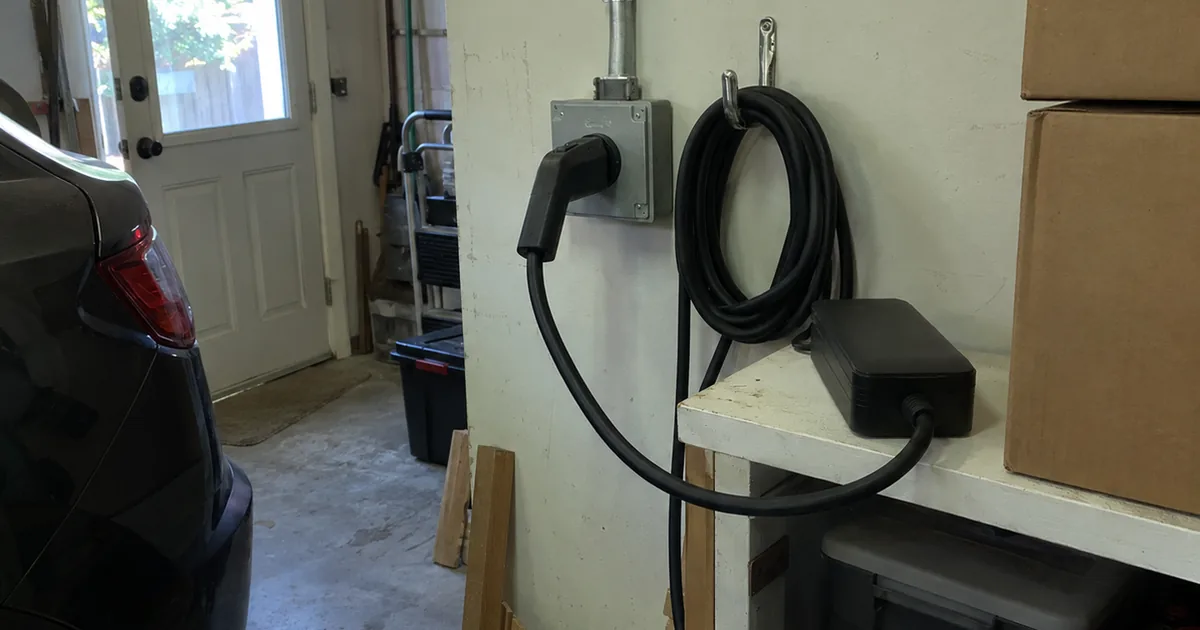
Car charging is a separate circuit question: what an inspection checks on a Level 2 charger in the garage.
Related reading
- Fontana garage fire separation: Check the garage-to-house door and wall before charging equipment is staged nearby.
- CPSC 2026 alarm warnings: Review current smoke and carbon monoxide alarm warnings while clearing the hallway.
- Redlands GFCI and AFCI protection: See what outlet protection testing can and cannot show.
- Chula Vista solar retrofit: Separate a permanently installed battery review from a portable charger walk-through.