The Duct Nobody Checks: A Bellflower Dryer Exhaust and Lint Fire Guide for Agents
The house was a two-bedroom on one of the east-side blocks, built in the early 1950s with a small addition sometime in the 1970s. The dryer sat in a narrow hallway closet between the kitchen and the back bedroom, pushed tight against the wall. The exhaust duct ran through the wall, turned ninety degrees up into the ceiling cavity, crossed the width of the addition, turned again, and exited at the far side of the house roughly twenty feet from the dryer. It was all foil flex, the kind that crushes at every turn, and the run was kinked where it entered the ceiling.
We pulled the dryer out about six inches to look at the transition connection. The foil duct behind the machine was crushed flat on one side where it had been compressed against the wall. At the exterior termination, the vent cap damper was stuck open and packed with lint and what looked like nesting material. Air flow at the termination was barely detectable with a hand held in front of it. The dryer top was hot to the touch after running a short cycle, and the laundry closet felt ten degrees warmer than the hallway.
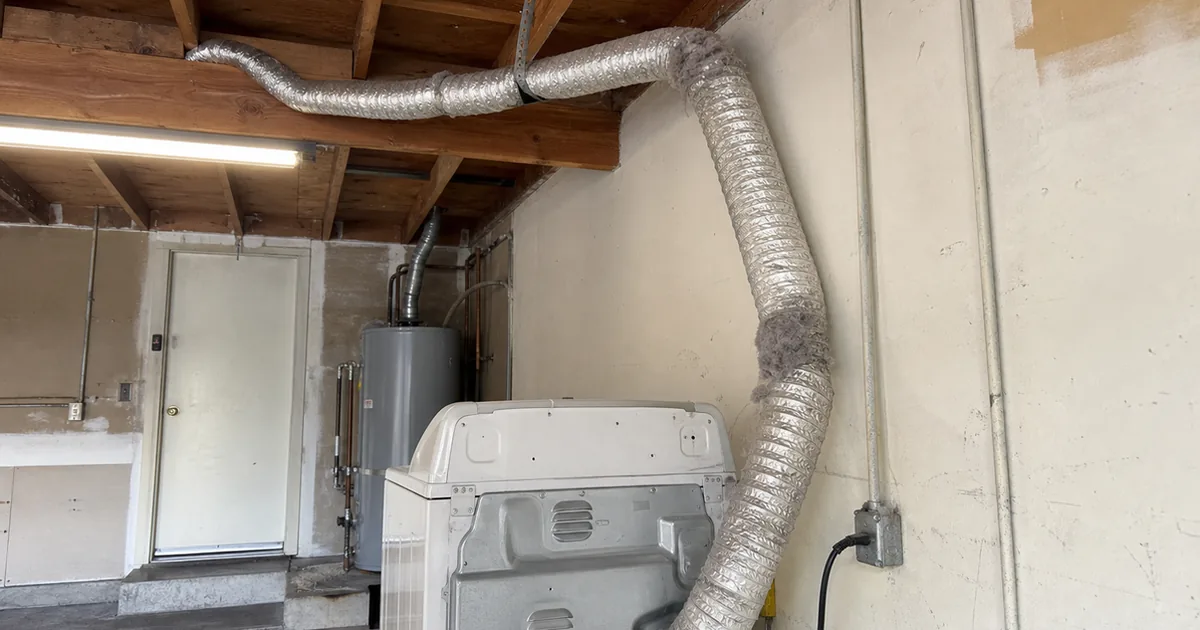
That is the shape of this finding. A dryer exhaust duct that nobody has looked at in twenty or thirty years, running too long, through the wrong material, with too many turns, and packed with the most flammable material in the house.
This guide is for the agent working Bellflower and the surrounding Gateway Cities, including nearby Downey, Lakewood, and Norwalk, where the same compact post-war housing stock, tight laundry configurations, and decades of deferred maintenance produce the same conditions. Here is what the dryer exhaust duct is supposed to look like, how it fails, and how to catch a fire hazard before the buyer inherits it.
Why this matters for the agent
Here is what is at stake. The National Fire Protection Association reports roughly 16,000 home fires per year caused by clothes dryers and washing machines, with the leading cause being failure to clean the dryer or the exhaust system. Lint is the fuel. It ignites at relatively low temperatures, it accumulates steadily, and once a duct run is restricted, the dryer generates more heat than it was designed to, and the lint sitting inside the duct is the thing that catches.
Bellflower makes this an agent’s issue for a reason that is physical, not statistical. The city is dense, built on small lots, and most of the housing stock dates to the late 1940s through early 1960s. Those homes were not designed for modern laundry equipment. Dryers ended up in garages, hallway closets, small interior utility rooms, and converted porches, often far from an exterior wall. That distance means a long exhaust duct run with multiple turns, and in a compact house the duct gets routed through walls, ceilings, and sometimes the attic. Every turn and every foot of length adds resistance, traps lint, and makes the system harder to clean. The small multifamily properties and back units that are common here make it worse, because those dryers are sometimes the farthest from any exterior wall.
An agent who asks about the dryer exhaust is catching a condition that a professional dryer vent cleaning resolves for a modest cost, and that left alone is a genuine fire hazard. Agents covering the broader Long Beach market see the same pattern in the older neighborhoods there.
What the dryer exhaust duct is supposed to look like
The setup is straightforward in principle. A clothes dryer produces hot, moist air loaded with fine lint particles, and it pushes that air through a duct to an exterior wall, where it exits through a vent cap with a damper that opens under airflow and closes when the dryer is off. Every part of that path matters.
The duct itself should be rigid or semi-rigid metal, four inches in diameter, with a smooth interior surface. The IRC Section M1502 requires metal construction at minimum No. 28 gauge. The smooth interior is the point, because lint catches on ridges, corrugations, and any rough surface inside the duct. Rigid metal duct with taped joints is the standard. Semi-rigid aluminum is acceptable for the transition piece at the dryer connection, the short visible section behind the machine, listed to UL 2158A, and limited to eight feet.
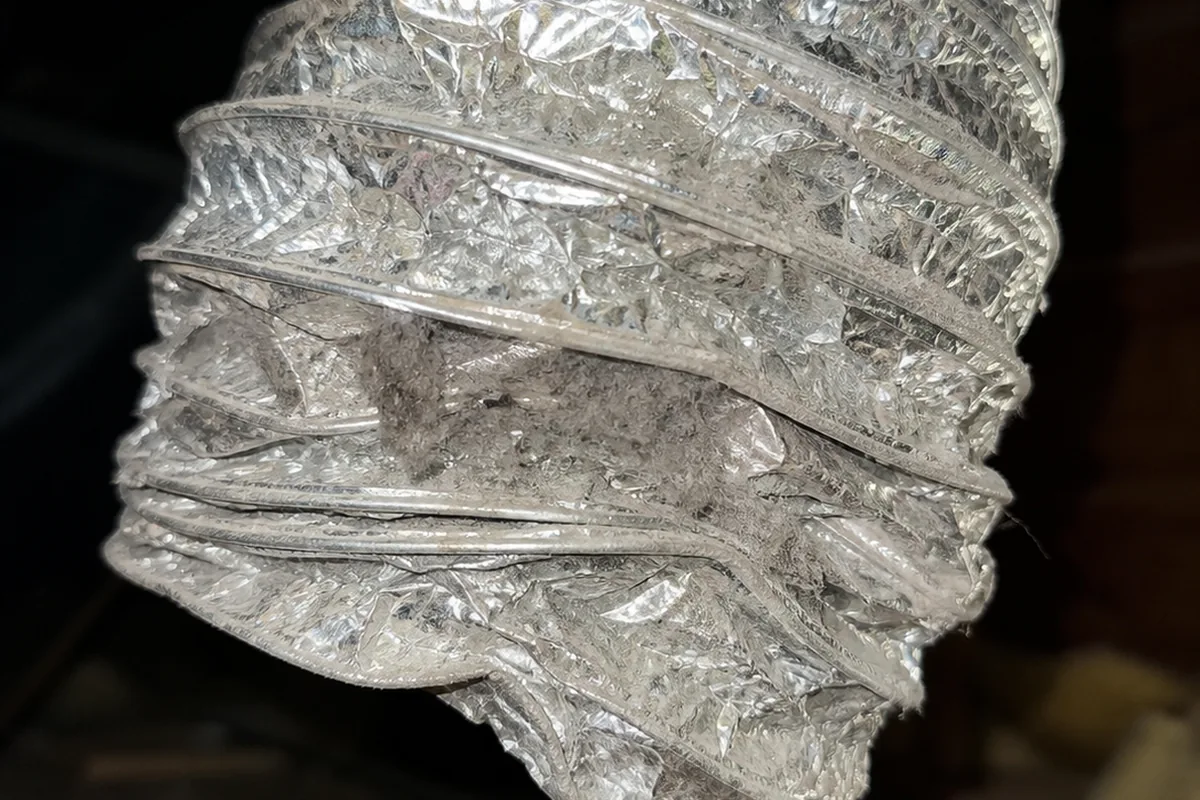
What is not acceptable, and what we find in roughly half the older Bellflower homes we inspect, is vinyl flex duct and foil flex duct. Vinyl is a fire hazard outright, it melts, and it has been prohibited by code for decades. Foil flex is better than vinyl but still traps lint in its corrugations, crushes easily, sags between supports, and is not permitted by the IRC for concealed dryer exhaust runs. It is the single most common deficiency we see in dryer exhaust systems in this market.
The maximum duct length under the IRC is 35 feet from the dryer connection to the exterior termination, and that number drops with every turn. A 90-degree elbow costs five feet of equivalent length. A 45-degree elbow costs two and a half feet. A typical Bellflower installation with two 90-degree turns and one 45-degree turn has already consumed 12.5 feet of its allowance just on the fittings, leaving 22.5 feet of actual duct before hitting the limit. In a compact house where the dryer is in an interior room, it is easy to exceed that.
What actually goes wrong
The failures are predictable and they repeat from house to house.
The first is the material. Foil or vinyl flex duct instead of rigid metal. It crushes at the turns, sags between supports, and its corrugated interior catches lint with every load. Over years, the duct fills. Air flow drops. The dryer works harder and hotter. That is the fire sequence.
The second is length and turns. A duct that exceeds the maximum equivalent length, factoring in every elbow, cannot move air fast enough to carry lint to the exterior. Lint settles in the duct, particularly at the low points where flex duct sags, and the restriction builds over time.
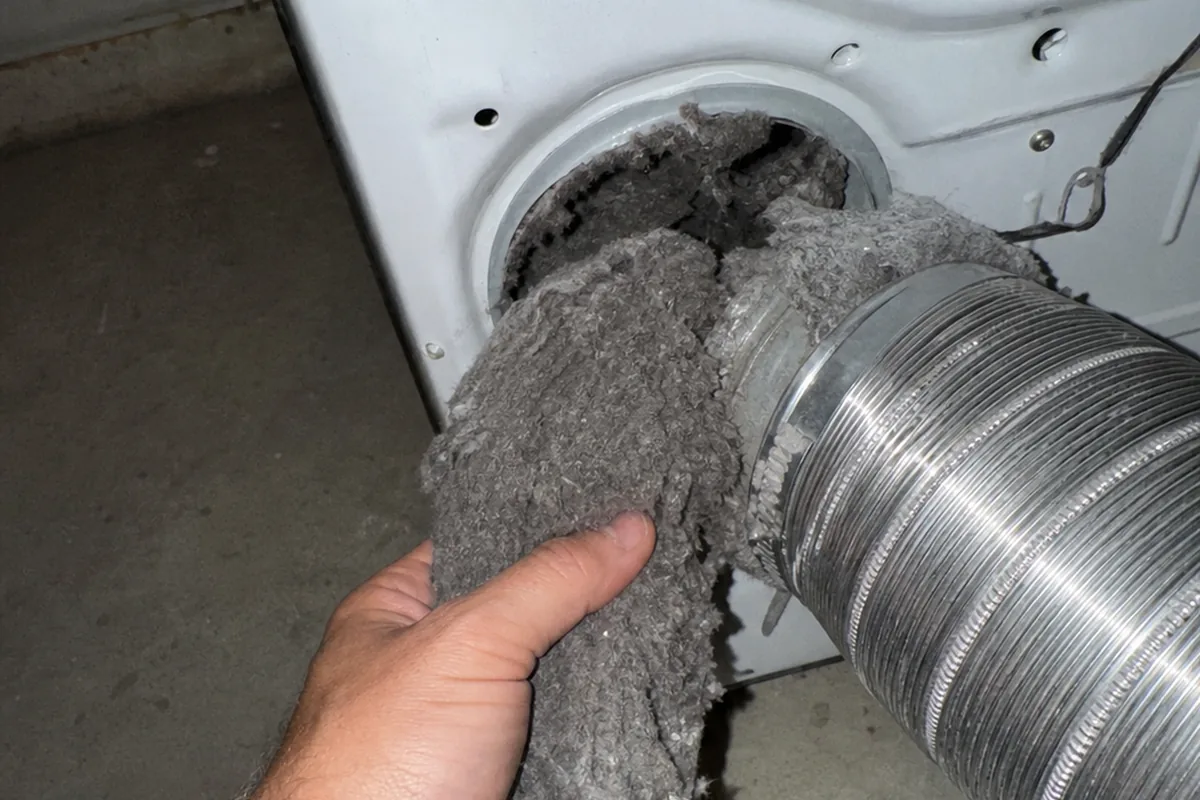
The third is the transition connection at the dryer itself. That short piece of duct between the machine and the wall is the most abused section, because every time someone pushes the dryer back against the wall, the duct crushes. We have pulled dryers out and found the transition duct pinched to half its diameter or less.
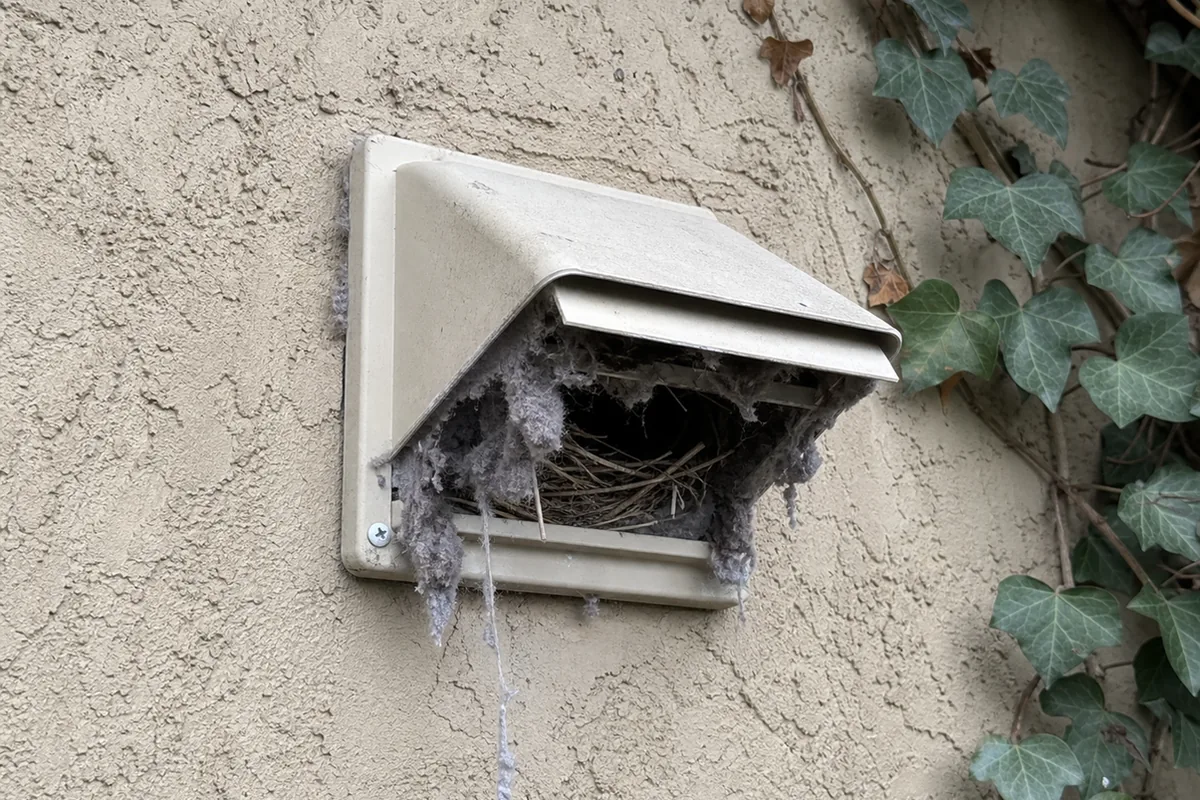
The fourth is the exterior vent cap. A vent cap should have a damper that opens freely under air flow and closes under gravity when the dryer is off. What we find instead: caps with screens that trap lint and eventually clog solid, caps with broken or stuck dampers, caps buried behind landscaping where nobody sees them, and caps that have become nesting sites for birds and insects. A blocked termination is a blocked system.
The fifth, less common but worth knowing, is the duct run that terminates in the wrong place. Into the garage. Into the attic. Into the crawlspace. Or through a soffit vent where the moist, lint-laden air re-enters the building. Any of these is a code violation and a problem.
Two boundaries so the scope is clear. This article is about the dryer exhaust duct and the lint fire hazard it creates. It is not about garage-to-dwelling fire separation, which is a separate subject dealing with the firewall and fire-rated assembly between an attached garage and the living space. And it is not about attic ventilation and insulation, though a duct that vents into the attic creates moisture problems that overlap with those conditions.
Schedule a Bellflower inspection →
What agents should tell every buyer
When a buyer is under contract in Bellflower, give them these points before the inspection.
- Ask where the dryer is and how far it sits from the nearest exterior wall. The farther the dryer is from the outside, the longer the duct run, and the higher the risk of lint accumulation and restriction.
- Look at the transition duct behind the dryer if you can see it. If it is foil flex, vinyl, or visibly crushed, the system needs attention regardless of what the rest of the duct looks like.
- Walk outside and find the vent cap. If you cannot find it, that is a finding in itself. If you can find it and the damper is stuck, clogged with lint, or packed with debris, the duct is restricted.
- Ask the seller when the dryer vent was last professionally cleaned. If the answer is “never” or a blank look, treat the system as restricted until proven otherwise.
- Notice the symptoms inside the house. Clothes taking more than one cycle to dry, the dryer top being hot to the touch, the laundry room feeling unusually warm, or a musty smell near the dryer are all signs the exhaust is not doing its job.
- Know the cost order. A professional dryer vent cleaning and a transition duct replacement is a modest service call. A dryer fire that starts in a wall cavity is not.
A buyer who hears this asks about the exhaust before the inspection, which is all this finding requires.
Red flags during showings
Some of this you can spot from the laundry area itself, and the rest the inspection verifies. Watch for these in Bellflower homes.
- A dryer pushed hard against the wall with no visible gap for the transition duct to run uncrushed.
- Foil or vinyl flex duct visible behind the dryer instead of semi-rigid metal.
- A laundry room, hallway closet, or garage laundry area that feels noticeably warm or humid after the dryer runs.
- Clothes that take significantly longer than one cycle to dry.
- The top of the dryer is hot to the touch during or after a cycle.
- The exterior vent cap is not visible, is buried behind shrubs, or has lint, cobwebs, or nesting material around the opening.
- The vent cap damper does not open when the dryer is running, or stays open when it is not.
- A musty or burnt smell near the dryer or in the laundry area.
If we see these, we document them and tell the buyer what the risk is. We do not sugarcoat a fire hazard.
The negotiation playbook
When a dryer exhaust finding surfaces in Bellflower, the deal usually moves one of a few ways.
The first path is professional cleaning and transition duct replacement. If the duct material is acceptable but the system is restricted from years of lint accumulation, a professional dryer vent cleaning service resolves it. They run a brush and vacuum through the entire run from the dryer to the exterior cap, replace the transition duct at the dryer connection with a proper semi-rigid metal piece, and verify airflow at the termination. This is a modest service call and should be the default outcome for most findings.
The second path is duct replacement. If the duct is vinyl, foil flex in a concealed run, crushed, or exceeds the allowable length, cleaning alone does not fix the material or the routing. The duct needs to be replaced with rigid metal, and the routing may need to change. This is a larger scope, typically involving a dryer vent specialist or an HVAC contractor, and the cost depends on how the duct is routed through the structure.
The third path is a credit for the scope. Where the buyer prefers to handle the work after closing, a credit based on a contractor’s bid is clean. Get the bid before agreeing on the number. A bid that says “clean and inspect” is different from one that says “reroute and replace.”
The fourth path is the combination finding. When the dryer exhaust issue is part of a broader fire safety and alarm compliance picture, or when the dryer is in a garage with fire separation deficiencies, the vent finding is one piece of a larger safety conversation. Address the exhaust as part of that scope rather than as a standalone item.
How the inspection actually catches it
This is a finding that often hides in plain sight, because the duct runs through walls and ceilings where nobody looks, and the symptoms are things homeowners learn to live with. We catch it by checking every piece of the system from the dryer to the exterior wall.
We start at the dryer. We pull it out far enough to see the transition connection, note the material, check for crushing, and look for lint accumulation at the connection point. We check whether the transition duct is listed semi-rigid metal or something else.
Then we go to the exterior termination. We check airflow at the vent cap with the dryer running, note whether the damper opens freely, and inspect for lint buildup, nesting material, or physical damage. A vent cap where you cannot feel air moving while the dryer is running tells us the duct is restricted somewhere in the concealed run.
We assess the duct material and routing where it is visible or accessible, and we note the approximate length and number of turns. Where the duct runs through inaccessible spaces, we report on what we can observe at the two ends and note the airflow result. We are not able to see inside a concealed duct, but a restricted system tells us at the termination what is happening inside.
What we do not do is disassemble the duct, clean it, or certify it as safe. We measure, document, and explain. When the system is restricted, when the material is wrong, or when the routing exceeds allowable limits, we say so directly and refer the buyer to a professional dryer vent cleaning service or an HVAC contractor. That referral is what turns a hidden fire hazard into a line item. Our inspection report guide explains how referrals like this are prioritized and presented.
Quick FAQ
How often should a dryer vent be cleaned? At least once a year, more often if the household does heavy laundry volume. In a Bellflower home with a long duct run and multiple turns, annual cleaning is a minimum. The NFPA identifies failure to clean as the leading cause of dryer fires.
Is foil flex duct acceptable for a dryer exhaust? Not for concealed runs through walls, ceilings, or floors. The IRC requires rigid metal duct with a smooth interior for concealed dryer exhaust runs. Foil flex traps lint in its corrugations, crushes easily, and sags over time. It is acceptable only as a short, visible transition piece at the dryer connection, and even there semi-rigid metal is the better choice.
What are the signs that a dryer vent is clogged? Clothes taking more than one cycle to dry, the dryer top running unusually hot, the laundry area feeling warm or humid, a musty or burnt smell near the dryer, and lint visible around the exterior vent cap. Any of these is worth investigating.
Can a dryer vent into the garage? No. The dryer exhaust must terminate at the exterior of the building. Venting into a garage, attic, crawlspace, or any enclosed space is a code violation and a moisture and fire hazard. A garage dryer must have its exhaust duct routed to an exterior wall.
How long can a dryer exhaust duct be? The IRC allows a maximum of 35 feet from the dryer connection to the exterior termination, reduced by five feet for every 90-degree turn and two and a half feet for every 45-degree turn. In a Bellflower home with an interior laundry location and two or three turns, that limit is easy to exceed. A longer run may require a listed dryer exhaust duct power ventilator.
The honest summary
Bellflower’s housing stock was built compact and close together, and the dryers ended up wherever they could fit, often far from any exterior wall and connected by the cheapest, most flexible duct available. Those ducts have been accumulating lint for decades, and the symptoms, longer dry times, a hot machine, a warm laundry room, are things homeowners learn to ignore because nothing dramatic happens until something dramatic happens.
We will check the dryer exhaust from the machine to the vent cap, note the duct material, check the transition connection, measure the airflow at the termination, and tell your buyer plainly whether the system is restricted. If we find something worth flagging, it goes in the report. The fix is usually a professional cleaning and a transition duct replacement, sometimes a duct re-route with rigid metal. The cost is modest. A dryer fire that starts inside a wall is not. That is the job.
See what every inspection includes → · Read our FAQ → · View a sample report → · Explore Bellflower home inspections →
Related reading
- Garage-to-Dwelling Fire Separation in Fontana. The firewall and fire-rated assembly between an attached garage and the living space, a different fire-safety subject.
- Firestops and Fire Blocking in Paramount. The concealed cavity barriers that slow fire spread through ordinary framing, a different mechanism from a lint-fed dryer duct fire but a companion fire-safety subject in a neighboring Gateway city.
- Attic Insulation and Ventilation in Woodland Hills. What happens in the attic space, including moisture issues from improper venting.
- Smoke and CO Alarm Compliance in Ontario. The alarm side of fire safety in California homes.
- Home Inspection Checklist for Los Angeles Buyers. A broader checklist that includes fire-safety items like dryer exhaust.
- How to Read a Home Inspection Report in California. How findings like a restricted dryer vent are prioritized alongside other deficiencies.
- Double-Tapped Breakers: A Downey Agent’s Guide. Another common Gateway Cities panel finding, a loose electrical connection rather than a fire-fuel accumulation problem.