The Coating That Was Never Meant to Hold Water: A Downey Foundation Dampproofing Guide for Agents
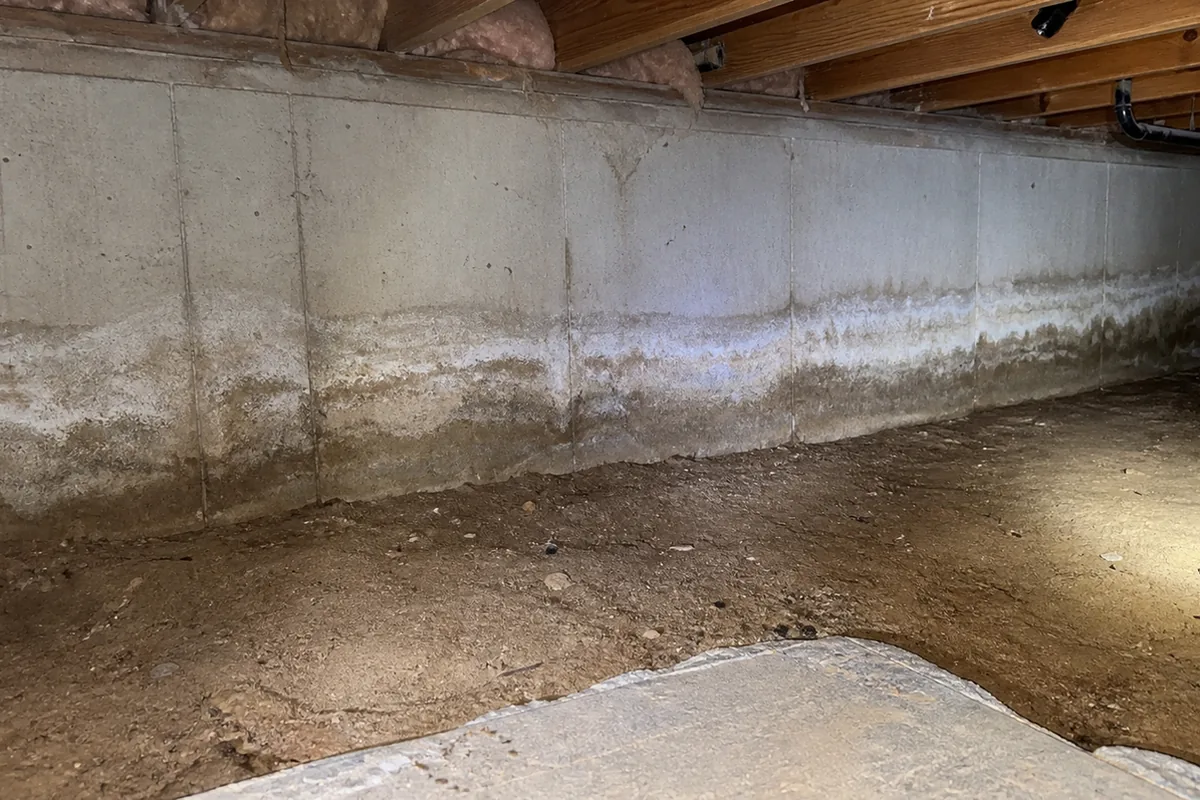
The house was a raised-foundation property in one of Downey’s aerospace-era tracts, built quickly in the 1950s to house families arriving for the plant work. Under the house, the crawlspace access hatch was tight and the soil below smelled like a wet basement, not a dry one. The stem wall along the north side, the side that gets the least sun and sits closest to a low point in the flat lot, had a dark tide line running six inches above grade. Below the line, the original black coating on the concrete was intact and chalky. Above the line, it was gone, and the bare concrete had a pale mineral bloom where water had been wicking through and evaporating for years.
We are keeping the address and buyer private and describing this as a composite of what we see across several Downey inspections a year, not one job. The pattern repeats often enough on this housing stock that the fix a seller and buyer usually reach for is not the fix the wall actually needs.
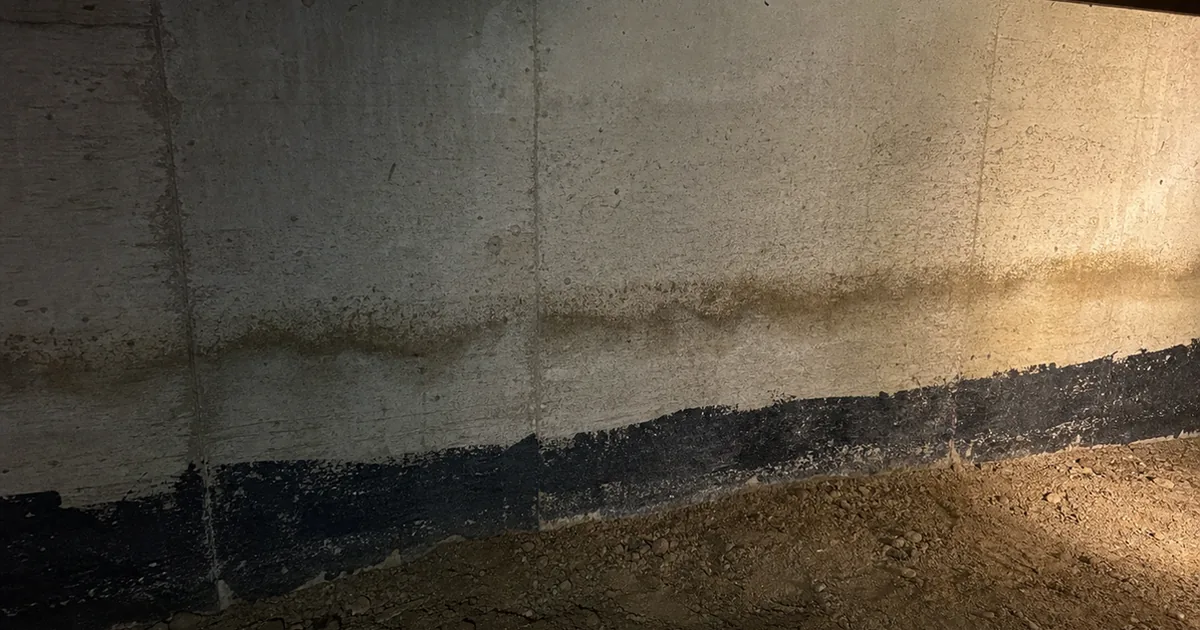
That is the shape of this finding. A wall was coated with a product built to resist soil moisture vapor, on a lot where the water was always going to ask more of it than vapor, and forty to seventy years later the coating is the weak point.
This guide is for the agent working Downey and the surrounding Gateway Cities, including nearby Lakewood, Paramount, and Norwalk, where the same postwar tract construction and flat clay-soil lots produce the same below-grade condition. Here is what dampproofing is, why it is not waterproofing, and what to do when we find the wrong one on a wall.
Why this matters for the agent
Here is what is at stake. A moisture-stained crawlspace is not automatically a structural problem, but it is a wood-destroying-organism magnet, an air-quality issue for whatever lives above it, and a signal the foundation wall was never built to keep water out. Buyers hear “foundation moisture” and think the worst. Agents who understand the actual distinction between dampproofing and waterproofing can walk a buyer through what is really going on instead of letting the word “foundation” alone drive the conversation.
Downey adds a specific wrinkle. The city’s aerospace-era tracts and the older stock in neighborhoods like Rancho Estates and Orange Estates sit on a flat plain with clay-heavy soil that does not drain itself. A flat lot has nowhere for water to run except toward the house unless the grading was done right, and clay soil holds that water against the foundation wall longer than sandy soil would. A coating that might have held up fine on a well-drained hillside lot elsewhere gets tested harder here. We are not saying every Downey foundation has this problem. We are saying the site conditions in this city are exactly the kind that expose the gap between what dampproofing does and what a builder assumed it would do.
Dampproofing and waterproofing are not the same system
Here is the distinction, and it is the one thing an agent needs to carry into every conversation about a moist crawlspace. Dampproofing is a thin coating, usually a black asphalt-emulsion product, sprayed or troweled onto the outside of a foundation stem wall or a crawlspace wall below grade. It is designed to resist soil moisture vapor moving through the concrete. It is not designed to hold back actual water under pressure. Waterproofing is a different category of product entirely, a thicker membrane system, sometimes sheet-applied, sometimes a heavier elastomeric coating, built and rated to resist hydrostatic pressure, meaning standing or moving water pushing against the wall with force.
The confusion is that both products often look similar from a distance. Both are usually black. Both go on the outside of a below-grade wall before backfill. A buyer standing in a crawlspace has no way to tell which one they are looking at, and honestly neither can most agents. What tells the story is the condition of the wall and the pattern of moisture above the coating line, not the color of the material.
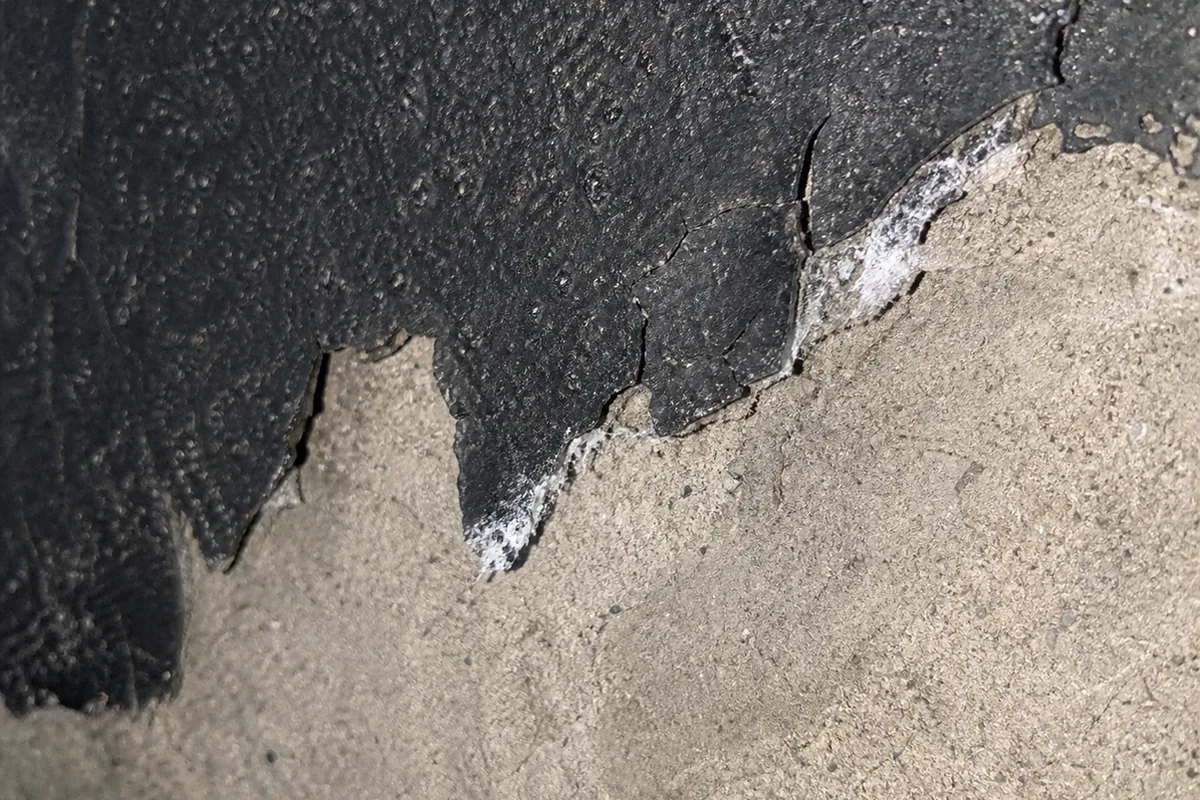
The problem shows up in two ways on Downey’s stock. In some cases the wrong product was used from the start, dampproofing applied where the drainage, grading, or water table called for a true waterproofing membrane. In other cases the original dampproofing was the right call at the time, applied correctly on a reasonably dry site, and it has simply reached the end of its service life. Asphalt-emulsion coatings do not last indefinitely below grade. They dry out, crack, and lose adhesion over decades, especially where backfill soil has expanded and contracted against them season after season, which is exactly what clay soil does. Either way, the result at the surface looks the same: a moisture line, a failed or absent coating, and water finding its way through.
Worth marking the boundary here, because Downey buyers sometimes confuse this with related but different conditions we write about elsewhere. This is about the coating and membrane specification and condition on the foundation wall itself. It is a different mechanism than the rising groundwater we see in Camarillo, where a seasonally high water table pushes moisture up from below regardless of what is coated on the wall. It is also different from orchard-land settlement in Corona, where the soil is physically moving the foundation rather than water passing through it while the wall stays put. And it is a different topic than seismic cripple-wall bracing, covered in our South Pasadena cripple-wall retrofit guide, a structural question with nothing to do with moisture. Here, the wall is standing where it should be. The question is only whether it keeps water out.
Why Downey’s tracts get this wrong so often
Downey was built fast, in a narrow window, when the aerospace and manufacturing economy pulled thousands of families into the city. Tract builders working that pace used dampproofing, cheaper and faster than a true waterproofing membrane. On a lot with decent drainage that was a reasonable call. On a flat lot with clay soil that holds water against the wall, it was a specification mismatch that would not show up for decades.
Layer on what has happened since. Downey lots have accumulated additions, converted garages, and regrading over seventy years, the way our Downey service page already documents. Every patio poured, planter bed added, or downspout rerouted without much thought shifted the grade around the foundation, sometimes for the worse. A wall that was marginal to begin with gets pushed past its limit by decades of small changes nobody connected back to the crawlspace below.
We see this most in the older, larger-lot neighborhoods in the northeast part of the city and in established postwar tracts like Rancho Estates and Downey Gardens, where raised foundations with real crawlspaces are more common than newer slab construction. A slab home has less exposure because there is less below-grade wall for the coating to fail on. A raised foundation with a crawlspace, a large share of Downey’s mid-century stock, has stem walls coated once, decades ago, and rarely inspected again until a buyer’s inspection brings someone underneath the house.
Schedule a Downey inspection →
What agents should tell every buyer
Give these points to a buyer under contract on a raised-foundation home in Downey before the crawlspace inspection.
- A moist crawlspace does not automatically mean the foundation is structurally compromised. It usually means the wall coating has failed or was undersized for the site, a moisture-management problem, not a settlement problem.
- Ask whether the crawlspace has ever been accessed and photographed, not just mentioned in a disclosure. Sellers who have not been under their own house in years are common here.
- The fix, when one is needed, ranges from grading correction at the surface to a proper waterproofing membrane applied from the exterior, which usually means excavation. Get a specific diagnosis before assuming either direction.
- Efflorescence, the white or gray mineral deposit left where water has evaporated through concrete, is a sign of past or ongoing moisture movement even if the wall feels dry on inspection day.
- Wood framing directly above a chronically moist crawlspace wall is at higher risk for wood-destroying organisms. If the moisture finding is significant, a pest inspection should look at that framing specifically.
- Clay soil on a flat lot, standard across Downey, does not forgive poor grading the way sandy soil does. Ask specifically how water moves around the foundation, not just whether the roof and gutters look fine.
A buyer who understands this distinction going into the crawlspace walkthrough asks better questions and reacts less emotionally to a moisture stain that turns out to be manageable.
Red flags during showings
Most of this requires getting under the house, but a few things show without a flashlight and a crawlspace suit.
- A musty smell noticeable from the living space, especially near flooring close to an exterior wall.
- Visible efflorescence or a stain line on any exposed foundation wall at grade, such as at a porch, planter, or garage stem wall.
- Soft or spongy flooring near an exterior wall, which can point to subfloor moisture tied back to the crawlspace below.
- Planters or hardscape built up against the foundation wall higher than the original grade line, trapping water instead of shedding it away.
- Downspouts that discharge directly at the foundation instead of extending away from the house.
- A crawlspace vent that has been sealed, blocked, or covered, trapping moisture that would otherwise ventilate out.
- Visible past patching or a different-colored coating on part of a wall, suggesting someone already tried to address a wet spot without solving the cause.
If we see these, we go under the house and check the wall directly.
The negotiation playbook
When a dampproofing or waterproofing finding surfaces in Downey escrow, the deal usually moves down one of a few paths.
The first path is a grading and drainage correction. If moisture is driven mostly by poor surface drainage, regrading and extending downspouts can resolve a meaningful part of the problem without touching the wall coating. This is the least invasive path, worth ruling in or out before anyone talks about excavation.
The second path is a targeted waterproofing membrane on the affected section of wall. This requires excavating along the stem wall’s exterior, applying a system rated for hydrostatic pressure, and backfilling with drainage in mind. It is a real project, priced by a waterproofing contractor, not a handyman.
The third path is a credit reflecting the uncertainty, especially when the extent of the intrusion is not yet fully diagnosed. Buyers in this position often want a specialist evaluation completed before committing to a repair scope, and the credit covers that step.
The fourth path, when the finding is limited to light past staining with no active moisture or wood damage, is accepting the condition and monitoring it. Not every stain line is an active leak. Document the finding and the buyer’s informed decision either way.
How the inspection actually catches it
This finding requires physically going under the house, which is what we do on every raised-foundation inspection in Downey. We access the crawlspace, walk or crawl the full perimeter where access allows, and examine every visible run of foundation wall for staining, coating condition, and efflorescence.
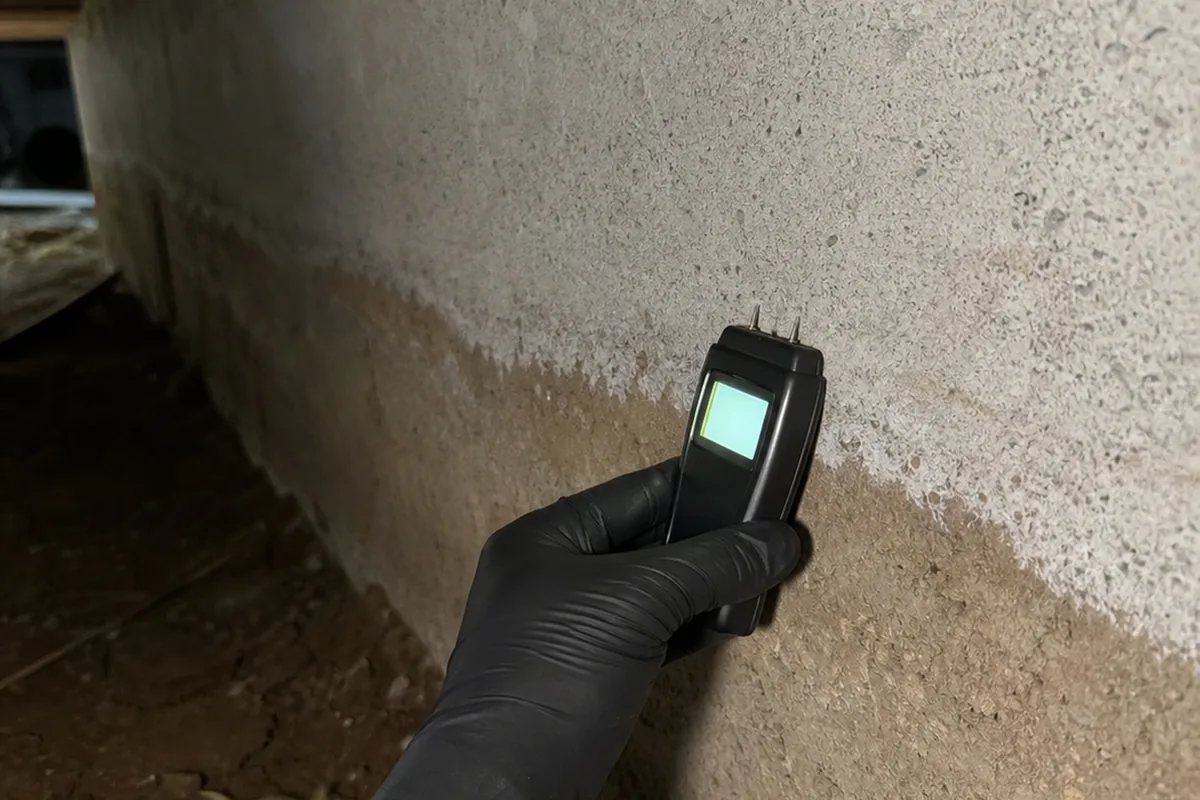
Where we see a stain line, active dampness, or coating failure, we use a moisture meter directly on the wall and on the nearby framing to get an actual reading rather than guessing from appearance alone. A wall that looks stained but reads dry tells a different story than one that reads elevated moisture in real time. We photograph the coating condition up close, note where it has cracked, flaked, or stopped short of covering the full below-grade height of the wall, and we note which direction the water appears to be coming from.
What we do not do is excavate, apply a new membrane, or diagnose exactly how many years the original coating has left. That is a waterproofing contractor’s scope. When a finding is significant, we say so plainly and recommend that scope, the same way our inspection report explains how findings get prioritized and handed off. If you want the full picture of what a Downey crawlspace inspection covers, our what’s included page lays out the whole scope.
Quick FAQ
Is dampproofing a building defect, or is it normal construction? Normal, standard construction on many sites for decades. It becomes a defect when site conditions call for a true waterproofing membrane and dampproofing was used instead, or when the coating has degraded past doing its job. We report which situation we are looking at.
Can dampproofing be upgraded to waterproofing without major excavation? Not in a way that solves the problem. A true membrane must be applied to the exterior face of the wall below grade, which generally requires excavating along that section. Interior sealants reduce symptoms but do not replace an exterior membrane against hydrostatic pressure.
Does this affect every Downey foundation? No. Slab-on-grade homes have far less exposure since there is minimal below-grade wall involved. Raised-foundation homes with a real crawlspace, common across the city’s postwar tracts, are where this matters, and even then it depends on grading and coating condition.
How is this different from a foundation crack? A crack is a structural finding about the concrete itself moving. A dampproofing issue is about whether water passes through an otherwise sound wall. The two get confused in the same crawlspace, so we document them separately.
Should a buyer walk away over a moisture stain in the crawlspace? Almost never on the stain alone. What matters is the extent, whether there is active wood damage, and what a specialist says the repair scope is. A well-documented finding with a clear path forward is a negotiation point, not a deal-breaker.
The honest summary
Downey’s postwar tracts were built fast, on flat clay lots, using the standard dampproofing spec of the era, and decades later a share of those foundation walls are showing exactly what you would expect: a thin coating that was never meant to hold back real water pressure, worn down by seventy years of clay soil pressing against it. We will not tell a buyer their foundation is failing when what we found is a coating past its service life on an otherwise sound wall, and we will not wave off active moisture and wood risk because the wall itself looks fine.
We go under the house, measure the moisture where we find it, and tell you plainly whether you are looking at a drainage fix, a wall-coating project, or something worth monitoring. That is the job on every crawlspace we walk in this city.
See what every inspection includes → · Read our FAQ → · Explore Downey home inspections →
Related reading
- High Water Table and Ground Moisture in Camarillo. A different mechanism, groundwater rising from below rather than a coating failing on the wall.
- Differential Settlement on Former Orchard Land in Corona. When the soil itself moves the foundation, distinct from moisture passing through an intact wall.
- Cripple-Wall Foundation Retrofit in South Pasadena. A seismic strengthening topic, not a moisture topic, but often confused with it near the same crawlspace.
- Where the Water Goes in Tarzana. Surface grading and drainage, the companion above-grade condition that often drives what we find below grade.
- How to Read a Home Inspection Report in California. How a finding like this gets prioritized and handed to the right specialist in writing.
- Firestops and Fire Blocking in Paramount. A concealed structural fire-safety topic from a neighboring Gateway city, unrelated to moisture but a useful companion on what an inspection documents behind finished surfaces.
- Efflorescence and Spalling on Concrete and Masonry in La Mesa. The concrete and masonry material’s own surface deterioration, a related but distinct condition from the coating or membrane specification covered here.
- Footings and Foundation Reinforcement at Room Additions in Santee. The structural adequacy of the footing itself, rather than the moisture coating applied to the foundation wall.