On inspections in San Jose kitchens, one of the first things we look for on a freestanding range is the small steel bracket nobody photographs. It sits behind the appliance, close to the floor or on the wall. You almost never see it at a showing.
We look for the bracket, for the rear leg or frame that should engage it, and for enough access to confirm both. If we cannot see it, the report says so. We do not pretend a visual inspection is a tilt test.
This guide is for the agent working San Jose and nearby, including Santa Clara, Fremont and Palo Alto, where the same question comes up in kitchens of every age.
Why this matters for the agent in San Jose
A hidden bracket is a showing-day and escrow item because nobody can see it from the doorway, and it never appears in listing photos. A buyer can walk through a clean kitchen with a newer range and have no idea whether the bracket exists, is attached, or is actually holding the range.
San Jose’s housing profile explains why the question lands here. The Census Bureau’s 2024 one-year American Community Survey estimates put the median year built at 1976, with about 51 percent of the city’s 345,884 housing units built from 1950 through 1979. Of 331,653 occupied units, 147,542 were renter-occupied, about 44.5 percent. Those are estimates, and they say nothing about the range in one particular kitchen.
A 1976 house does not tell you the age of its range. Ranges get replaced on their own schedule, and with nearly half of occupied homes rented, many kitchens are managed by landlords, property managers and maintenance crews rather than by the person signing your purchase contract.
The CPSC data below is national. Nothing in it says San Jose has more or fewer range tip-overs than anywhere else. The San Jose angle is the housing mix, not an incident count.
What an anti-tip bracket is
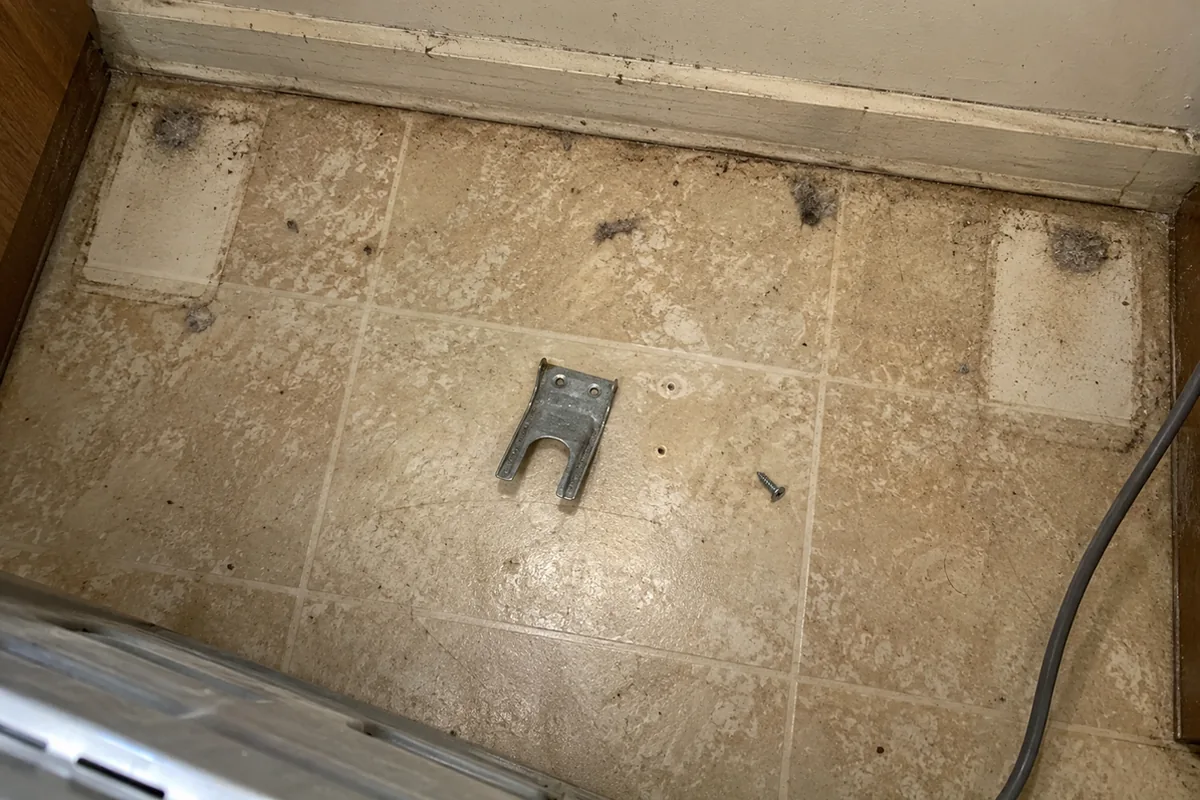
An anti-tip bracket is a small metal part that stops a freestanding range from tipping forward when weight lands on an open oven door. CPSC describes it as typically a fork-shaped piece of metal attached where the floor and wall meet behind the range, or a metal bracket attached to the wall. On the floor type, a rear leg of the range slides into the fork. On the wall type, the rear of the range aligns with the bracket.
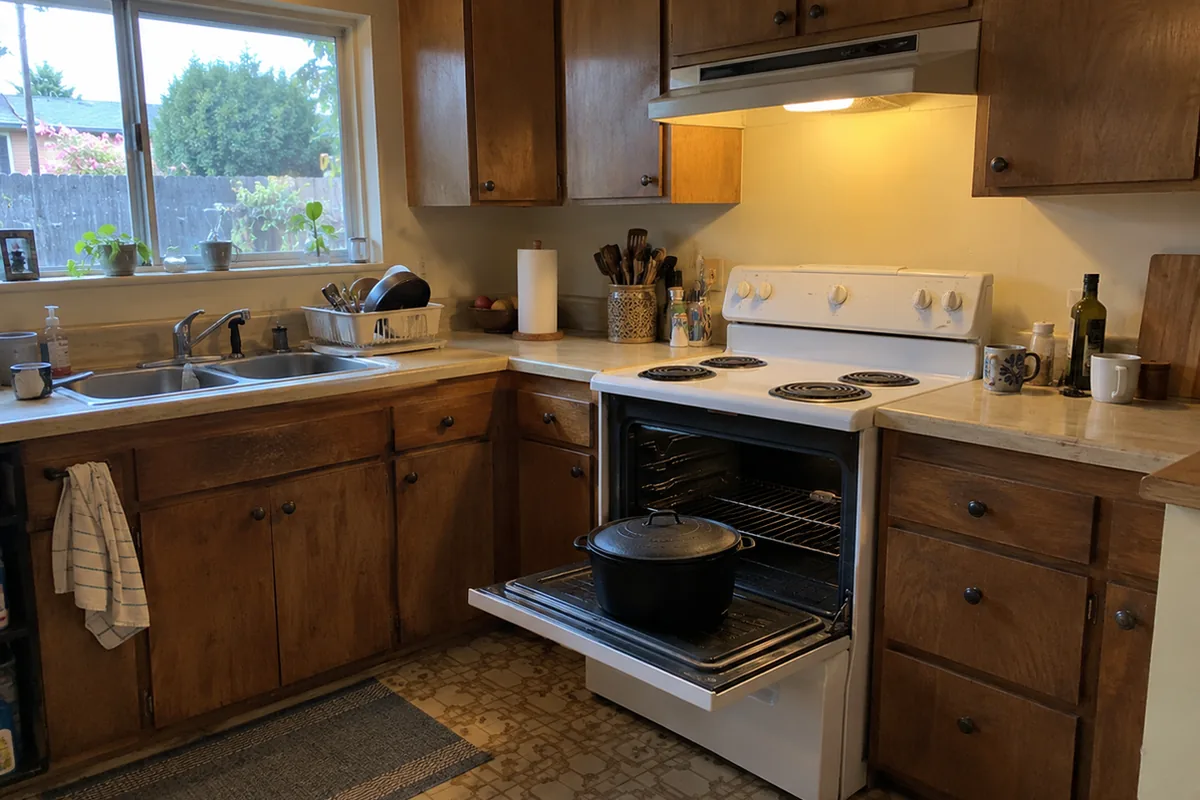
A bracket that is present is not necessarily a bracket that is engaged. The part can be screwed down while the rear leg sits beside it. The range can be pulled out for cleaning and pushed back without the leg entering the slot. This is the first point agents should keep straight.
The bracket does one narrow job. CPSC’s safety alert also tells owners not to put heavy food on an open oven door, not to push down on it, not to use it to stand up, and to keep children from using it as a step.
The standard that put brackets on new ranges, and what CPSC counted
On June 3, 1991, Underwriters Laboratories adopted a tougher stability test for abnormal use: a 250-pound static weight on the center of an open oven door. A CPSC staff report, Range Tipovers: An Evaluation of Range Stability, names UL 858 for electric ranges and ANSI Z21.1 for gas ranges, with identical stability requirements. The normal-use test is 75 pounds on the open door with the range unsecured. To pass the abnormal test, most manufacturers supply a bracket that secures the range to the floor or an adjacent wall or cabinet.
CPSC’s own tip sheet says it plainly: “Since 1991, voluntary standards have required new ranges to be supplied with an anti-tip bracket.” That is a supply standard. It does not tell you that a given bracket is still installed in a given kitchen.
What did CPSC count? Its staff reviewed 33 reports of range tip-over incidents from 1980 through 2006. Two things showed up in the reviews: the range was not secured to a wall, floor or cabinet, and enough weight sat on the open oven door to tip it. The victims fell into two groups, children from 15 months to 5 years, and older adults who leaned on the open door for support or while cleaning inside the oven. The safety alert reports 13 fatalities tied to stove, oven and range instability and tip-over from 2000 through 2008, many of them children under 10. In the nine in-depth investigations behind those deaths, the hardware was not installed or not properly engaged.
Staff testing added a number. With an unsecured range held to the 75-pound line, 26 percent of simulated events with up to two children climbing on an open door would have tipped it. At 100 pounds, about 1.5 percent would. Two older children, or more than two, could still tip an unsecured range. The report does not conclude that brackets have reduced deaths, and we will not claim it.
Recalls show the same gap between having hardware and having it installed. A December 2021 GE Appliances recall and a March 2022 Danby Products recall covered free-standing and slide-in ranges that could tip because the bracket was not secured to the wall or floor. The remedy in both was a free in-home service call to check the bracket and make sure it was securely installed.
Why the bracket goes missing
In the incident reports CPSC staff reviewed, it appears the devices were not installed at all. The report adds that no conclusions about why could be drawn from the available information. So what follows are patterns inspectors see, not CPSC findings.
- The range was pulled out for cleaning and pushed back without the rear leg entering the bracket.
- The range was replaced, and the delivery or install crew never fitted the supplied hardware.
- An owner bought the range and never installed the bracket.
- A used range moved between units, and the bracket stayed behind or did not match the new spot.
- Flooring or a remodel changed the floor height or wall position, and the range went back without a check.
CPSC documented one version of the fourth pattern. In a 2010 investigation of an apartment range with no anti-tip features, the manager said the range was “built” sometime between 1970 and 1987 and had been bought used and installed by the maintenance manager.
CPSC estimates an average range life of 13 years for electric and 15 for gas. Our reading, and it is ours rather than CPSC’s, is that most ranges in service today postdate 1991. The usual problem is therefore installation and re-installation, not an old range for which hardware never existed.
Better to raise the bracket question during the inspection period than after it ends. Call 1-888-88-INSP-9 to book a San Jose inspection, and the report will say what we could and could not verify in the kitchen.
What agents should tell every buyer
- Ask whether the bracket was verified, not whether the range is new. A newer range does not answer the installation question. Ask the inspector to note whether the bracket was visible and whether engagement could be confirmed.
- Do not push, pull or tilt a range at a showing. A gas range is tied to a gas line. Moving it is for the owner or an appliance technician.
- Treat “not verified” as a question for the seller. It is not a finding that the bracket is missing. Ask the seller to have an authorized appliance technician or the manufacturer confirm it.
- Ask when the range last moved. Cleaning, replacement, flooring work and a move between units are ordinary reasons. Ask whether anyone confirmed engagement afterward.
- Repeat CPSC’s door rule. No heavy items on an open oven door, no pushing down on it, no using it to stand.
- For a tenant-occupied purchase, plan around the tenant. The kitchen is in use, and the tenant should not be asked to move a gas range. Our tenant-occupied inspection guide covers the access limits.
Red flags during showings
Agents should look, and only look. Nothing here can prove a bracket is absent.
A range that sits visibly out from the counter line, crooked, or with an unusual gap at the wall deserves a question. So does scuffed flooring in front of it, which suggests the range has been dragged. None of this shows what happened to the bracket. It shows the range may have moved, which is a reason to ask whether anyone checked the rear connection afterward.
Heavy items stacked on an open oven door are a hazard in the moment. Do not use the door as a test, and do not demonstrate a tilt for a buyer.
The negotiation playbook
Bracket not seen. The first path is a plain request. Ask the seller to have the manufacturer or an appliance technician confirm the bracket and engagement before the inspection response deadline or before close. The request names the question without claiming the bracket is missing.
Bracket appears missing. Ask the seller to contact the range maker or an authorized technician. CPSC notes that some manufacturers send a replacement bracket at no charge, and that for a range made after 1991 an owner can also contact the retailer, property manager or homebuilder.
Seller fixes before close. The work should include fastening the bracket to the floor or wall and engaging the range, not just delivering a loose metal part. The two recalls above involved exactly that kind of service call.
Rental or tenant-occupied. Send the request to the owner or property manager, who CPSC names among the parties to contact. The tenant should report the concern and should not move a gas range.
Keep every ask tied to what was observed. “The bracket was not verified” supports a request for confirmation. “The bracket is missing” needs a basis, and a photo of the front of the range is not one. We can only describe what is visible in the report; see our guide to reading a California inspection report for how those notes translate into follow-ups.
How the inspection checks it, and where our scope stops
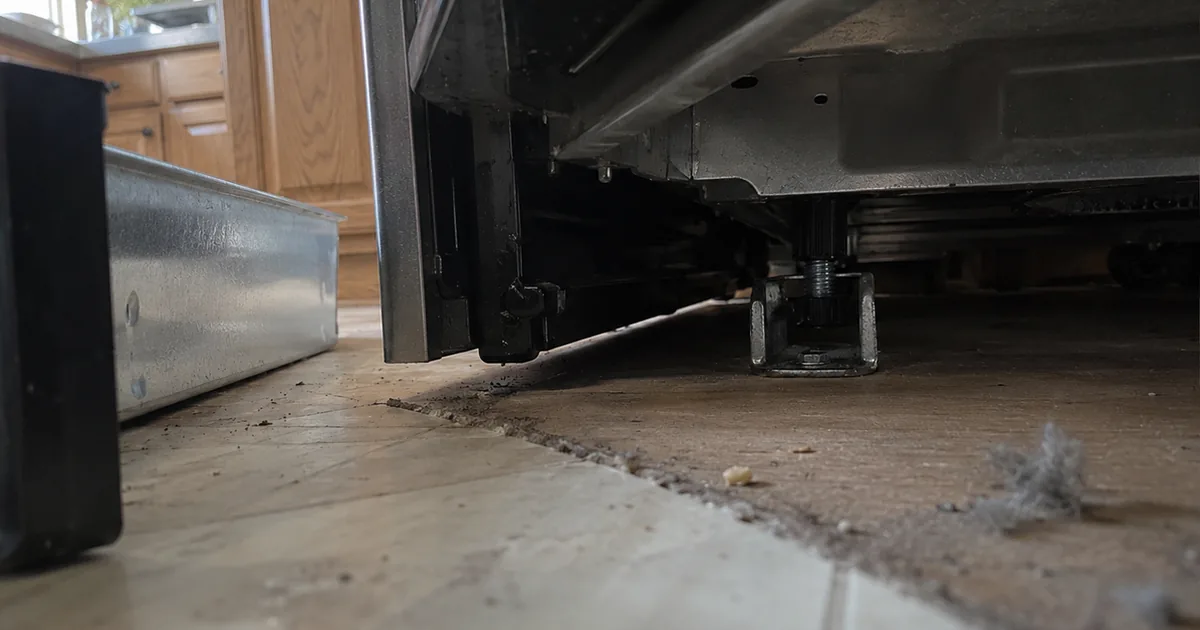
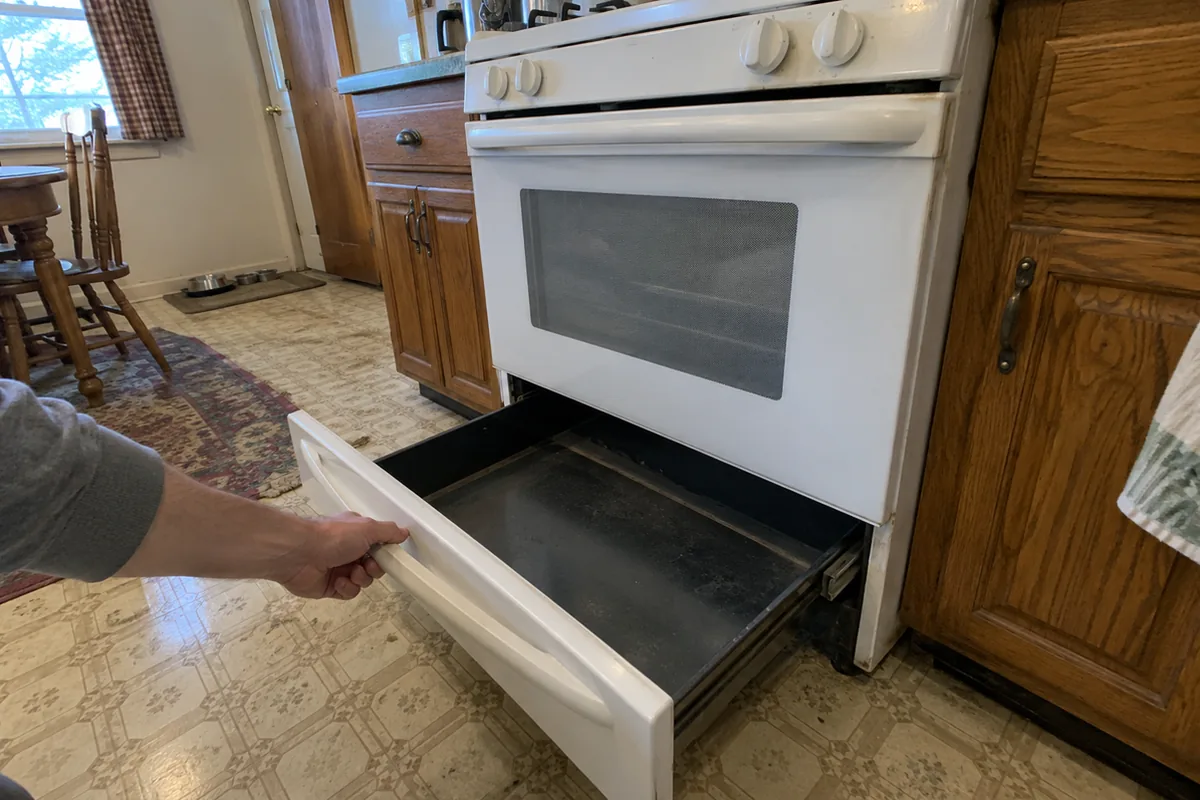
CPSC describes a no-move method first. With everything removed from the range and the oven, cooktop and drawer cool, pull the bottom drawer out completely and shine a flashlight under the stove. You should see the back feet, one of which slides into the bracket. If there is no bracket underneath, look behind the range for a wall bracket.
That depends on access. The drawer must come out, the underside must be visible, and the wall behind may stay hidden. Stored items and appliance design can limit the view.
CPSC’s other two steps are different. Sliding the range about three inches from the wall to look from both sides is appliance movement, and grasping the back and trying to tilt it toward you, where more than an inch means it is not engaged, is a test for an owner or technician. We do not ask a buyer or agent to do either at a showing.
The InterNACHI Standards of Practice, last revised October 2022, say the inspector is not required to “inspect or move any household appliances”, or to move furniture or stored items. Your inspection agreement sets what is included, so check it.
So we look where the kitchen allows. If the drawer comes out and we can see the rear foot and bracket, or a wall bracket, we describe it. If the range is tight to the wall, the drawer will not come out or the connection stays hidden, the report says the bracket was not verified. We do not pull a range forward for a better photo, and we do not certify attachment because a range is standing in its opening. For the wider limits on what a visual inspection covers, see what a home inspection covers and what needs a specialist.
Quick FAQ
Does every range need an anti-tip bracket? CPSC says new ranges have been supplied with one since 1991 under voluntary standards. For a range made before 1991, it says to ask the manufacturer about a retrofit device. Either way, presence and engagement still need to be checked at the appliance.
Can an inspector tell if it is engaged? Sometimes. If we can see the rear foot in the floor bracket or the range lined up with a wall bracket, we report that. If access is limited, the honest answer is “not verified,” not a guess.
Is this required by law for a sale? This guide does not assert legal obligations. CPSC says voluntary standards require manufacturers to supply the bracket. Ask your broker or attorney about disclosure on a particular sale.
What about slide-in ranges? The two recalls above covered both free-standing and slide-in ranges, so slide-ins are part of the same bracket question.
What about dressers and TVs? Different category. CPSC’s 2019 tip-over report estimated 27,100 emergency-department-treated injuries a year (2016 through 2018) across TVs, furniture and appliances, about 1,000 of them appliance-only. Of 556 reported fatalities from 2000 through 2018, 38 were appliance-only, and stoves and ovens were the largest appliance group at 26. Counts for 2016 through 2018 are incomplete because of reporting lag.
The honest summary
Add one line to the pre-listing checklist: whoever moves the range for cleaning, replacement or flooring confirms the bracket is fitted and the range is engaged. Add one to the buyer checklist: ask whether the bracket was verified, never move a range at a showing, and follow up on “not verified.” Renters should tell the landlord or property manager.
A hidden bracket is easy to ignore until the range moves. Your checklist should not ignore it.
Related reading
- Inspecting a House a Tenant Still Lives In for access, notice and what furniture hides.
- Not Inspected: The Report Line Nobody Is Required to Clear for blocked areas and the “not inspected” lines in a report.
- What a Home Inspection Covers, and What Needs a Specialist for scope in plain terms.
- 2026 CPSC Alarm Warnings: Read the Back of the Detector for another CPSC safety item agents see in kitchens and hallways.
Our what’s included page lists the full scope of every San Jose inspection, our sample inspection report shows how a “not verified” note appears, and the FAQ answers the booking questions.
See what every inspection includes → · Read our FAQ → · Explore San Jose home inspections →
To book an inspection in San Jose or anywhere in the Bay Area, call 1-888-88-INSP-9. We will document what is actually there, in writing, the same day.