When we walk a backyard with a pool, the first thing we check is the gate, not the water. It takes ten seconds and it tells us a lot about how the rest of the yard has been looked after.
That surprises people, because most buyers assume the pool is part of the inspection. It usually is not. The pool is the part of the property where the report says the least, and the part where a surprise costs the most.
The pool and spa shell are outside a standard inspection
A standard home inspection under the InterNACHI Standards of Practice does not include the pool or the spa. The standards say the inspector is not required to inspect swimming pools or spas, and not required to determine the structural integrity or leakage of pools or spas. They also say the inspector is not required to determine the adequacy of whirlpool or spa jets, water force or bubble effects.
So the plaster, the tile line, the shell and the plumbing under the deck are not part of the baseline scope. A report that says the pool shell was not inspected is not hiding anything. It is describing the job accurately.
That is the baseline, and companies handle the edges differently, so ask what yours does. At Inspection.re we look at the pump, filter and heater on the equipment pad as visible equipment, look for leaks around the pad, and note cracking in the deck and coping. If something looks serious, we recommend a pool specialist. What we do not do is leak-test the shell or the lines, run a dye test, or scope a heat exchanger.
If you have not read our guide to what a home inspection covers and what needs a specialist, the pool is one of the clearest examples of that line.
The gate, the fence and the deck are still in front of us
The rest of the backyard is part of the exterior, and the exterior is in scope. We walk the deck, the fence, the gates, the doors that open to the yard, the outdoor receptacles and the lighting we can reach. A pool does not make those items invisible. It makes them matter more.
Here is what we look at around a pool, in the order we usually do it:
- The gate latch. Does the gate swing out, away from the pool? Does it close by itself when we let it go from partway open, and does the latch catch without a push?
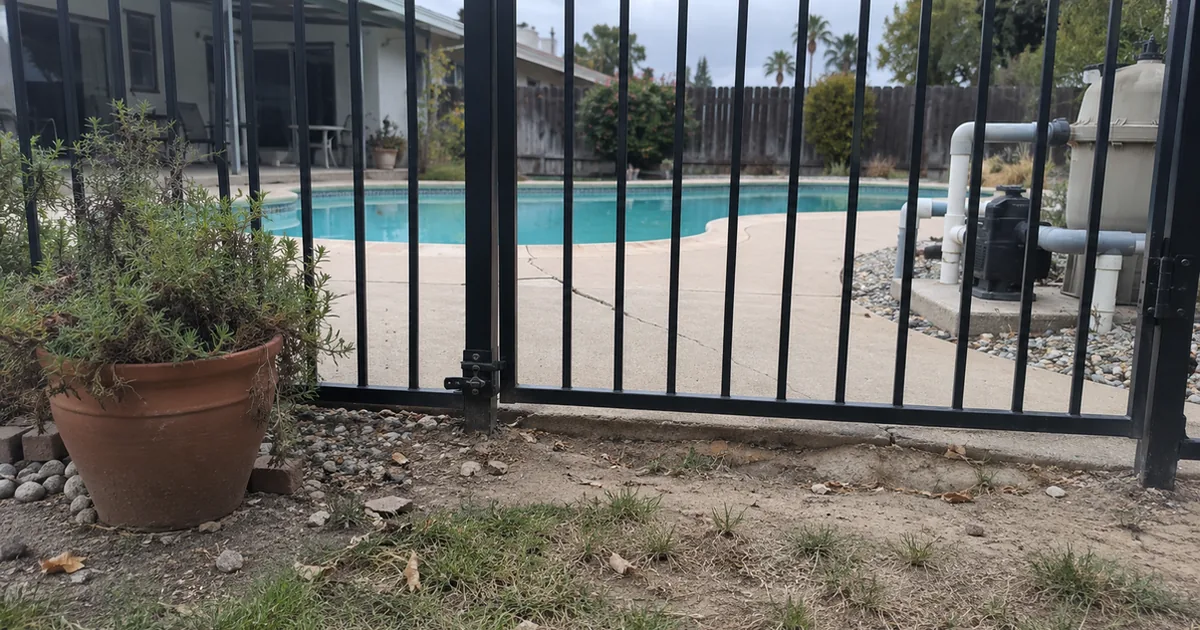
- The fence height and the gap underneath. A low spot where dirt has washed out, or a bottom rail that has sagged, changes the gap.
- Handholds and footholds. Horizontal rails on the outside of the fence, planters stacked against it and furniture pushed up to it all work as steps.
- Doors from the house to the yard. We note whether they have alarms or self-closing hardware, and whether the hardware still works.
- Deck cracks, heaves and trip points, and standing water against the house wall.
- Outdoor receptacles and lights near the water. We check that they are protected and operating as they should, and we note anything that looks wrong from the deck.
None of that is a pool inspection. It is the part of a pool yard that a home inspector can see from dry ground.
California writes the barrier numbers into the Health and Safety Code
The California Swimming Pool Safety Act sets specific numbers for an enclosure, and they make a useful checklist even when the law does not directly apply to an older pool. Section 115923 of the Health and Safety Code says an enclosure must have:
- Access gates that open away from the pool and are self-closing, with a self-latching device placed no lower than 60 inches above the ground.
- A minimum height of 60 inches.
- A maximum vertical clearance from the ground to the bottom of the enclosure of two inches.
- Gaps or voids that do not allow passage of a sphere of four inches in diameter or larger.
- An outside surface free of protrusions, cavities or other characteristics that could serve as handholds or footholds for a child below the age of five.
We read the Act the way an inspector reads any code: as a reference, not as a verdict. Section 115922 ties the requirement for drowning-prevention features to the issuance of a building permit for construction or remodeling of a pool or spa at a private single-family home. When that permit is pulled, the pool needs at least two of seven listed safety features, and the local building official inspects them before final approval.
The seven features include the enclosure described above, removable mesh fencing with a self-closing, self-latching gate, a safety pool cover, exit alarms on doors and windows, a self-closing and self-latching device on doors with a release mechanism at least 54 inches high, a water entrance alarm, and other equivalent protection verified by an approved testing laboratory. Section 115922 also bars certain pairings, for example an exit alarm and a self-closing device on the same door.
What this means on inspection day: an older pool may have been built under different rules and never touched by a permit that triggered the current ones. A pool that was remodeled recently should have the features in place. A gate that does not latch is a safety concern in either case, whatever year the pool was built. Confirm the current text with your agent or an attorney, because we are not giving a legal opinion.
Four fence and gate checks you can do in two minutes
Anyone can repeat what we do at the gate. You do not need tools beyond a tape measure.
- Open the gate about halfway and let go. It should swing shut and click closed on its own, every time, not just when you help it.
- Look at where the latch is mounted. If a child can reach it from the outside, it is too low. The statute puts the release no lower than 60 inches.
- Crouch and look under the bottom rail at several points along the fence line. Anything over two inches is worth noting, especially where soil has eroded.
- Run your eye along the outside face. Look for planters, chairs, trash bins and horizontal rails that make a ladder.
These checks are quick enough to repeat at the final walkthrough, which is when many people notice that a latch has been taped or wedged open for the move.
The seller’s side of the pool: permits, service records and the disclosure form
The inspection does not replace asking questions. A few of the most useful ones sit on the seller’s side.
Ask whether the pool or spa had a permit, and when. Ask who services it and for how long, and request the service records. Ask the age of the pump, filter and heater, and whether any equipment has been replaced in the last few years. The seller’s Transfer Disclosure Statement includes a list of features and items, and a pool or spa is one of them, which gives you something concrete to compare against what you see.
None of that proves the equipment works. It gives the specialist a starting point and gives you a baseline if the pool fails a test later. You can read how we think about disclosure in our article on the pre-listing inspection for California sellers.
What a pool specialist adds that a home inspection cannot
A pool specialist inspects the part we do not. The scope varies by company, so ask for it in writing, but the usual list looks like this:
- A leak check. Specialists commonly use a bucket test or a dye test to see whether the water level drops faster than evaporation explains. A home inspector does not do that, and a leak in a pool shell or plumbing line can be expensive to find and fix.
- The pump, filter and valves, run under load, so the person looking can hear bearings and see seals.
- The heater, including the heat exchanger. This is often the most costly single piece of equipment.
- The shell and the surface: plaster, tile, coping, and the visible condition of the steps and benches.
- Drain covers and suction outlets. Federal drain-cover rules apply to public pools, and a specialist will look at what is installed on a private pool, though the legal requirements differ.
- Electrical bonding and equipment-pad wiring, which a specialist can test more directly than we can from the deck.
Think of it as two inspections that meet at the pool edge. We cover the house and the yard. The specialist covers the water and the machinery. Neither replaces the other, and neither can see the other’s half.
How to read the pool section of your report
In a standard inspection report, the pool and spa show up as a limitation, with the observations made from the deck listed separately. Read that section in two parts.
The first part tells you the pool was not evaluated. Treat that as a task, not an absence of problems. If you are within your contingency period, ordering the specialist is the step that closes the gap. Our article on the inspection contingency in California explains why the timing matters.
The second part lists what we saw: a gate that does not latch, a gap under the fence, a cracked deck slab, a missing cover on an outdoor receptacle. Those are repair items you can take to the seller, the same as any other finding. If a report is new to you, how to read a home inspection report in California walks through the ratings.
Pool safety is also a local question
Pool-heavy parts of California, such as the Coachella Valley and the Inland Empire, see more of these yards than coastal neighborhoods do. If you are buying in Palm Springs, Murrieta or Riverside, expect the pool to be part of the conversation from the first showing.
Each city also has its own building department, and local requirements can add to the state’s. If you are buying in Temecula or San Diego, call the city or county building office about the property’s permit history before you rely on any assumption.
For a place where pool and spa safety is the whole subject, see our guide to pool and spa safety in Beverly Hills. It is written for agents, and it goes deeper on the local picture.
What to do next
Treat the pool as a separate decision with its own timeline. Before the contingency period ends, schedule the pool specialist, ask the seller for the permit and service history, and repeat the gate checks above at the final walkthrough.
Then book the home inspection so the two reports arrive close together. You can see how a typical report looks on our inspection report page, what a visit covers on the what’s included page, and common questions on the FAQ. When you are ready, you can schedule your inspection or call us at 1-888-88-INSP-9.